
Chapter 16 · The Importance of Good Communication in Business
How information moves through a business, which communication methods work best and why misunderstandings can be costly.
Learning objectives
- Understand the nature of communication and the role of feedback.
- Distinguish internal, external, formal and informal communication and different channels.
- Compare communication methods and explain the benefits and limitations of effective communication.
What Is Communication?
Communication is the process of sending and receiving information. Businesses communicate with employees, managers, customers, suppliers and investors. A message is useful only when the receiver understands it, and feedback helps confirm whether it has been received correctly.
Figure 16.2 illustrates four connected parts of the communication process. In its job-application example, the applicant sends a job application to the personnel manager; an invitation to interview is feedback. When the manager replies, the original receiver becomes the sender.
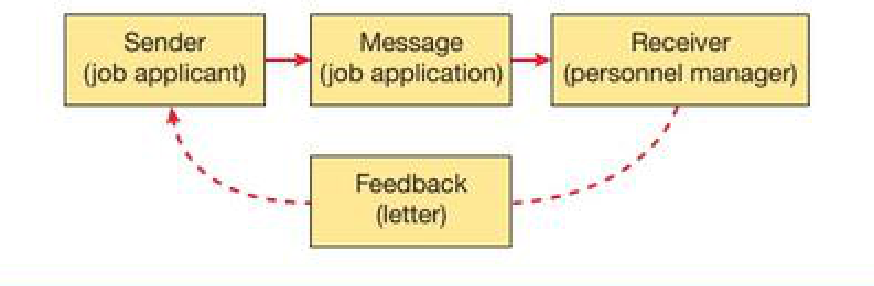
Deepika Mendis, Head of Finance at Portland Carriers plc, emails Celia to request a sales report. Deepika is the sender, Celia is the receiver, and the request for a copy of the report is the message. A reply enclosing the report provides feedback.
Communication is two-way when feedback is available. Without feedback, a sender cannot be sure whether instructions were understood, whether a deadline was clear, or whether the receiver needs further information.
How Does Communication Take Place?
Businesses use communication channels—the routes through which information travels. Communication can move vertically through the hierarchy or horizontally between people at a similar organisational level.
Downward Communication
Downward communication travels from managers or senior employees to subordinates. Examples include a department manager setting sales targets, giving safety instructions or explaining a new work procedure.
- It provides leadership and guidance.
- It allows managerial decisions to be carried out.
- It helps managers command, coordinate and organise business operations.
Upward Communication
Upward communication travels from employees towards managers. Examples include suggestions from workers, progress reports, requests for equipment and feedback on a new policy.
- It helps managers understand staff needs and opinions.
- It reveals problems that senior employees may not have noticed.
- It can make workers feel valued and give managers information for decisions.
Horizontal Communication
Horizontal communication passes between employees or departments at the same level. For example, the production and marketing managers may coordinate a product launch; workers on the same production line may discuss schedules or quality concerns.
Horizontal communication encourages coordination and reduces the risk that departments pursue conflicting plans.
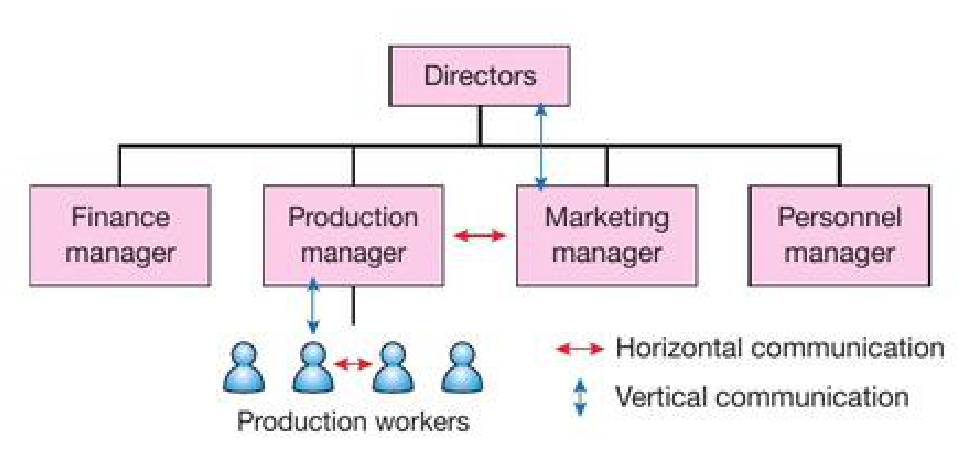
Roberto Navarro, regional manager of six ELMart supermarkets in southern Spain, sends May 2016 performance figures to the finance director for a board report. The message includes total turnover of €574,700 and profit of €114,500. As information goes to someone higher in the hierarchy, this is upward communication.
ELMart calculation: overall profit margin = €114,500 ÷ €574,700 × 100 ≈ 19.9%. This is a useful example of the financial information that can be shared through a business communication channel.
Internal and External Communication
Internal communication occurs between people within the business. This may include staff meetings, emails between departments, a manager giving a formal warning, or directors discussing a possible merger.
External communication occurs between the business and people or organisations outside it, such as customers, suppliers, investors, the government or the media. Examples include a statement sent to credit-card customers or a focus group gathering public views on a product.
Internal
- Manager sends instructions to employees
- Workers report faults to supervisors
- Departments exchange performance data
External
- Customer receives an order confirmation
- Business requests prices from a supplier
- Company communicates with investors
The distinction depends on who communicates with whom, not the technology: email, a phone call or video meeting can be either internal or external.
Formal and Informal Communication
Formal communication follows the recognised or approved channels of a business. Examples include written reports, official staff instructions, departmental meetings and company notices. Formal channels support accurate records and clear responsibilities.
Informal communication takes place through unofficial channels, sometimes called the grapevine. Employees may hear news from colleagues during a break or outside the workplace.
- Possible benefit: the grapevine spreads information quickly, may reveal employee concerns and can encourage cooperation.
- Possible drawback: rumours can be distorted or misleading, making people uncertain and reducing trust in management.
- Formal groups: committees and departments established by the business.
- Informal groups: friendships, sports or social groups, and colleagues who know one another outside formal structures.
If a formal notice says that a shift pattern has not been finalised but a rumour claims all working hours will change next week, workers may worry unnecessarily. Managers should communicate clearly and correct misinformation.
Managers sometimes listen to informal networks to understand how employees feel, but important decisions should still be confirmed through reliable formal channels.
Check your understanding · Halfway
Answer the question first, then reveal the suggested response.
Identify the four stages of the communication process shown in Figure 16.2.
Show suggested answer
A sender creates and sends a message to a receiver; the receiver responds with feedback. Feedback confirms whether the communication has been understood.
Explain the difference between downward and upward communication using a workplace example.
Show suggested answer
Downward communication is a manager giving instructions to workers; upward communication is workers sending reports, feedback or requests to the manager.
What type of communication occurs between the marketing and production managers at the same level?
Show suggested answer
Horizontal communication: an exchange of information between people or departments at a similar level of the business hierarchy.
ELMart reported €114,500 profit and €574,700 turnover. Calculate its overall profit margin.
Show suggested answer
Profit margin = €114,500 ÷ €574,700 × 100 ≈ 19.9%.
Give one example of internal communication and one of external communication.
Show suggested answer
Internal: a supervisor emails employees about a shift change. External: the company sends an order update to a customer.
Explain one advantage and one disadvantage of communication through the grapevine.
Show suggested answer
It may spread news quickly or alert managers to staff concerns, but rumours can be inaccurate and cause uncertainty or mistrust.
The Importance of Good Communication in Business
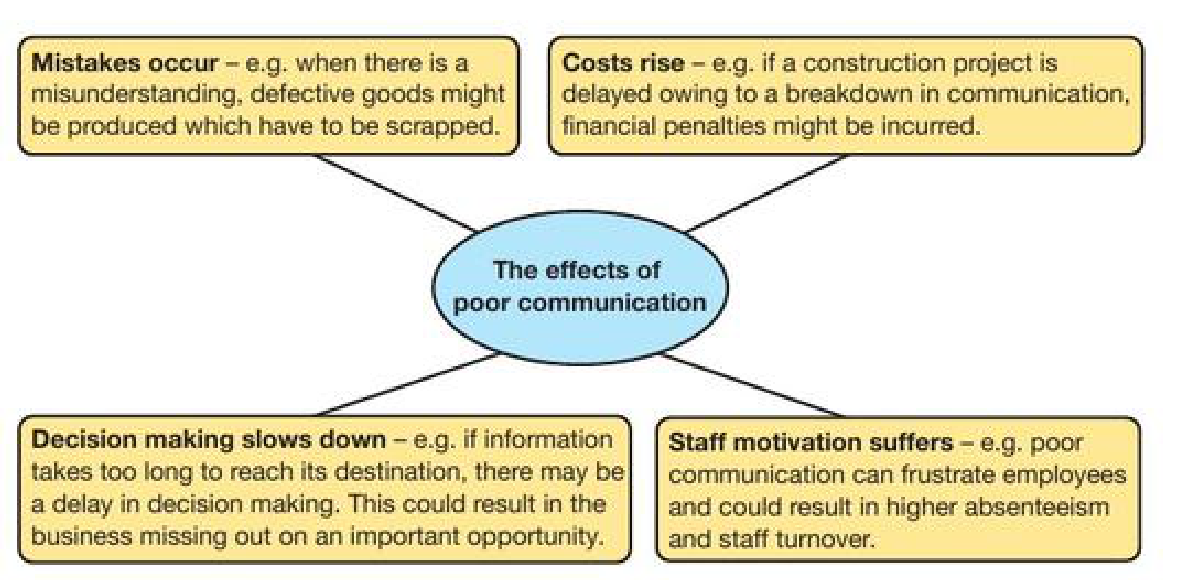
Good communication helps employees understand their tasks, allows managers to make informed decisions and builds a positive impression with customers. Poor communication can undermine efficiency and profitability even when the underlying product or service is good.
- Mistakes occur: misunderstood instructions may lead to defective products, wasted resources or incorrect customer orders.
- Costs rise: a delay caused by inadequate instructions may require rework, extra payments or financial penalties.
- Decision-making slows down: information that takes too long to reach managers may cause a missed opportunity.
- Staff motivation suffers: confusion can frustrate workers, increase absence or raise staff turnover.
If a company accidentally publishes a much lower price on its website, customers may order at the mistaken price and the business may face financial losses or reputational harm. Checking and confirming product information is an important part of effective external communication.
Good external communication helps build trust, answer enquiries and protect the company’s reputation. Good internal communication reduces duplicated work and improves the coordination of departments.
Methods of Communication
A business should choose the communication method that best suits the message. Speed, confidentiality, cost, number of recipients, need for evidence and opportunity for feedback all matter. Business communication methods can be grouped into the following categories.
Face-to-Face Communication
People exchange spoken information while they can see one another. Examples include job interviews, staff training, customer service at a reception desk and presentations to investors.
Advantages
- Feedback can be immediate.
- Can encourage cooperation and new ideas.
- Clarifying misunderstandings may save time.
Disadvantages
- Negative body language may act as a barrier.
- No written record may be kept.
- Meetings can include irrelevant discussion.
- The audience may be limited by space or availability.
Written Communication
Written communication presents information in words or documents, and can give the business a useful record. Different methods suit different purposes.
- Letters: flexible, relatively private and useful for personalised information, but can take time to write and deliver.
- Reports: provide structured facts, figures and analysis; detailed reports require time to research and prepare.
- Memorandums: brief internal notes to provide instructions or reminders and confirm discussions.
- Forms: standardised documents used for job applications, expenses, orders or timesheets; they can be inflexible.
- Noticeboards: inexpensive ways to reach groups of employees, but notices may be overlooked or become outdated.
Yuri Kutepov manages 50 staff at an insurance call centre. He posts a notice on Monday about a brief Thursday meeting, expecting rumours to spread the news. At the meeting, 11 employees are absent. 11 ÷ 50 × 100 = 22% absent, so the noticeboard and grapevine did not reliably reach everyone. An emailed confirmation or direct message with acknowledgement may have worked better.
Electronic Communication
Electronic methods allow businesses to send information quickly, often across long distances and to many recipients.
- Email: quick written messages and files, although recipients may ignore overloaded inboxes.
- Internet and company websites: promote and sell products, advertise vacancies, research markets, provide information and answer customer queries.
- Mobile phones: allow calls, texts, images and access to online services for employees working away from the office.
- Social media: connects businesses with customers for feedback, promotions and service; it can also carry criticism and needs monitoring.
- Intranets: internal networks that share timetables, directories, policies and documents within a business.
- Videoconferencing: people in different locations meet with audio and video. Teleconferencing: a group discusses matters by telephone.
- Public address systems: broadcast spoken announcements to staff or customers.
- Electronic noticeboards: show written information, pictures or video to people in places such as receptions, stations or airports.
For example, internal social networks can help employees share work updates. A confectionery business could use public social media to collect customer feedback, target promotions, answer enquiries and observe competitors. Public comments must be monitored carefully.
Choosing a suitable method: a sensitive disciplinary matter may require a private face-to-face discussion and a written record; an urgent safety alert may suit a PA announcement; a detailed financial assessment may be best delivered as a formal report.
Large vs Small Businesses
In small businesses, the owner usually works closely with employees. Informal communication can be fast, direct and easy to clarify, particularly when staff share the same workplace. Feedback may also arrive quickly.
In large businesses, there are more employees, departments, locations and levels of management. Written instructions, reporting systems, meetings and digital networks become more important to ensure that information reaches the right people consistently.
Small businesses
- Owners and staff often speak directly.
- Fast feedback and informal channels can work well.
- Less need for elaborate systems, but verbal messages may be forgotten.
Large businesses
- Formal channels coordinate several departments and sites.
- Reports and intranets create shared records.
- Messages can become delayed or distorted if channels are poorly managed.
Overall judgement: the best method is the one that delivers the right message clearly, securely and promptly, while allowing feedback wherever needed. Business size affects the communication system, but good communication is essential in every organisation.
End-of-chapter questions
Answer the question first, then reveal the suggested response.
Define business communication and explain why feedback matters.
Show suggested answer
Communication is the sending and receiving of information. Feedback allows the sender to check that the receiver understood the message and can act on it correctly.
A manager posts an important safety instruction on a noticeboard. Explain why this may not be enough.
Show suggested answer
Some workers may not notice the message or may misunderstand it. A direct briefing, confirmation of receipt or demonstration could help ensure everyone understands.
Compare internal and external communication, giving one example of each.
Show suggested answer
Internal communication is among people within the business, such as a team meeting. External communication is with outsiders, such as a supplier order or customer announcement.
Outline two possible effects of poor communication on business costs.
Show suggested answer
Mistakes can produce defective goods that must be reworked; delays may cause overtime, lost time or contractual penalties.
Why may a formal written report be more appropriate than a short phone call for the board of directors?
Show suggested answer
A report can provide structured data, evidence and a record that directors can study and compare. A phone call is faster for simple urgent messages, but less suitable for large amounts of detailed information.
State two advantages and two disadvantages of face-to-face communication.
Show suggested answer
Advantages include immediate feedback and stronger cooperation. Disadvantages include the absence of a permanent record and barriers created by body language or limited meeting space.
In the staff-communication case, 11 out of 50 employees missed a meeting. Calculate the absentee percentage and suggest an improvement.
Show suggested answer
11 ÷ 50 × 100 = 22%. The manager could also send each employee a direct message, obtain confirmation of receipt and remind staff before the meeting.
Distinguish between an intranet and the internet in business communication.
Show suggested answer
An intranet is an internal network for authorised people in the organisation; the internet is a broader public network that businesses use to communicate with both internal and external audiences.
Give two benefits and one limitation of using social media to communicate with customers.
Show suggested answer
It allows quick responses to enquiries and can gather feedback or promote products at relatively low cost. However, public complaints can harm reputation if the business does not monitor and respond appropriately.
Assess whether social media is a good communication method for ChoccoMate.
Show suggested answer
It can rapidly collect customer views, target advertising and answer queries, but negative comments are public and the business must devote staff time to monitoring information. It is useful if ChoccoMate can manage feedback and safeguard customer data.
Evaluate whether a growing business should rely only on informal communication.
Show suggested answer
Informal conversations are quick and encourage relationships, especially in small teams. As staff, sites and departments grow, the firm is likely to need formal records, recognised channels and reliable feedback as well. A combination is usually more effective.
Chapter 16 recap
Good business communication combines a clear sender, message, receiver and feedback. Managers should choose appropriate internal or external, formal or informal channels and select from face-to-face, written and electronic methods. When communication is poor, mistakes, costs, delays and staff frustration may increase.
Original revision explanations and practice questions for Pearson Edexcel International GCSE Business (9–1). Selected diagrams are credited in their captions. Historical business examples are illustrative. IGCSE360 is independent of Pearson.