
Chapter 18 · Recruitment and Selection
How businesses decide what workers they need, attract applicants and select the most suitable people.
Learning objectives
- Understand full-time, part-time, job share, casual, seasonal and temporary employment.
- Understand the recruitment documents: job description, person specification, application form and curriculum vitae.
- Understand internal and external recruitment, job advertisements, shortlisting and interviewing.
Types of Employment
When recruiting, a business must decide the type of employment most suitable for the work. A shop needs extra workers during busy weekends; a farm needs harvest workers for a short season; an expanding manufacturer might require permanent workers. The hours and length of employment should match its needs and the employees it hopes to attract.
Full-Time Employment
A full-time worker normally works the business’s full working week, usually five days. The exact hours vary by country and employer. Hours and working-time regulations differ between countries, so there is no single universal definition of full-time work. Full-time workers may be eligible for employee benefits as well as pay.
- Business advantage: continuity, availability and opportunity for workers to gain detailed knowledge of their roles.
- Possible drawback: higher total staffing commitment if demand is unpredictable.
Part-Time Employment
Part-time employees work fewer hours than full-time colleagues. A business can use them at busy times, extend opening hours and control staffing levels. Part-time work may suit students or parents who cannot work full time.
- Business advantage: flexible cover for evenings or weekends.
- Possible drawback: more people may be needed to cover all hours, increasing coordination and training needs.
Job Share
A job share occurs when two part-time employees divide the work and pay of a single full-time post. It may suit workers seeking more family or leisure time. The business can benefit from the ideas of two people, but they must coordinate and communicate effectively.
Two employees each work half the week in one full-time office role. They agree a handover process so that customer requests are not missed.
Other Types of Employment
- Casual employment: hours are variable and are not guaranteed; some workers are called in at short notice, for example for hospitality or events.
- Seasonal employment: work is needed in a particular part of the year, such as harvest time, a ski season or the busy pre-Christmas delivery period.
- Temporary employment: a short-term contract, perhaps to cover maternity or paternity leave, prolonged absence or a project; the precise duration varies.
These arrangements can improve flexibility because staff are hired when needed. However, employees may face uncertain income or limited job security. The business should consider the training needed for workers with short contracts.
Full-time or permanent roles
- Suitable for ongoing workloads.
- Support continuity and specialised knowledge.
- Require longer-term staffing commitments.
Flexible or short-term roles
- Help match work to busy periods.
- Allow cover for short-term absences.
- May involve higher turnover and repeated training.
Recruitment
Recruitment is the process of attracting people to apply for jobs. Selection is choosing the most suitable candidate from the applicants. Larger firms often use a human resources department; in a smaller firm the owner may handle the process.
- A business may be expanding and need more workers.
- Employees may be leaving and need replacing.
- Promotion may create a vacancy in another post.
- A temporary replacement may be needed when a worker is absent.
AHC distributes goods for manufacturers across Turkey. In this historical example it operated more than 130 vehicles and wanted to recruit 12 additional Class 1 HGV drivers. The historical advertisement lists weekly pay, overnight allowance, paid holiday, pension, insurance and other terms.
The painting and coating company usually promotes managers who already work there. Its human resources manager argues that existing workers are known to the business, making recruitment quicker, cheaper and more predictable.
Stages in the Recruitment Process
Good recruitment follows a clear sequence. The recruitment-process diagram shows stages designed to reduce the chance of appointing unsuitable workers and having to repeat recruitment and training.
- Identify staffing requirements: decide how many employees are needed, what jobs must be done and what type of contract is appropriate.
- Prepare job description and person specification: state the tasks and the characteristics an applicant needs.
- Advertise appropriately: choose places and methods that will reach suitable applicants.
- Evaluate applications and draw up a shortlist: compare forms or CVs with the criteria.
- Interview candidates: ask questions and gather more evidence.
- Evaluate interviews and appoint: choose the strongest suitable candidate and communicate the outcome.
- Give feedback: tell unsuccessful applicants where appropriate.
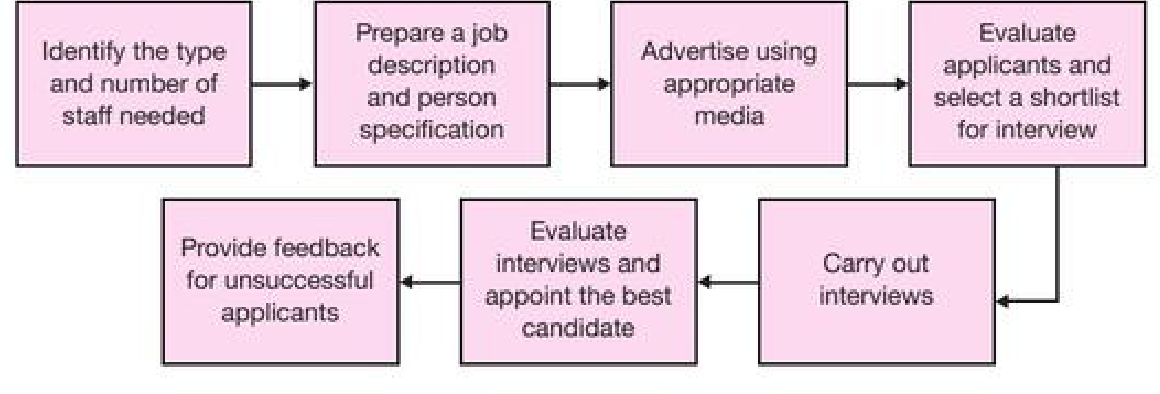
A poor selection decision can be expensive: the business may need to repeat advertising, interviews, induction and training. A planned process therefore saves time and reduces risk.
Recruitment Documents
Recruitment uses a number of documents to exchange information between a business and potential employees. The most suitable document depends on whether the employer is describing a job, checking criteria or collecting applicant information.
Job Description
A job description states the job title, its general purpose, tasks, duties and responsibilities. It helps candidates understand the role and managers assess performance against what was expected. It may need updating if the job changes.
A manufacturer in Nagpur, India, needs seven production workers to handle machinery, operate forklift trucks, clean equipment and work in teams. The work may involve heavy lifting, noisy conditions and a 40-hour working week. A clear job description would tell applicants what the work entails before they apply.
Person Specification
A person specification describes the qualities a successful candidate should possess—qualifications, experience, knowledge, skills, attitudes and personal attributes. Employers can distinguish essential conditions from desirable ones. A shortlist should give priority to applicants meeting essential requirements.
| Selection area | Essential requirement | Desirable requirement |
|---|---|---|
| Qualifications | Relevant technical knowledge or training | Additional digital-media qualification |
| Experience | Experience producing or managing website content | Experience supervising a small team |
| Skills | Clear communication and organisation | Knowledge of analytics or search optimisation |
A job description explains what the employee will do; a person specification describes what the employee needs to bring. Both should be relevant to the actual job rather than arbitrary requirements.
Application Form
A job application form is a standard document completed by candidates. It can collect contact details, education, qualifications, work history, relevant experience and reasons for applying. Because all applicants are asked for similar information, employers can compare them efficiently and fairly.
- Advantage: standardised answers help compare large numbers of applicants.
- Limitation: a fixed format may not reveal every useful aspect of a person’s experience or ability.
Curriculum Vitae (CV) or Résumé
A curriculum vitae (CV) or résumé is prepared by the job seeker rather than on an employer’s standard form. It normally includes education, experience, skills and other relevant personal information, but the applicant can choose how to present it. Presentation, spelling, grammar and structure may also give the employer evidence about the candidate’s communication and organisational skills.
Unlike a standard application form, CVs may vary greatly in length and layout, making direct comparisons harder. Applicants should tailor their CV to the job without inventing qualifications or experience.
Check your understanding · Halfway
Try the question before revealing the suggested answer.
Give two differences between full-time and part-time employment.
Show suggested answer
Full-time employees normally work the full working week, whereas part-time workers work fewer hours. Part-time hours may help employers staff busy periods; full-time roles often provide greater continuity.
A retailer needs staff for weekend rush hours. Which type of employment is appropriate, and why?
Show suggested answer
Part-time employment could be suitable because the retailer needs extra workers at specific busy times rather than throughout the full week.
Distinguish job sharing from casual employment.
Show suggested answer
Job sharing divides a full-time post between two part-time employees with planned responsibilities; casual workers are engaged for variable hours, with no guaranteed work.
Explain why a fruit farm might employ seasonal workers rather than permanent staff.
Show suggested answer
The harvest produces a temporary peak in labour demand. Seasonal workers provide capacity when fruit needs picking without maintaining the same staff level all year.
Identify two reasons a business may need to recruit new employees.
Show suggested answer
The business may be expanding; an existing employee may leave, be promoted or take extended leave.
Use the Ankara Haulage job advert: identify one requirement and one benefit offered to drivers.
Show suggested answer
Requirement: experienced Class 1 HGV driving and willingness to travel, among others. Benefit: weekly pay, overnight allowance, paid holiday, pension or insurance (as in the historical advert).
Internal and External Recruitment
Internal recruitment means filling a vacancy by appointing someone already employed in the business. External recruitment means recruiting a person from outside it. Each has benefits and limitations.
Internal recruitment
- Benefits: reduced advertising costs, existing familiarity with the business, known performance and motivation through promotion.
- Limitations: smaller pool of candidates; a promotion can leave another vacancy; fewer fresh perspectives.
External recruitment
- Benefits: larger pool of candidates, access to specialist experience and potentially fresh ideas.
- Limitations: recruitment may take longer and cost more; the new recruit’s performance is less predictable.
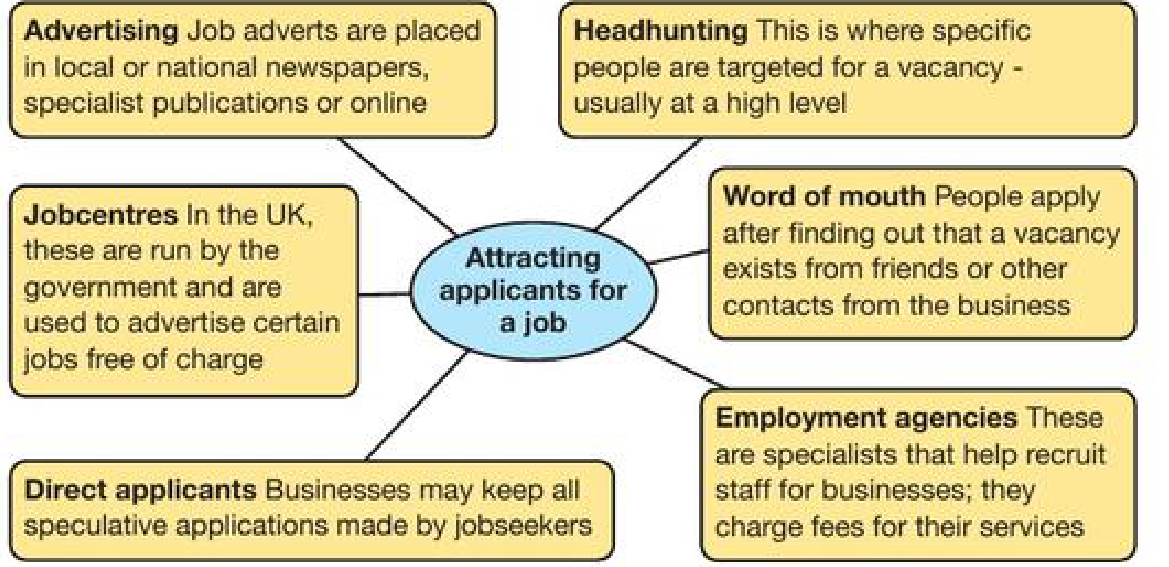
For external recruitment, a business can use advertising, headhunting, word of mouth, employment agencies, jobcentres or direct applications. The best method depends on the vacancy: a specialist manager and a temporary shop assistant are unlikely to be recruited in exactly the same way.
Job Advertisements
A job advertisement should attract suitable applicants and discourage applications from people who do not meet essential criteria. It often includes:
- Job title and a short description of the duties.
- Name and contact details of the employer.
- Skills, qualifications and experience required.
- Salary, benefits and relevant employment conditions.
- How to apply and any closing date.
A business must also choose the advertising medium. Local newspapers or jobcentres may suit local jobs; national publications and specialist online websites may be more effective for management or highly skilled roles. Online advertising can be inexpensive and reach a wide geographical area, but may attract many unsuitable applications.
The example advertisement specifies experience driving Class 1 HGVs, willingness to travel abroad and at weekends, some English and (preferably) forklift experience. Such details help applicants decide whether the job is suitable.
Shortlisting
Shortlisting is selecting a manageable number of the most suitable applicants to invite to interview. The business compares application forms or CVs against the person specification, especially essential requirements.
Using a standard application form may make comparisons quicker because information appears in a consistent order. However, reviewing many applications can still be time-consuming and the business must apply its criteria consistently.
Suppose a manufacturer receives 100 applications for seven production vacancies. It can shortlist candidates with the required technical skills and experience, then use interviews to assess suitability and reliability.
Interviewing
Candidates selected for an interview can provide detailed information and ask their own questions about the role. Interviews can be used to clarify an application, assess motivation, attitude and communication skills, and ask how someone would solve job-related problems.
A well-planned interview is likely to be fairer and more informative. Interviewers should prepare suitable questions, ask candidates a similar set of core questions and make the setting as comfortable as possible. Open questions—such as “Tell us about a time you solved a problem”—encourage explanations rather than one-word answers.
- Strength: employers can ask follow-up questions and judge communication face to face.
- Limitation: a candidate may feel nervous and an interview alone cannot always predict job performance.
- Good practice: compare responses to essential selection criteria; do not base the decision solely on first impressions.
Large vs Small Businesses
It is important to recognise that both large and small businesses recruit staff and may use different contracts. However, the formality and scale of their recruitment arrangements often differ.
Large business
- Often has a dedicated human resources department.
- Can use formal job descriptions and specifications.
- May recruit large numbers for varied posts.
- Can afford recruitment specialists and advertising.
Small business
- Often relies on the owner to recruit.
- May advertise informally or use personal recommendations.
- Could recruit relatively few employees.
- Has less time and money to repeat an unsuccessful appointment.
Judgement: a small firm may use informal methods effectively, but clear job requirements, fair selection and appropriate checks remain important. A large firm may gain consistency from formal processes, but these can be expensive and time-consuming.
End-of-chapter questions
Try the question before revealing the suggested answer.
List four distinct types of employment explained in Chapter 18.
Show suggested answer
Any four of full-time, part-time, job share, casual, seasonal and temporary.
Describe the difference between recruitment and selection.
Show suggested answer
Recruitment attracts people to apply for a vacancy; selection identifies and appoints the most suitable applicant.
Put these steps in the appropriate sequence: interview, advertise, determine staffing needs, shortlist, prepare job description.
Show suggested answer
Determine staffing needs → prepare job description and person specification → advertise → shortlist → interview; appoint and provide feedback afterward.
Differentiate a job description from a person specification.
Show suggested answer
The job description outlines the title, duties and responsibilities; the person specification describes the qualifications, skills, experience and qualities required of a worker.
Why does a person specification distinguish essential from desirable criteria?
Show suggested answer
Essential criteria identify requirements a candidate should meet; desirable criteria help the employer distinguish between otherwise suitable candidates.
Explain one strength and one weakness of standard job application forms.
Show suggested answer
Strength: all candidates give comparable information in a common format. Weakness: standard fields may not allow applicants to explain unusual but valuable experiences.
State two benefits of internal recruitment and one drawback.
Show suggested answer
Benefits include lower costs, known employee performance, quicker appointment and greater motivation through promotion. Drawback: a smaller pool of candidates or a further vacancy after promotion.
Why might an employer use specialist recruitment websites or employment agencies?
Show suggested answer
These methods can reach people with appropriate specialist qualifications or experience; agencies may also help identify candidates, though they can charge fees.
Explain why shortlisting should be based on a person specification.
Show suggested answer
It helps employers compare relevant skills and qualifications consistently and select the best-matched applicants for further assessment.
What are open interview questions, and how can they help an employer assess applicants?
Show suggested answer
Open questions encourage extended answers rather than a simple yes or no. They can reveal experience, communication skills, reasoning and the ability to handle work situations.
Evaluate whether a growing manufacturer should recruit a purchasing manager internally and additional production staff externally.
Show suggested answer
An internal manager may already know the company and suppliers, reducing cost and uncertainty. External recruitment can provide access to more production workers and specialist skills. However, internal promotion creates another vacancy, and external selection can take longer.
Chapter 18 recap
Good recruitment begins with the right type of employment and a clear understanding of what the job requires. Businesses prepare job descriptions and person specifications, attract applicants internally or externally, review application forms and CVs, shortlist suitable candidates and interview them before making an appointment. A considered recruitment process helps businesses avoid costly mistakes.
Original revision explanations and practice questions for Pearson Edexcel International GCSE Business (9–1). Selected diagrams are credited in their captions. Historical business examples are illustrative. IGCSE360 is independent of Pearson.