Proper fraction
Numerator smaller than denominator.
\(\frac58\)
Develop the fluency to move between fraction, decimal and percentage forms, simplify equivalent fractions, find fractions of quantities and handle recurring decimals with clear algebraic working.
Subtopic 1
A fraction has the form \(\frac{a}{b}\), where \(a\) and \(b\) are integers and \(b\neq0\). The top number is the numerator; the bottom number is the denominator.
For an improper fraction the numerator is at least as large as the denominator; a mixed number consists of a whole number and a proper fractional part. Convert mixed numbers to improper fractions before longer calculations.
Numerator smaller than denominator.
Numerator greater than or equal to denominator.
A whole number plus a proper fraction.
Write \(\frac{23}{6}\) as a mixed number.
\(23\div6=3\) remainder 5.
\[\frac{23}{6}=\boxed{3\frac56}\]Write \(4\frac37\) as an improper fraction.
The denominator does not change when converting a mixed number to an improper fraction.
Convert \(\frac{47}{6}\) to a mixed number.
Step 1: Divide 47 by 6: \(47=7\times6+5\).
Step 2: \(\boxed{7\frac56}\).
A ribbon is \(\frac{53}{8}\text{ m}\) long. Express it as a mixed number and find the number of complete 1 m lengths.
Step 1: \(53\div8=6\) remainder 5, so length \(=6\frac58\text{ m}\).
Step 2: There are \(\boxed6\) complete one-metre lengths, with \(\frac58\text{ m}\) left.
Attempt the early questions first, then the exam-style question. Open Show Answer only after trying your own working.
Convert \(\frac{19}{4}\) to a mixed number.
Step 1: \(19\div4=4\) remainder 3.
Step 2: \(\boxed{4\frac34}\).
Convert \(5\frac27\) into an improper fraction.
Step 1: Numerator \(=5\times7+2=37\).
Step 2: \(\boxed{\frac{37}{7}}\).
Convert \(\frac{29}{6}\) to a mixed number.
Step 1: \(29=4\times6+5\).
Step 2: \(\boxed{4\frac56}\).
Write \(3\frac56\) as an improper fraction. How many sixths does it contain?
Step 1: \(3\times6+5=23\).
Step 2: \(\boxed{\frac{23}{6}}\), meaning 23 one-sixth parts.
Subtopic 2
The denominator tells you how many equal parts the whole is divided into; the numerator tells you how many parts are required.
Method: divide by the denominator, then multiply by the numerator. If you need the quantity remaining after taking a fraction, subtract the fraction used from 1 first.
Find \(\frac37\) of 84.
Which is greater: \(\frac58\) of 144 or \(\frac7{10}\) of 120?
So \(\boxed{\frac58\text{ of }144}\) is greater.
A jacket costs $156. Its price is reduced by \(\frac14\). Find the sale price.
\(\frac38\) of 240 books are borrowed. How many remain?
Step 1: Borrowed \(=240\div8\times3=90\).
Step 2: Remaining \(=240-90=\boxed{150}\) books.
A club spends \(\frac25\) of its \$900 funds on equipment, then \(\frac13\) of the remainder on transport. How much remains?
Step 1: Equipment \(=\frac25\times900=\$360\); remaining \(=\$540\).
Step 2: Transport \(=\frac13\times540=\$180\).
Step 3: Remaining \(=540-180=\boxed{\$360}\).
Attempt the early questions first, then the exam-style question. Open Show Answer only after trying your own working.
Find \(\frac34\) of 80.
Step 1: \(80\div4=20\).
Step 2: \(20\times3=\boxed{60}\).
\(\frac7{12}\) of 144 students take a bus. How many students is that?
Step 1: \(144\div12=12\).
Step 2: \(12\times7=\boxed{84}\).
A bag holds 96 marbles; \(\frac5{8}\) are blue. How many are not blue?
Step 1: Blue \(=96\div8\times5=60\).
Step 2: Not blue \(=96-60=\boxed{36}\).
A phone priced at \$320 is reduced by \(\frac3{16}\) of its price. Find the sale price.
Step 1: Discount \(=320\div16\times3=\$60\).
Step 2: Sale price \(=320-60=\boxed{\$260}\).
Subtopic 3
Equivalent fractions have the same value. Multiplying or dividing numerator and denominator by the same non-zero number does not change the fraction's value.
Equivalent fractions have the same value. Multiply or divide both numerator and denominator by the same non-zero integer. The simplest form uses the highest common factor to cancel completely.
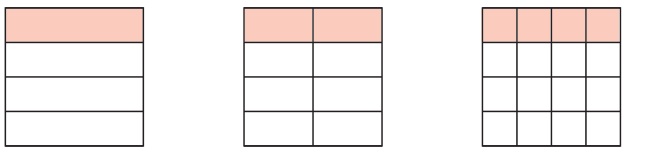
A fraction is in simplest form when numerator and denominator have no common factor greater than 1. Dividing both by their HCF is usually the fastest method.
Simplify \(\frac{42}{56}\).
HCF = 14.
\[\frac{42}{56}=\frac{42\div14}{56\div14}=\boxed{\frac34}\]A club has 48 adults and 32 children. What fraction of all members are children?
Write \(\frac{84}{126}\) in simplest form.
Step 1: HCF of 84 and 126 is 42.
Step 2: \(\frac{84\div42}{126\div42}=\boxed{\frac23}\).
Find \(x\) if \(\frac{14}{21}=\frac{x}{45}\).
Step 1: \(\frac{14}{21}=\frac23\).
Step 2: \(\frac{x}{45}=\frac23\), so \(x=45\times\frac23=\boxed{30}\).
Attempt the early questions first, then the exam-style question. Open Show Answer only after trying your own working.
Simplify \(\frac{12}{18}\).
Step 1: Divide top and bottom by 6.
Step 2: \(\boxed{\frac23}\).
Write \(\frac{42}{56}\) in simplest form.
Step 1: HCF \(=14\).
Step 2: \(\boxed{\frac34}\).
Find the missing numerator: \(\frac5{12}=\frac{x}{60}\).
Step 1: 12 is multiplied by 5.
Step 2: 5 multiplied by 5 gives \(\boxed{x=25}\).
Of 150 learners, 45 chose science. What fraction chose science, in simplest form?
Step 1: Fraction \(=\frac{45}{150}\).
Step 2: Divide by 15: \(\boxed{\frac3{10}}\).
Subtopic 4
Use place value to convert a terminating decimal to a fraction. To convert a fraction to a decimal, divide the numerator by the denominator.
To convert a terminating decimal into a fraction, place its digits above 10, 100, 1000, and so on, depending on the last decimal place, then simplify. Conversely, a fraction represents numerator divided by denominator.

Write over \(10\), \(100\), \(1000\), etc. depending on the last decimal place, then simplify.
Calculate numerator \(\div\) denominator.
Write \(0.36\) as a fraction in simplest form.
Write \(0.1375\) as a fraction in simplest form.
Convert \(\frac7{20}\) to a decimal.
Write \(0.056\) in simplest fractional form.
Step 1: \(0.056=\frac{56}{1000}\).
Step 2: Divide numerator and denominator by 8: \(\boxed{\frac7{125}}\).
\(0.375\) of a 64 kg shipment is flour. Find the mass of flour using a fraction.
Step 1: \(0.375=\frac{375}{1000}=\frac38\).
Step 2: Flour mass \(=\frac38\times64=\boxed{24\text{ kg}}\).
Attempt the early questions first, then the exam-style question. Open Show Answer only after trying your own working.
Convert \(0.6\) to a simplest fraction.
Step 1: \(0.6=\frac6{10}\).
Step 2: \(\boxed{\frac35}\).
Write \(0.045\) as a simplest fraction.
Step 1: \(0.045=\frac{45}{1000}\).
Step 2: Cancel 5: \(\boxed{\frac9{200}}\).
Convert \(\frac7{16}\) into a decimal.
Step 1: Compute \(7\div16\).
Step 2: \(\boxed{0.4375}\).
A fraction of the total votes is \(0.3125\). Express it as a simplest fraction.
Step 1: \(0.3125=\frac{3125}{10000}\).
Step 2: Divide by 625: \(\boxed{\frac5{16}}\).
Subtopic 5
A terminating decimal ends. A recurring decimal contains a digit or block of digits that repeats forever. Both are rational numbers.
A terminating decimal ends; a recurring decimal repeats forever and can be written with dot or bar notation. To turn a recurring block into a fraction, multiply by a suitable power of ten and subtract to cancel the repeating digits.
\(\frac38=0.375\)
The decimal stops.
\(\frac7{11}=0.636363\ldots\)
The block 63 repeats forever.
A dot marks a recurring digit. For example \(0.\dot3=0.3333\ldots\). If a block repeats, dots can mark the start and end of the recurring block.
Convert \(\frac5{12}\) to a decimal.
So the decimal is \(0.41\dot6\).
Convert \(0.272727\ldots\) to a fraction.
Let \(x=0.272727\ldots\).
\[100x=27.272727\ldots\]\[99x=27\]\[x=\frac{27}{99}=\boxed{\frac3{11}}\]Convert \(0.1666\ldots\) to a fraction.
Let \(x=0.1666\ldots\).
\[10x=1.6666\ldots\]\[100x=16.6666\ldots\]\[90x=15\]\[x=\boxed{\frac16}\]Choose multipliers so the recurring tails line up before subtracting. One recurring digit usually needs a factor of 10; two recurring digits usually need 100.
Convert \(0.\overline{27}\) to a fraction.
Step 1: Let \(x=0.272727\ldots\). Then \(100x=27.272727\ldots\).
Step 2: Subtract: \(99x=27\), so \(x=\frac{27}{99}=\boxed{\frac3{11}}\).
Convert \(0.1\overline{6}=0.16666\ldots\) to a fraction.
Step 1: Let \(x=0.1666\ldots\), so \(10x=1.6666\ldots\) and \(100x=16.6666\ldots\).
Step 2: Subtract: \(90x=15\).
Step 3: \(x=\frac{15}{90}=\boxed{\frac16}\).
Attempt the early questions first, then the exam-style question. Open Show Answer only after trying your own working.
Is \(\frac38\) terminating or recurring as a decimal?
Step 1: \(3\div8=0.375\).
Step 2: It is \(\boxed{\text{terminating}}\).
Write \(0.\overline{4}\) as a fraction.
Step 1: Let \(x=0.444\ldots\). Then \(10x-x=4\).
Step 2: \(\boxed{x=\frac49}\).
Convert \(0.\overline{18}\) to a simplest fraction.
Step 1: \(x=0.1818\ldots\), so \(100x-x=18\).
Step 2: \(x=\frac{18}{99}=\boxed{\frac2{11}}\).
Convert \(0.2\overline{3}=0.23333\ldots\) to a fraction.
Step 1: Let \(x=0.23333\ldots\), so \(10x=2.3333\ldots\) and \(100x=23.3333\ldots\).
Step 2: Subtract: \(90x=21\).
Step 3: \(\boxed{x=\frac7{30}}\).
Subtopic 6
Per cent means “out of 100”. Fractions, decimals and percentages can represent exactly the same value.
Conversions: percent means per hundred. Fraction to percentage: divide, then multiply by 100. Percentage to fraction: put the percentage number over 100 and simplify. Percentages may exceed 100%.
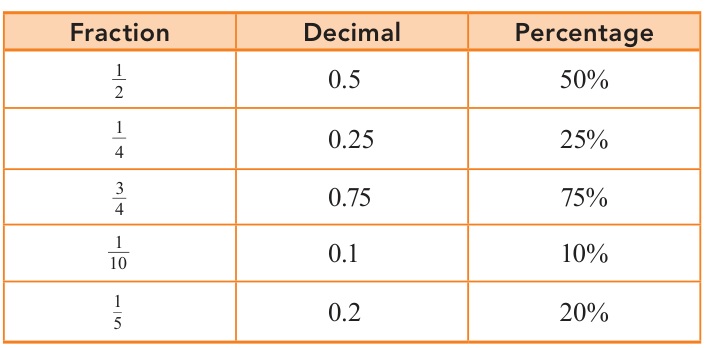
| Fraction | Decimal | Percentage |
|---|---|---|
| \(\frac12\) | 0.5 | 50% |
| \(\frac14\) | 0.25 | 25% |
| \(\frac34\) | 0.75 | 75% |
| \(\frac15\) | 0.2 | 20% |
| \(\frac1{10}\) | 0.1 | 10% |
Multiply by 100 to get a percentage; divide by 100 to get a decimal.
Fraction to percentage: divide then ×100. Percentage to fraction: write over 100 then simplify.
Convert \(\frac7{20}\) to a percentage.
Convert \(135\%\) to a decimal and mixed number.
Which is greatest: \(38\%\), \(\frac25\), or \(0.37\)?
Therefore \(\boxed{\frac25}\) is greatest.
Convert \(\frac7{20}\) to a percentage.
Step 1: \(\frac7{20}=0.35\).
Step 2: \(0.35\times100=\boxed{35\%}\).
Three survey choices received \(28\%\), \(\frac3{10}\) and \(0.285\) of the votes. Which is largest?
Step 1: Convert to percentages: \(28\%\), \(30\%\) and \(28.5\%\).
Step 2: The largest is \(\boxed{\frac3{10}=30\%}\).
Attempt the early questions first, then the exam-style question. Open Show Answer only after trying your own working.
Convert \(0.48\) to a percentage.
Step 1: Multiply by 100.
Step 2: \(\boxed{48\%}\).
Convert \(12.5\%\) to a fraction.
Step 1: \(12.5\%=\frac{12.5}{100}=\frac{125}{1000}\).
Step 2: \(\boxed{\frac18}\).
Convert \(\frac9{40}\) to a percentage.
Step 1: \(9\div40=0.225\).
Step 2: \(0.225\times100=\boxed{22.5\%}\).
A class survey records proportions \(\frac7{25}\), 0.31 and 35%. Which is the largest?
Step 1: Convert \(\frac7{25}=28\%\) and \(0.31=31\%\).
Step 2: Compare 28%, 31% and 35%.
Step 3: \(\boxed{35\%}\) is greatest.
Begin with routine conversions, then move into recurring-decimal algebra and mixed-form exam questions. Keep the answer closed until you have attempted each question.
Classify \(\frac7{12},\frac{19}{6},3\frac25\).
\(\frac7{12}\): proper. \(\frac{19}{6}\): improper. \(3\frac25\): mixed number.
a) Write \(\frac{29}{8}\) as a mixed number. b) Write \(5\frac34\) as an improper fraction.
a) \(29\div8=3\) remainder 5, so \(\boxed{3\frac58}\).
b) \(5\times4+3=23\), so \(\boxed{\frac{23}{4}}\).
Find \(\frac7{12}\) of 180.
Simplify \(\frac{54}{72}\).
HCF = 18.
\[\frac{54}{72}=\boxed{\frac34}\]Write \(0.425\) as a fraction in simplest form.
Convert \(\frac{13}{40}\) to a decimal.
Convert \(\frac5{16}\) to a percentage.
Write \(62.5\%\) as a fraction in simplest form.
State whether each terminates or recurs: \(\frac7{25},\frac29,\frac{11}{40}\).
\(\frac7{25}=0.28\): terminating.
\(\frac29=0.2222\ldots\): recurring.
\(\frac{11}{40}=0.275\): terminating.
Convert \(0.454545\ldots\) to a fraction.
Let \(x=0.454545\ldots\).
\[100x=45.454545\ldots\]\[99x=45\]\[x=\boxed{\frac5{11}}\]Convert \(0.23333\ldots\) to a fraction.
Let \(x=0.23333\ldots\).
\[10x=2.3333\ldots\]\[100x=23.3333\ldots\]\[90x=21\]\[x=\boxed{\frac7{30}}\]A tablet costs $288 and is reduced by \(\frac{3}{16}\) of its original price. Find the sale price.
Class A has \(\frac7{15}\) of students travelling by bus. Class B has 46%. Which class has the greater proportion?
So \(\boxed{\text{Class A}}\) has the greater proportion.
Arrange \(0.58,\frac7{12},57\%\) from smallest to largest.
Let \(x=0.181818\ldots\). a) Express \(x\) as a fraction. b) Hence find \(5x\).
In a survey, \(\frac38\) prefer A, 36% prefer B and 0.245 prefer C. Which is most popular and by how many percentage points does it exceed the least popular?
A is most popular and C least popular.
\[37.5-24.5=\boxed{13\text{ percentage points}}\]I can move between proper, improper and mixed forms.
I divide by the denominator and multiply by the numerator.
I simplify fully and recognise equivalent forms.
I use place value and division confidently.
I can convert recurring decimals to fractions using algebra.
I can compare fractions, decimals and percentages by converting to a common form.
Chapter 4 revision: This chapter follows the subtopic headings and core concepts in the supplied Cambridge O Level Mathematics, Second Edition. Figure crops come from the provided textbook. Additional questions are original exam-style practice, not reproduced Cambridge examination questions.