Worked example · Easy
Temperature change
The temperature rises from -4°C to 7°C. Find the increase.
\[7-(-4)=11\]
Increase: \(\boxed{11^\circ\text{C}}\).
Build reliable arithmetic with negative numbers, integers, decimals and fractions. The aim is not only to calculate correctly, but to choose the right operation, apply the correct sign and follow the correct order.
Subtopic 1
Negative numbers are numbers less than zero. They appear in temperatures, bank balances, heights below sea level, lifts below ground level and many other contexts. Zero is neither positive nor negative.
If the values are on opposite sides of zero, count the distance to zero and then beyond it. Algebraically, the difference between 8 and -5 is:
\[8-(-5)=13.\]Distances and changes across zero must include both sides of zero.
The temperature rises from -4°C to 7°C. Find the increase.
Increase: \(\boxed{11^\circ\text{C}}\).
An account is $68 overdrawn. How much must be paid in for the balance to become $125 in credit?
Start at \(-68\), finish at \(+125\).
\[125-(-68)=193\]Amount required: \(\boxed{\$193}\).
A submarine moves from \(-85\text{ m}\) to \(27\text{ m}\). Find the change in its height.
Change = final height minus starting height.
\[27-(-85)=27+85=\boxed{112\text{ m upward}}\]
Try each question before opening its worked solution.
Which is colder: \(-12^\circ\text{C}\) or \(-7^\circ\text{C}\)?
On the number line, \(-12<-7\).
\[\boxed{-12^\circ\text{C}}\]
Calculate the temperature rise from \(-6^\circ\text{C}\) to \(9^\circ\text{C}\).
\[9-(-6)=9+6=\boxed{15^\circ\text{C}}\]
An account goes from \(-\$45\) to \(\$120\). How much has the balance increased?
\[120-(-45)=120+45=\boxed{\$165}\]
Subtopic 2
A number line helps explain the rules. Adding a negative number moves left; subtracting a negative number has the same effect as adding the corresponding positive number.
\(a+(-b)=a-b\)
\(a-(-b)=a+b\)
Keep track of the operation separately from the sign attached to a number.


Work out \(-3+(-7)\).
Work out \(-6-(-9)\).
Evaluate \(-15+(-8)-(-11)+6\).
Change addition of a negative to subtraction; change subtraction of a negative to addition.
\[-15-8+11+6=-23+17=\boxed{-6}\]
The rule “two negatives make a positive” is not a general addition rule. It applies here because you are subtracting a negative, and later to multiplication/division of two negative factors.
Try each question before opening its worked solution.
Calculate \(-9+(-4)\).
Add two negative values by adding their magnitudes.
\[-9-4=\boxed{-13}\]
Calculate \(7-(-12)-5\).
\[7+12-5=19-5=\boxed{14}\]
A lift is on floor \(-3\), goes up 8 floors, then down 11 floors. Which floor?
\[-3+8-11=5-11=\boxed{-6}\]
Subtopic 3
For multiplication and division, the sign depends only on whether the signs are the same or different.
| Signs | Result |
|---|---|
| same: \(+\times+\), \(-\times-\), \(+\div+\), \(-\div-\) | positive |
| different: \(+\times-\), \(-\times+\), \(+\div-\), \(-\div+\) | negative |
An even number of negative factors gives a positive product. An odd number gives a negative product.
An odd number of negative factors gives a negative product; an even number gives a positive product.
Work out \((-8)(-6)\).
Same signs → positive.
\[8\times6=48\Rightarrow\boxed{48}\]Work out \((-2)\times5\times(-7)\).
There are two negative signs, so the result is positive.
\[2\times5\times7=\boxed{70}\]Evaluate \((-2)(-3)(-4)(5)\).
There are three negative factors, so the final product is negative.
\[2\times3\times4\times5=120\]
\[\boxed{-120}\]
Try each question before opening its worked solution.
Calculate \((-7)\times6\).
The signs differ, so the product is negative.
\[\boxed{-42}\]
Calculate \((-144)\div(-12)\).
Two negative signs give a positive quotient.
\[\boxed{12}\]
Evaluate \((-2)(-5)(-3)(-4)\).
Four negative factors give a positive product.
\[2\times5\times3\times4=\boxed{120}\]
Subtopic 4
When a calculation contains several operations, multiplication and division are completed before addition and subtraction unless brackets change the order.
In a mixed operation calculation, resolve multiplication and division before addition and subtraction.
Work out \((-4\times-3)+(5\times-2)\).
Work out \(\frac{6(-5)+4(-3)}{-7+1}\).
Numerator:
\[6(-5)+4(-3)=-30-12=-42\]Denominator:
\[-7+1=-6\]Then divide:
\[\frac{-42}{-6}=\boxed{7}\]Work out \(18-(-3)(4)+(-24)\div6\).
Do multiplication and division first: \((-3)(4)=-12\), \((-24)\div6=-4\).
\[18-(-12)+(-4)=18+12-4=\boxed{26}\]
Try each question before opening its worked solution.
Evaluate \(12+(-3)\times4\).
Multiply first: \((-3)\times4=-12\).
\[12-12=\boxed0\]
Calculate \(7-(-18)\div3\).
Division first: \((-18)\div3=-6\).
\[7-(-6)=\boxed{13}\]
Evaluate \((-24)\div(-6)+3(-5)-(-2)\).
Divide and multiply: \(4+(-15)-(-2)\).
\[4-15+2=\boxed{-9}\]
Subtopic 5
Use the same order every time. A useful memory aid is BIDMAS (or BODMAS/PEMDAS in other systems).
Operations at the same level are done from left to right. A fraction bar acts like brackets around the entire numerator and denominator.
Brackets first; powers next; multiply and divide left to right; add and subtract left to right.
Work out \(9-2\times4\).
Work out \((7-3)^2+4\times(-5)\).
Evaluate \(36\div3\times2-(5-2)^2\).
Brackets and indices first: \((5-2)^2=3^2=9\).
Division and multiplication have equal priority: go left to right.
\[36\div3\times2=12\times2=24\]
\[24-9=\boxed{15}\]
Enter brackets exactly as written. Do not rely on a calculator to repair missing brackets or an incorrectly typed negative sign.
Try each question before opening its worked solution.
Calculate \(8+6\times3\).
Multiply before adding: \(6\times3=18\).
\[8+18=\boxed{26}\]
Evaluate \((9-5)^2+3\times2\).
\[(9-5)^2=16,\quad3\times2=6\]
\[16+6=\boxed{22}\]
Calculate \(40\div(6-2)\times3-2^3\).
Bracket \(6-2=4\), power \(2^3=8\).
\[40\div4\times3-8=10\times3-8=\boxed{22}\]
Subtopic 6
For large integers, use a written method such as long multiplication or a grid. Both rely on place value and should give the same result.
Estimate products first and align place values correctly in written multiplication.
Work out \(426\times37\).
Split 37 into 30 and 7:
\[426\times30=12780\]\[426\times7=2982\]\[12780+2982=\boxed{15762}\]A hall has 48 rows with 36 seats in each row. Find the total number of seats.
Calculate \(608\times27\) using place value.
Split \(27=20+7\).
\[608\times20=12160\]
\[608\times7=4256\]
\[12160+4256=\boxed{16416}\]
Try each question before opening its worked solution.
Work out \(35\times24\).
\[35(20+4)=700+140=\boxed{840}\]
Find \(214\times36\).
\[214(30+6)=6420+1284=\boxed{7704}\]
A warehouse stores 48 cartons, each holding 125 notebooks. How many notebooks altogether?
\[48\times125=(50-2)125=6250-250=\boxed{6000}\]
Subtopic 7
Ignore the decimal points while multiplying, then place the decimal point in the answer so that the total number of decimal places matches the total in the two factors.
Estimate the size of your product: multiplying by a decimal smaller than 1 decreases a positive quantity.
Work out \(0.6\times0.04\).
There are three decimal places altogether.
\[6\times4=24\Rightarrow0.024\]\(\boxed{0.024}\)
Work out \(3.24\times0.7\).
There are three decimal places altogether:
\[\boxed{2.268}\]Work out \(3.25\times0.48\).
First multiply integers: \(325\times48=15600\).
There are 2 + 2 = 4 decimal places in the factors.
\[3.25\times0.48=\boxed{1.56}\]
Try each question before opening its worked solution.
Calculate \(0.7\times0.06\).
\(7\times6=42\) and there are 3 decimal places.
\[\boxed{0.042}\]
Evaluate \(2.4\times1.25\).
\[24\times125=3000\] Three decimal places in total.
\[\boxed{3}\]
Paint covers \(6.25\text{ m}^2\) per litre. How much area can \(3.6\) litres cover?
\[6.25\times3.6=6.25(3+0.6)=18.75+3.75\]
\[\boxed{22.5\text{ m}^2}\]
Subtopic 8
Long division or chunking can be used. For a context question, always interpret the remainder: sometimes it means another container, bus or box is needed.
An interpretation question may require rounding the number of buses or boxes up, rather than reporting a remainder.
Work out \(936\div26\).
\(26\times30=780\), leaving 156.
\(26\times6=156\).
\[936\div26=30+6=\boxed{36}\]625 students travel in coaches that each hold 48 students. What is the minimum number of coaches needed?
13 coaches are not enough because one student remains.
Minimum needed: \(\boxed{14}\).
How many full groups of 28 can be made from 997, and how many are left?
\(28\times35=980\).
Remainder \(997-980=17\).
\[\boxed{35\text{ groups, remainder }17}\]
Try each question before opening its worked solution.
Compute \(672\div21\).
\(21\times32=672\).
\[\boxed{32}\]
Calculate \(935\div24\), stating quotient and remainder.
\(24\times38=912\), leaving \(935-912=23\).
\[\boxed{38\text{ remainder }23}\]
There are 1245 people and each minibus seats 32. Find the minimum number of minibuses needed.
\(32\times38=1216\), leaving 29 people.
They need another minibus: \(38+1=\boxed{39}\).
Subtopic 9
Make the divisor an integer by multiplying both numbers by the same power of 10. This does not change the value of the division.
Always move the decimal point the same number of places in BOTH numbers.
Work out \(4.8\div0.6\).
Work out \(18.72\div0.24\).
Multiply both numbers by 100:
\[18.72\div0.24=1872\div24=\boxed{78}\]Calculate \(0.0468\div0.012\).
Multiply the divisor and dividend by 1000.
\[0.0468\div0.012=46.8\div12=\boxed{3.9}\]
If you move the decimal point in the divisor, you must move it by the same number of places in the dividend.
Try each question before opening its worked solution.
Calculate \(7.2\div0.9\).
Multiply both numbers by 10: \(72\div9\).
\[\boxed8\]
Work out \(4.86\div0.18\).
Multiply both values by 100: \(486\div18\).
\[\boxed{27}\]
\(5.4\) litres of juice are poured into cups holding \(0.15\) litres each. How many complete cups?
\[5.4\div0.15=540\div15=\boxed{36\text{ cups}}\]
Subtopic 10
Fractions must have a common denominator before their numerators can be added or subtracted. Mixed numbers are safest to convert to improper fractions first.
Find a common denominator first, calculate with numerators, then simplify the answer.
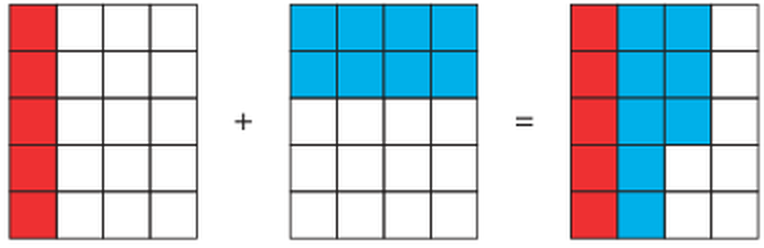
Work out \(\frac34+\frac56\).
LCM of 4 and 6 is 12.
\[\frac34+\frac56=\frac9{12}+\frac{10}{12}=\frac{19}{12}=\boxed{1\frac7{12}}\]Work out \(4\frac25-1\frac34\).
Calculate \(2\frac34-1\frac56+\frac23\).
Use improper fractions: \(\frac{11}{4}-\frac{11}{6}+\frac23\).
Common denominator 12:
\[\frac{33}{12}-\frac{22}{12}+\frac8{12}=\frac{19}{12}\]
\[\boxed{1\frac7{12}}\]
Try each question before opening its worked solution.
Find \(\frac13+\frac14\).
Common denominator 12.
\[\frac4{12}+\frac3{12}=\boxed{\frac7{12}}\]
Work out \(\frac78-\frac13\).
Common denominator 24.
\[\frac{21}{24}-\frac8{24}=\boxed{\frac{13}{24}}\]
A jug contains \(2\frac12\) litres. \(\frac34\) litre and \(\frac56\) litre are used. How much remains?
\[\frac52-\frac34-\frac56=\frac{30-9-10}{12}\]
\[\boxed{\frac{11}{12}\text{ litre}}\]
Subtopic 11
Multiply the numerators and multiply the denominators. Cancelling common factors before multiplying keeps the numbers smaller.
Simplifying factors before multiplying is useful when the numerators and denominators are large.
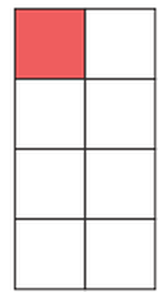
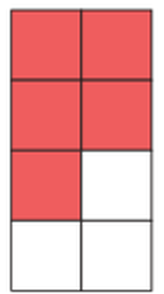
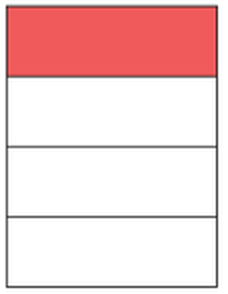
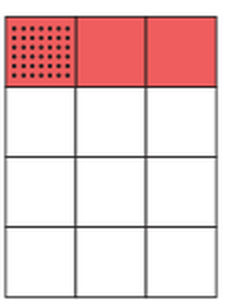
Work out \(\frac7{15}\times6\).
Work out \(\frac{9}{14}\times\frac{21}{20}\).
Cancel \(21\div14=3\div2\) and \(9\div20\) has no common factor.
\[\frac9{14}\times\frac{21}{20}=\frac{9\times3}{2\times20}=\frac{27}{40}\]\(\boxed{\frac{27}{40}}\)
Work out \(2\frac14\times1\frac23\).
Calculate \(\frac{15}{28}\times\frac{14}{25}\).
Cancel 14 with 28 to get \(1\) and \(2\); cancel 15 with 25 to get \(3\) and \(5\).
\[\frac{15}{28}\times\frac{14}{25}=\frac{3\times1}{2\times5}=\boxed{\frac3{10}}\]
Try each question before opening its worked solution.
Evaluate \(\frac34\times\frac25\).
Multiply numerators and denominators.
\[\frac{3\times2}{4\times5}=\boxed{\frac3{10}}\]
Find \(1\frac12\times\frac49\).
Change the mixed number: \(1\frac12=\frac32\).
\[\frac32\times\frac49=\frac{12}{18}=\boxed{\frac23}\]
A rectangular field is \(\frac78\text{ km}\) long and \(\frac25\text{ km}\) wide. Find its area.
\[\frac78\times\frac25=\frac{14}{40}=\boxed{\frac7{20}\text{ km}^2}\]
Subtopic 12
To divide by a fraction, multiply by its reciprocal. The reciprocal of \(\frac ab\) is \(\frac ba\).
Keep the first fraction, change division to multiplication, flip the second fraction. This memory aid is useful, but you should understand that “flip” means taking the reciprocal.
Only invert the divisor (the second fraction); convert mixed numbers to improper fractions first.
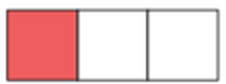
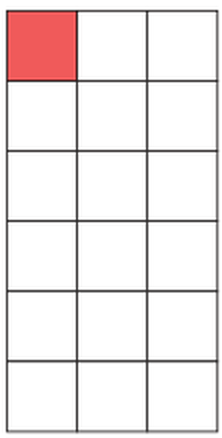
Work out \(5\div\frac14\).
Work out \(\frac56\div\frac7{12}\).
Work out \(3\frac38\div1\frac12\).
Calculate \(2\frac14\div\frac38\).
Convert the mixed number: \(2\frac14=\frac94\).
Multiply by the reciprocal \(\frac83\).
\[\frac94\times\frac83=\frac{72}{12}=\boxed6\]
Try each question before opening its worked solution.
Calculate \(3\div\frac12\).
\[3\times\frac21=\boxed6\]
Work out \(\frac59\div\frac{10}{27}\).
Multiply by the reciprocal and cancel.
\[\frac59\times\frac{27}{10}=\frac{15}{10}=\boxed{\frac32}\]
A ribbon \(2\frac25\text{ m}\) long is cut into \(\frac3{10}\text{ m}\) pieces. How many complete pieces?
\[\frac{12}5\div\frac3{10}=\frac{12}5\times\frac{10}3=\boxed8\]
The first questions build fluency. The later questions combine several skills, as exam questions often do. Keep each answer closed until you have attempted the question.
Find the difference between \(-12^\circ\text{C}\) and \(5^\circ\text{C}\).
Work out: a) \(-7+(-8)\) b) \(3-(-11)\) c) \(-4-6\) d) \(-9-(-2)\).
a) \(-15\)
b) \(14\)
c) \(-10\)
d) \(-7\)
Work out: a) \((-6)(7)\) b) \((-8)(-5)\) c) \(54\div(-9)\) d) \((-72)\div(-8)\).
a) \(-42\)
b) \(40\)
c) \(-6\)
d) \(9\)
Work out \(18-3\times4+2\).
Multiplication first:
\[18-12+2=\boxed{8}\]Work out \((9-5)^2-3\times6\).
Work out \(538\times46\).
Work out \(1152\div32\).
\(32\times30=960\), remainder 192. \(32\times6=192\).
\[1152\div32=\boxed{36}\]Work out \(0.35\times0.8\).
Three decimal places altogether:
\[\boxed{0.280=0.28}\]Work out \(7.56\div0.18\).
Work out \(0.7+0.4\times0.25\).
Multiply first:
\[0.4\times0.25=0.1\]\[0.7+0.1=\boxed{0.8}\]Work out \(\frac5{12}+\frac7{18}\).
LCM of 12 and 18 is 36.
\[\frac{15}{36}+\frac{14}{36}=\boxed{\frac{29}{36}}\]Work out \(5\frac16-2\frac34\).
Work out \(\frac8{15}\times\frac9{16}\).
Cancel \(8\) with \(16\), and 9 with 15:
\[\frac12\times\frac35=\boxed{\frac3{10}}\]Work out \(\frac7{10}\div\frac{14}{15}\).
Work out \(1\frac45\times2\frac7{9}\).
A bank balance is \(-\$145\). A payment of $230 is deposited and then $96 is withdrawn. Find the final balance.
738 people must travel in coaches holding 52 people each. Find the minimum number of coaches required.
One more coach is needed.
\(\boxed{15}\) coaches.
Work out \(\frac{18-3^2}{5-8}\).
Numerator:
\[18-3^2=18-9=9\]Denominator:
\[5-8=-3\]\[\frac9{-3}=\boxed{-3}\]Work out \(2\frac12+\frac34\div\frac98\). Give the answer in simplest form.
Do the division first:
\[\frac34\div\frac98=\frac34\times\frac89=\frac23\]Then add:
\[2\frac12+\frac23=\frac52+\frac23=\frac{15}{6}+\frac46=\frac{19}{6}=\boxed{3\frac16}\]Work out \(2.4-0.6\div0.15\times0.3\).
Division and multiplication are at the same level, so work left to right:
\[0.6\div0.15=4\]\[4\times0.3=1.2\]\[2.4-1.2=\boxed{1.2}\]A student writes \(6+2\times5=40\). Explain the error and give the correct answer.
The student added first, but multiplication must be done before addition.
\[6+2\times5=6+10=\boxed{16}\]A container is \(\frac34\) full. Then \(\frac25\) of the liquid currently in the container is used. What fraction of the full container remains?
Using \(\frac25\) means \(\frac35\) remains.
\[\frac35\times\frac34=\frac9{20}\]\(\boxed{\frac9{20}}\) of the full container remains.
I can move across zero and calculate differences in context.
I distinguish addition/subtraction rules from multiplication/division sign rules.
I apply brackets, powers, multiplication/division, then addition/subtraction.
I can multiply and divide large integers using a written method and interpret remainders.
I place decimal points using place value and make a decimal divisor into an integer.
I use common denominators for add/subtract, cancel for multiply, and reciprocals for divide.
Illustrations are taken only from actual Chapter 6 diagrams where present; explanations and practice questions are newly written. Text-only book pages are not reproduced as images.