Worked example · Easy
Find integer values
Write down the integer values satisfying \(-4<x\leq1\).
The values must be greater than \(-4\), so \(-4\) is not included. The value 1 is included.
\[\boxed{x=-3,-2,-1,0,1}\]Learn to solve linear inequalities accurately, represent solutions on number lines, and interpret or construct shaded regions on coordinate graphs.
Subtopic 1
Inclusive endpoints use filled circles; strict endpoints use open circles. Reverse the sign whenever multiplying or dividing by a negative number, including in compound inequalities.
An inequality compares values that are not necessarily equal. The four main symbols are:
| Symbol | Meaning | Example |
|---|---|---|
| \(<\) | less than | \(x<4\) |
| \(\leq\) | less than or equal to | \(x\leq4\) |
| \(>\) | greater than | \(x>4\) |
| \(\geq\) | greater than or equal to | \(x\geq4\) |
You normally solve an inequality in the same way as an equation. However:
\[\boxed{\text{Multiplying or dividing by a negative number reverses the inequality sign.}}\]For example, if \(-2x<-6\), dividing by \(-2\) gives \(x>3\).
An open circle excludes the endpoint; a filled circle includes it. Draw the ray towards smaller values for “less than” or towards larger values for “greater than”.
Write down the integer values satisfying \(-4<x\leq1\).
The values must be greater than \(-4\), so \(-4\) is not included. The value 1 is included.
\[\boxed{x=-3,-2,-1,0,1}\]Solve \(3x+5<20\).
Solve \(5x-7\leq2x+8\).
Solve \(4-3x<13\).
Divide by \(-3\), so reverse the sign.
\[\boxed{x>-3}\]Solve \(7<3x+1\leq16\).
Subtract 1 from all three parts:
\[6<3x\leq15\]Divide all three parts by 3:
\[\boxed{2<x\leq5}\]A rectangle has width \(a\) cm and length \((2a-3)\) cm. Its perimeter is greater than 24 cm but no more than 42 cm. Find the possible values of \(a\).
Perimeter:
\[2a+2(2a-3)=6a-6\]So:
\[24<6a-6\leq42\]\[30<6a\leq48\]\[\boxed{5<a\leq8}\]Use an open point for \(<\) or \(>\), and a filled/closed point for \(\leq\) or \(\geq\).
Solve \(-10<5-3x\leq8\).
Worked method — show your mathematical steps and check restrictions or units.
Attempt each question before opening its step-by-step solution.
Solve \(4x-7\geq9\).
Step-by-step solution
Solve \(9-2x<1\).
Step-by-step solution
List integer values satisfying \(-3<2x+1\leq7\).
Step-by-step solution
A taxi fare is \(4+3k\) dollars for \(k\) kilometres. It must cost less than 34 dollars. What is the greatest whole number of kilometres?
Step-by-step solution
Subtopic 2
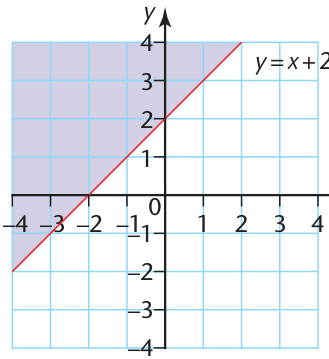
Draw the equality line first. Solid means inclusive; dashed means strict. Test a point away from the boundary to choose the correct side.
An inequality involving \(x\) and \(y\) describes a region of the coordinate plane. The corresponding equation gives the boundary line.
For \(<\) or \(>\), draw the boundary as a dashed line because points on the line are not included.
For \(\leq\) or \(\geq\), draw a solid line because points on the line are included.
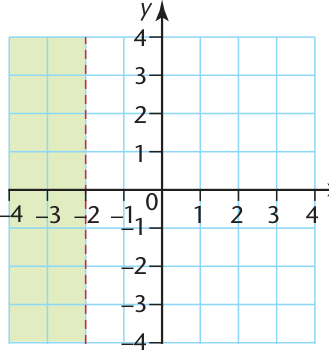
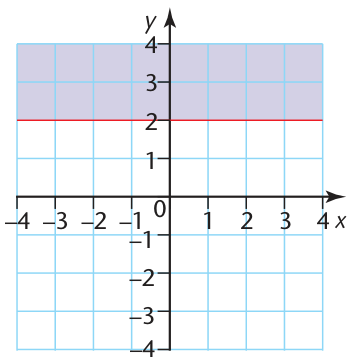
Describe the region \(y\geq3\).
Draw the solid horizontal line \(y=3\). Since values of \(y\) must be at least 3, shade above the line.
Boundary: solid. Region: above the line.
Which side of \(y=2x-1\) satisfies \(y<2x-1\)?
The boundary is dashed. Test \((0,0)\):
\[0<2(0)-1\]\[0<-1\]This is false, so shade the side not containing \((0,0)\).
A graph has a dashed vertical boundary \(x=4\) and the region to the left is shaded. Write the inequality.
Dashed means no equality. Left of \(x=4\) means smaller \(x\)-values.
\[\boxed{x<4}\]Show the region satisfying \(2x+3y\leq12\).
The boundary is \(2x+3y=12\), a solid line. Useful intercepts are \((0,4)\) and \((6,0)\).
Test \((0,0)\):
\[2(0)+3(0)\leq12\]True, so shade the side containing the origin.
For \(2x+3y>12\), give the boundary equation and test whether \((0,0)\) is in the region.
Worked method — show your mathematical steps and check restrictions or units.
Attempt each question before opening its step-by-step solution.
Write the inequality for the region to the right of the dashed line \(x=-2\).
Step-by-step solution
Write the inequality for the region on or below the solid line \(y=4\).
Step-by-step solution
For \(y<2x+1\), does \((1,2)\) lie in the region?
Step-by-step solution
Rewrite \(3x+2y\geq12\) in the form \(y\geq mx+c\).
Step-by-step solution
Subtopic 3
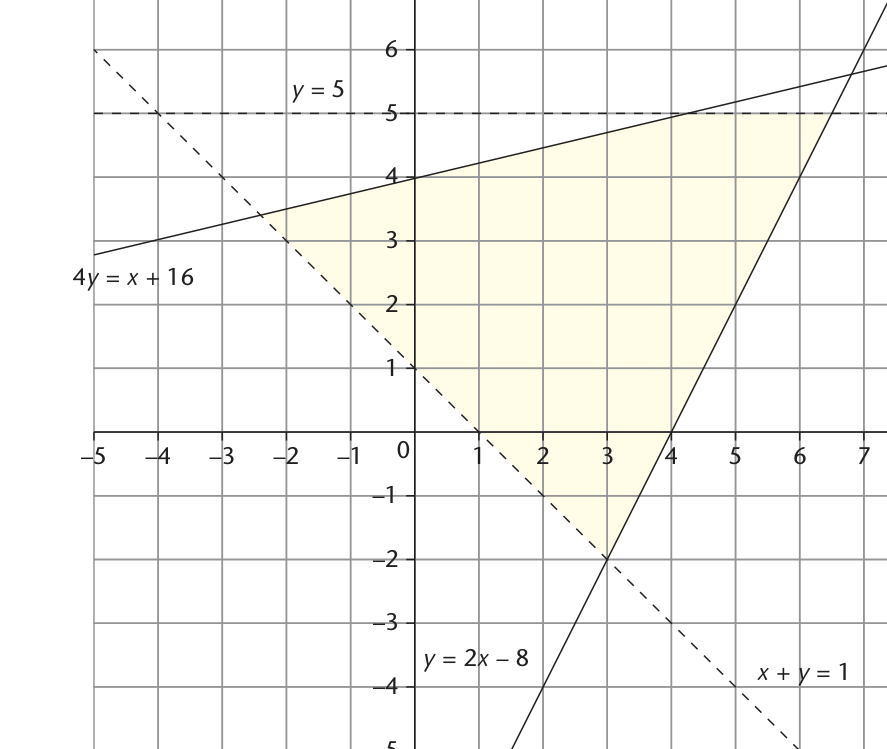
Each inequality represents one half-plane; the solution is the overlap satisfying them all. To describe a graph, read every boundary separately and use a point in the required region.
When several inequalities must all be true, their solution is the intersection of the allowed regions. A useful textbook technique is to shade the regions that do not satisfy each inequality; the required region is then the part left unshaded.
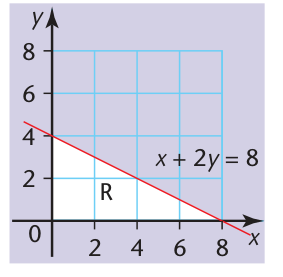
Describe the region satisfying \(x\geq0\), \(y\geq0\) and \(x+2y\leq8\).
\(x\geq0\) keeps the region on or to the right of the \(y\)-axis.
\(y\geq0\) keeps the region on or above the \(x\)-axis.
\(x+2y\leq8\) keeps the region on the side of the line containing \((0,0)\).
The common triangular region is the solution.
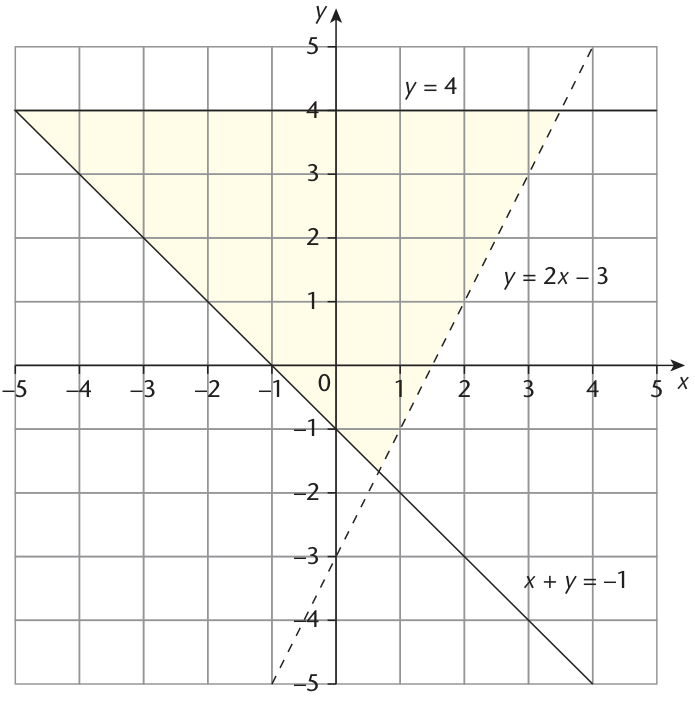
A required region lies below the solid line \(y=5\), above the dashed line \(y=x-2\), and to the right of the solid line \(x=-1\). Write the three inequalities.
Below solid \(y=5\): \(y\leq5\).
Above dashed \(y=x-2\): \(y>x-2\).
Right of solid \(x=-1\): \(x\geq-1\).
\[\boxed{y\leq5,\quad y>x-2,\quad x\geq-1}\]The inequalities are \(x\geq0\), \(y\geq0\), \(x+y\leq6\) and \(x\leq4\). State the vertices of the region.
Boundaries are the axes, \(x+y=6\), and \(x=4\).
Intersections in the allowed region:
\[(0,0),\quad(4,0),\quad(4,2),\quad(0,6)\]Vertices: \(\boxed{(0,0),(4,0),(4,2),(0,6)}\).
Find the vertices of the region satisfying \(x\geq0\), \(y\geq0\) and \(x+2y\leq10\).
Worked method — show your mathematical steps and check restrictions or units.
Attempt each question before opening its step-by-step solution.
Does \((2,3)\) satisfy \(x\geq0\), \(y>0\), and \(x+y\leq6\)?
Step-by-step solution
For \(y\geq x\) and \(y\leq6-x\), find where their boundaries intersect.
Step-by-step solution
State the inequalities for the triangle in the first quadrant on or below \(2x+y=8\).
Step-by-step solution
Is \((3,1)\) inside the region \(x>0\), \(y\geq0\), \(3x+2y<12\)?
Step-by-step solution
Start with one-variable inequalities and number lines, then move to shaded graph regions and systems of inequalities. Keep each answer closed until you have attempted the question.
Write the integer values satisfying \(-2<x\leq3\).
Method: Check whether the inequality includes equality, apply reversible algebraic operations carefully, and test the resulting answer or boundary.
\[\boxed{x=-1,0,1,2,3}\]Solve \(4x+3<19\).
Method: Check whether the inequality includes equality, apply reversible algebraic operations carefully, and test the resulting answer or boundary.
\[4x<16\]\[\boxed{x<4}\]Solve \(7x-5\geq16\).
Method: Check whether the inequality includes equality, apply reversible algebraic operations carefully, and test the resulting answer or boundary.
\[7x\geq21\]\[\boxed{x\geq3}\]Solve \(10-2x>18\).
Method: Check whether the inequality includes equality, apply reversible algebraic operations carefully, and test the resulting answer or boundary.
\[-2x>8\]Divide by \(-2\) and reverse the sign.
\[\boxed{x<-4}\]Solve \(6x-7\leq2x+9\).
Method: Check whether the inequality includes equality, apply reversible algebraic operations carefully, and test the resulting answer or boundary.
\[4x-7\leq9\]\[4x\leq16\]\[\boxed{x\leq4}\]Solve \(3(x-4)>2x+5\).
Method: Check whether the inequality includes equality, apply reversible algebraic operations carefully, and test the resulting answer or boundary.
\[3x-12>2x+5\]\[\boxed{x>17}\]Solve \(-5<2x+1\leq11\).
Method: Check whether the inequality includes equality, apply reversible algebraic operations carefully, and test the resulting answer or boundary.
\[-6<2x\leq10\]\[\boxed{-3<x\leq5}\]The perimeter of a square of side \(s\) cm is at least 28 cm but less than 52 cm. Find the possible values of \(s\).
Method: Check whether the inequality includes equality, apply reversible algebraic operations carefully, and test the resulting answer or boundary.
\[28\leq4s<52\]\[\boxed{7\leq s<13}\]Should the boundary for \(y>3x-1\) be solid or dashed? Explain.
\(\boxed{\text{Dashed}}\), because \(>\) does not include points on the boundary line.
For \(y\leq x+4\), does the point \((0,0)\) lie in the required region?
Method: Check whether the inequality includes equality, apply reversible algebraic operations carefully, and test the resulting answer or boundary.
\[0\leq0+4\]This is true, so \(\boxed{(0,0)\text{ lies in the region}}\).
A graph has a solid horizontal boundary \(y=-2\), with the region above it shaded. Write the inequality.
Solid means equality is included; above means greater values of \(y\).
\[\boxed{y\geq-2}\]For \(3x+2y<12\), state the boundary line, whether it is solid or dashed, and whether \((0,0)\) is in the required region.
Boundary: \(3x+2y=12\).
It is dashed because the inequality is strict.
At \((0,0)\), \(0<12\), which is true, so the origin is in the required region.
Describe the region satisfying \(x\geq0\), \(y\geq0\) and \(2x+y\leq8\). State the intercepts of the sloping boundary.
The region lies in the first quadrant and on/below the solid line \(2x+y=8\).
If \(x=0\), \(y=8\), so one intercept is \((0,8)\).
If \(y=0\), \(2x=8\), so \(x=4\), giving \((4,0)\).
A region is below the solid line \(y=6\), above the dashed line \(y=2x-4\), and left of the solid line \(x=3\). Write the three inequalities.
Method: Check whether the inequality includes equality, apply reversible algebraic operations carefully, and test the resulting answer or boundary.
\[\boxed{y\leq6,\quad y>2x-4,\quad x\leq3}\]Find all integer values of \(x\) satisfying \(-7\leq3x+2<11\).
Method: Check whether the inequality includes equality, apply reversible algebraic operations carefully, and test the resulting answer or boundary.
\[-9\leq3x<9\]\[-3\leq x<3\]Integers:
\[\boxed{-3,-2,-1,0,1,2}\]A school group has \(n\) students. A bus costs $420 plus $8 per student. The total cost must be more than $500 but no more than $620. Find the possible integer values of \(n\).
Since \(n\) is an integer:
\[\boxed{n=11,12,\ldots,25}\]The region satisfies \(x\geq0\), \(y\geq0\), \(x\leq5\) and \(x+y\leq7\). State its vertices.
Starting at the origin and following the boundaries:
\[(0,0),\ (5,0),\ (5,2),\ (0,7)\]So the vertices are \(\boxed{(0,0),(5,0),(5,2),(0,7)}\).
Does \((2,3)\) satisfy all three inequalities \(x>0\), \(y\leq4\), and \(x+2y<9\)?
\(2>0\): true.
\(3\leq4\): true.
\(2+2(3)=8<9\): true.
So \(\boxed{(2,3)\text{ satisfies all three inequalities}}\).
I know when equality is included and can read compound inequalities correctly.
I always reverse the inequality sign when multiplying or dividing by a negative number.
I use open and closed endpoints correctly and shade in the correct direction.
I use dashed lines for strict inequalities and solid lines for inclusive inequalities.
I can test a convenient point to determine which side of a boundary is required.
I can identify the common region satisfying all inequalities and work backwards from a region to its inequalities.