Worked example 1 · Foundation
Classify an object
A mark has a position but no length or width. Name it.
- It has zero dimensions, so it is a point.
- Its position can be shown on a diagram as a small dot.
Learn the exact geometric vocabulary, classifications and properties needed to interpret diagrams and give precise reasons in Cambridge-style questions.
Exam method: Follow the worked examples from foundation through exam-style. Attempt each question before opening its solution; use your own working to compare steps.
Textbook subtopic 1
A point marks a position and has no dimensions (0-D). A line has length but no width (1-D). A plane is a flat 2-D surface with length and width. A solid has length, width and height (3-D).
A drawing is made on flat paper, but it can represent a 3-D object. Use the vocabulary of point, line, plane, surface and solid precisely in written explanations.
Do not decide an object’s dimensions from the flat page on which it is drawn.
A mark has a position but no length or width. Name it.
A mathematical figure has length and width, but no thickness. What kind of figure is it?
A cuboid is drawn on a worksheet. Explain why the solid is still 3-D.
Begin with the basic questions, then attempt the more demanding exam-style items. Open an answer only after trying the question.
Question 1 (Foundation): How many dimensions does a point have?
Question 2 (Foundation): What is a one-dimensional figure?
Question 3 (Developing): What is the correct term for a flat surface extending in two directions?
Question 4 (Developing): Is a triangle regarded as 2-D or 3-D?
Question 5 (Exam-style): A cylinder is shown in a printed picture. State the dimensions of the represented object and explain.
Textbook subtopic 2
Angles measure a turn about a vertex. A full turn is \(360^\circ\), a half turn \(180^\circ\), and a quarter turn \(90^\circ\). An acute angle is smaller than \(90^\circ\); a right angle is exactly \(90^\circ\); an obtuse angle lies between \(90^\circ\) and \(180^\circ\); and a reflex angle lies between \(180^\circ\) and \(360^\circ\).
When measuring an angle with a protractor, place its centre on the vertex, align its zero line with one arm, and read the correct scale. A straight angle is \(180^\circ\).
An obtuse angle is smaller than a straight angle. A reflex angle is larger than a straight angle.
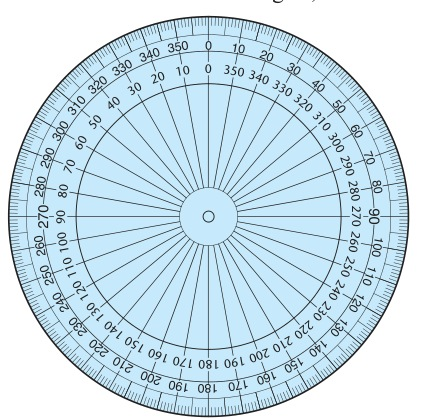
Classify \(132^\circ\).
The smaller angle between two rays is \(110^\circ\). Find the reflex angle.
A reflex angle is \(295^\circ\). Find the smaller angle and classify it.
Begin with the basic questions, then attempt the more demanding exam-style items. Open an answer only after trying the question.
Question 6 (Foundation): Classify \(42^\circ\).
Question 7 (Foundation): Classify \(90^\circ\).
Question 8 (Developing): What is the size of a straight angle?
Question 9 (Developing): Find the reflex angle corresponding to \(145^\circ\).
Question 10 (Exam-style): An angle is \(305^\circ\). Find the smaller angle between the rays.
Textbook subtopic 3
Parallel lines have the same direction and never meet. Perpendicular lines intersect at \(90^\circ\). A perpendicular bisector cuts a given line segment into two equal parts at right angles.
The arrows drawn on corresponding lines show that they are parallel. A small square marks a right angle. When a problem asks for a perpendicular bisector, both conditions—90° and equal halves—must be satisfied.
Bisecting a line does not automatically mean meeting it at 90°.
Two straight roads are always the same distance apart. Describe their relationship.
A 10 cm segment is cut at \(90^\circ\) into pieces of 5 cm and 5 cm. Name the cutting line.
A line crosses a 12 cm segment at right angles, 4 cm from one end. Is it a perpendicular bisector?
Begin with the basic questions, then attempt the more demanding exam-style items. Open an answer only after trying the question.
Question 11 (Foundation): What word describes two coplanar lines that never meet?
Question 12 (Foundation): At what angle do perpendicular lines intersect?
Question 13 (Developing): A bisector divides an 18 cm segment into what two lengths?
Question 14 (Developing): A line splits a segment equally but crosses at 60°. Is it a perpendicular bisector?
Question 15 (Exam-style): A segment has endpoints 2 cm and 14 cm along a ruler. Where must its perpendicular bisector cross?
Textbook subtopic 4
A bearing states a direction, measured clockwise from north at the starting point. Write it using three digits, such as \(045^\circ\), \(090^\circ\) and \(270^\circ\). Draw north lines at the correct point.
To reverse a bearing between two places, add or subtract \(180^\circ\) so that the answer lies between \(000^\circ\) and \(360^\circ\). Beware: the reverse direction starts at the other location.
Write 045°, not 45°, and start the clockwise measurement from north at the named starting location.
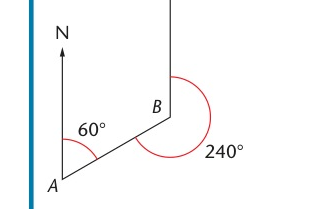
A direction is \(7^\circ\) clockwise from north. Write its bearing.
The bearing of B from A is \(062^\circ\). Find the bearing of A from B.
A ship sails from P to Q on bearing \(295^\circ\). Find the bearing of P from Q.
Begin with the basic questions, then attempt the more demanding exam-style items. Open an answer only after trying the question.
Question 16 (Foundation): What is the bearing of due east?
Question 17 (Foundation): What is the bearing of due west?
Question 18 (Developing): Write \(38^\circ\) clockwise from north as a bearing.
Question 19 (Developing): Find the reverse bearing of \(120^\circ\).
Question 20 (Exam-style): The bearing of X from Y is \(314^\circ\). Find the bearing of Y from X.
Textbook subtopic 5
Triangles are named by their sides and angles. An equilateral triangle has three equal sides and three \(60^\circ\) angles. An isosceles triangle has two equal sides and two equal base angles. A scalene triangle has three unequal sides; a right-angled triangle has one \(90^\circ\) angle.
Angle classification and side classification describe different properties. For example, a right-angled triangle may also be isosceles.
Equal sides face equal angles. A right-angled triangle need not have three different sides.
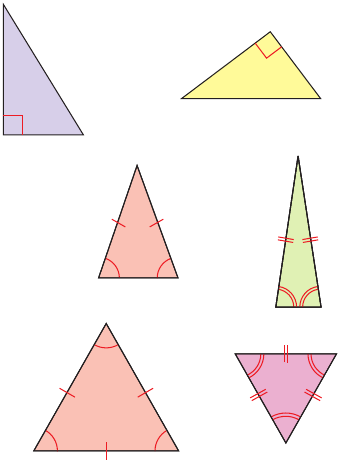
A triangle has sides 6 cm, 6 cm and 9 cm. Name its side classification.
An isosceles triangle has a vertex angle of \(40^\circ\). Find each base angle.
A triangle has angles \(45^\circ,45^\circ,90^\circ\). Give two names.
Begin with the basic questions, then attempt the more demanding exam-style items. Open an answer only after trying the question.
Question 21 (Foundation): A triangle has three equal sides. Name it.
Question 22 (Foundation): A triangle has sides 3 cm, 4 cm and 5 cm. Classify by sides.
Question 23 (Developing): How large is each interior angle in an equilateral triangle?
Question 24 (Developing): In an isosceles triangle the equal base angles are \(50^\circ\). Find the vertex angle.
Question 25 (Exam-style): A triangle has angles \(30^\circ,60^\circ,90^\circ\). Classify by angles and sides.
Textbook subtopic 6
A quadrilateral has four sides. Know the defining properties of a square, rectangle, parallelogram, rhombus, trapezium, kite, and isosceles trapezium. The textbook describes a trapezium as having one pair of parallel sides.
A square has four equal sides and four right angles. A rectangle has four right angles and equal opposite sides. A rhombus has four equal sides. In a parallelogram, both pairs of opposite sides are parallel. A kite has two pairs of adjacent equal sides; an isosceles trapezium has one pair of parallel sides and equal non-parallel sides.
Diagonals give useful clues: square and rhombus diagonals meet at right angles; rectangle diagonals are equal; parallelogram diagonals bisect one another. A diagonal connects opposite corners.
Don’t claim every rhombus is a square. A square is a special rhombus, but the converse is not true.
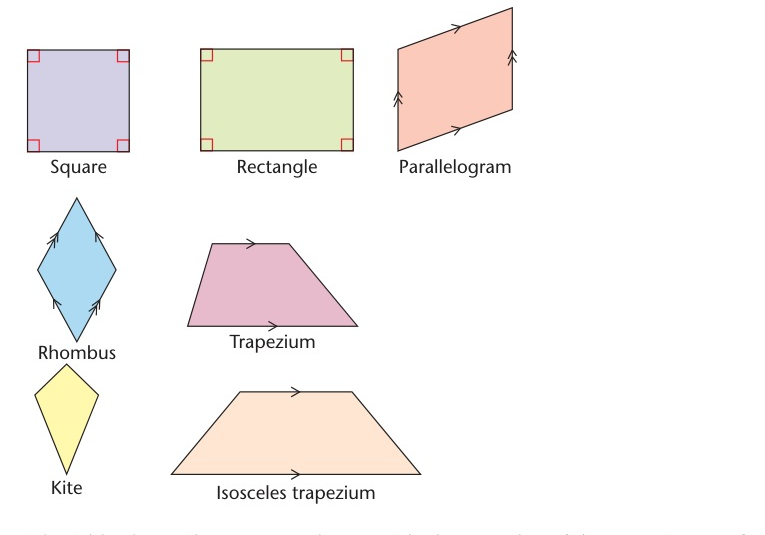
A quadrilateral has four right angles but adjacent sides 4 cm and 7 cm. What is it?
A parallelogram has four equal sides and diagonals that cross at right angles, but its angles are not all right angles. Name it.
A quadrilateral has just one pair of parallel sides and equal non-parallel sides. State the most specific name.
Begin with the basic questions, then attempt the more demanding exam-style items. Open an answer only after trying the question.
Question 26 (Foundation): Which special quadrilateral has four equal sides and four right angles?
Question 27 (Foundation): Which quadrilateral has two pairs of adjacent equal sides?
Question 28 (Developing): Which quadrilateral always has opposite sides parallel and equal?
Question 29 (Developing): Which quadrilateral has equal diagonals but need not have four equal sides?
Question 30 (Exam-style): A quadrilateral has all four sides equal, opposite angles equal, but no right angles. Name it and explain why it is not a square.
Textbook subtopic 7
A polygon is a closed 2-D shape made from straight line segments. Common names: pentagon (5 sides), hexagon (6), octagon (8), decagon (10). A regular polygon has equal sides and equal interior angles; other polygons are irregular.
An interior angle lies inside the polygon. An exterior angle is made by extending a side. A diagonal joins two non-adjacent vertices; a side is not a diagonal.
Having equal sides alone is insufficient for regularity; equal angles are also required.
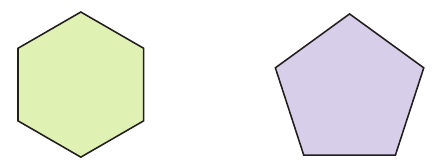
A closed figure has 8 straight sides. Name it.
A pentagon has five equal sides, but one interior angle differs from the others. Is it regular?
How many distinct diagonals does a pentagon have?
Begin with the basic questions, then attempt the more demanding exam-style items. Open an answer only after trying the question.
Question 31 (Foundation): Name a polygon with six sides.
Question 32 (Foundation): How many sides does a decagon have?
Question 33 (Developing): What two conditions make a polygon regular?
Question 34 (Developing): Is the line joining two adjacent vertices a diagonal?
Question 35 (Exam-style): How many diagonals can be drawn from one vertex of a regular octagon?
Textbook subtopic 8
A solid is 3-D. An edge is where faces meet and a vertex is a corner; the plural is vertices. A face is a flat surface. The cube has six square faces; the cuboid has rectangular faces. A sphere has one curved surface, while a hemisphere, cylinder and cone have flat and curved surfaces.
A prism has the same cross-section along its length; triangular and rectangular prisms are examples. A pyramid has a polygonal base and triangular side faces meeting at a point. A frustum is the portion left after a cone or pyramid is cut parallel to its base.
Do not call a curved surface a flat face. Use “surface” where needed.
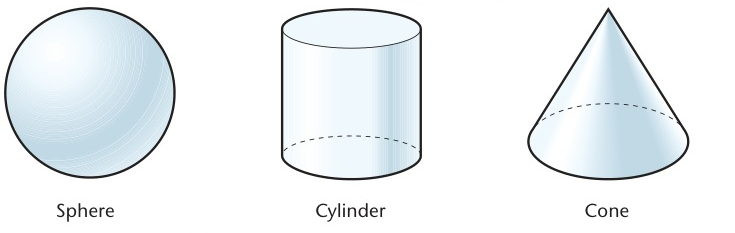
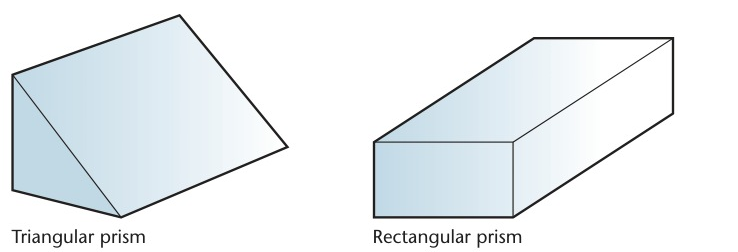
State the numbers of faces, edges and vertices of a cuboid.
A solid has identical triangular cross-sections all along its length. Name it.
The top of a cone is removed by a cut parallel to the circular base. Name the solid left behind.
Begin with the basic questions, then attempt the more demanding exam-style items. Open an answer only after trying the question.
Question 36 (Foundation): How many faces does a cube have?
Question 37 (Foundation): How many vertices does a cuboid have?
Question 38 (Developing): Which solid has only a curved surface?
Question 39 (Developing): What is the cross-section of a triangular prism along its length?
Question 40 (Exam-style): Describe how a pyramid differs from a prism.
Textbook subtopic 9
A net is a flat arrangement of connected faces that folds to form a 3-D solid. Before deciding whether a net works, identify the required faces, check how they are joined, and imagine folding along every common edge.
A cube is made from six squares; a cuboid from three pairs of matching rectangles; a triangular prism from two congruent triangular ends and three rectangular side faces; and a triangular pyramid from four triangular faces. Here the emphasis is on polygon-faced solids.
A correct collection of faces may still make an incorrect net if the arrangement overlaps when folded.
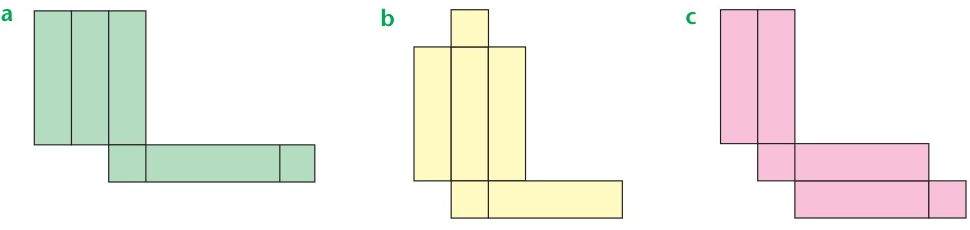
How many square faces must appear in the net of a cube?
Describe the faces in a triangular-prism net.
A student draws a net of a square-based pyramid with one square and three triangles. Is it complete?
Begin with the basic questions, then attempt the more demanding exam-style items. Open an answer only after trying the question.
Question 41 (Foundation): How many squares are in a cube net?
Question 42 (Foundation): What faces are required for a square-based pyramid?
Question 43 (Developing): Describe the ends of a triangular prism.
Question 44 (Developing): Can six separate squares with no joined edges be called a single cube net?
Question 45 (Exam-style): A net has two identical triangles and three rectangles, joined correctly. Name the solid.
Textbook subtopic 10
Congruent figures have exactly the same shape and size: their corresponding side lengths and angles are equal. They remain congruent if one is turned, moved or reflected.
Similar figures have equal corresponding angles and corresponding side lengths in a constant ratio. The factor multiplying each length is the scale factor. Congruent figures are similar with scale factor 1.
Equal areas alone do not prove congruence. And equal angles without proportional sides are not enough in arbitrary polygons.
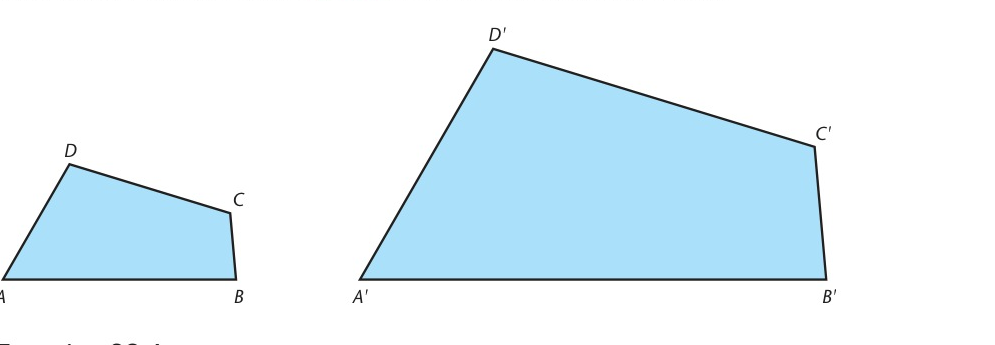
Two triangles have corresponding sides 3 cm, 4 cm and 5 cm. One has been rotated. Are they congruent?
A length of 4 cm in the first shape is 10 cm in the second. Find the enlargement scale factor.
One triangle has sides 3, 4, 5 cm; another has sides 6, 8, 10 cm. Are they similar or congruent?
Begin with the basic questions, then attempt the more demanding exam-style items. Open an answer only after trying the question.
Question 46 (Foundation): What does congruent mean?
Question 47 (Foundation): Can a reflection change a shape from congruent to non-congruent?
Question 48 (Developing): A 3 cm side becomes 9 cm. Find the scale factor.
Question 49 (Developing): Two rectangles are 2 cm by 5 cm and 4 cm by 10 cm. Are they similar?
Question 50 (Exam-style): Shapes have corresponding side ratios 2, 2 and 3. Are they similar?
Textbook subtopic 11
The centre is equidistant from the circumference; the radius runs from centre to circumference, and the diameter runs through the centre from one side to the other. Thus \(d=2r\). The circumference is the boundary of the circle.
A chord joins two points on the circumference. A tangent touches the circle at one point. An arc is part of the circumference; a sector is bounded by two radii and an arc; a segment is bounded by a chord and an arc. The longer and shorter parts are called major and minor.
A chord does not have to pass through the centre. Only the longest chord through the centre is a diameter.
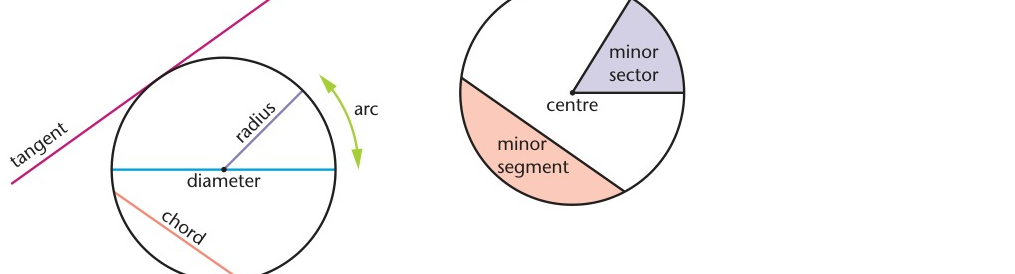
A circle has radius 7.5 cm. Find its diameter.
A shaded region is bounded by two radii and an arc. What is it? What if bounded by a chord and an arc?
A minor sector has central angle \(60^\circ\) and arc length 4.5 cm. Find the whole circumference.
Begin with the basic questions, then attempt the more demanding exam-style items. Open an answer only after trying the question.
Question 51 (Foundation): What is the name for a line segment from the centre to the circle?
Question 52 (Foundation): What is the relation between diameter and radius?
Question 53 (Developing): What do we call a line touching a circle at exactly one point?
Question 54 (Developing): What is the name of the region between a chord and its arc?
Question 55 (Exam-style): A circle has a diameter of 18 cm. Find its radius and state what a 2-radius region is called.