Control Accounts
Control accounts summarise totals from particular ledgers. This chapter focuses on the Sales Ledger Control Account for trade receivables and the Purchases Ledger Control Account for trade payables, including entries, examples, sources, set-offs and unusual balances.
Topic 1: Control accounts and why they are prepared
Start by understanding what control accounts summarise and why they help accountants check the ledgers.
1. What is a Control Account?
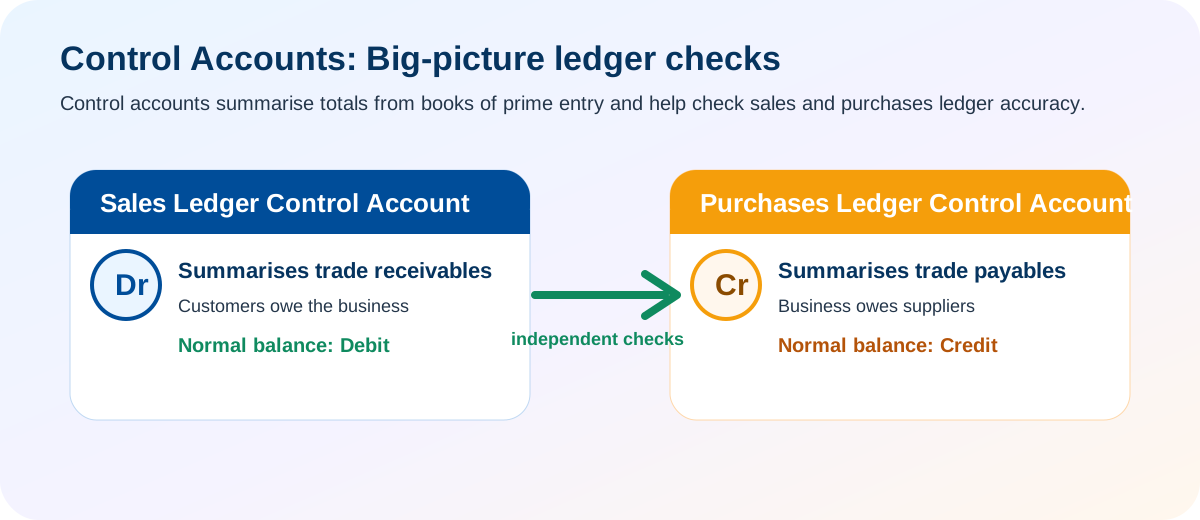
There are two main control accounts:
Sales Ledger Control Account (SLCA)
Summarises trade receivables.
It is also called the Total Trade Receivables Account.
Purchases Ledger Control Account (PLCA)
Summarises trade payables.
It is also called the Total Trade Payables Account.
2. Why are Control Accounts Prepared?
Control accounts help a business to:
- check the accuracy of the sales and purchases ledgers
- locate errors more quickly
- reduce the possibility of fraud
- quickly find total trade receivables and trade payables
- help prepare draft financial statements
- provide a summary of transactions with customers and suppliers
Suppose the individual customers owe:
- Ali = $2,000
- Sara = $1,500
- Ahmed = $500
$2,000 + $1,500 + $500 = $4,000
The closing balance of the Sales Ledger Control Account should also be $4,000. If it is $3,800, an error may exist in the sales ledger or control account.
3. Important Point
They therefore provide an independent check.
Topic 2: Sales Ledger Control Account
The SLCA summarises what credit customers owe the business.
4. Sales Ledger Control Account
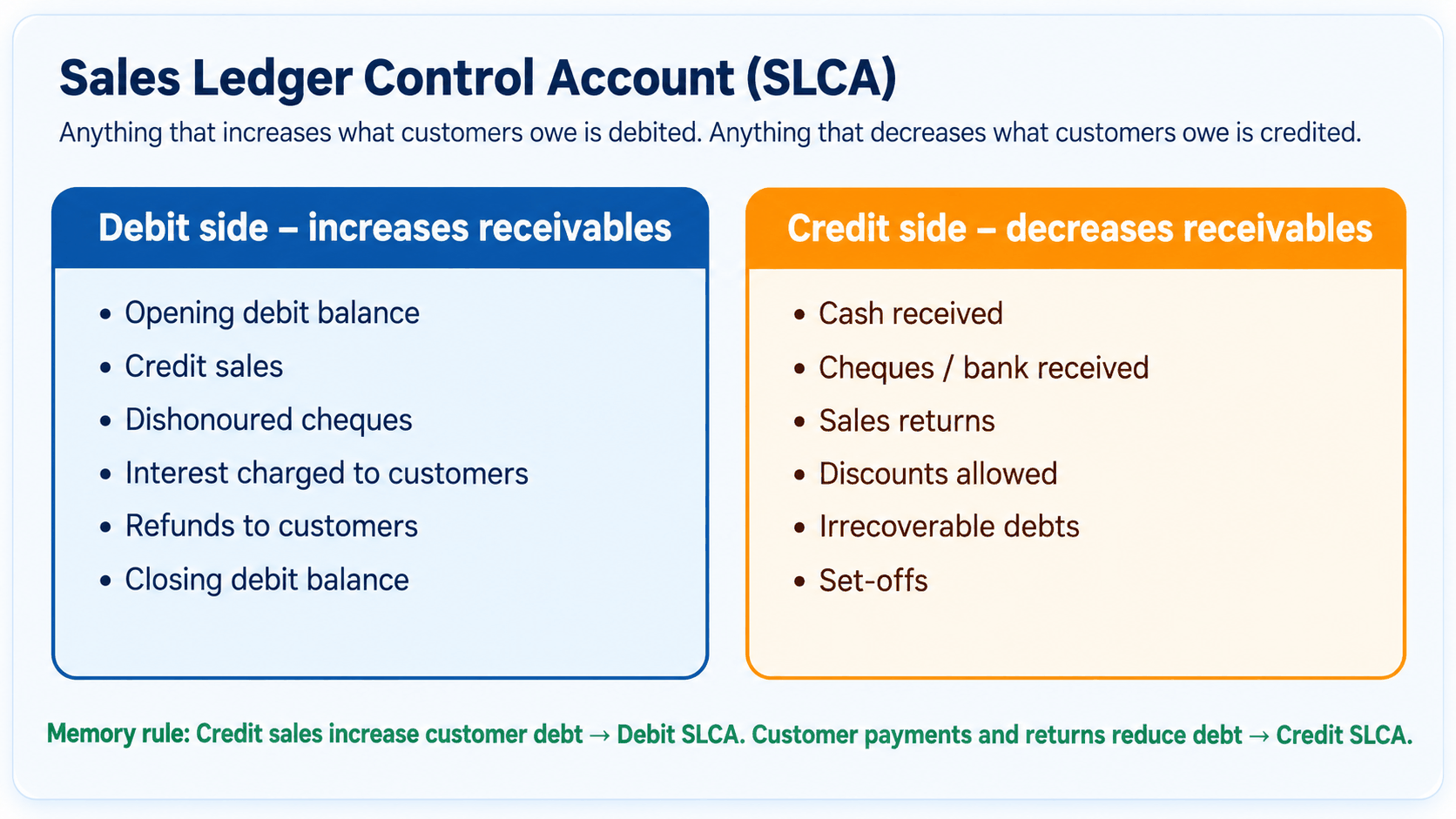
Anything that decreases the amount customers owe → Credit
5. Entries in the Sales Ledger Control Account
Sales Ledger Control Account
Debit Side – increases receivables
- Opening debit balance
- Credit sales
- Dishonoured cheques
- Interest charged to customers
- Refunds to customers
- Closing debit balance
Credit Side – decreases receivables
- Cash received
- Cheques/bank received
- Sales returns
- Discounts allowed
- Irrecoverable debts
- Set-offs
6. Simple Sales Ledger Control Account Example
Opening trade receivables = $5,000
During the month:
- Credit sales = $20,000
- Cash received = $5,000
- Cheques received = $10,000
- Sales returns = $2,000
- Discounts allowed = $500
- Irrecoverable debts = $500
So the SLCA would have a closing debit balance of $7,000.
The textbook uses the same format, including sales, returns, discounts, irrecoverable debts, receipts and closing balances.
7. Why are Certain Items on Each Side?
Credit Sales
Credit sales increase what customers owe.
Therefore: Debit SLCA
Money Received from Customers
When customers pay, the amount they owe falls.
Therefore: Credit SLCA
Sales Returns
Customers return goods, so their debt decreases.
Therefore: Credit SLCA
Discounts Allowed
A customer may owe $1,000 but pay $950 because a $50 discount is allowed.
The debt falls by the full $1,000:
- Bank = $950
- Discount allowed = $50
Both reduce trade receivables.
Dishonoured Cheque
A customer pays $600, but the cheque is dishonoured.
The customer once again owes the $600.
Therefore: Debit SLCA $600
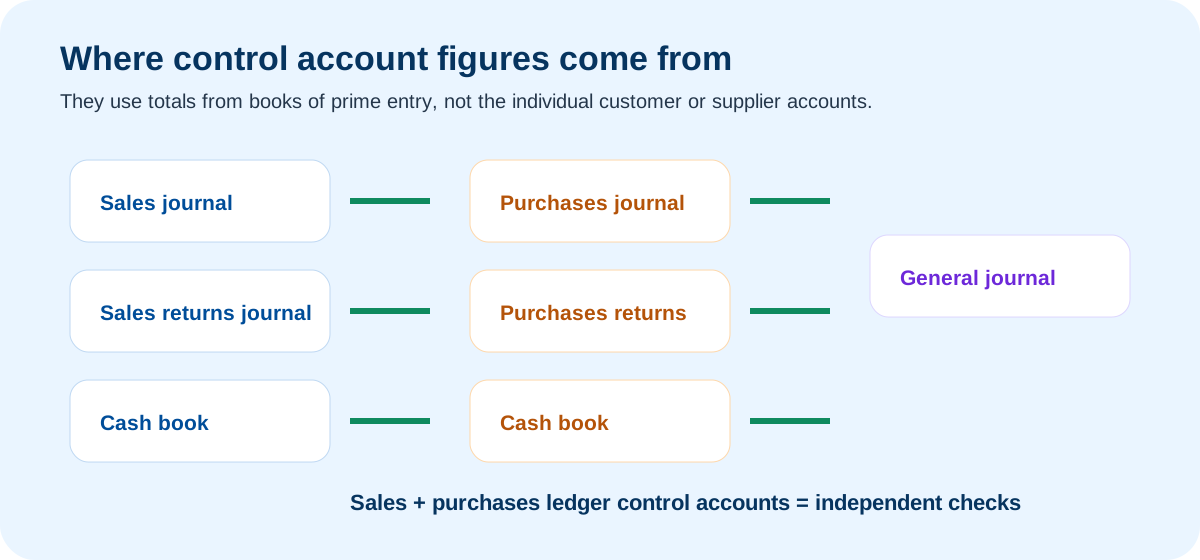
8. Sources of Sales Ledger Control Account Information
| Item | Main Source |
|---|---|
| Credit sales | Sales journal |
| Sales returns | Sales returns journal |
| Cash/cheques received | Cash book |
| Discounts allowed | Cash book |
| Irrecoverable debts | General journal |
| Dishonoured cheques | Cash book |
| Interest charged | General journal |
Topic 3: Purchases Ledger Control Account
The PLCA summarises what the business owes its credit suppliers.
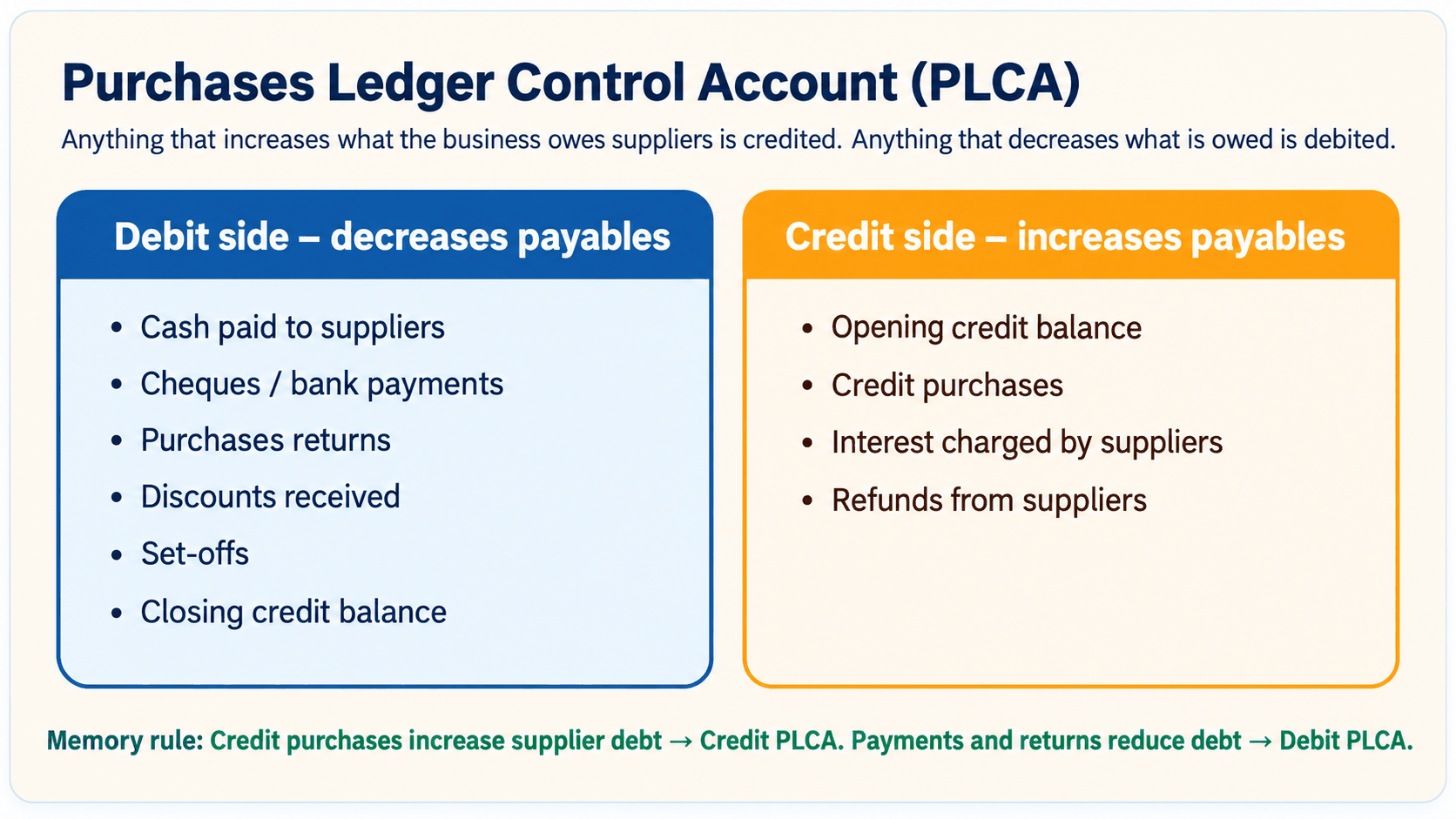
9. Purchases Ledger Control Account
Anything that decreases the amount owed → Debit
10. Entries in the Purchases Ledger Control Account
Purchases Ledger Control Account
Debit Side – decreases payables
- Cash paid to suppliers
- Cheques/bank payments
- Purchases returns
- Discounts received
- Set-offs
- Closing credit balance
Credit Side – increases payables
- Opening credit balance
- Credit purchases
- Interest charged by suppliers
- Refunds from suppliers
11. Simple Purchases Ledger Control Account Example
Opening trade payables = $4,000
During the month:
- Credit purchases = $15,000
- Payments to suppliers = $10,000
- Purchases returns = $1,000
- Discounts received = $500
Therefore, the PLCA has a closing credit balance of $7,500.
12. Why are Certain Items on Each Side?
Credit Purchases
Buying goods on credit increases what the business owes suppliers.
Therefore: Credit PLCA
Payments to Suppliers
Paying suppliers reduces the debt.
Therefore: Debit PLCA
Purchases Returns
Returning goods reduces what is owed to suppliers.
Therefore: Debit PLCA
Discounts Received
Suppose the business owes a supplier $1,000 but pays $950 and receives a $50 discount.
The total liability is removed by:
- Bank = $950
- Discount received = $50
So discount received appears on the debit side of the PLCA.
Interest Charged by Supplier
If a supplier charges $100 interest for late payment, the business now owes an extra $100.
Therefore: Credit PLCA $100
13. Sources of Purchases Ledger Control Account Information
| Item | Main Source |
|---|---|
| Credit purchases | Purchases journal |
| Purchases returns | Purchases returns journal |
| Payments to suppliers | Cash book |
| Discounts received | Cash book |
| Refunds from suppliers | Cash book |
| Interest charged | General journal |
Topic 4: Set-offs, unusual balances and closing balances
Control accounts also include special situations such as contra entries and abnormal balances.
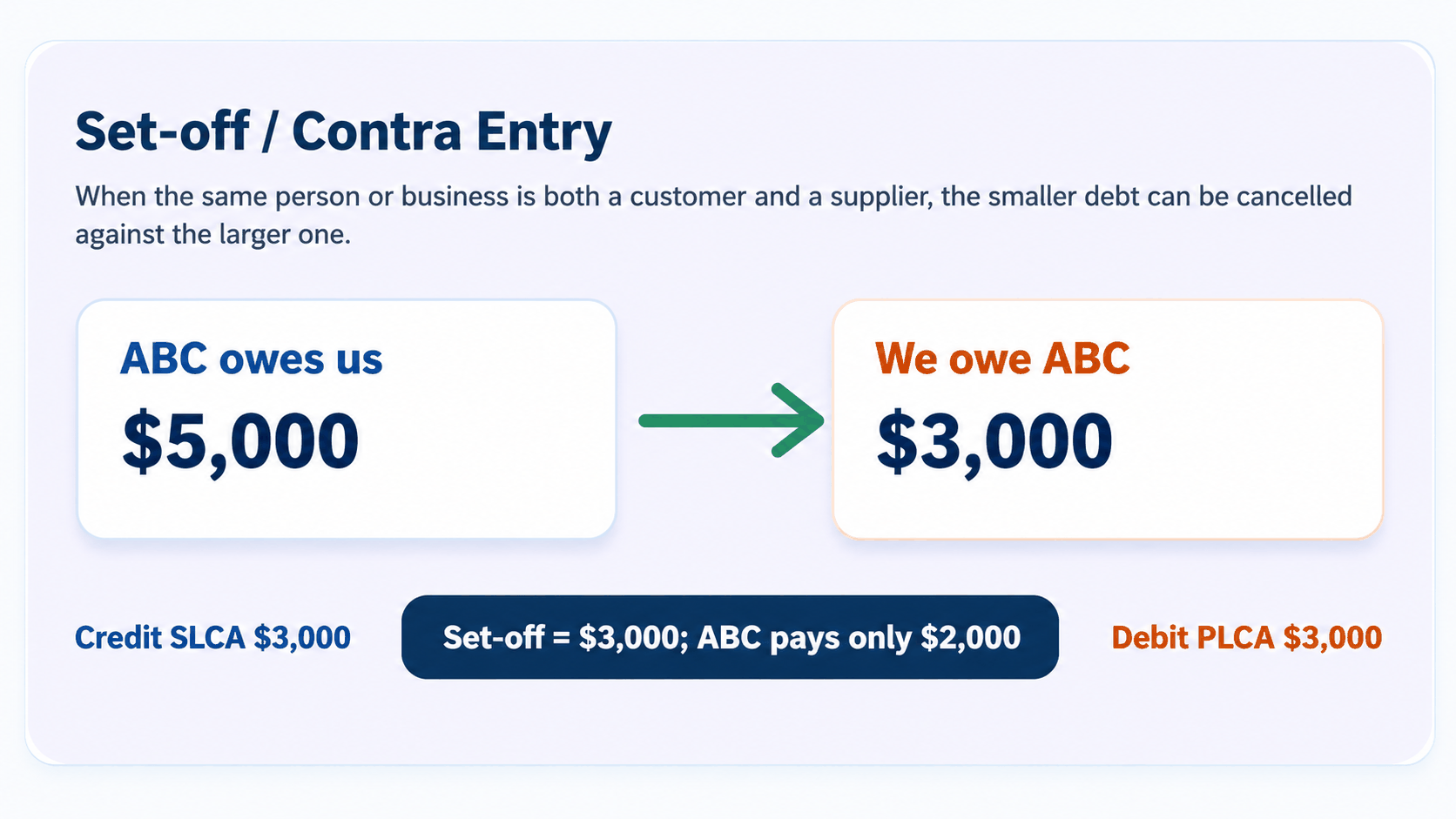
14. Set-off / Contra Entry
Sometimes the same person or business is both:
- a customer, and
- a supplier
ABC owes the business $5,000.
The business owes ABC $3,000.
Instead of both paying the full amounts:
Set-off = $3,000
ABC then only pays:
$5,000 − $3,000 = $2,000
Credit SLCA $3,000
Debit PLCA $3,000
because both debts are reduced.
The set-off is normally the smaller of the two debts.
15. Unusual Sales Ledger Balances
Normally, customers owe the business, so SLCA has a debit balance.
However, sometimes a customer may have a credit balance, meaning the business owes the customer.
This could happen because:
- customer overpaid
- cash discount was not deducted
- customer returned goods after paying
- customer paid in advance
Customer owes = $500
Customer accidentally pays = $600
The business now owes the customer:
$600 − $500 = $100
Customer has a $100 credit balance.
16. Unusual Purchases Ledger Balances
Normally, the business owes suppliers, so the PLCA has a credit balance.
A supplier may occasionally have a debit balance, meaning the supplier owes the business.
Possible reasons:
- business overpaid the supplier
- discount was not deducted
- goods were returned after payment
- business paid the supplier in advance
17. Opening and Closing Balances
Sales Ledger Control Account
Opening trade receivables:
Debit balance b/d
Closing trade receivables:
Credit balance c/d, then brought down as a debit next period.
Purchases Ledger Control Account
Opening trade payables:
Credit balance b/d
Closing trade payables:
Debit balance c/d, then brought down as a credit next period.
18. Provision for Doubtful Debts
This is a common examination trap.
Topic 5: Quick comparison and final memory rules
Use this final section to compare SLCA and PLCA quickly before attempting exam-style questions.
Quick Comparison
| Sales Ledger Control Account | Purchases Ledger Control Account |
|---|---|
| Total trade receivables | Total trade payables |
| Customers owe us | We owe suppliers |
| Normal balance = Debit | Normal balance = Credit |
| Credit sales increase debt | Credit purchases increase debt |
| Receipts reduce debt | Payments reduce debt |
| Discounts allowed reduce debt | Discounts received reduce debt |
| Sales returns reduce debt | Purchases returns reduce debt |
Remember
Sales Ledger Control Account
Increase customer debt → Debit
Decrease customer debt → Credit
Purchases Ledger Control Account
Increase supplier debt → Credit
Decrease supplier debt → Debit
Set-off
Credit SLCA + Debit PLCA