Capital and Revenue Expenditure and Receipts
This chapter explains how to classify expenditure and receipts correctly. It also shows how wrong treatment affects profit, non-current assets, and the financial statements.
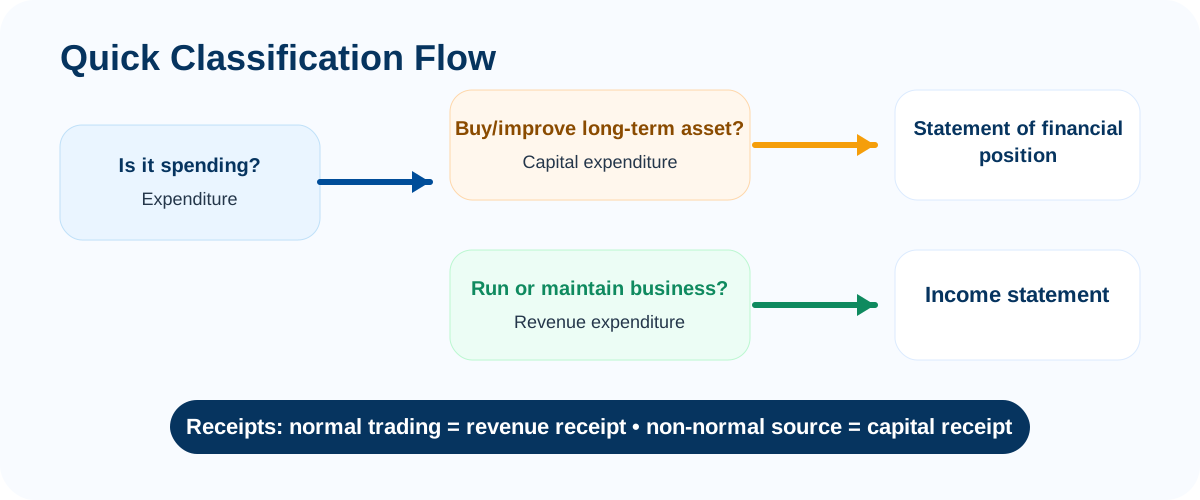
Topic 1: Capital and Revenue Expenditure
Expenditure must be classified according to whether it creates a long-term asset benefit or is used in day-to-day operations.
1. Capital Expenditure
The benefit normally lasts for more than one accounting period. Capital expenditure is recorded in the statement of financial position.
Examples
- Purchase of machinery
- Purchase of a motor vehicle
- Purchase of buildings
- Installation costs of machinery
- Transport costs to bring a new asset to the business
- Legal fees connected with buying an asset
- Extension of a building
- Cost of converting an asset for a different use
A business buys machinery:
| Item | $ |
|---|---|
| Machine | 20,000 |
| Transport | 500 |
| Installation | 1,000 |
| Legal fees | 200 |
| Total capital expenditure | 21,700 |
2. Revenue Expenditure
The benefit is normally used up within the current accounting period.
Examples
- Wages
- Salaries
- Rent
- Stationery
- Petrol
- Postage
- Purchases of goods for resale
- Ordinary repairs and maintenance
A business pays:
- Rent = $2,000
- Wages = $4,000
- Petrol = $500
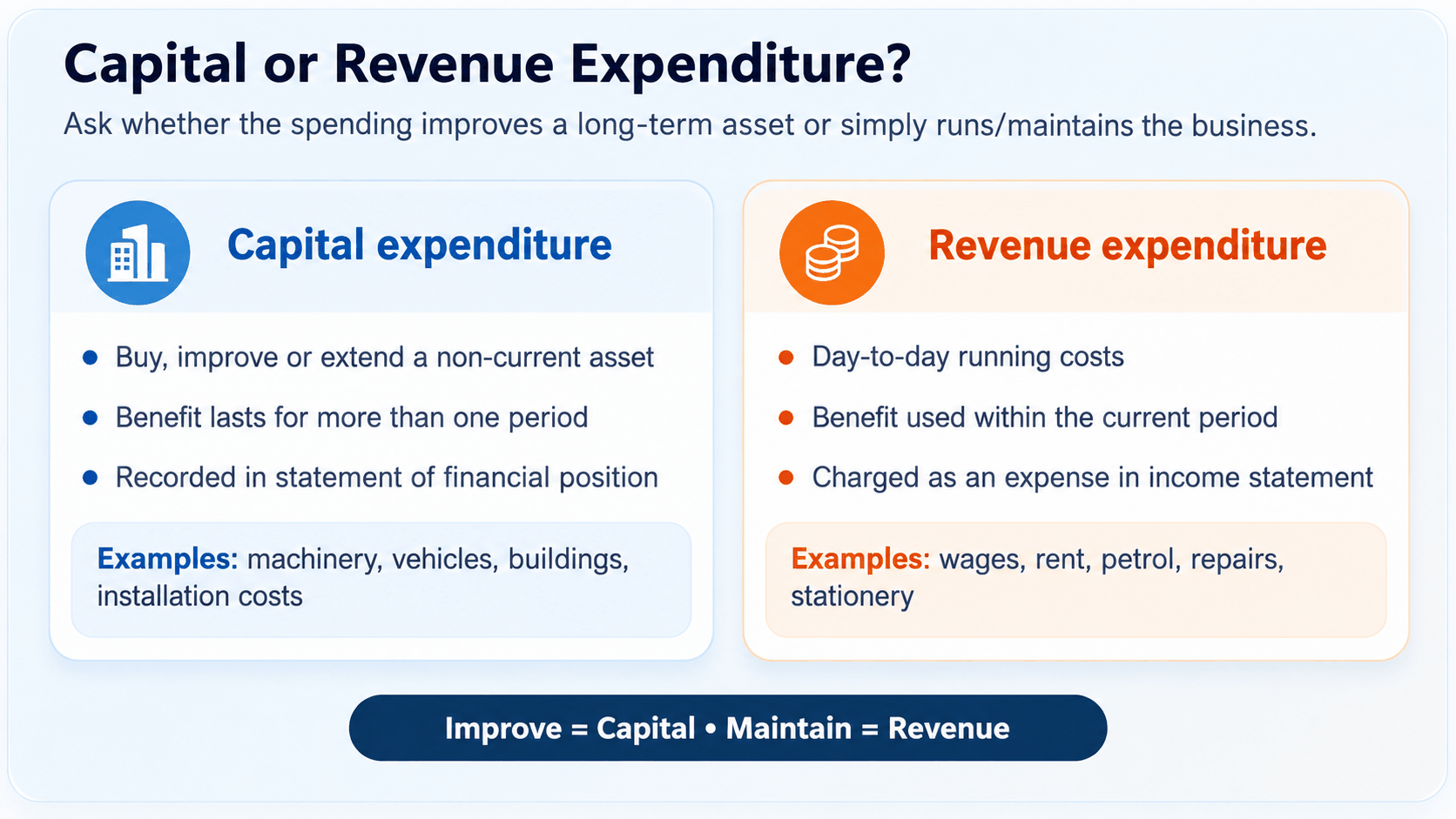
3. Capital or Revenue? — The Important Difference
| Capital Expenditure | Revenue Expenditure |
|---|---|
| Buys or improves a non-current asset | Day-to-day running cost |
| Benefit lasts more than one period | Benefit normally used within the period |
| Usually non-recurring | Usually recurring |
| Statement of financial position | Income statement |
| Improves/extends an asset | Maintains an asset |
Ordinary service
A delivery van needs ordinary service costing $300.
This keeps the van in its existing condition → Revenue expenditure.
Asset conversion
The van is converted into a refrigerated delivery vehicle for $5,000.
This improves/adapts the asset → Capital expenditure.
4. A Common Examination Example
A business buys equipment for $9,000.
Additional costs
- Delivery = $300
- Installation = $250
- Supplies to be used in it = $1,000
$9,000 + $300 + $250 = $9,550
$1,000
The equipment, delivery and installation are necessary to acquire and prepare the asset for use. The supplies are used in day-to-day operations.
Topic 2: Capital Receipts and Revenue Receipts
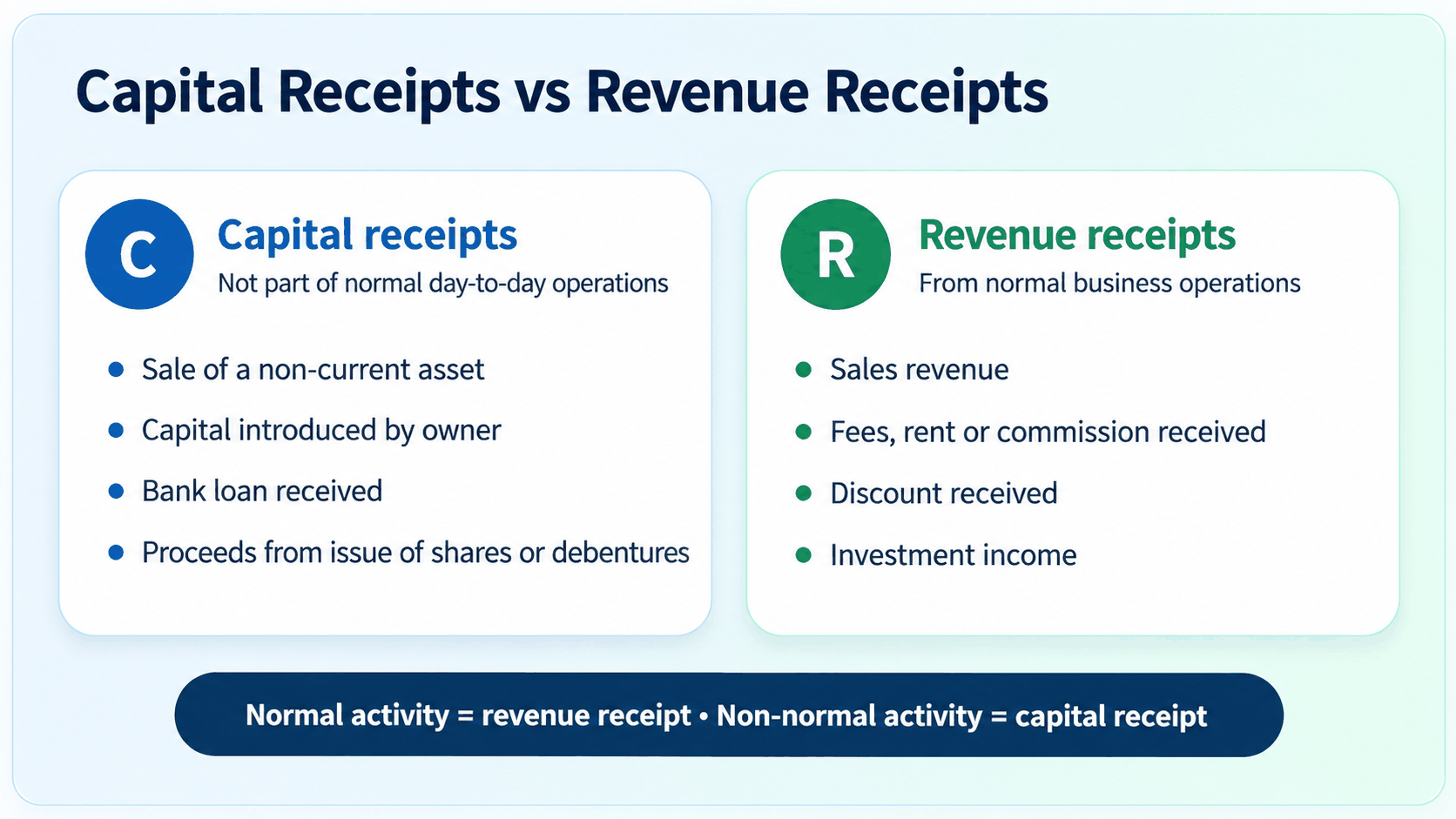
Receipts must also be classified according to whether they arise from normal business operations or from non-operating activities.
5. Capital Receipts
Examples
- Proceeds from selling a non-current asset
- Additional capital introduced by the owner
- Bank loan received
- Issue of shares
- Issue of debentures
- Insurance claim
A business sells an old machine for $6,000.
The $6,000 is a capital receipt because selling machinery is not the normal trading activity of the business.
6. Revenue Receipts
Examples
- Sales revenue
- Fees received
- Rent received
- Commission received
- Discount received
- Investment income
A business receives:
- Sales revenue = $25,000
- Rent received = $2,000
- Commission received = $500
7. Capital Receipts vs Revenue Receipts
| Capital Receipt | Revenue Receipt |
|---|---|
| Not from normal operating activities | From normal business activities |
| Usually non-recurring | Usually recurring |
| Example: sale of machinery | Example: sales revenue |
| Example: bank loan | Example: rent received |
A furniture shop selling its delivery van → Capital receipt.
Topic 3: Incorrect Treatment and Financial Statement Effects
Incorrect classification can change profit and asset values, so this is a very important exam area.
8. Incorrect Treatment of Expenditure
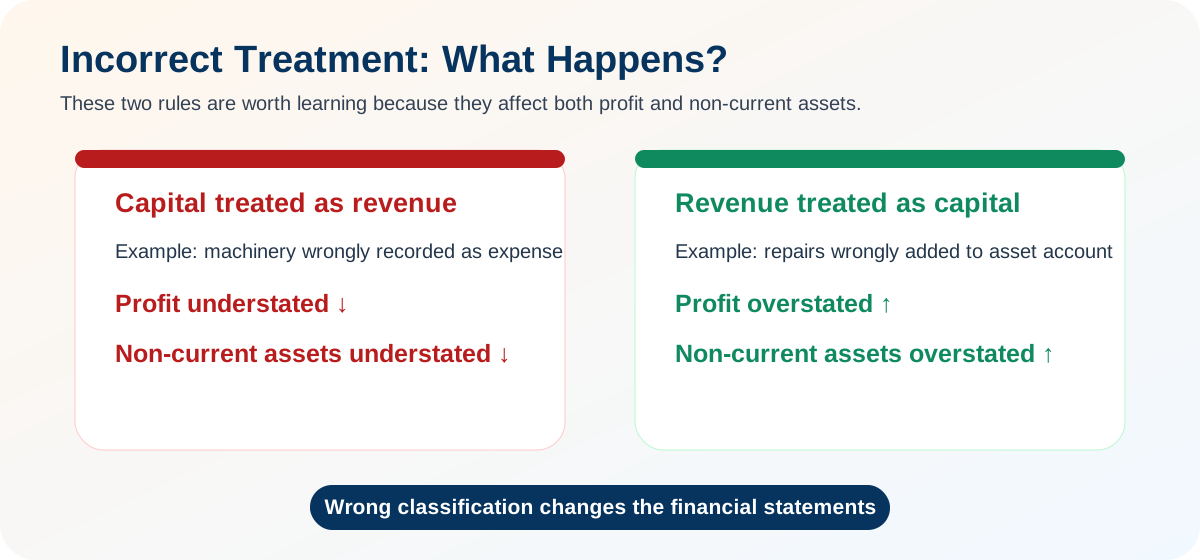
Capital Expenditure Treated as Revenue Expenditure
Suppose machinery costing $5,000 is wrongly recorded as an expense.
Expenses are overstated
The machinery has been treated as a day-to-day expense.
Profit is understated
The incorrect expense reduces profit too much.
Non-current assets are understated
The machinery has not been included correctly as an asset.
Correct profit before the error = $20,000
If $5,000 machinery is wrongly treated as an expense:
9. Revenue Expenditure Treated as Capital Expenditure
Suppose machinery repairs of $800 are wrongly added to the Machinery account.
Expenses are understated
The repairs have not been charged correctly as an expense.
Profit is overstated
Profit is too high because an expense has been omitted.
Non-current assets are overstated
The Machinery account includes repairs that should not be capitalised.
Correct profit = $10,000
Repairs of $800 were not treated as an expense.
10. Quick Rule for Expenditure Errors
| Error | Profit | Non-current assets |
|---|---|---|
| Capital expenditure treated as revenue | Understated | Understated |
| Revenue expenditure treated as capital | Overstated | Overstated |
11. Incorrect Treatment of Capital Receipts
Suppose a business sells a motor vehicle for $5,000, but incorrectly records the amount as sales revenue.
Consequences
- Sales are overstated
- Profit is overstated
- The non-current asset may remain overstated because its disposal was not recorded correctly
Topic 4: Classification Examples, Key Terms and Memory Rules
Use these final tables to revise the chapter quickly before attempting questions.
12. Classification Examples
| Item | Classification |
|---|---|
| Purchase of machinery | Capital expenditure |
| Installation of machinery | Capital expenditure |
| Legal fees when buying property | Capital expenditure |
| Machinery repairs | Revenue expenditure |
| Wages | Revenue expenditure |
| Petrol | Revenue expenditure |
| Purchase of goods for resale | Revenue expenditure |
| Sale of old vehicle | Capital receipt |
| Bank loan received | Capital receipt |
| Sales revenue | Revenue receipt |
| Rent received | Revenue receipt |
| Discount received | Revenue receipt |
Key Terms
Capital expenditure
Money spent buying or improving a non-current asset for long-term use.
Revenue expenditure
Day-to-day operating expenses.
Capital receipt
Money received from non-operating activities.
Revenue receipt
Income arising from normal business activities.
Intangible asset
A non-physical asset, such as goodwill or a patent.
Remember
Buy or improve a long-term asset.
Run and maintain the business.
Money from non-normal activities.
Money from normal business activities.
Profit ↓ and Assets ↓
Profit ↑ and Assets ↑