Interested Parties
Interested parties are people or organisations that have an interest in a business and use its accounting information to help make decisions. This chapter explains internal and external users, what each group looks for, and how to write specific exam answers.
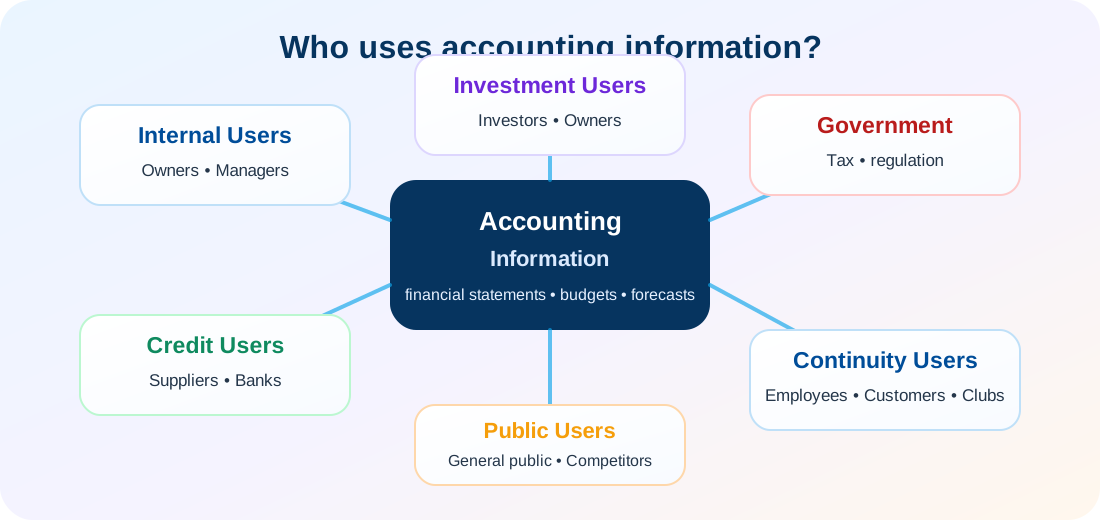
Topic 1: Meaning and Types of Interested Parties
Different users need accounting information for different decisions.
1. What are Interested Parties?
They can be divided into two broad groups:
Internal users
People within the business.
External users
People or organisations outside the business.
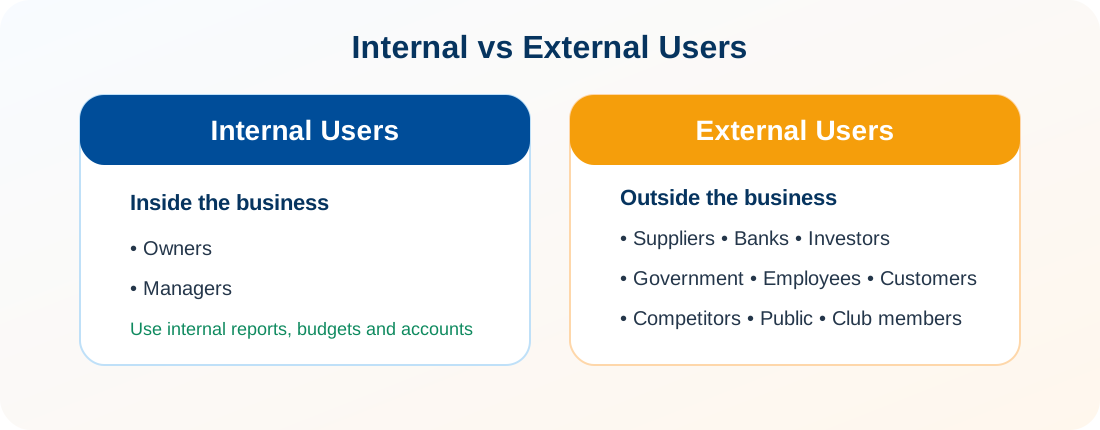
2. Internal and External Users
Internal Users
Main examples are owners and managers. They may use:
- Financial statements.
- Budgets.
- Forecasts.
- Management accounts.
External Users
External users include:
- Trade payables / suppliers.
- Banks.
- Investors.
- Club members.
- Government.
- Tax authorities.
- Employees.
- Customers.
- Competitors.
- General public.
Topic 2: Internal Users
Owners and managers use accounting information to judge performance, plan ahead and control the business.
3. Owners
Owners include sole traders and partners. They have invested capital in the business and their main objective is normally to earn profit.
Owners want accounting information to find out:
- How much profit or loss was made.
- Whether the business is financially successful.
- What future earnings may be.
- Whether their investment is performing well.
They may then decide whether to:
- Continue operating.
- Expand.
- Reduce the size of the business.
- Close the business.
4. Managers
Managers are responsible for running the business. Accounting information helps them with:
Planning
Deciding what the business should do in the future.
Controlling
Checking whether the business is operating as planned.
Decision-making
Making choices about how the business should operate.
Managers are particularly interested in improving the business's profitability and future prospects.
Topic 3: Credit, Lending and Investment Users
Suppliers, banks and investors mainly focus on liquidity, repayment ability, risk and return.
5. Trade Payables / Suppliers
Trade payables are suppliers who sell goods or services to the business on credit. They want to know whether the business:
- Has enough liquidity.
- Can pay its debts.
- Can pay within the agreed credit period.
Therefore, suppliers are particularly interested in the business's short-term liquidity position.
| Useful information | Why it matters |
|---|---|
| Current ratio | Shows general ability to pay current liabilities. |
| Liquid ratio | Shows ability to pay using liquid assets, excluding inventory. |
| Trade payables turnover | Shows how quickly the business pays suppliers. |
6. Banks and Other Lenders
Banks are particularly interested when a business applies for a loan. Before lending money, the bank wants to know whether the business can:
- Pay the loan interest.
- Repay the loan itself.
- Remain financially healthy.
- Grow successfully in the future.
7. Why Limited Liability Matters to Banks
When lending to a limited company, banks must consider that shareholders have limited liability. If the company becomes bankrupt, shareholders are not normally required to repay company debts beyond what they have invested.
8. Investors
Both current and potential investors are interested in:
- Risk.
- Return on investment.
- Profitability.
- Future prospects.
Current investors
Want to know how well their existing investment is performing. They may examine Return on Capital Employed (ROCE).
Potential investors
Want information to help decide whether they should invest.
Topic 4: Clubs, Government, Employees and Customers
Other interested parties use accounting information to assess tax, facilities, job security and future continuity.
9. Club Members
Members of clubs and societies want to know whether the organisation has enough money to:
- Maintain facilities.
- Repair facilities.
- Improve facilities.
- Expand activities.
- Continue operating in the future.
10. What Can a Club Do if it is Short of Funds?
If a club has repeated deficits, it may:
- Hold a fundraising competition or event.
- Operate a café or restaurant.
- Rent out equipment.
- Rent out facilities such as halls or fields.
- Increase subscriptions.
- Recruit more members.
- Ask for donations.
11. Government
The government is interested in the profits reported by businesses because these help determine the amount of tax that should be paid.
12. Tax Authorities
Tax authorities use business accounting records to check whether:
- Taxes have been calculated correctly.
- The correct amount of tax has been paid.
13. Employees
Employees may use accounting information to assess:
- How profitable the business is.
- Whether it can afford wage increases.
- Whether bonuses might be possible.
- Their level of job security.
- Whether the business is growing.
- Opportunities for promotion.
- Risk of the business closing.
14. Customers
Customers may also be interested in the long-term financial health of a business. They want confidence that the business will continue operating.
Manufacturers
May depend on the business for raw materials or components.
Retailers and wholesalers
May depend on a continuous supply of goods.
Final consumers
May need after-sales service, repairs and spare parts in the future.
Topic 5: Competitors, Public and Information Focus
Competitors and the public use accounts for comparison, research, employment and financial analysis.
15. Competitors
Competitors use accounting information to compare their own performance with other businesses in the same industry. They may compare:
- Profitability.
- Liquidity.
- Efficiency.
16. General Public
Members of the general public may also use financial statements. Examples include:
- Students.
- Researchers.
- Job seekers.
- Financial analysts.
They use the information for their particular needs.
17. Quick Interested Parties Table
| Interested Party | Main Reason for Using Accounting Information |
|---|---|
| Owners | Profitability and whether to continue or expand. |
| Managers | Planning, controlling and decision-making. |
| Trade payables | Ability to pay short-term debts. |
| Banks | Ability to pay interest and repay loans. |
| Investors | Risk and return on investment. |
| Club members | Whether funds are sufficient for facilities and services. |
| Government | Determine tax due. |
| Tax authorities | Check taxes are correctly calculated and paid. |
| Employees | Pay, bonuses, job security and promotion. |
| Customers | Future continuity of supplies and services. |
| Competitors | Compare financial performance. |
| General public | Research, employment or financial analysis. |
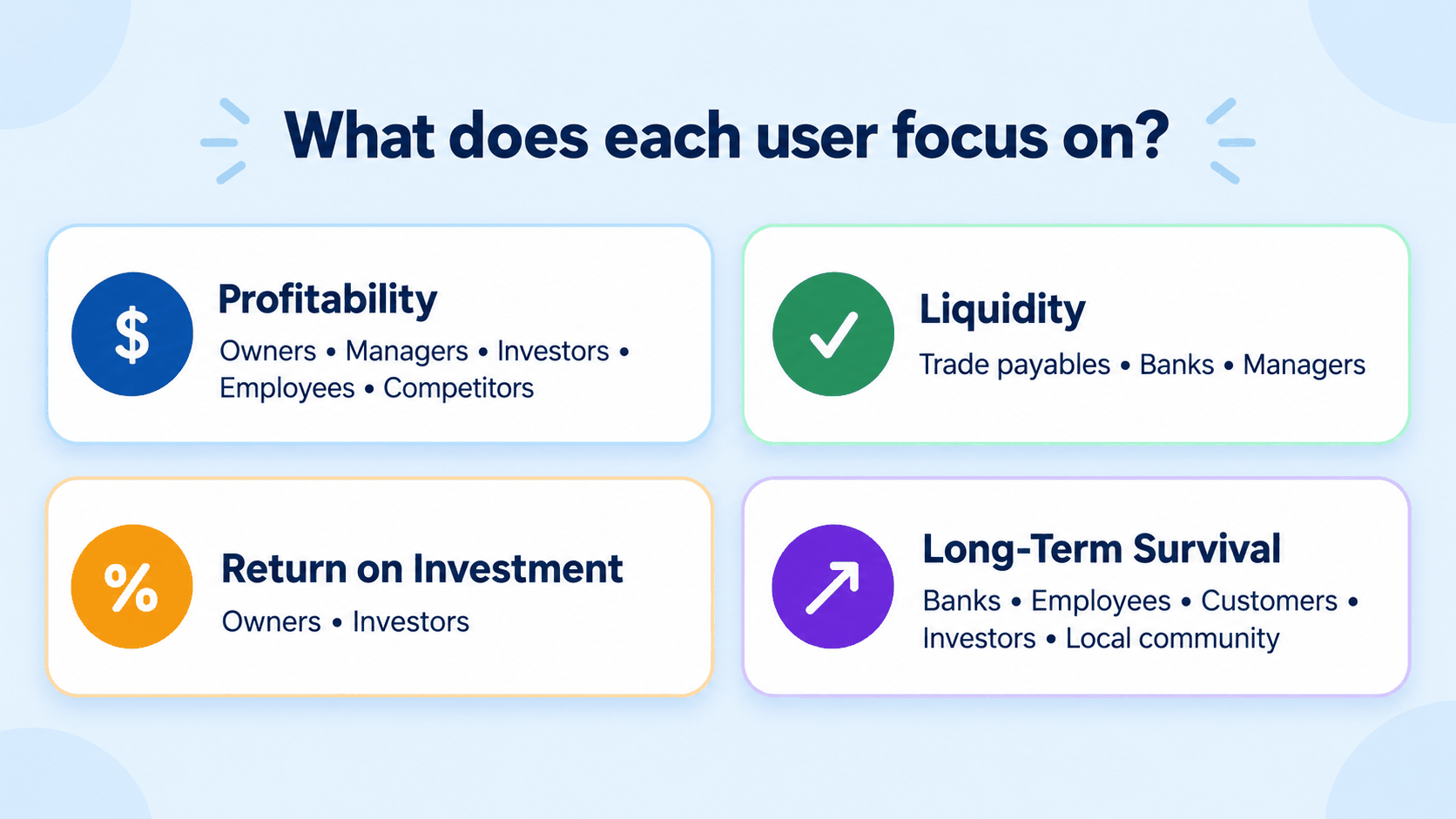
18. Which Information Matters Most?
Profitability
Important particularly to owners, managers, investors, employees and competitors.
Liquidity
Important particularly to trade payables, banks and managers.
Return on Investment
Important particularly to owners and investors.
Long-Term Survival
Important to banks, employees, customers, investors and club members.
19. Internal vs External – Easy Rule
Internal
Inside the business:
- Owners.
- Managers.
External
Outside the business:
- Suppliers.
- Banks.
- Investors.
- Government.
- Employees not involved in management.
- Customers.
- Competitors.
- General public.
- Club members.
Topic 6: Exam Answer Technique
Exam answers should identify the interested party and explain the exact decision being made.
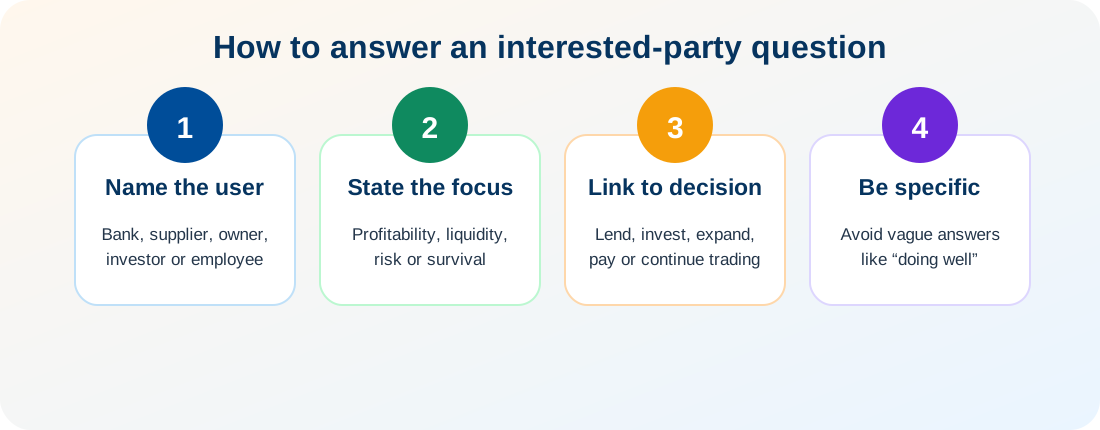
20. How to Answer Exam Questions
If asked: Why would a bank be interested in the financial statements?
Write something specific:
| Interested party | Specific exam answer |
|---|---|
| Trade payable | To determine whether the business can pay amounts owing when due. |
| Investor | To assess the risk and return before deciding whether to invest. |
| Employee | To assess job security and whether the business may be able to afford higher salaries or bonuses. |
| Owner | To assess profitability and help decide whether to expand, reduce or continue the business. |
Remember
Internal Users
Owners + managers.
External Users
Suppliers + banks + investors + club members + government + tax authorities + employees + customers + competitors + general public.
Main Focus
Owners → profit. Managers → planning and control. Suppliers → liquidity. Banks → loan repayment.
Other Users
Investors → risk and return. Club members → funds and facilities. Government and tax authorities → tax. Employees → pay and job security. Customers → future continuity. Competitors → comparison.