Accounting Principles
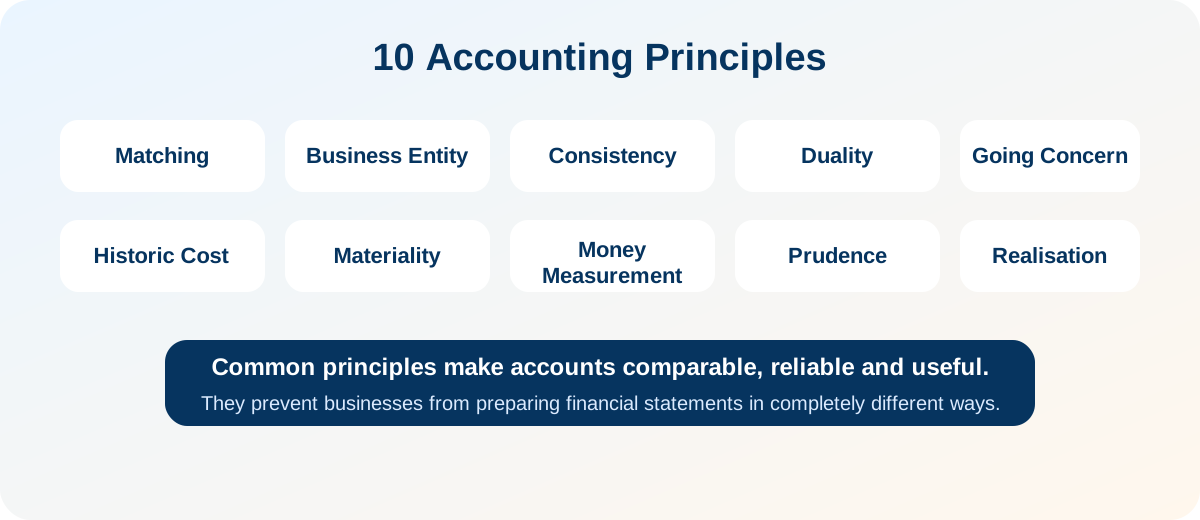
Accounting principles are common rules, concepts or conventions used when preparing financial statements. They help businesses prepare accounts in a consistent way so that users can compare and understand the information more easily.
Topic 1: Why Accounting Principles Matter
Common principles stop businesses from preparing accounts in completely different ways and make comparison less difficult.
1. What are Accounting Principles?
Without common principles, businesses could prepare accounts in different ways, making comparison difficult.
| No. | Principle | Easy idea |
|---|---|---|
| 1 | Matching | Match income with related expenses. |
| 2 | Business entity | Business and owner are separate. |
| 3 | Consistency | Use the same methods each year. |
| 4 | Duality | Every transaction has two effects. |
| 5 | Going concern | The business is expected to continue. |
| 6 | Historic cost | Record assets at original cost. |
| 7 | Materiality | Focus on items significant enough to matter. |
| 8 | Money measurement | Record only items measurable in money. |
| 9 | Prudence | Be cautious under uncertainty. |
| 10 | Realisation | Record revenue when earned. |
Topic 2: Matching, Business Entity, Consistency, Duality and Going Concern
These principles explain the timing of income and expenses, the separation of owner and business, double entry and the assumption that the business will continue.
2. Matching Principle
The matching principle states that revenue and the expenses incurred in earning that revenue should be recorded in the same accounting period. It does not matter exactly when cash is received or paid.
Commission relating to December sales = $4,000.
It is not paid until March of the following year.
The $4,000 must still be included as an expense in the year in which the December sales were earned.
This explains accrued expenses, prepaid expenses, accrued income and prepaid income.
3. Matching Principle and Stationery
Unused stationery is treated as a current asset because it belongs to the next accounting period.
Purchases = $170
Closing unused stationery = $70
Stationery used = $100 + $170 − $70 = $200
Therefore, $200 is charged as the stationery expense and the unused $70 belongs to the next period.
4. Business Entity Principle
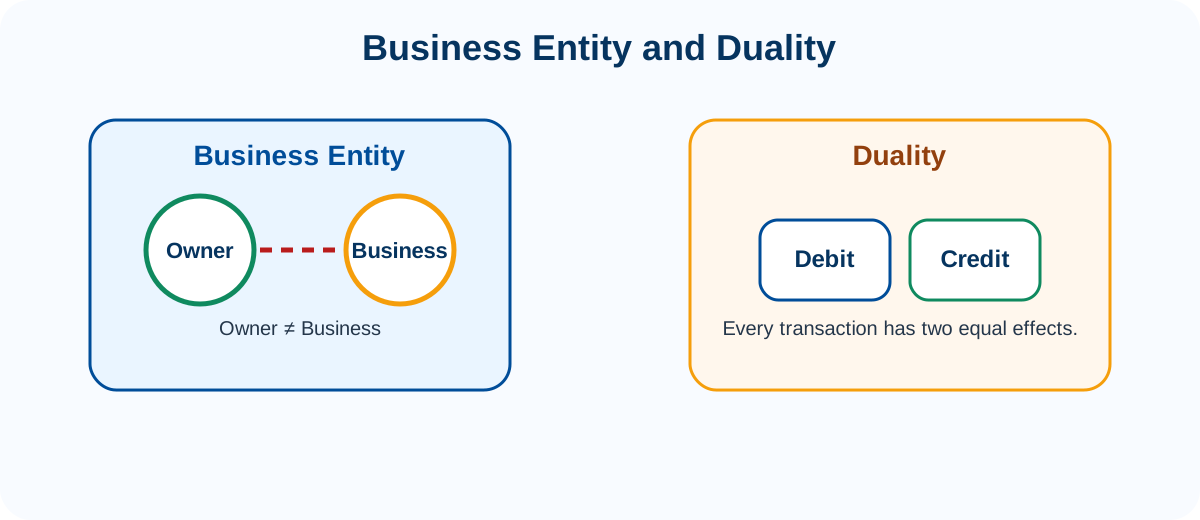
The business entity principle states that the business is treated separately from its owner. Personal transactions of the owner must not be treated as business transactions.
This applies to sole traders, partnerships and limited companies.
5. Owner's Capital and Drawings
The business entity principle also explains the entries for capital and drawings.
| Owner action | Entry idea | Reason |
|---|---|---|
| Owner introduces money | Credit Capital | The business now owes more to the owner. |
| Owner takes business money or goods privately | Debit Drawings | Drawings reduce the owner's capital. |
Correction: Dr Drawings $500 and Cr Electricity $500.
The $500 is not a business expense.
6. Consistency Principle
The consistency principle states that accounting methods should normally be used consistently from one accounting period to the next.
Consistency allows meaningful comparison between years. If a method is changed for a valid reason, the change and its effect should be properly disclosed.
7. Duality Principle
The duality principle is the basis of double-entry book-keeping. Every transaction has two effects. Therefore, for every debit there must be an equal credit.
Machinery increases: Dr Machinery $5,000.
Cash decreases: Cr Cash $5,000.
8. Going Concern Principle
The going concern principle assumes that the business will continue operating for the foreseeable future rather than closing down soon. The textbook treats this as normally meaning at least the next 12 months.
If the business is expected to continue
Assets can continue to be used in the business.
If the business is going to liquidate
Assets would be valued at net realisable value, and the textbook states that all assets would be treated as current assets.
Topic 3: Historic Cost, Materiality and Money Measurement
These principles explain how assets are recorded, when items matter enough to record separately and why only monetary items appear in financial statements.
9. Historic Cost Principle
The historic cost principle states that assets are recorded at the amount originally paid to acquire them. The original purchase price is not changed simply because market prices rise or fall.
Historic cost = $40,000
Current value = more than $150,000
The accounting record still begins with the original cost of $40,000.
Advantage
Historic cost is objective, known and verifiable.
Limitation
It may not show the asset's current economic or market value.
10. Materiality Principle
Information is material if it is important enough to affect the decisions of users of financial statements. An item that is very small and unimportant may be treated more simply.
11. Materiality Depends on the Business
The same amount may be material to one business but not another.
Materiality depends on the size of the item, nature of the item, size of the business and importance to users.
12. Money Measurement Principle
The money measurement principle states that only transactions and events which can be measured reliably in money are recorded in the financial statements.
Items such as customer satisfaction, brand recognition, employee skills and efficiency of management processes are normally excluded. Even though these may be extremely valuable, there is no generally acceptable way to give them a reliable monetary value.
13. Non-Financial Factors May Still Affect Profit
Although customer loyalty is not shown as an asset, it may indirectly improve financial results.
Topic 4: Prudence and Realisation
Prudence prevents overstatement of profit and assets. Realisation explains when revenue should be recognised.
14. Prudence Principle
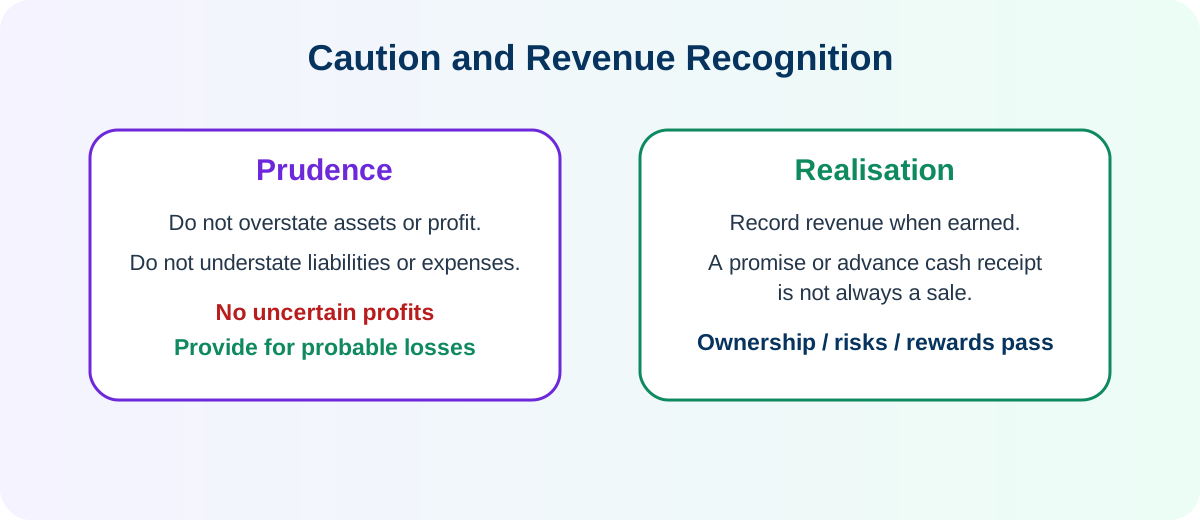
The prudence principle requires accountants to be cautious when there is uncertainty.
- Assets should not be overstated.
- Income should not be overstated.
- Liabilities should not be understated.
- Expenses should not be understated.
15. Examples of Prudence
Provision for Doubtful Debts
Some customers may fail to pay, so a provision is created rather than assuming every debt will definitely be collected.
Depreciation
Non-current assets lose value. Accumulated depreciation is deducted so that assets are not overstated.
Inventory
Inventory is valued at the lower of cost and net realisable value. This also applies prudence.
16. Prudence When Principles Conflict
The textbook states that where there is a conflict between accounting principles, the prudence principle should be applied.
17. Realisation Principle
The realisation principle determines when revenue should be recognised. Revenue from a sale is recognised when it has been earned, normally when legal ownership and the risks and rewards of the goods have passed from the seller to the buyer.
18. Cash Sale and Credit Sale
Revenue can be recognised whether the sale is a cash sale or a credit sale. In a cash sale, the seller receives cash. In a credit sale, the seller receives a trade receivable.
19. Sale or Return
Under sale or return, goods may be sent to a retailer who can return them if they remain unsold. The seller still owns the goods until the conditions for the sale are satisfied. Therefore, sending the goods does not immediately create sales revenue.
20. Payment Received in Advance
If a customer pays $2,500 in advance for custom-made furniture, the business does not immediately recognise the $2,500 as sales revenue. In the textbook's example, revenue is recognised when the completed furniture is delivered to the customer.
Topic 5: Exam Tables and Memory Guide
Use the principle, easy meaning and example to identify the correct concept in exam questions.
21. Quick Principles Table
| Principle | Easy meaning | Example |
|---|---|---|
| Matching | Match income with related expenses. | Accrued expense included. |
| Business entity | Business separate from owner. | Personal expenses → drawings. |
| Consistency | Use same methods each year. | Same depreciation method. |
| Duality | Every transaction has two effects. | Debit + credit. |
| Going concern | Business expected to continue. | Assets used rather than immediately sold. |
| Historic cost | Record at original cost. | Building recorded at purchase cost. |
| Materiality | Focus on significant items. | $30 asset treated as expense. |
| Money measurement | Record only monetary items. | Staff skills not recorded as asset. |
| Prudence | Be cautious under uncertainty. | Provision for doubtful debts. |
| Realisation | Record revenue when earned. | Sale recognised when ownership passes. |
Common Exam Clues
| If the question says... | Principle |
|---|---|
| Accruals or prepayments | Matching |
| Owner's private transaction | Business entity |
| Same method every year | Consistency |
| Two entries for every transaction | Duality |
| Business expected to continue | Going concern |
| Original purchase price | Historic cost |
| Small insignificant amount | Materiality |
| Cannot measure in money | Money measurement |
| Do not overstate profit/assets | Prudence |
| Revenue recognised when earned | Realisation |
Remember
Matching
Same accounting period.
Business Entity
Owner ≠ Business.
Consistency
Same methods.
Duality
Two effects.
Going Concern
Business will continue.
Historic Cost
Original cost.
Materiality
Significant enough to matter.
Money Measurement
Must be measurable in money.
Prudence
Do not overstate assets or profit.
Realisation
Revenue recognised when earned.