Needs
Goods or services required for basic life and wellbeing, such as essential food, water and shelter.

Economics begins with scarcity: resources are limited while human wants are extensive. This chapter builds the core way economists think about choice, opportunity cost, resource allocation, productive resources, economic systems, production possibility curves and different types of goods.
You should be able to use economic terminology accurately, explain cause-and-effect relationships and apply the ideas to unfamiliar situations. The aim is not to memorise isolated definitions: high-mark answers connect a concept to a decision, consequence or diagram.
Scarcity applies in every economy, including wealthy ones. It does not mean the same thing as poverty. Poverty concerns whether people can obtain basic necessities; scarcity exists because no society has enough resources to satisfy every possible want.
Goods or services required for basic life and wellbeing, such as essential food, water and shelter.
Desires for additional goods and services. Wants can expand as income, tastes and technology change.
Because resources have alternative uses, economic agents must choose. Households choose what to buy and how much labour to supply; firms choose what and how to produce; governments choose how to use tax revenue and public resources.
A firm might produce one more unit only if the extra revenue justifies the extra cost. A consumer might buy one more item only if the additional benefit is worth the price. Much of later microeconomics develops this idea.
| Area | Focus | Examples |
|---|---|---|
| Microeconomics | Individual households, firms and particular markets. | The price of coffee; wages in construction; a firm's output decision. |
| Macroeconomics | Economy-wide variables and their relationships. | Inflation, national unemployment, total demand and economic growth. |
The word next-best matters. If a government directs more resources towards healthcare, the opportunity cost is the most valuable alternative use of those resources that can no longer be undertaken. The concept applies to individuals, firms and governments.
Which goods and services should be produced, and in what quantities?
Which production methods and combinations of resources should be used?
How should the resulting goods and services be distributed among people?
The real economy is too complex to examine every influence at once. Economists therefore use simplified representations called models. Models help isolate important relationships, but their conclusions depend on the assumptions used.
Economics is a social science because it studies human behaviour. Individuals are not perfectly predictable, so economists often analyse broad patterns and use assumptions such as consumers seeking satisfaction and firms seeking objectives such as profit.
| Type | Meaning | Example |
|---|---|---|
| Positive | A claim about what is, or what may happen, that can in principle be tested against evidence. | “A higher cigarette tax is likely to reduce quantity demanded.” |
| Normative | A claim involving a value judgement about what ought to happen. | “The government should raise the cigarette tax.” |
This assumption allows economists to focus on a single relationship before gradually adding more complexity. For example, when studying how price affects quantity demanded, other influences on demand may initially be held unchanged.
Responses can differ between the short run and longer periods. A consumer may need time to change habits. A firm may be able to increase workers' hours quickly but need much longer to build a factory or adopt a new technology. Therefore the effect of an economic change often depends on how much time has passed.
Production requires resources. Economists group these productive inputs into four broad factors.
Natural resources used in production, including physical land and raw materials. Some are renewable; others, such as fossil fuels, are non-renewable.
Human effort used in production, including workers with different skills, training and experience.
Produced resources used to help make other goods and services, such as machinery, buildings, tools and equipment.
The entrepreneurial ability to organise resources, identify opportunities, innovate and bear risk.
Physical capital is different from money itself: it means produced assets used in production. Fixed capital lasts across many production cycles, such as machinery or factory buildings. Working capital refers to inputs used up during the production process, such as materials and components.
| Factor | Typical reward | Why it is paid |
|---|---|---|
| Land | Rent | Payment for the use of natural resources or land. |
| Labour | Wages / salaries | Payment for workers' time, effort and skills. |
| Capital | Interest | Return associated with using capital rather than placing funds in an alternative financial use. |
| Enterprise | Profit | Reward for organising resources and bearing business risk. |
Specialisation can occur between workers, firms and countries. It can raise output because people become more skilled at repeated tasks, less time is lost switching activities, natural differences in ability are used more effectively, and large-scale production may become easier.
Entrepreneurs add dynamism to an economy by recognising possible income-earning opportunities, combining the other factors of production, innovating and accepting the risk that a project may fail. This role can be especially important in new and smaller firms.
| Time period | Economic meaning | Illustration |
|---|---|---|
| Short run | At least one factor is fixed; a firm may be able to vary labour but not all other inputs. | Use overtime before new machinery can be installed. |
| Long run | All factors of production can be varied. | Expand premises and add machinery as well as labour. |
| Very long run | Technology and the wider policy environment may also change. | Adopt a new production technology or respond to major regulatory change. |
An economic system coordinates millions of decisions about what, how and for whom to produce. The key difference between systems is the balance between market forces and state direction.
Prices, consumer choices and profit incentives guide most resource allocation. Secure property rights and a stable framework help markets operate.
The state directs production and resource allocation. Planning can pursue social priorities directly but requires huge amounts of information and administration.
Markets allocate many resources, while government also taxes, spends, regulates and supplies or influences some activities.
| Issue | Market-oriented system | Central planning |
|---|---|---|
| Coordination | Decentralised through prices and market decisions. | Decisions are coordinated by government plans. |
| Information | Prices transmit information about scarcity and preferences. | Planners must gather and process large volumes of information. |
| Incentives | Profit and private ownership can encourage innovation and responsiveness. | Targets may not always create the intended incentives. |
| Government role | Usually smaller, though still needed for rules, property rights and market failures. | Large role in deciding output and distribution. |
Most modern economies are mixed rather than purely market or purely planned. The degree of intervention differs between countries. Transition economies are economies moving from extensive central planning towards greater use of markets. The adjustment can be difficult because prices, firms, workers and institutions must adapt to new incentives, risk and decision-making freedom.
A PPC turns scarcity, choice and opportunity cost into a diagram. It assumes a fixed quantity and quality of resources and a given state of technology for the period shown.
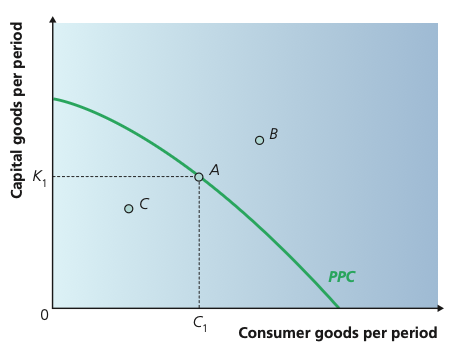
Point A lies on the production possibility curve and represents a feasible, productively efficient combination of consumer and capital goods. Point B is outside the current PPC and is unattainable with existing resources and technology, while point C is inside the PPC and indicates that some resources are unemployed or underused.
Adapted from Cambridge International AS & A Level Economics, Second Edition, by Peter Smith (with Adam Wilby and Mila Zasheva).
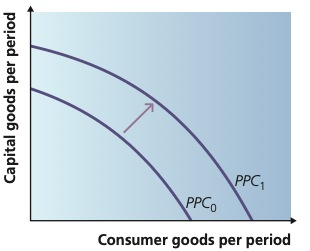
The outward movement from PPC₀ to PPC₁ shows an increase in productive capacity. With more or better factors of production, or improved technology, the economy can produce a greater quantity of both categories of output than before.
Adapted from Cambridge International AS & A Level Economics, Second Edition, by Peter Smith (with Adam Wilby and Mila Zasheva).
Moving along a PPC means producing more of one output only by giving up some of the other. A straight PPC indicates constant opportunity cost. A bowed-out PPC usually reflects increasing opportunity cost because resources are not equally suited to both uses.
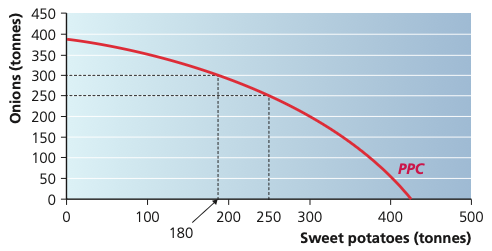
The farmer can increase sweet-potato output from 180 to 250 tonnes only by reducing onion output from 300 to 250 tonnes. The opportunity cost of the extra 70 tonnes of sweet potatoes is therefore 50 tonnes of onions.
Adapted from Cambridge International AS & A Level Economics, Second Edition, by Peter Smith (with Adam Wilby and Mila Zasheva).
Consumer goods provide current consumption. Capital goods are used to increase or support future production. Choosing more capital goods today may require less current consumption, but it can increase future productive capacity.
Spending that adds to the capital stock and can increase future productive capacity.
Household spending on goods and services for current use.
A good not normally regarded as scarce because availability exceeds the amount people want at a zero price in the relevant situation. Clean atmospheric air is a common example, although environmental change can make formerly abundant resources scarce.
A scarce good. Private goods are normally excludable, rival in consumption and rejectable.
People who do not pay can generally be prevented from consuming it.
Consumption by one person reduces the amount available to others.
A person can choose not to consume it.
Examples often include street lighting or a lighthouse. Because non-payers cannot easily be excluded, people can benefit without paying. This creates the free-rider problem, which weakens the incentive for private firms to provide a pure public good through the market.
Some goods are semi-public. A road may be non-excludable when no toll exists, but heavy congestion makes consumption rival because one driver's use reduces the quality available to others.
| Type | Why the market outcome may be inappropriate | Typical direction of consumption | Examples |
|---|---|---|---|
| Merit good | Consumers may underestimate or not fully understand the benefits. | Under-consumed in a free market. | Education; preventive healthcare. |
| Demerit good | Consumers may underestimate costs or overestimate benefits. | Over-consumed in a free market. | Tobacco; harmful drugs. |
The underlying issue is often information failure: consumers do not have, understand or act on complete information about the consequences of consumption. Identifying merit and demerit goods can also involve normative judgements about what society considers desirable.
18 questions. Each answer is marked immediately with a short explanation of why it is correct or incorrect.