Correct externalities
Use taxes, subsidies, standards and permits to move output towards the social optimum.

Government intervention is intended to move markets closer to socially efficient outcomes, but every policy carries information, administrative, incentive and unintended-effect problems. The key exam skill is to explain the mechanism and then evaluate whether the intervention is likely to improve welfare.
Use taxes, subsidies, standards and permits to move output towards the social optimum.
Assess price controls, quotas, licences, public provision, privatisation and regulation.
Explain tradable permits, property rights and information provision.
Judge policies using information, incentives, administration, spillovers and welfare effects.
Governments use indirect taxes and subsidies not only to raise or spend revenue, but also to change market incentives. When the free-market quantity differs from the socially efficient quantity, a well-designed intervention can move production or consumption towards the point where MSB = MSC.
A fixed monetary tax per unit. The supply curve shifts upward by the same vertical amount at every quantity.
A percentage of the selling price. The monetary tax is larger at higher prices, so the post-tax supply curve becomes steeper.
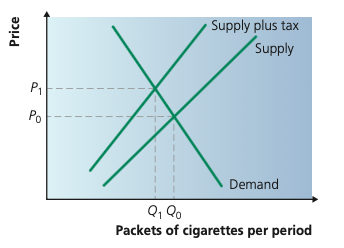
An ad valorem tax raises the price from P0 to P1 and reduces cigarette consumption from Q0 to Q1. Because the tax is a percentage of price, the post-tax supply curve is steeper rather than shifting upward in parallel.
Adapted from Cambridge International AS & A Level Economics, Second Edition, by Peter Smith (with Adam Wilby and Mila Zasheva).
Elasticity matters. Cigarettes are used in the textbook because tobacco can be addictive, making demand relatively price inelastic. A large share of the tax can therefore be passed to consumers through a higher price, while the fall in quantity may be comparatively small. This shows why a tax can raise revenue without necessarily changing behaviour by very much.
A production externality exists when MSC > MPC. Left alone, firms base decisions on private cost and produce too much. A corrective pollution tax can make the producer face more of the external cost. Under the polluter pays principle, the polluter should bear the external cost imposed on society.
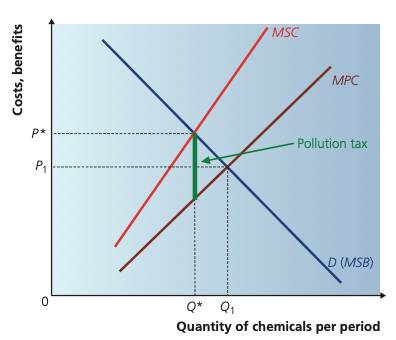
With a negative production externality, firms respond to MPC and produce Q1, even though society faces the higher MSC. A pollution tax equal to the external cost can move output toward the socially efficient quantity Q*, where MSB = MSC.
Adapted from Cambridge International AS & A Level Economics, Second Edition, by Peter Smith (with Adam Wilby and Mila Zasheva).
The same logic can be expressed through the marginal benefit and marginal cost of pollution abatement: pollution should be reduced until the marginal benefit of further reduction equals its marginal cost. The optimum is not automatically zero pollution.
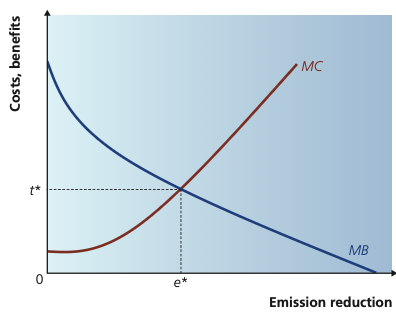
The efficient reduction in emissions is e*, where the marginal social benefit of further abatement equals its marginal cost. A tax of t* gives firms an incentive to undertake this amount of emission reduction; eliminating every last unit of pollution would cost more than the additional benefit.
Adapted from Cambridge International AS & A Level Economics, Second Edition, by Peter Smith (with Adam Wilby and Mila Zasheva).
A government could alternatively impose an emissions standard at e*. If policymakers knew the marginal costs and benefits perfectly, a correctly chosen tax and a correctly chosen quantity standard could achieve the same target. The difficulty is information: health benefits, environmental damage, future effects and firms’ abatement costs are hard to measure precisely, and costs can differ between firms using old and new technology.
A subsidy lowers producers' effective costs and shifts supply to the right/down. It may be used when a merit good is underconsumed or where there is a positive external benefit. If the government wants consumption to rise from the market quantity to a larger social optimum, the subsidy can reduce the price paid by consumers and increase quantity traded.
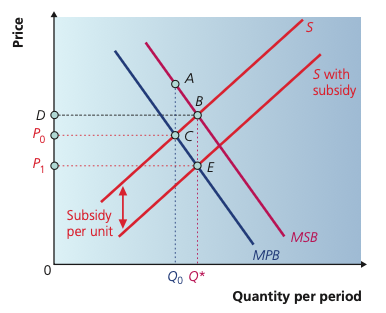
Museum visits are treated as a merit good with MSB > MPB. A subsidy shifts supply downward, lowers the price paid by visitors from P0 to P1 and raises consumption from Q0 toward the socially preferred quantity Q*.
Adapted from Cambridge International AS & A Level Economics, Second Edition, by Peter Smith (with Adam Wilby and Mila Zasheva).
The benefit of a subsidy is shared between consumers and producers according to demand and supply conditions. The government must also finance the subsidy. In the museum example, the deadweight loss from underconsumption may be reduced, but the fiscal cost has an opportunity cost because taxation may have to rise or other public spending may have to fall.
Rather than changing incentives through tax or subsidy, governments can impose rules directly on prices, quantities, entry or whether a good may be produced at all.
Maximum and minimum prices can address affordability, income or market-power concerns, but holding price away from equilibrium creates disequilibrium. A maximum rent below equilibrium can create excess demand and discourage supply. A minimum wage above equilibrium may raise pay for workers who keep their jobs but can create unemployment in some labour markets.
A production quota places an upper limit on quantity. Restricting output below the competitive equilibrium raises the market price, changes consumer and producer surplus and creates a deadweight welfare loss unless the original free-market quantity itself was socially excessive.
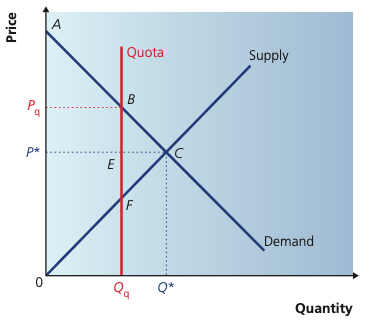
A quota restricts output to Qq instead of the free-market quantity Q*. The resulting scarcity raises price from P* to Pq, redistributes surplus between consumers and producers and creates a deadweight welfare loss if the original equilibrium was efficient.
Adapted from Cambridge International AS & A Level Economics, Second Edition, by Peter Smith (with Adam Wilby and Mila Zasheva).
In the textbook quota diagram, consumers lose surplus because they buy a smaller quantity at a higher price. Producers receive a transfer of some former consumer surplus, but part of the original total surplus disappears as deadweight loss. A quota may still be justified if the original market output was socially excessive, but a quota imposed on an otherwise efficient competitive market reduces welfare.
A licensing system allows firms to operate only if they meet specified conditions, such as quality, environmental standards or price rules. This can be useful in water supply, transport, health or other markets where quality and safety matter, but monitoring is costly and the authority needs enough information to set sensible standards.
A government may ban an extreme demerit good or harmful activity entirely. Prohibition can reduce legal supply, but it may create illegal markets, smuggling and enforcement costs. A ban is therefore not automatically equivalent to eliminating consumption.
A natural monopoly has substantial economies of scale over the relevant range of market demand. Its marginal cost may lie below average cost. Requiring P = MC can therefore cause losses, while allowing unconstrained profit maximisation may lead to a high price and restricted output.
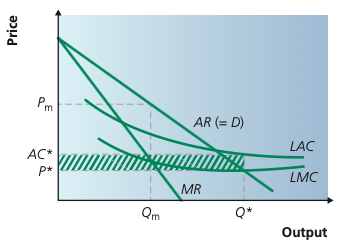
The natural monopoly has falling long-run average cost across the relevant market. Profit maximisation gives Qm and Pm; forcing the allocatively efficient price P* at Q* would leave price below average cost, creating a financial loss unless fixed costs are recovered another way.
Adapted from Cambridge International AS & A Level Economics, Second Edition, by Peter Smith (with Adam Wilby and Mila Zasheva).
Nationalisation transfers a privately owned firm or industry into public ownership. It has historically been used for natural monopolies and strategic industries where private profit maximisation was considered inconsistent with social objectives.
For a nationalised natural monopoly, a two-part tariff can help reconcile efficiency and financial viability: a fixed connection charge contributes toward fixed costs, while the usage charge can be set closer to marginal cost. The textbook also stresses the danger of weak accountability, principal–agent problems and X-inefficiency when managers face little competitive pressure.
A public enterprise can use a two-part tariff: a fixed connection charge helps cover fixed costs, while the usage charge can be set closer to marginal cost. The drawback is that managers may face weak incentives and limited accountability, creating principal–agent problems and X-inefficiency.
Privatisation transfers state-owned enterprises into private ownership. Common aims include improving efficiency through stronger incentives and shareholder accountability, encouraging growth and raising government revenue.
The textbook groups the main motives for privatisation into three broad aims: improve the performance of natural monopolies, encourage economic growth and raise government revenue. Whether these aims are achieved depends heavily on whether genuine competition can be introduced and whether the industry is effectively regulated after the sale.
Profit incentives and competition may encourage cost reduction, investment and innovation.
Changing ownership does not remove economies of scale, so a privatised monopoly may still need regulation.
Results depend on competition, institutional quality, regulation and the capabilities of the new owners.
Regulators can limit prices, profits or service conditions. Under an RPI − X-type price cap, firms are allowed price increases below the inflation rate by an amount representing expected productivity improvement. If inflation is 8% and X is 3%, the permitted increase is 5%.
Price-cap regulation is not the only possible approach. A regulator could limit the firm’s permitted rate of return, but that can weaken the incentive to minimise cost because the firm may have little reason to become more efficient once the permitted return is secured. The textbook also warns that an excessive focus on cutting costs may reduce service quality, maintenance and long-run investment, sacrificing dynamic efficiency.
Regulation faces asymmetric information: the firm often knows more about its true costs than the regulator. Tough cost targets may also encourage quality reductions or under-investment. Regulatory capture occurs when the regulator becomes too sympathetic to the industry's interests rather than acting independently.
Deregulation removes restrictions to encourage entry, competition, innovation and efficiency. It can reduce X-inefficiency, but too little oversight may allow excessive risk-taking or harmful behaviour.
Governments can supply goods directly, especially public goods, but public production is not guaranteed to be efficient. Alternatives include contracting out through competitive tendering and public–private partnerships (PPPs), where government and private firms share funding or operation. These approaches aim to combine public objectives with private-sector expertise and competitive pressure.
A tradable pollution permit gives a firm the legal right to emit up to a specified amount. The government controls the overall cap by limiting the total permits issued, while firms can buy and sell permits among themselves.
This is often described as a cap-and-trade system. The cap fixes the total permitted pollution, while trading allows permits to move toward firms for which cutting emissions is relatively costly. Firms that can reduce pollution cheaply have an incentive to do so and sell spare permits, so the target can be reached at a lower overall cost than if every firm were ordered to make the same reduction.
Property rights are the legal rules that give people or organisations control over resources. Secure property rights support markets because owners can control, exchange and defend what they own.
The argument associated with Ronald Coase is that an externality can sometimes be internalised when property rights are clear and the transaction costs of bargaining are low. The textbook’s clean-air example also shows the practical limit: when a factory affects many residents to different degrees, organising individual bargaining and enforcement can be so costly that government has to act collectively.
Externalities can sometimes be understood as a failure to define or enforce property rights. If residents had enforceable rights to clean air, a polluting firm might have to compensate them, thereby internalising the external cost. However, this becomes impractical when many people are affected and negotiation or enforcement involves high transaction costs. In such cases government may act collectively on their behalf.
When market failure results from missing or asymmetric information, policy can improve the information available to buyers or sellers. Inspection schemes, warranties, disclosure requirements, health information and product labels can reduce uncertainty and improve decisions.
Traditional microeconomics often models people as responding rationally to incentives. Behavioural economics combines economic analysis with insights from psychology and recognises that actual decisions can be influenced by habits, impulse, framing, social norms and limited attention.
A nudge changes the choice architecture rather than removing freedom of choice. Examples in the textbook include placing healthy foods in prominent positions, using messages that emphasise socially responsible behaviour, and automatically enrolling workers into pension schemes while allowing them to opt out.
Nudge theory uses the design of choices to encourage behaviour that policymakers consider socially beneficial without necessarily banning alternatives or imposing a large financial penalty.
Place healthier options prominently so they are easier to choose.
Messages can stress that most people behave responsibly, encouraging conformity.
Automatic enrolment with an opt-out can raise participation because many people accept the default.
Government failure occurs when intervention intended to improve resource allocation produces a less efficient outcome or a welfare loss. The existence of market failure therefore does not prove that any particular policy will improve welfare.
Government failure can occur because markets are interconnected. A policy that improves one market can create a distortion elsewhere. For example, a broad sales tax may finance useful public services but still drive a wedge between the price consumers pay and the marginal cost of production, creating an excess burden or deadweight loss in the taxed market.
Authorities may not know the true external cost, benefit, demand response or efficient price.
Designing, monitoring and enforcing taxes, permits, quotas and regulation uses scarce resources.
Price controls may create shortages or surpluses; prohibition may create illegal markets.
Subsidies, protection or poorly designed regulation can weaken efficiency or encourage gaming.
| Intervention | Possible problem |
|---|---|
| General sales tax | Raises revenue but moves a previously efficient market away from P = MC and can create deadweight welfare loss. |
| Pollution tax | Wrong tax rate if external costs are estimated poorly; monitoring can be expensive. |
| Subsidy | Difficult to set the efficient amount and must be financed from elsewhere. |
| Price controls | Create disequilibrium and may damage supply incentives. |
| Prohibition | Can encourage smuggling or black markets. |
| Nationalisation | Weak accountability can create X-inefficiency. |
| Regulation | Asymmetric information and regulatory capture can reduce effectiveness. |
20 questions. Each answer is marked immediately with a short explanation of why it is correct or incorrect.