Explain globalisation
Define the process and connect it to lower transport and communication costs, trade liberalisation, financial deregulation and migration.

Globalisation links national economies more closely through trade, investment, finance, technology, information and the movement of people. This final chapter explains why globalisation has accelerated, how its effects differ across economies, and how regional economic integration can create or divert trade.
Define the process and connect it to lower transport and communication costs, trade liberalisation, financial deregulation and migration.
Assess effects on living standards, structural change, FDI, financial stability and the environment across countries at different income levels.
Distinguish free trade areas, customs unions, common markets, monetary unions and full economic union.
Explain trade creation and trade diversion and judge whether integration improves resource allocation and national welfare.
Globalisation is the process by which national economies become more closely integrated. It increases the extent to which consumers, workers, firms, financial institutions and governments in one country are affected by economic events elsewhere.
Lower transport and communication costs, fewer trade barriers and financial deregulation increase cross-border flows of goods, services, capital and knowledge. The result is greater economic interdependence, so events in one economy have stronger effects elsewhere.
Adapted from the Cambridge International AS & A Level Economics book by Peter Smith (Second Edition, with Adam Wilby and Mila Zasheva).
Falling transport costs and faster logistics made it easier to split production across countries. Digital communication, the internet, e-commerce and video communication allow firms to coordinate international operations and reach customers rapidly.
Lower transport and communication costs also allow firms to fragment production, locating labour-intensive stages where labour is relatively abundant and coordinating the resulting international production network. This helps explain the expansion of multinational production.
Successive reductions in tariffs and other restrictions under GATT and the WTO, alongside regional trade agreements, made cross-border trade easier and encouraged firms to operate beyond domestic markets.
Many countries removed controls on international capital movements. Combined with faster financial technology, this made cross-border investment and financing easier.
In some regions, restrictions on labour mobility fell. Migration changes labour supply, transfers skills and connects economies through employment, remittances and production networks.
| Area | Possible gains | Possible costs / limitations |
|---|---|---|
| Living standards | Specialisation, trade and larger markets can support growth, lower some prices and widen consumer choice. | Benefits may be uneven. Low-income consumers may not gain access to many new products, while local cultures and consumption patterns can be displaced. |
| Producers | Firms can access larger markets, exploit economies of scale and source inputs internationally. | Domestic firms that cannot compete with lower-cost foreign producers may contract or close. |
| Workers | Expanding sectors and FDI may create jobs, training and new skills. | Structural change can create occupational and geographical unemployment while displaced workers retrain. |
| FDI and technology | MNCs can spread capital, production methods and knowledge internationally. | Profits may flow abroad, market power can increase, and host economies may capture only part of the gain. |
| Financial integration | Capital can move toward investment opportunities and firms may access wider sources of finance. | Financial disturbances can spread rapidly between countries, increasing systemic risk. |
| Environment | Global cooperation and technology transfer may support cleaner production. | More production and trade can increase transport emissions, resource use and environmental pressure unless growth is sustainable. |
Greater international specialisation changes the pattern of production. In some high-income economies, traditional manufacturing has declined while service industries have expanded. This deindustrialisation can improve long-run efficiency if resources move toward activities in which the country has stronger comparative advantage, but the transition may impose substantial short-run costs on particular workers and regions.
Closer links mean that positive developments can spread, but negative shocks can spread too. The textbook uses the global financial crisis and the Covid-19 pandemic as examples of events whose effects crossed borders rapidly. Commodity-price shocks can also transmit through production costs, inflation and trade.
A large increase in an important input such as oil can raise firms' costs in many economies at the same time.
Interconnected banks and capital markets mean that losses or credit shortages in one financial centre can affect lending and investment elsewhere.
When shocks are international, action by a single country may be insufficient. Coordinated monetary, fiscal or financial measures may become more important.
Economic integration occurs when countries formally link their economies through regional agreements or trading blocs. The textbook presents four successive stages of regional integration, with increasing policy coordination as the relationship becomes closer.
The textbook presents four progressively closer stages: free trade area → customs union → common market → full economic union. Each stage adds more shared rules, factor mobility or macroeconomic coordination.
Adapted from the Cambridge International AS & A Level Economics book by Peter Smith (Second Edition, with Adam Wilby and Mila Zasheva).
| Form | Internal trade barriers | External policy | Further integration |
|---|---|---|---|
| Free trade area | Tariffs, quotas and other restrictions between members are removed. | Each member keeps its own barriers against non-members. | Usually focused on trade in goods; labour need not move freely. |
| Customs union | Internal trade restrictions are removed. | Members adopt a common external tariff or other common barriers. | May increase competition, scale economies and technology diffusion. |
| Common market | Includes customs-union trade arrangements. | Common external trade policy. | Adds freer movement of factors and greater harmonisation of taxes, regulation and public procurement. |
| Full economic union | Common-market arrangements continue. | Highly coordinated external and macro policy. | Adds a common currency or permanently fixed internal exchange rates and a common monetary policy. |
A free trade area removes barriers between member countries while allowing each member to set its own external tariffs. The absence of a common external tariff can create a problem: imports may enter through the member with the lowest tariff and then move within the area, so rules of origin and customs administration may be needed.
A free trade area has no common external tariff. If one member sets much lower tariffs against non-members, imports may enter through that country and then be resold inside the area. Rules of origin or other administrative controls may therefore be needed, adding transaction costs.
A customs union goes further by combining free internal trade with a common external tariff. Potential benefits include access to a larger market, internal and external economies of scale, stronger competitive pressure and the diffusion of technology. Possible disadvantages include administrative costs, political tensions and regional concentration of industry.
Beyond tariff removal, a customs union may create wider gains through economies of scale, stronger competition and the spread of technology. However, activity may concentrate in richer or more central regions, potentially increasing regional inequality within the union.
A larger combined market can allow firms, especially in small countries, to produce at a more efficient scale.
Protected domestic firms face greater pressure to adopt efficient production methods and technologies.
Firms may cluster near richer or more central areas, potentially widening regional inequality inside the bloc.
A common market adds freer movement of labour and capital and attempts to harmonise important parts of the economic environment. Monetary union refers to countries sharing a currency. Full economic union combines common-market arrangements with a shared currency or permanently fixed internal exchange rates and a common monetary policy.
With a common currency or permanently fixed exchange rates, individual members cannot set an independent monetary policy. If most of the union is booming but one member is in recession, the common interest rate may be inappropriate for that country. Full economic union therefore requires close coordination and works more smoothly when members' business cycles are reasonably aligned.
Removing internal barriers changes relative prices and competitive conditions. Expanding sectors attract resources, while previously protected sectors may shrink. The long-run efficiency gain therefore comes with short-run adjustment costs such as business closures, retraining and labour mobility.
Trade creation occurs when economic integration replaces higher-cost domestic production or higher-cost imports with cheaper output from a partner inside the bloc. This moves production toward a more efficient source and can increase welfare.
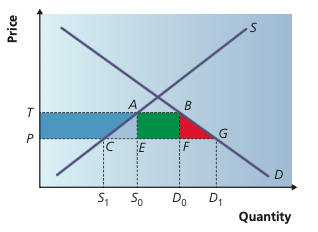
Removing the internal tariff lowers price from T to P, reduces domestic supply and increases domestic demand. Consumers gain PTBG; part is transferred from producers and lost tariff revenue, while ACE and BFG are the textbook's net welfare-gain areas from more efficient production and extra consumption.
Adapted from the Cambridge International AS & A Level Economics book by Peter Smith (Second Edition, with Adam Wilby and Mila Zasheva).
Gain from the lower price and higher consumption, so consumer surplus increases.
Lose some producer surplus as inefficient domestic output contracts.
Can rise because resources leave higher-cost production and consumption expands at a lower price, although lost tariff revenue must be accounted for.
Trade diversion occurs when membership causes imports to switch away from a cheaper, more efficient non-member toward a higher-cost producer inside the bloc because the external tariff changes relative prices.
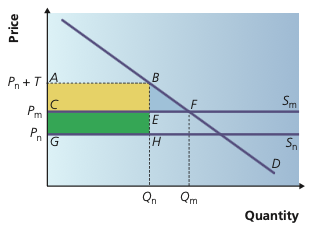
After joining the customs union, imports switch from the cheaper non-member supply Sn to the higher-cost member supply Sm. Consumer surplus rises, but tariff revenue is lost. The textbook's welfare judgment depends on whether the gain BFE is larger or smaller than the loss CEHG.
Adapted from the Cambridge International AS & A Level Economics book by Peter Smith (Second Edition, with Adam Wilby and Mila Zasheva).
| Trade creation | Trade diversion | |
|---|---|---|
| Source switch | Toward a lower-cost supplier. | Away from the most efficient global supplier toward a higher-cost member. |
| Resource allocation | Usually improves. | May become less efficient globally. |
| Consumer price | Usually falls. | May fall relative to the tariff-inclusive old price, but not necessarily to the lowest possible world price. |
| Welfare judgment | Likely positive, allowing for redistribution and lost tariff revenue. | Ambiguous: consumer gains must be compared with lost tariff revenue and the cost of switching to a less efficient producer. |
20 questions. Each answer is marked immediately with a short explanation of why it is correct or incorrect.