Explain the resource gap
Show why low saving, scarce capital and shortages of foreign exchange can restrict investment and development.

Countries at different stages of development are linked through trade, aid, foreign investment and borrowing. This chapter examines how external resources can support development, why those flows sometimes disappoint, and how international institutions influence the process.
Show why low saving, scarce capital and shortages of foreign exchange can restrict investment and development.
Evaluate trade, aid, foreign direct investment and international borrowing as ways of obtaining resources.
Distinguish the roles of the IMF, World Bank and WTO and explain why lending is often conditional.
Balance potential gains against dependency, market power, debt burdens, weak incentives and policy constraints.
A country's potential productive capacity depends on the quantity and quality of its factors of production and on how efficiently they are used. More or better resources can shift long-run aggregate supply to the right, but many low-income countries face severe constraints before this process can begin.
A low-income country may face a domestic saving gap, because low incomes limit the funds available for investment, and a foreign-exchange gap, because imported machinery and technology must be paid for in foreign currency. Trade, aid, FDI and borrowing are different ways of trying to relax these constraints.
Limited education, training and healthcare can reduce labour productivity and make new technologies harder to adopt.
Plant, machinery and infrastructure may be insufficient, while domestic production of capital goods may be limited.
Low incomes tend to restrict saving and domestic investment. A shortage of foreign currency can also prevent the import of needed capital equipment.
External resources can help break this constraint. The textbook identifies four broad routes: international trade, overseas aid, foreign direct investment and international borrowing.
| Route | How it can help | Main issue to evaluate |
|---|---|---|
| Trade | Earns foreign exchange that can finance imports of capital goods. | Can the country compete successfully and develop suitable comparative advantage? |
| Overseas aid | Provides finance, technical assistance or resources without relying entirely on domestic saving. | Is the aid well targeted and does it preserve local incentives? |
| FDI | Brings capital, technology, skills and access to international markets through MNCs. | How much of the benefit remains in the host economy? |
| Borrowing | Allows investment before sufficient domestic funds have been accumulated. | Will future export and income growth be sufficient to service the debt? |
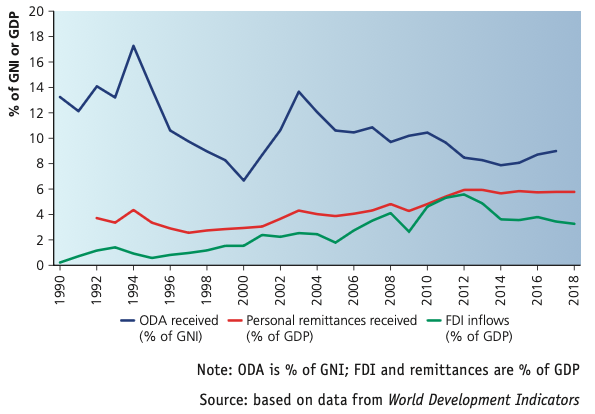
The chart compares official development assistance (ODA), personal remittances and FDI inflows. ODA is shown as a percentage of GNI, while remittances and FDI are shown as percentages of GDP. Their changing paths show that external finance comes from several sources whose importance varies over time.
Adapted from the Cambridge International AS & A Level Economics book by Peter Smith (Second Edition, with Adam Wilby and Mila Zasheva).
Many LDCs need imported machinery and technology to expand their productive capacity. Because imports must be paid for in foreign currency, trade strategy becomes closely linked to investment.
Import substitution means replacing goods that were previously imported with domestically produced alternatives, often supported by tariffs or other protection. The immediate aim is to reduce the use of foreign exchange.
Export promotion is an outward-looking strategy that aims to increase foreign-exchange earnings by selling more goods and services abroad. Success requires producers to compete in world markets and to identify activities in which the country can develop comparative advantage.
Primary-product exporters may try to move into processing and other higher-value-added stages. However, they can face tariff escalation or stronger competition once they move beyond raw materials. The textbook also stresses that earlier Asian success occurred when world trade was expanding and some HICs were leaving labour-intensive industries, so the same strategy cannot be assumed to work equally well for every country at every time.
| Issue | Import substitution | Export promotion |
|---|---|---|
| Orientation | Inward-looking | Outward-looking |
| Main foreign-exchange effect | Attempts to save foreign currency by reducing imports | Attempts to earn foreign currency by increasing exports |
| Market size | Depends heavily on domestic demand | Can reach much larger world markets |
| Competitive pressure | Protection may reduce it | Strong international competition can encourage efficiency |
Official Development Assistance (ODA) is official aid provided for development purposes. The textbook distinguishes long-term development assistance from emergency relief following events such as droughts or natural disasters.
Aid can be intended to reduce poverty and global inequality.
If poorer economies grow, they may become larger markets for goods and services produced elsewhere.
Aid may finance education, healthcare or infrastructure where externalities, public-good characteristics or information problems would otherwise lead to underprovision.
| Form | Meaning |
|---|---|
| Bilateral aid | Aid flows directly from one country to another. |
| Multilateral aid | Aid is channelled through an international organisation such as the World Bank or United Nations. |
| Tied aid | Aid is provided subject to conditions specified by the donor, often including how or where funds are spent. |
| Project aid | Resources are supplied for a particular development project. |
| Technical assistance | Expertise, advice or skills are provided rather than only finance. |
| Voluntary aid | Assistance provided by non-governmental organisations, commonly for humanitarian purposes. |
Very poor countries may lack the administrative resources to use funds effectively, while corruption or inefficiency can divert resources from priority uses.
Tied aid can require purchases from the donor at unfavourable prices. Project aid can fail if prestigious rather than high-priority projects are selected.
Repeated inflows of cheap goods can depress local prices and weaken incentives for domestic producers. Long-term aid dependency may also reduce pressure for domestic initiative.
Dutch disease describes a loss of competitiveness in other tradable sectors after a large foreign-currency inflow contributes to currency appreciation. The textbook notes that substantial aid inflows can create a similar risk: an appreciation can make the recipient country's exports less competitive.
The textbook does not treat trade and aid as mutually exclusive. Aid can help provide foundations such as human capital and infrastructure, while trade can create stronger incentives, larger markets and continuing foreign-exchange earnings. Their effectiveness depends on how each is designed and on whether richer countries allow meaningful market access.
Fair trade schemes aim to improve the returns received by small producers in LDCs. The economic case may involve market power or information failure: producers may be weak in bargaining or unable to observe world prices easily.
Higher or more predictable returns, information and advice can strengthen incentives and improve producers' bargaining position.
Supporting production when long-run market prices are falling may delay movement into alternative activities with better prospects.
Foreign direct investment (FDI) occurs when a firm based in one country invests in productive activity in another. A multinational company (MNC) carries out production in more than one country.
The firm wants access to a particular market and finds local production attractive.
The firm locates where it can obtain natural resources, particular skills or lower-cost labour.
The firm organises its production chain internationally and places stages of production where they can be performed most efficiently.
An MNC can train local workers and managers and introduce new technology. If those workers later move to domestic firms or create businesses, knowledge spreads beyond the original foreign-owned plant. The size of this gain is smaller if the MNC imports most skilled staff and inputs or uses highly capital-intensive production.
| Issue | Why the expected gain may be smaller |
|---|---|
| Employment | Capital-intensive production or reliance on expatriate managers may limit local job creation and skills transfer. |
| Local labour market | High MNC wages can attract the strongest workers away from domestic firms. |
| Tax revenue | Tax holidays and concessions used to attract investment can reduce receipts. |
| Transfer pricing | Internal prices between parts of an MNC can shift reported profits toward lower-tax locations, making tax collection difficult. |
| Profit repatriation | Profits sent abroad create a leakage and reduce the foreign-exchange benefit retained locally. |
| Market power | A large MNC may weaken local competition and gain substantial economic influence. |
| Environment | Weak environmental regulation can create incentives to locate polluting activity where standards are less strict. |
| Regional inequality | Investment concentrated in cities can widen rural–urban differences. |
International borrowing can provide resources for development before a country has accumulated enough domestic saving. Loans may be available on concessional terms from international institutions or on commercial terms from financial markets.
Conditionality means that finance is provided only if the borrower accepts specified policy conditions. The IMF and World Bank have often attached economic-policy requirements to their lending.
The textbook traces the debt crisis to the oil shocks of the 1970s. Non-oil-producing LDCs faced sharply higher import bills, while oil exporters deposited large surpluses with international banks. Banks were willing to lend, and many countries borrowed at variable interest rates. A second oil shock and higher interest rates around 1979–80 then made existing debts much harder to service.
The textbook traces the debt crisis to the oil shocks of the 1970s. Non-oil-producing LDCs faced larger current-account deficits just as oil exporters deposited large surpluses in international banks. Banks then lent heavily to LDCs, often at variable interest rates. When interest rates later rose sharply, debt servicing became much more difficult.
Debt service uses export earnings and government resources to pay interest and principal. If a high proportion of export revenue is devoted to debt service, fewer resources remain for education, healthcare, infrastructure and productive investment.
Debt rescheduling can postpone repayments, but it does not by itself remove the underlying burden. Sustainable borrowing requires the borrowed funds to raise the country's future capacity to generate income and foreign exchange.
The 1944 Bretton Woods conference established institutions intended to support the international economic system. For this chapter, the key organisations are the IMF, the World Bank and the trade system that developed from GATT into the WTO.
| Institution | Core textbook role | Typical time horizon / focus |
|---|---|---|
| International Monetary Fund (IMF) | Provides assistance to countries facing balance-of-payments problems, usually with policy conditions. | Primarily short-term stabilisation and external financing. |
| World Bank | Provides finance for longer-term development projects; concessional lending is also available through the IDA. | Long-term development and investment. |
| GATT / World Trade Organization (WTO) | Encourages reductions in trade barriers and provides a framework for trade negotiations and dispute settlement. | Rules and conditions governing international trade. |
The Heavily Indebted Poor Countries (HIPC) Initiative was introduced to provide debt relief for countries with unsustainable debt burdens. Debt forgiveness was conditional on demonstrating commitment to specified policies rather than being automatic.
Debt forgiveness can release resources for development, but it also creates a possible moral hazard: borrowers may expect future debts to be forgiven. The HIPC approach therefore tied relief to policy commitments, including measures intended to promote growth, poverty reduction, private enterprise and export diversification.
A central evaluation issue is moral hazard: if governments expect debts to be cancelled regardless of behaviour, incentives to borrow and manage finances responsibly may weaken. Against this, excessive debt service can itself prevent spending on the investment and social services needed for development.
IMF and World Bank conditions were strongly influenced by market-oriented ideas associated with the Washington Consensus. The textbook notes that experience showed these measures were not a complete development strategy. Robust institutions, good governance, functioning markets, social protection and targeted poverty reduction also matter.
This contributed to greater emphasis on inclusive growth: growth should not be judged only by aggregate output, but also by whether its benefits reach the population and improve opportunities.
| Policy issue | Possible case for conditionality | Possible criticism |
|---|---|---|
| Macroeconomic stability | Conditions may address the policies that created a balance-of-payments problem. | Restrictive policies can impose short-run costs through lower output and employment. |
| Market reform | Competition, incentives and openness may raise efficiency. | A standard package may not fit countries with different institutions and development constraints. |
| Debt relief | Can release resources for development spending. | May create moral hazard unless accompanied by credible reforms and accountability. |
| Inclusive growth | Focuses attention on infrastructure, poverty reduction and wider access to opportunities. | Success still depends on implementation capacity and institutions. |
20 questions. Each answer is marked immediately with a short explanation of why it is correct or incorrect.