Define growth precisely
Distinguish an increase in current output from an expansion of the economy's productive capacity.

Economic growth expands the resources available to an economy. This chapter distinguishes actual growth from potential growth, shows how growth is measured, explains the role of capital, labour and productivity, and evaluates the benefits and costs of growth.
Distinguish an increase in current output from an expansion of the economy's productive capacity.
Calculate percentage changes in real GDP and explain why nominal GDP can mislead.
Link capital accumulation, labour, productivity, technology and human capital to long-run productive capacity.
Balance higher living standards, employment and tax revenue against environmental damage and inequality.
An increase in the economy's productive capacity — the maximum output it is capable of producing.
An increase in measured real GDP over a period of time. It can occur because aggregate demand rises or because existing resources are used more fully.
The distinction matters because an economy can produce more without increasing its productive capacity. For example, if unemployment falls during a recovery, real GDP may rise as unused labour is brought back into production. That is actual growth, but capacity may be unchanged.
If an economy is operating inside its production possibility curve (PPC), a move towards the curve represents higher actual output through better use of existing resources. An outward shift of the PPC represents potential economic growth because the maximum production possibilities have expanded.
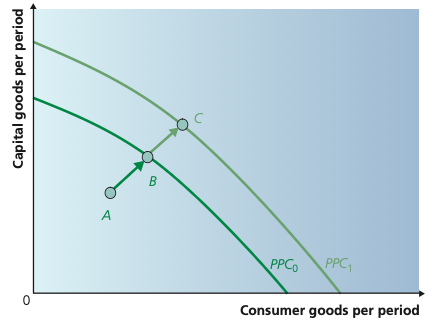
A movement from A to B represents actual growth as previously underused resources are brought into production. A movement from B to C requires the production possibility curve to shift outward from PPC₀ to PPC₁, so it represents an increase in productive capacity — potential economic growth.
Adapted from Cambridge International AS & A Level Economics, Second Edition, by Peter Smith (with Adam Wilby and Mila Zasheva).
Potential growth can also be shown by a rightward shift of LRAS. For example, better workforce skills allow more output to be produced at full employment. The economy's capacity output rises.
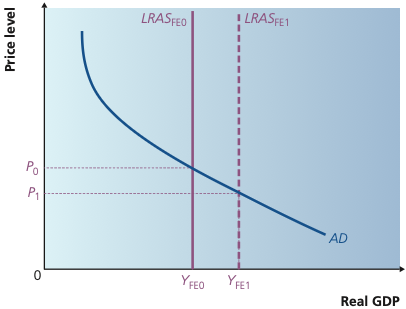
Potential economic growth can also be shown by a rightward shift of LRAS. As productive capacity increases from YFE0 to YFE1, the economy is capable of producing more real GDP at full employment.
Adapted from Cambridge International AS & A Level Economics, Second Edition, by Peter Smith (with Adam Wilby and Mila Zasheva).
Actual economic growth is normally measured as the annual percentage change in real GDP. Real GNI can also be useful, particularly where net income from abroad is significant.
Nominal GDP is measured at current prices. It can rise simply because prices rise. Real GDP removes the effect of changing prices, so it gives a better measure of changes in the quantity of output produced.
GDP measured at current prices. It includes the effect of price changes.
GDP measured at constant prices. It adjusts for changes in the general price level.
Observed GDP tells us how much is actually produced, not exactly how much the economy could produce at full capacity. A rise in GDP may therefore represent a move from inside the PPC towards the frontier rather than an outward shift of the frontier itself. Economists often look at the underlying trend rate of growth of real GDP when thinking about potential growth.
When comparing countries, the size of the population matters. GDP per head (GDP per capita) adjusts GDP for population and is more useful than total GDP when considering the average amount of output or income available per person.
Capacity output can increase in two broad ways: the economy can have more factors of production, or it can use its existing factors more productively.
Net additions to machinery, buildings and other capital increase the amount the economy can produce.
A larger workforce can raise capacity output. International migration can change the labour supply more quickly than natural population growth.
New technology can make capital and other factors more productive and raise output from the same quantity of inputs.
Education, training, healthcare and nutrition can improve workers' skills, health and productivity.
Output per worker or, more precisely, output per hour worked.
Output per unit of capital.
Total output divided by the total quantity of inputs used.
A rise in productivity means more output can be produced from given resources, shifting long-run aggregate supply to the right.
In economics, investment means firms' expenditure on capital goods such as machinery and factory buildings. It does not mean buying shares or placing money in a savings account.
Total investment, including spending needed to replace worn-out capital.
Gross investment minus depreciation. Positive net investment adds to the capital stock.
The loss in value of capital equipment through wear and tear.
Investment involves an opportunity cost: resources used to produce capital goods today cannot simultaneously be used for current consumption. The gain is greater productive capacity in the future.
The contribution of capital to growth can be strengthened when new capital embodies improved technology. Innovation can create new types of capital or better ways of using existing capital, increasing productivity.
More labour can increase productive capacity, but the quality of labour is also crucial. Education and training develop human capital. Better healthcare and nutrition can also raise productivity, especially where poor health reduces the effectiveness of the workforce.
Economic growth can expand the resources available to society and help improve living standards, but it can also impose costs. A strong answer should consider both sides rather than assuming growth is automatically beneficial.
More resources can allow higher consumption and improved access to goods and services.
Growth can increase employment and may improve working conditions and career opportunities.
Higher incomes and activity can increase tax revenues, allowing greater public expenditure.
Greater resources can support better education, healthcare and investment in human capital.
More production can increase pollution and resource depletion, reducing quality of life and imposing costs on future generations.
Growth does not guarantee that gains are evenly distributed. Income and wealth may become more concentrated.
If benefits accrue mainly to a small group, rising inequality may generate dissatisfaction or conflict.
Policies aimed at faster long-run growth may divert resources from current consumption towards investment.
There is a debate over whether lower-income economies should prioritise rapid growth first or devote more resources immediately to meeting basic needs. A growth-first strategy argues that expansion eventually creates more resources to reduce poverty. The alternative view is that meeting basic needs, improving health and building human capital can itself support growth. The key point is that growth does not automatically translate into better living standards for everyone.
20 questions. Each answer is marked immediately with a short explanation of why it is correct or incorrect.