5.2 Digital currency
Digital currency exists as data rather than physical notes or coins. This topic explains how digital money can be transferred, how cryptocurrency differs from a centrally controlled digital-currency system, and how blockchain links transactions together using blocks, hashes and previous-hash values.
What you need to understand
You should be able to explain what digital currency is and how it is used; distinguish the centrally controlled digital-currency model in the textbook from cryptocurrency; explain why cryptocurrency uses decentralisation and cryptography; define blockchain; describe what is stored in a block; explain how hashes link blocks together; and describe how the textbook explains tamper detection, proof-of-work and miners.
What is digital currency?
Digital currency is money that exists in a digital form. Unlike physical notes and coins, it has no physical form. It can still be used as a form of payment for goods and services and can be transferred between accounts when transactions take place.
The textbook contrasts digital currency with conventional fiat currency. Fiat currency refers to ordinary government-backed money such as dollars, pounds, euros or yen. The book explains that modern fiat currency is backed by governments and banking systems rather than being tied directly to reserves of gold or silver. It also notes that the word fiat comes from Latin and means “let it be done”.
How digital currency is used
Digital money makes online financial activity possible. The textbook gives online banking such as PayPal and smartphone payment systems such as Apple Pay as examples. Money can be transferred electronically between accounts, even though it can later be converted into physical cash if required.
Centralised digital currency
In the model used in the textbook, ordinary digital-currency transfers rely on a central banking system. For example, if one person uses Bank X and another person uses Bank Y, the transfer passes through the banking system and a central bank structure.
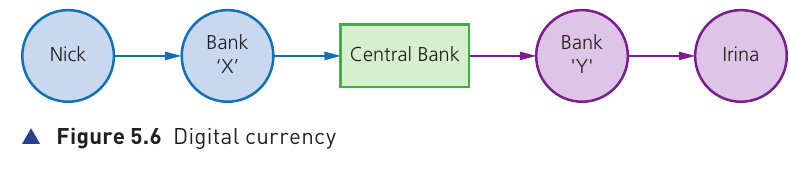
This centralised arrangement means that banks and governments can regulate the system. The textbook identifies confidentiality and security as important concerns in centralised digital-currency systems.
Cryptocurrency and decentralisation
Cryptocurrency is presented in the textbook as a form of digital currency that uses decentralisation. Instead of every transaction depending on one central banking authority, the system operates through a distributed network.
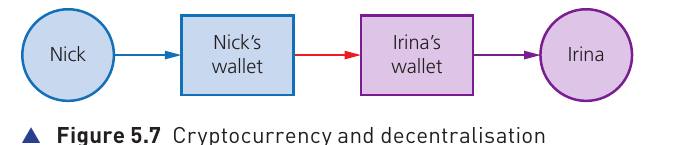
| Traditional digital-currency model in the textbook | Cryptocurrency model in the textbook |
|---|---|
| Regulated by central banks and governments. | No central state authority controls the network in the model described. |
| Transactions pass through a centralised banking system. | Transactions operate through a decentralised network and digital wallets. |
| Transactions and exchange rates are determined by central banks and governments in the textbook model. | Rules are set by the cryptocurrency community/network. |
| Confidentiality and security are identified as concerns in the centralised system. | Cryptography is used to track transactions, and the blockchain network is described by the textbook as providing greater security. |
| Transaction records are maintained by the banking system. | The textbook states that cryptocurrency transactions are publicly available so transactions and the amount of money in the system can be tracked. |
Why cryptography is used
Cryptocurrency uses cryptography to track transactions. The textbook links cryptocurrency with blockchain and explains that the system operates within a blockchain network rather than through one central server.
Blockchaining
A blockchain is described as a decentralised database. The computers in the blockchain are interconnected, but they are not controlled through one central server. Transaction data is stored across the computers in the blockchain network.
When a new transaction takes place, the networked computers receive a copy of the transaction. The textbook states that the transaction cannot be changed without the consent of all network members and describes this distributed approach as effectively removing security risks such as hacking.
Uses of blockchain mentioned in the textbook
Cryptocurrency exchanges
The textbook lists cryptocurrency (digital-currency) exchanges as a use of blockchain.
Smart contracts
Smart contracts are also listed as a blockchain use.
Research
The book specifically lists research, particularly within pharmaceutical companies.
Other areas
The textbook also lists politics and education.
What is stored in a block?
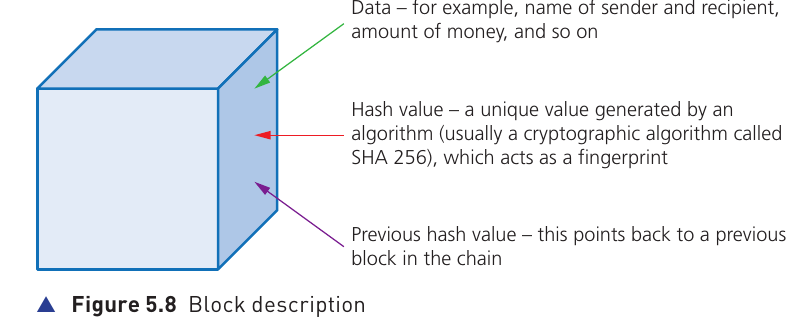
Whenever a new transaction takes place, a new block is created. The textbook identifies three important items in the block:
- Data: information about the transaction, such as the sender, recipient and amount.
- Hash value: a unique value generated by an algorithm. The textbook gives SHA-256 as an example and describes the hash as acting like a fingerprint for the block.
- Previous hash value: the hash of the preceding block. This is what links the current block backwards to the chain.
Hashes, timestamps and the chain
A new hash value is created for each new block. The textbook also states that a block includes a timestamp to identify when the event took place. The previous-hash field connects one block to the block before it, producing a chain.
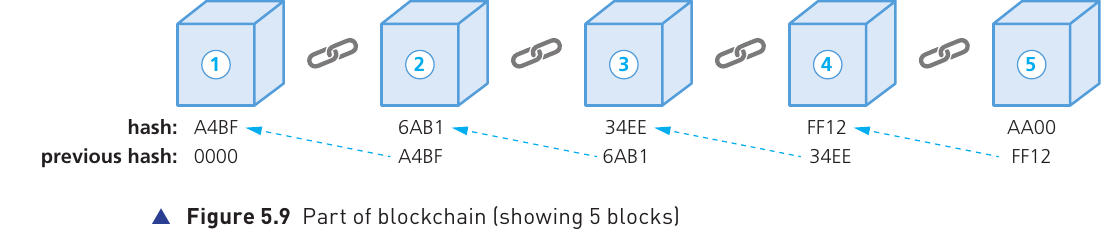
The first block is called the genesis block because there is no earlier block for it to point to. In Figure 5.9, its previous-hash value is shown as 0000.
What happens if a block is changed?
Suppose the data inside block 2 is altered. Because the block's data has changed, its hash also changes. Block 3 still contains the old hash of block 2 in its previous hash field, so the link no longer matches. This makes block 3 and the later part of the chain invalid until the inconsistency is resolved.
Proof-of-work and miners
The textbook explains that simply recalculating all later hashes should not be easy enough for an attacker to rebuild the chain immediately. It introduces proof-of-work as a mechanism that deliberately makes the creation of a valid new block computationally time-consuming.
In the particular explanation used by the textbook, proof-of-work is described as taking about ten minutes for each block. Miners are described as special network users who perform this work and receive a commission for newly created blocks. This slows block creation and makes rapid tampering with an entire chain much more difficult. The textbook also says that this means the currency is regulated by the computers across the network rather than by one central authority.
Adding and sharing new blocks
When a new block is created, it is sent to the computers in the blockchain network and checked before it is added. A new network user receives a copy of the blockchain. This distributed copying is central to the textbook's explanation of why blockchain does not depend on one central server.