
Business Activity
A business is an organisation that produces goods or provides services. People start businesses to provide something that customers value; the money received from selling goods and services is known as revenue.
Businesses use inputs such as labour, materials, money, equipment and premises. These are organised into a production process to create outputs — goods or services. They may purchase resources from suppliers and sell their outputs to consumers or other businesses.
A repair workshop uses tools, spare parts, a mechanic's skills and workshop space to repair bicycles. The repaired bicycle and repair service provide value to the customer, who pays the workshop for its work.
Businesses operate in a changing environment. They must consider customer preferences, the prices charged by competing businesses, advances in technology, government decisions and other outside influences. A product that sells well today might not be as popular next year.
Goods and Services
Businesses produce two broad types of output: goods and services. Goods are physical products that can usually be touched, stored and owned. Services are activities carried out for other people or businesses.
Goods
Physical items such as trainers, furniture, books and packaged food. These may be used immediately or kept for later.
Services
Activities such as banking, education, transport, cleaning and repairing a mobile phone.
Consumer goods and producer goods
Some goods are bought for personal use, while others are used by businesses in producing further goods and services.
| Consumer goods | Producer goods |
|---|---|
| Goods bought for personal or household use. | Goods used by businesses to help produce other goods or services. |
| Examples: a pair of shoes, a television, a family bicycle. | Examples: an industrial oven, a delivery van, factory equipment. |
A loaf of bread bought by a family is a consumer good. A commercial oven purchased by the bakery to make bread is a producer good. If the bakery also offers cake-decoration lessons, those lessons are a service.
The same item can sometimes be used differently. For example, a laptop bought for family entertainment is a consumer good, while an identical laptop purchased for office work is used as a producer good.
Satisfying Needs and Wants
Businesses respond to the things that people require or would like to have. Understanding these helps a business decide which goods and services to offer.
Needs
Basic requirements for survival, such as food, safe water, warmth and shelter.
Wants
Desirable but non-essential items and experiences, such as holidays, designer clothing or a new gaming console.
People's wants are almost unlimited, but the resources available to produce goods and services are limited. Businesses therefore have to choose how to use their resources. Economists describe this problem as scarcity.
Customers need food, but may want a meal at a stylish restaurant. The restaurant has limited space, staff and ingredients, so it must decide what dishes to prepare and how many customers it can serve.
Businesses that understand customer needs and wants are more likely to offer products people will buy. However, customer tastes, incomes and preferences can change over time.
Check your understanding · Halfway point
Try these questions before revealing the suggested answers.
A bakery purchases flour and bakes bread for customers. Identify one input and one output.
Show suggested answer
Input: flour (also labour, electricity or ovens). Output: bread.
Is a haircut a consumer good or a service? Explain your answer.
Show suggested answer
A haircut is a service because it is an activity performed for a customer, not a physical item.
Explain one difference between a need and a want, with an example.
Show suggested answer
A need is essential for survival, such as safe water. A want improves comfort or enjoyment but is not essential for survival, such as a gaming console.
Why do businesses have to make choices about what to produce?
Show suggested answer
Resources are limited, while customers have many wants. Businesses must decide how best to use money, materials and labour to produce what customers will buy.
The Purpose of Business Activity
Most businesses exist to produce goods or services that customers need or want. However, businesses are set up for different reasons, so their goals are not always the same.
Private enterprise
A private enterprise is owned by private individuals or groups. Many private businesses aim to earn profit, but owners may also value independence, personal satisfaction or business growth.
Social enterprise
A social enterprise carries out business activity mainly to achieve a social or environmental objective. It may earn revenue from selling products and reinvest any surplus in its mission.
Public enterprise
A public enterprise is controlled by the government or another public authority. It is usually established to provide services or goods judged to be important for the community, rather than focusing primarily on profit.
A privately owned gym might aim to earn profit for its owner. A café run as a social enterprise might provide training and employment for disadvantaged young people. A government-run transport service might aim to provide affordable travel for the public.
Although these organisations have different purposes, all need to manage their resources and deliver outputs that people find useful.
Business Stakeholders
Stakeholders can be inside or outside the business. Different groups often have different expectations, so decisions that benefit one stakeholder might create problems for another.
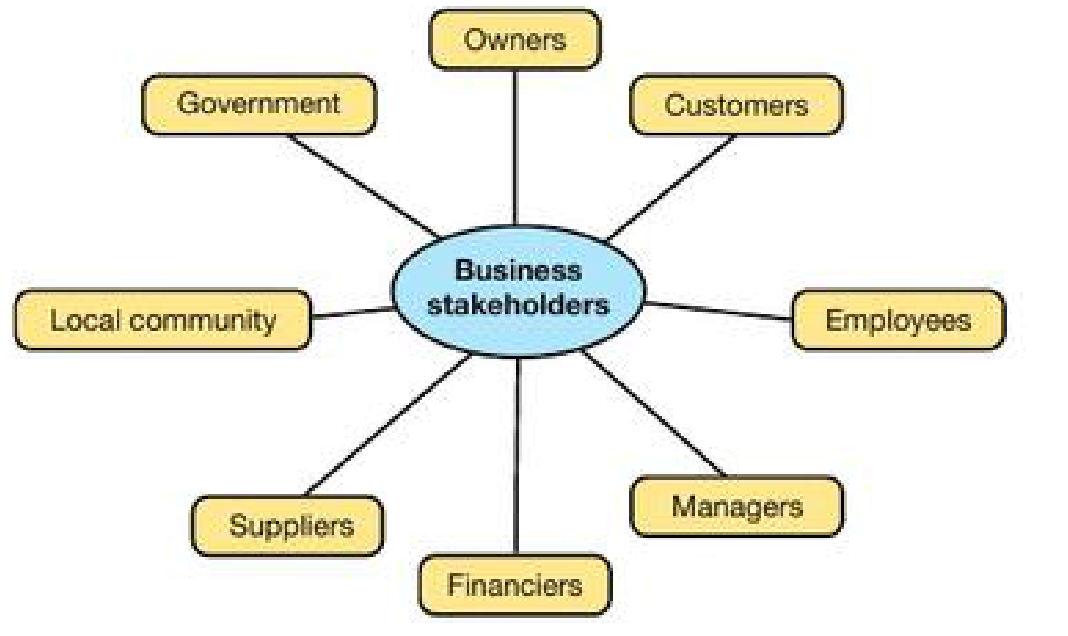
| Stakeholder | What matters to them |
|---|---|
| Owners | Business performance, profit, growth and a return on their investment. |
| Customers | Good-quality goods and services, fair prices and reliable service. |
| Employees | Fair wages, safe conditions, job security, training and promotion. |
| Managers | Meeting targets, leading staff effectively and having the resources to do their jobs. |
| Financiers | Repayment of loans or a suitable financial return. |
| Suppliers | Regular orders, prompt payment and a stable trading relationship. |
| Local community | Employment opportunities and minimal noise, congestion or pollution. |
| Government | Employment, tax revenue and compliance with the law. |
Why stakeholder interests can conflict
Consider a manufacturer that plans to extend its opening hours. Owners might welcome higher sales, while employees could be concerned about shift patterns and local residents might object to more noise. Managers have to consider these different interests when making decisions.
Do not simply name a stakeholder. For stronger answers, explain how a business decision affects that group and use the details of the business in the question.
The Changing Business Environment
Businesses are affected by factors beyond their direct control. This is the external business environment. Changes may create new opportunities, but they can also make business activity more difficult.
- Competition: a new rival may attract customers by offering lower prices or a better service.
- Economic conditions: falling household incomes can reduce demand for non-essential products, while rising costs can reduce profits.
- Government decisions and laws: new rules, taxes or regulations can change business costs or how firms operate.
- Technology: online selling, digital payment methods or new equipment may offer faster ways to serve customers.
- Population and lifestyles: changes in age, tastes and buying habits can shift demand.
- World events: international disruption can affect supply and demand.
If more customers begin buying online, a shop could create an online store to reach them. However, it may need to invest in delivery arrangements and a secure payment system. The change offers an opportunity while adding new costs.
To survive, businesses need to notice external changes and respond appropriately. Their ability to adapt can influence how successfully they satisfy customers and meet their objectives.
End-of-chapter understanding questions
Use these to test definitions, application, explanation and evaluation. Expand each answer after attempting it yourself.
Define business activity and give one example.
Show suggested answer
Business activity is the production and provision of goods and services to meet customer needs and wants; for example, a repair shop fixes bicycles for a fee.
State one example each of a consumer good, a producer good and a service.
Show suggested answer
Consumer good: school bag. Producer good: commercial baking oven. Service: dental treatment. Other valid examples are acceptable.
Identify two stakeholders of a supermarket and describe what each wants.
Show suggested answer
For example, customers want good-quality products at fair prices; employees want fair pay and safe working conditions. Relevant alternative stakeholder interests are acceptable.
Explain why a business might not always satisfy the wishes of all its stakeholders.
Show suggested answer
Stakeholder interests may conflict. For example, employees may want higher wages, while owners may want to limit costs to increase profits.
A new café is owned and managed by one person. Explain why independence may be an objective for that owner.
Show suggested answer
The owner may want to make decisions without being directed by an employer and have more control over working hours and the way the business operates.
Explain two ways that a change in the external business environment could affect a clothing shop.
Show suggested answer
An economic downturn may reduce spending and sales; a new competitor may require the shop to improve prices or customer service. Technology, regulations and changing tastes are also valid.
Analyse how a rise in the cost of electricity could affect a small bakery.
Show suggested answer
Higher electricity bills increase production costs. If the bakery increases its prices to protect profit, some customers might buy less; if it keeps prices unchanged, profit margins could fall.
A bicycle repair shop expands to sell refurbished bicycles. Assess one possible benefit and one possible risk of this decision.
Show suggested answer
Benefit: it can attract more customers and earn additional revenue by selling goods alongside repair services. Risk: it needs more stock, space and working capital, which increases costs and could lead to unsold bicycles. The stronger decision depends on local demand and available finance.
Chapter 1 recap
Business activity uses limited resources to create goods and services that meet people's needs and wants. Different types of businesses have different purposes; stakeholders have different interests; and changes outside the business can influence decisions and success.