
Chapter 20 · Training
Explore why businesses train workers, how training takes place, and the benefits and limitations of different methods.
Learning objectives
- Understand the importance of training to businesses and workers.
- Compare induction, on-the-job and off-the-job training.
- Explain training for health and safety.
- Evaluate the benefits and limitations of training for businesses of different sizes.
The Importance of Training
Training is the process of increasing employees’ skills and knowledge so that they can perform their work more effectively. Employees need training at different stages: when joining a firm, when tasks change, when new equipment arrives, or before promotion.
Businesses invest in training to help workers perform better, learn new skills, maintain safe workplaces and respond to change. Better-trained workers may make fewer errors, produce more output and feel more motivated. Managers can also develop the leadership skills needed to support others.
- Improved quality: fewer mistakes and less waste may improve customer satisfaction.
- Higher productivity: efficient work can reduce average labour cost per unit.
- Greater safety: workers need to understand machinery, hazards and procedures.
- Recruitment and retention: training and development may make employment more attractive.
- A cost to consider: courses, trainers and time away from work require funding, and workers may later leave.
A historical example from 2015 describes a cereal producer in Canada with 180 employees. Ten agricultural-college graduates attended an intensive course covering company working practices, farm machinery and health and safety before starting work. Training was particularly important because machinery and agricultural operations could be dangerous.
Safety-sensitive work requires practical training before staff use dangerous equipment. Instructions should cover hazard recognition, safe operation and emergency procedures.
Induction Training
Induction training is provided to new employees when they first start their job. Its main purpose is to help them settle in, understand the business and become confident working safely and effectively. Good induction can reduce anxiety, confusion and early mistakes.
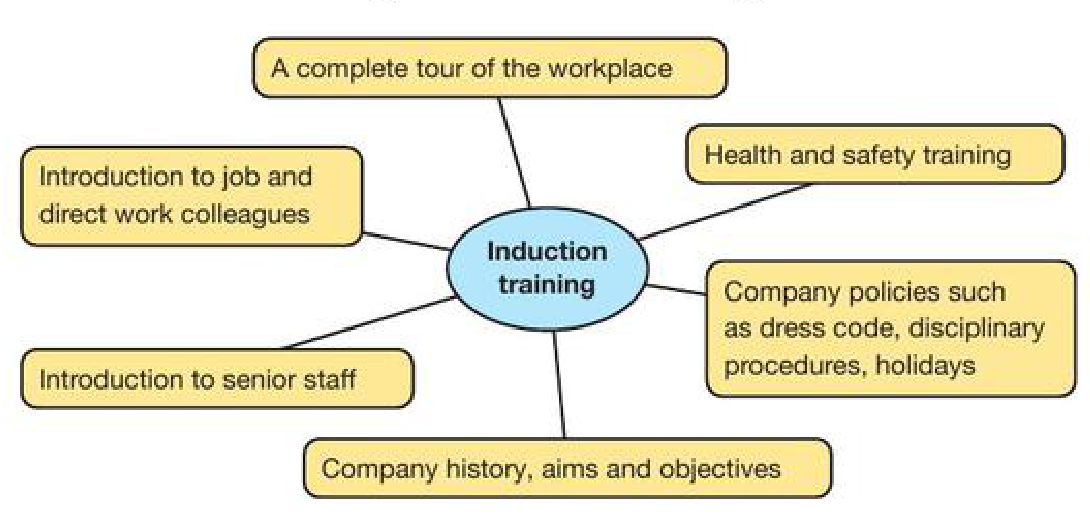
- A tour of the workplace and introduction to colleagues and senior staff.
- An explanation of company history, aims and objectives.
- Company rules, including working hours, dress codes, holidays and disciplinary procedures.
- Health and safety instructions relevant to the job.
- An introduction to the equipment, processes and systems used at work.
A historical example describes Google’s two-week induction programme for new software engineers, called “Nooglers”. New recruits learned about company culture, security, products and their own teams. Technical tutorials and group exercises introduced the internal tools they would use. This is a historical example, not a description of the company’s current programme.
Benefit: recruits can feel welcome and understand expectations sooner. Limitation: induction takes employee and trainer time, and it does not replace training for more specialised tasks.
On-the-job Training
On-the-job training takes place in the normal workplace while employees are carrying out their work. It gives trainees practical experience using the actual equipment, tasks and working conditions of their role.
Watching Another Worker
A new recruit learns by watching or shadowing a capable, experienced colleague and then imitating the correct technique. The quality of the training depends on whether the experienced employee is willing and able to teach well.
Mentoring
A mentor provides support and advice over a period of time. The trainee may work independently, asking the mentor for help when necessary. Mentoring is useful when judgement, confidence and professional development matter.
Job Rotation
Employees spend time performing different jobs or working in different departments. This builds a broader understanding of the organisation and makes it easier to cover absences, transfer staff or respond to changing workloads.
Advantages
- Output may continue while the trainee learns.
- Skills are relevant because the trainee works on real tasks.
- Often cheaper and easier to organise than external courses.
Disadvantages
- Mistakes or supervision may slow production or waste materials.
- Trainees may be under pressure while learning.
- Training quality depends on the colleague providing it.
- A lack of experience may create risks in dangerous occupations.
A new waiter could shadow an experienced colleague, practise taking orders during quieter hours and rotate between table service and reception. Such training is closely related to the job, but poorly supervised mistakes may affect customers.
Check your understanding · Halfway
Try each question yourself, then expand the suggested answer.
Define training and explain why AFC trained new staff before letting them operate machinery.
Show suggested answer
Training increases workers’ skills and knowledge. AFC wanted new recruits to understand machinery, company practices and safety procedures so that they could work effectively and reduce workplace risks.
Why should new workers receive health and safety training before operating dangerous machinery?
Show suggested answer
They need to recognise hazards, use equipment correctly and understand emergency procedures. This can reduce the risk of injury, damage and avoidable downtime.
State three things that might be included in a new employee’s induction programme.
Show suggested answer
Examples include a workplace tour, introduction to colleagues, company rules, health and safety, and the company’s aims and objectives.
Explain why Google’s induction case includes technical tutorials as well as introductions to colleagues.
Show suggested answer
New recruits need to understand both the company culture and the systems and tools necessary to carry out their jobs. Technical tutorials help them become productive.
Distinguish between mentoring and job rotation.
Show suggested answer
Mentoring involves an experienced person advising a trainee. Job rotation involves an employee gaining experience across several roles or departments.
Give one advantage and one disadvantage of on-the-job training.
Show suggested answer
It uses real tasks, so learning is directly relevant and output may continue; however, inexperienced workers may make mistakes or slow production.
Off-the-job Training
Off-the-job training takes place away from the normal working area. Examples include college courses, external workshops, classroom teaching and simulated work environments. It can focus attention on learning without the pressure of completing the usual job.
Advantages
- Mistakes during training do not normally damage the firm’s output.
- Trainees can concentrate without everyday workplace distractions.
- Specialist instruction or simulation can be used.
- Customers and fellow workers may face less risk during practice.
Disadvantages
- Employees may produce no normal output while training.
- External specialists, venues and equipment can be costly.
- Some skills cannot be reproduced perfectly away from the job.
- Courses may take time to organise.
A historical example describes Emirates giving new cabin crew a seven-week initial programme in specialist training facilities. It combines theory and practical simulation, including mock aircraft interiors, safety and emergency procedures, first aid, service, fitness and security. Annual refresher training is also described. The programme details are historical and may have changed.
Choosing a method: a firm might use on-the-job mentoring for routine tasks but off-the-job simulation for procedures where mistakes could put people at risk. A blended programme can combine the strengths of both.
Training in Health and Safety
Some jobs involve significant risks from machinery, vehicles, chemicals, food handling or other workplace hazards. Health and safety training explains how to prevent accidents and respond correctly when something goes wrong. Relevant laws and the training required differ between countries and occupations.
- Correct use and maintenance of safety equipment, protective clothing, fire extinguishers, hard hats and goggles.
- Hygienic working practices in workplaces such as food preparation areas.
- Safe handling of dangerous substances, including harmful chemicals.
- Recognising and managing risks from bullying, violence, threats and stress.
- Understanding workplace safety policies, emergency procedures and reporting responsibilities.
Businesses may also need to supply clear instructions, effective supervision and suitable protective equipment. Training alone is not sufficient if machines or working conditions are unsafe. Employers may also be subject to inspections and requirements to maintain suitable health and safety policies.
AFC’s employees need to operate agricultural machinery safely. Emirates cabin crew need to practise emergency procedures and first aid before working with passengers. In both settings, training is a practical part of risk management.
The Benefits of Training
The primary benefit of training is to improve employees’ knowledge, skills and ability to work efficiently. It may increase productivity and output quality, but its results depend on whether training is relevant and applied in practice.
Keeping Workers Up to Date
Employees need updated training when new technology arrives, when safety procedures or legislation change, after a takeover, or when a business introduces new working practices.
Improving Labour Flexibility
Multi-skilled workers can move between different jobs when necessary. This may reduce disruptions when someone is absent and help firms respond to changes in customer demand.
Improving Job Satisfaction and Motivation
Workers who feel capable and supported may gain confidence and greater job satisfaction. Development opportunities can improve motivation and help reduce unnecessary labour turnover.
New Jobs in the Business
Expansion, new products and new production methods may create roles that require different skills. Retraining existing staff can help businesses fill positions without always recruiting externally.
Training for Promotion
Employees who move into positions with more responsibility may need new technical, supervisory and leadership skills. Training supports their transition and can make internal promotion more successful.
Workers may need training to use a replacement stock-management system. After learning the new process, they can make fewer entry errors, help colleagues and serve customers more efficiently.
The Limitations of Training
Training is an investment, but it is not free and does not guarantee improved results. Businesses must balance its expected benefits against the time, money and risks involved.
High Cost of Training Courses and Other Resources
Firms may pay fees for specialist trainers, equipment, travel, course materials and facilities. Even training delivered internally can require paid instructors, dedicated space and expensive machinery.
Learning by Doing
Some work is difficult to learn fully through off-the-job simulation. Trainees may still need to practise the real tasks under realistic conditions before they perform confidently.
Loss of Output
Employees attending off-the-job courses are away from normal production. On-the-job learners may also produce less while they practise, and skilled colleagues may spend time supervising rather than producing.
Employees Leaving
Trained employees may move to another employer. The business then loses some of the benefit of its investment, especially if specialist skills are costly to teach and competitors recruit experienced workers.
Evaluation: cheaper training is not automatically better. Training more staff could improve flexibility, but a business should consider safety, the complexity of new equipment, the number of workers who need training and the possible cost of mistakes or delays.
Large vs Small Businesses
Businesses of all sizes need workers to understand their jobs. The amount, formality and cost of training can differ, however, because firms have different numbers of employees and financial resources.
Large businesses
- Can often afford specialist training centres, equipment and courses.
- May offer structured induction programmes for large groups.
- Need consistent training and communication across many departments.
- May have enough staff to cover duties while colleagues attend training.
Small businesses
- Often rely on experienced colleagues to train recruits directly.
- May provide highly personalised mentoring.
- Can find the cost of courses or time away from work harder to absorb.
- May need staff to learn several tasks to cover a small workforce.
A small firm with an excellent mentor may train a worker very effectively, while large firms need not always provide good-quality instruction. The right method depends on the nature of the job, risks, available resources and the worker’s needs.
End-of-chapter questions
Try each question yourself, then expand the suggested answer.
What is off-the-job training? Give one business example.
Show suggested answer
It means learning away from normal work tasks or the usual workplace. A simulated aircraft-cabin training session is one example.
Compare one benefit and one drawback of off-the-job training with on-the-job training.
Show suggested answer
Off-the-job training offers focused learning without risking real output, but it can cost more and temporarily remove workers from production. On-the-job training is more directly practical but mistakes may affect work.
Explain how an induction programme can reduce labour turnover.
Show suggested answer
It helps recruits feel welcome, understand expectations and build confidence, so fewer may leave soon after joining.
Why might a trained employee improve business productivity?
Show suggested answer
The employee can carry out tasks more accurately and efficiently, reducing wasted time, mistakes or rejected output.
Describe two matters that should be covered by health and safety training in a food-processing business.
Show suggested answer
Safe use of equipment and protective clothing; food hygiene and safe handling of hazardous cleaning chemicals are appropriate examples.
Explain how job rotation could improve labour flexibility.
Show suggested answer
Workers learn several jobs, enabling the manager to move them to departments that need extra staff or cover absences.
Analyse how training may increase employee motivation.
Show suggested answer
It can make workers feel supported and competent, improve prospects for promotion and increase job satisfaction, which may encourage greater effort and retention.
Explain two limitations of training to a small business.
Show suggested answer
Course fees and equipment may strain its budget; employee absence or a colleague supervising trainees can reduce the limited workforce’s output.
A business compares specialist off-site training costing US$120,000 with on-the-job training costing US$60,000. Calculate the cost difference and give one other factor it should consider.
Show suggested answer
US$120,000 − US$60,000 = US$60,000. The business should also consider training effectiveness, worker safety, downtime, and the risk of mistakes; the cheapest course is not necessarily the best value.
A business has installed complex new machinery. Assess the risk of choosing only cheap on-the-job training.
Show suggested answer
It may save fees and allow workers to learn on actual machines, but insufficient expertise or supervision could cause damage, safety incidents and delays. A combination of specialist instruction and supervised practice may be preferable.
Evaluate whether larger businesses always provide better training than smaller businesses.
Show suggested answer
Large firms often have more funds and formal programmes, but small firms may offer close mentoring and task-specific coaching. Quality depends on trainers, relevance, resources, job risks and opportunities to practise, not size alone.
Chapter 20 recap
Training develops workers’ skills, effectiveness and safety. Induction introduces new employees, on-the-job methods teach through real work and off-the-job methods allow more focused instruction or simulation. Training can improve productivity, motivation and flexibility, but firms must consider costs, lost output and the risk that trained workers leave.
Original revision explanations and practice questions for Pearson Edexcel International GCSE Business (9–1). Selected diagrams are credited in their captions. Historical business examples are illustrative. IGCSE360 is independent of Pearson.