
Chapter 21 · The Importance of Motivation in the Workplace
Understand what drives people at work, why employee motivation matters, and the theories of Herzberg, Maslow and Taylor.
Learning objectives
- Understand the nature of motivation at work.
- Explain its importance in attracting staff, retaining staff and improving productivity.
- Apply and compare the motivation theories of Herzberg, Maslow and Taylor.
What Is Meant by Motivation?
Motivation is the desire to achieve a goal. At work, a motivated person has the drive to carry out tasks, overcome difficulties and achieve results. Some workers are self-motivated; others need encouragement, support or rewards from their employer. Motivation is not the same as skill: two employees with similar ability and training can produce different results because they have different levels of drive.
Both employees joined a bank after university and originally earned the same salary. Anju is reliable, helps new staff and has been promoted, so she now earns 20% more. Jaya has become unreliable, uncooperative and disappointed in her career, and is seeking another job. The contrast illustrates that employees can differ in attitude and motivation even when their starting circumstances are similar.
A manager should try to find why a worker is unmotivated rather than assume everyone responds to the same reward. Job content, relationships, personal ambitions and working conditions may all matter.
Why Is Employee Motivation Important in Business?
A motivated workforce can make the workplace more positive and productive. Three important benefits explain why this matters to business performance.
Easier to Attract Employees
A business known for treating workers well can develop a good reputation as an employer. Suitable applicants may be more willing to apply and accept offers. Recruiting capable and reliable workers can give a firm an advantage over competitors.
Easier to Retain Employees
Motivated workers may be less likely to leave their jobs. Staff turnover is the rate at which employees leave a business. Lower turnover means the firm may spend less on advertising vacancies, interviews, induction and further training. It also helps managers keep experienced teams together.
Higher Labour Productivity
Motivated employees may work harder, cooperate better, finish tasks promptly and take pride in quality. This can increase labour productivity (output per worker), limit wasted time and improve profitability. Poor motivation may cause absenteeism, weak teamwork, conflict and lost output. Productivity also depends on other factors, such as equipment and training, so it cannot be attributed to motivation alone.
This Latvian electric-motor manufacturer experienced low morale alongside old machinery, high turnover, weak productivity and absenteeism. In 2013 it re-equipped its factory. Historical figures show staff turnover declining from 33% in 2013 to 15% in 2015, while output per worker increased from 1,200 to 1,530 units.
From 2013 to 2015, productivity rose by 27.5%: (1,530 − 1,200) ÷ 1,200 × 100. Over the same years, absenteeism fell from 7.4% to 4.9%, a reduction of 2.5 percentage points. The charts suggest improvements after re-equipping, but do not by themselves prove a single cause.
How Can Businesses Influence Motivation?
Businesses can influence motivation by meeting human needs through pay, security, social contact and the chance to perform challenging or creative work. Managers should recognise that different employees may value different conditions and rewards.
- Basic needs: adequate pay allows workers to buy essential items.
- Security: safer workplaces and job security reduce anxiety.
- Social needs: teamwork and supportive colleagues create friendships and belonging.
- Personal achievement: responsibility, recognition and interesting work can make employees feel valued.
Teamworking can help meet social needs: colleagues can form relationships and feel part of a group. A manager who isolates staff or ignores their input may lose this benefit.
The next three sections explain the motivation theories of Herzberg, Maslow and Taylor. Each offers a different explanation of what encourages people to work.
Check your understanding · Halfway
Try each question, then select “Show suggested answer” to check your understanding.
Define motivation and explain how it differs from a worker’s ability.
Show suggested answer
Motivation is the desire to achieve a goal, while ability is the skill or capacity to perform a task. Two equally skilled workers may produce different results if their motivation differs.
Give two reasons why a motivated workforce can help a business recruit and retain staff.
Show suggested answer
An employer with happy staff may gain a positive reputation that attracts applicants; satisfied, motivated workers may be less likely to leave, reducing recruitment and training costs.
A manufacturer reduced annual staff turnover from 33% to 15%. Calculate the change in percentage points.
Show suggested answer
Staff turnover decreased by 33 − 15 = 18 percentage points. This is a reduction of about 54.5% relative to the original 33%.
Calculate the percentage increase in productivity from 1,200 units per worker in 2013 to 1,530 in 2015.
Show suggested answer
(1,530 − 1,200) ÷ 1,200 × 100 = 27.5%.
Describe two ways poor motivation can reduce labour productivity.
Show suggested answer
Workers may cooperate less or work more slowly, and absenteeism can reduce the amount of labour available, delaying output.
What are social needs, and how could a business meet them?
Show suggested answer
These are needs for friendship, contact and belonging. Teams, supportive communication and social activities can help meet them.
Herzberg Two-Factor Theory
Psychologist Frederick Herzberg argued that two groups of workplace factors affect employees. Motivators create job satisfaction, while inadequate hygiene factors cause dissatisfaction. Improving hygiene factors may remove a source of dissatisfaction, but Herzberg believed this alone would not create lasting motivation.
| Motivators (increase satisfaction) | Hygiene factors (prevent dissatisfaction) |
|---|---|
| Achievement of goals | Pay |
| Promotion opportunities | Working conditions |
| Responsibility | Job security |
| Interesting work | Quality of supervision |
| Recognition | Relationships at work |
| Personal development | Company policy |
Motivators include achievement, promotion, responsibility, interesting work, recognition and personal development. Hygiene factors include pay, working conditions, job security, quality of supervision, relationships and company policy.
Herzberg therefore recommended giving people opportunities for achievement and responsibility, recognising their efforts and using job enrichment to make their tasks more meaningful. However, hygiene factors must still be adequate: poor pay or unsafe conditions can leave employees unhappy.
The international vehicle dealer offered staff benefits such as additional holidays, discounted company shares, discounts through retailers and childcare vouchers. The historical case also describes employee charity activities. These benefits may address security and social needs, although opportunities for responsibility and achievement are also important in Herzberg’s theory.
Maslow's Hierarchy of Needs
Psychologist Abraham Maslow arranged human needs into a hierarchy. In this model, needs near the bottom are considered more basic, while needs towards the top concern personal development and achievement. Managers can use the hierarchy to consider which needs a job helps employees meet.
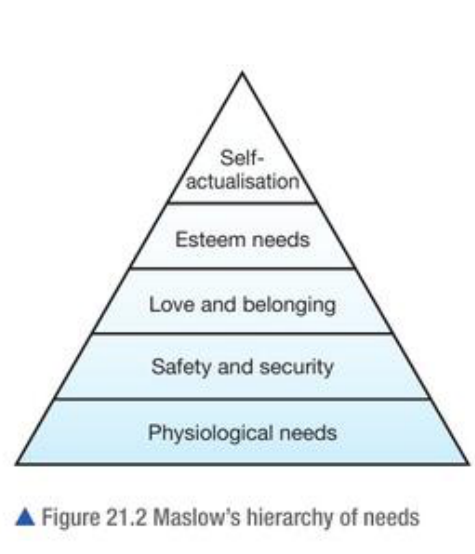
Physiological Needs
These are the essential needs for survival, such as food, water, clothing, warmth and rest. Work can help satisfy them by providing pay and, in some jobs, meals or accommodation.
Safety and Security
People need protection from danger and uncertainty. At work, this may mean safe conditions, protective procedures, job security and predictable rules.
Social Needs
People want friendships, care, communication and a sense of belonging. Teamwork, supportive colleagues and workplace social activities can help meet these needs.
Esteem Needs
Employees want recognition and respect from others, as well as confidence and self-respect. Praise, awards, acknowledgement of good performance and promotion may help.
Self-actualisation
At the top of the hierarchy is the desire to develop one’s abilities and reach personal potential. Jobs offering creativity, problem-solving, independent decisions and new challenges may help meet this need.
According to this theory, once a need has been sufficiently satisfied it becomes a weaker motivator, and higher needs become more important. It also explains that unmet basic needs can make higher-level rewards less effective. Actual employees may not follow the hierarchy in exactly the same order, so businesses should examine individual circumstances.
A worker concerned about job security may place less value on an exciting project than on secure employment. Another worker with adequate pay and security might be more motivated by responsibility, praise or chances to develop new skills.
Taylor's Theory of Scientific Management
In 1911, Frederick Taylor argued that workers were largely motivated by money. He believed that managers should study work carefully, identify the most efficient way to perform it and link earnings to output so that workers would have an incentive to produce more.
- Break jobs down into simpler, specialised tasks.
- Provide suitable tools and equipment.
- Require employees to follow a consistent working procedure.
- Give workers proper training and rest breaks.
- Link pay to the quantity of output produced: a “fair day’s pay for a fair day’s work”.
Suppose a worker earns US$2 for every satisfactory item produced. Producing 80 items earns US$160; producing 95 earns US$190. The extra 15 items increase pay by US$30. This is an illustrative calculation.
Potential advantages
- Clear output targets can encourage greater effort and productivity.
- Standardised methods and training may make production more efficient.
- Employees can see a direct financial return from extra output.
Considerations and limitations
- Too much emphasis on speed may reduce care or quality.
- Repetitive tasks may become boring and fail to meet social or esteem needs.
- Output is difficult to measure fairly in some service or team-based jobs.
Comparison: Taylor emphasises pay and efficiency; Herzberg emphasises achievement and work satisfaction; Maslow emphasises different levels of human needs. No one theory necessarily motivates every employee in every occupation.
Large vs Small Businesses
In practice, businesses of all sizes need motivated staff. Poor motivation can reduce output, raise recruitment costs and make it harder to provide good customer service.
Small businesses: employees may work closely with the owner, take on a broader range of tasks and have more influence over how the business operates. A supportive owner may recognise good work quickly. However, a small firm may have limited funds for promotion, specialised training or financial rewards.
Large businesses: there may be more structured training, formal promotion routes, teamworking and job rotation. These can give employees opportunities to develop. However, managers may need to work harder to maintain personal recognition across a large workforce.
A small retailer could motivate employees through direct praise and varied responsibilities, while a large manufacturer could offer formal promotion paths and team development. The best choice depends on the staff, job and available resources.
End-of-chapter questions
Try each question, then select “Show suggested answer” to check your understanding.
Explain the difference between Herzberg’s motivators and hygiene factors.
Show suggested answer
Motivators, such as responsibility and recognition, are intended to create job satisfaction. Hygiene factors, such as pay and safe working conditions, cause dissatisfaction if inadequate but do not by themselves necessarily motivate workers.
Classify promotion and job security using Herzberg’s theory.
Show suggested answer
Promotion is a motivator; job security is a hygiene factor.
Suggest two forms of job enrichment for a production worker.
Show suggested answer
Give the worker responsibility for checking quality or let them solve production problems and help make decisions, rather than only repeat a narrow task.
State the five levels of Maslow’s hierarchy from the bottom to the top.
Show suggested answer
Physiological needs; safety and security; love and belonging (social needs); esteem needs; self-actualisation.
Explain how praise from a manager could meet an employee’s needs.
Show suggested answer
Praise demonstrates respect and recognition, helping satisfy Maslow’s esteem needs and acting as a Herzberg motivator.
Use the Inchcape case to identify one way the firm might satisfy staff social needs.
Show suggested answer
Charity events and shared challenges can create relationships and a sense of teamwork or belonging.
Describe two aspects of Taylor’s scientific management.
Show suggested answer
Break work into specialist tasks with efficient procedures, and link payment to the amount of output produced. Training and suitable equipment also feature in Taylor’s approach.
A worker receives US$3 per completed item. Calculate earnings for 70 items and the difference if output rises to 85 items.
Show suggested answer
At 70 items the worker earns US$210. At 85 items earnings are US$255, an increase of US$45. These are illustrative figures.
Why might piece-rate pay be unsuitable for some customer-service jobs?
Show suggested answer
Service quality, cooperation and customer satisfaction are difficult to measure solely by quantity. Workers could rush interactions to increase output.
Evaluate whether a higher salary is always enough to motivate employees.
Show suggested answer
Higher pay can help meet basic needs and reduce dissatisfaction, and Taylor predicts financial incentives may raise output. However, Herzberg stresses recognition and responsibility, while Maslow highlights social and esteem needs. Its effectiveness depends on the employee and existing conditions.
A small firm is losing staff but cannot afford big pay rises. Recommend two ways it could improve motivation.
Show suggested answer
It could offer meaningful responsibility and recognise achievements, while improving communication, teamwork and safe working conditions. The owner should first check the cause of departures; inadequate basic pay or security cannot simply be ignored.
Chapter 21 recap
Motivation is the desire to achieve a goal. A motivated workforce may help a business attract and retain staff and improve productivity. Herzberg distinguishes motivators from hygiene factors, Maslow considers different levels of human needs, and Taylor focuses on efficiency and pay linked to output. Managers should choose approaches that suit their employees and business.
Educational adaptation of Pearson Edexcel International GCSE (9–1) Business, Chapter 21 (source pp. 174–182). Examples and figures are for revision; historical figures do not describe current company performance. IGCSE360 is an independent learning resource and is not affiliated with Pearson.