
Chapter 23 · Organisation Structure and Employees
Understand who is responsible for what, how managers communicate and delegate, and why organisational structures change as businesses grow.
Learning objectives
- Read and explain organisational charts showing hierarchical, flat, centralised and decentralised structures.
- Understand employee roles, accountability, authority, chain of command, span of control and delegation.
- Evaluate appropriate organisational structures for growing businesses.
Organisational Charts
A growing business needs a clear formal organisation. It divides work between people and departments so that planning, decision making, coordination and communication are manageable. An organisational chart is a diagram of that structure. It shows job titles, positions in the hierarchy, relationships between employees and the lines along which people report to one another.
- Functions and departments: the different activities into which the business is divided.
- Roles and responsibilities: what individual workers and managers do.
- Accountability: the person to whom an employee must answer for performance.
- Communication channels: lines through which information and instructions can travel.
The hotel belongs to an international hotel chain. Its general manager, Anil Karmi, oversees five departments: front office, reservations and marketing, housekeeping, restaurant, and kitchen. For example, Pradeep Pulami manages housekeeping, while Aarif Vesawkar is responsible for the kitchen. The department managers report through the hotel’s chain of command.
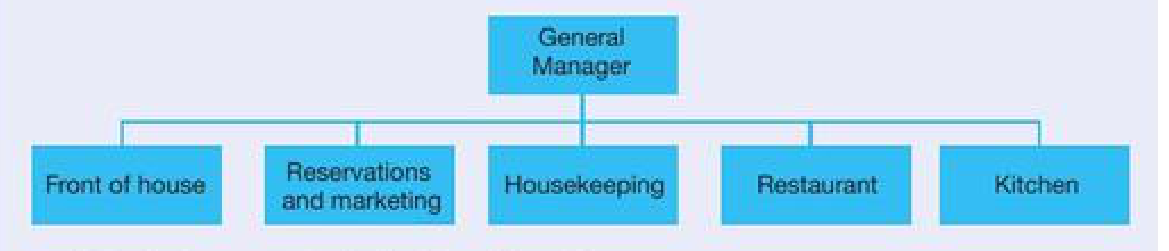
The chart illustrates that the general manager supervises five departments. Each department has its own specialist role, but they must coordinate: the kitchen and restaurant, for example, work closely together to serve guests.
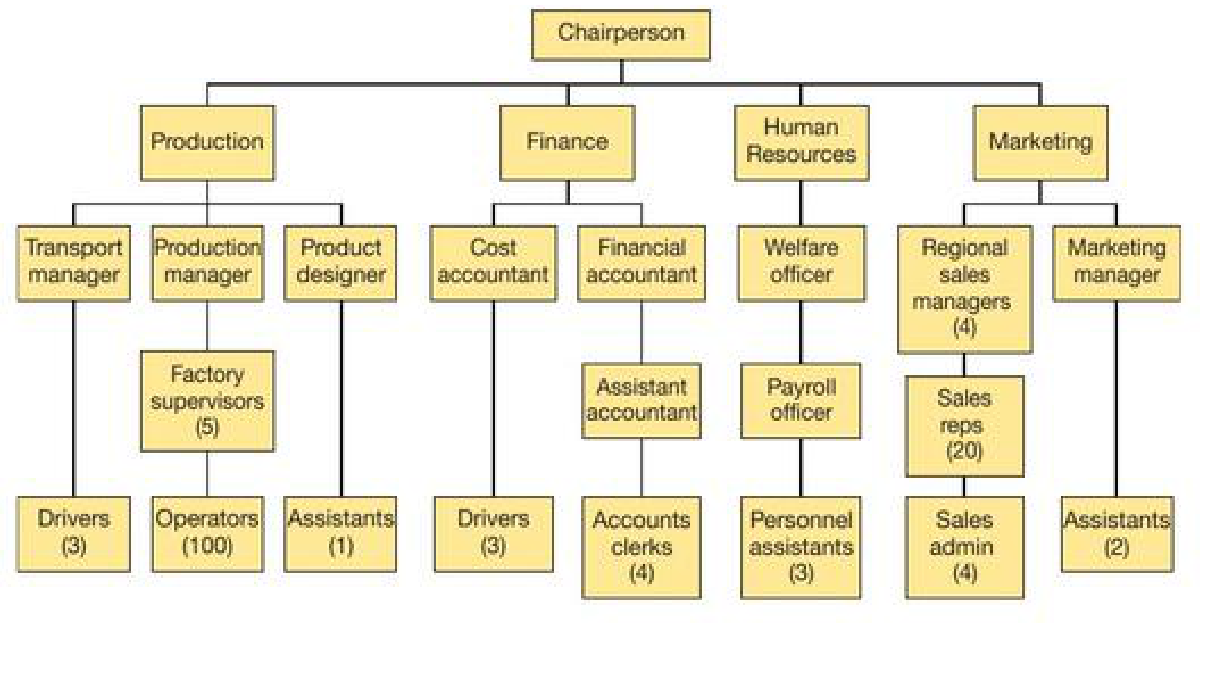
Denham Plc, a manufacturer, provides an example of a larger hierarchical business. Its chairperson sits at the top of the chart, above the production, finance, human resources and marketing directors. The chart extends to managers, supervisors, operatives and clerical employees.
Employee Roles and Responsibilities
An employee’s position determines their responsibility, authority and accountability. Authority is the right to give instructions and make decisions; accountability means having to explain performance to someone higher in the organisation. The same role may look different in a small business compared with a large one.
Directors
Directors are appointed by owners to run the business and make major decisions. Alongside the chairperson, they form the board of directors. In Denham Plc, the production, marketing, human resources and finance directors each lead a department and are accountable to the chairperson.
Managers
Managers plan, organise, control resources, motivate workers, solve problems and make day-to-day decisions. Their task is to help achieve business objectives. At Denham Plc, production and transport managers, regional sales managers and accountants with managerial responsibilities operate below department directors.
Supervisors
Supervisors oversee workers in a specific area and check their performance, conduct and work standards. Denham Plc has five factory supervisors, each responsible for 20 operatives. Supervisors carry out some management functions but generally have less authority than senior managers.
Operatives
Operatives are skilled workers who carry out practical production activities such as operating machines, assembling products, using tools and maintaining equipment. Denham Plc’s production department employs 100 operatives, who report to factory supervisors.
General Staff
General staff include office clerks, drivers, assistants and other workers who provide support rather than supervising others. Their positions are commonly at lower levels of an organisational chart. Skills and opportunities can improve through training and experience.
Professional Staff
Professional staff have specialist qualifications and training. For example, professions include lawyers, accountants, doctors, pilots and dentists. Businesses with many professionals may use different organisational structures because specialist employees may have substantial independent expertise.
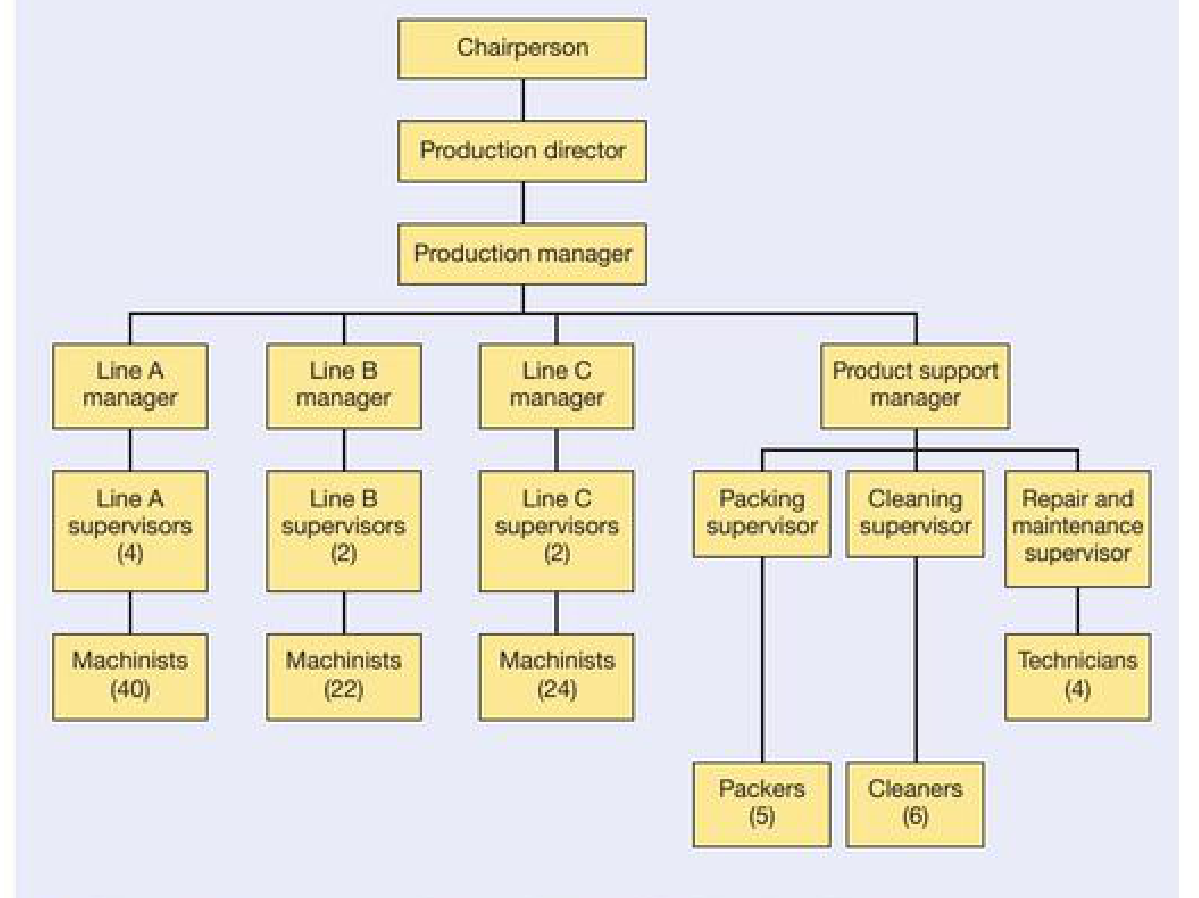
The Taiwanese manufacturer makes electric motors and operates three production lines. Its chart includes a chairperson, production director, production manager, line managers and supervisors, machinists and support workers. Employees such as machinists and repair technicians are operatives; line supervisors monitor their teams.
Check your understanding · Halfway
Try each question before opening the suggested answer.
Define an organisational chart and identify two things it shows.
Show suggested answer
It is a diagram showing the formal structure of a business. It can show job titles, department roles, lines of accountability, communication routes and positions in the hierarchy.
In the Zeta Hotel chart, how many departments report directly to the general manager?
Show suggested answer
Five: front office, reservations and marketing, housekeeping, restaurant and kitchen. The general manager’s charted span of control is five departments.
Explain the difference between authority and accountability.
Show suggested answer
Authority is the right to direct workers and make decisions; accountability is having to explain and answer for how duties have been carried out.
Describe one responsibility of a director and one of a supervisor.
Show suggested answer
A director leads a department and makes major decisions; a supervisor monitors the day-to-day work and standards of employees in their area.
In the Denham Plc chart, a factory supervisor oversees 20 operatives. Calculate the span of control.
Show suggested answer
The span of control is 20 because these are the supervisor’s direct subordinates.
Explain why a large manufacturer may use several levels of management.
Show suggested answer
With many specialised departments and employees, different managers help organise work, supervise teams and provide clear reporting and accountability. Too many levels may, however, slow communication.
Features of Organisational Structures
An organisation chart shows more than job titles. Managers can use it to understand who gives instructions, how many employees each manager oversees and whether decision-making authority is concentrated or shared.
Chain of Command
The chain of command is the route through which orders and instructions pass down the hierarchy. Information may also travel upward. A long chain can cause delays, distort messages or make it harder to gain acceptance for changes. For example, an instruction at Denham Plc may pass from a director to a production manager, then to a factory supervisor and finally to an operative.
Span of Control
A manager’s span of control is the number of subordinates they directly oversee—not every worker further down the chart. A wide span means more direct reports; a narrow span means fewer. A very wide span can become difficult to monitor, while a narrow span often requires more management levels and may raise costs.
Each regional sales manager oversees five sales representatives, so the span of control is 5. A factory supervisor oversees 20 operatives, so that supervisor’s span is 20. The number is based on direct reports only.
Flat and Hierarchical (Tall) Structures
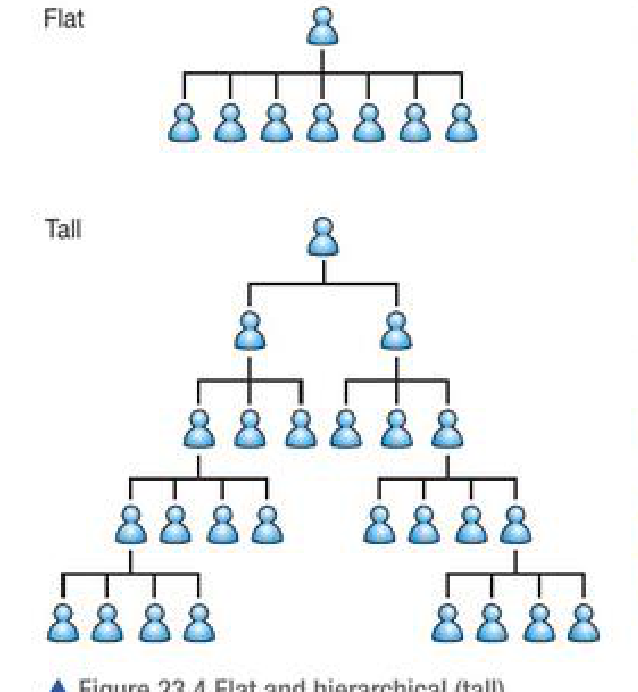
A flat structure has few management levels and generally a short chain of command. A tall or hierarchical structure has more levels and typically a longer chain. Figure 23.4 compares these structures.
Flat structure
- Shorter communication routes may improve clarity and speed.
- Fewer managers can reduce management costs.
- Direct contact may make control friendlier and less formal.
- Managers may be stretched if they supervise many employees.
Tall structure
- More levels may provide clearer promotion routes.
- More managers allow closer supervision of small teams.
- A long chain can delay or distort communication.
- Management costs and formality may be higher.
Delegation
Delegation happens when a senior person passes responsibility for completing a task, together with suitable authority, to a subordinate. The manager remains accountable for the overall result. Delegation can save management time and motivate workers by offering more responsibility, but it may cause dissatisfaction if staff see extra tasks as unpaid work or lack the ability to complete them.
The effectiveness of delegation partly depends on whether the business is centralised or decentralised, as discussed next.
Centralisation and Decentralisation
Centralisation places most important decision making near the top of an organisation. Decentralisation pushes some decisions down to lower managers or workers. Most real businesses use a mix: some decisions may remain with senior managers, while others are made close to customers and day-to-day operations.
Centralised — advantages
- Senior management retains control over resources.
- Experienced senior managers may make consistent decisions.
- Departments are less likely to act independently in conflicting ways.
- Coordination and control are easier.
Centralised — disadvantages
- Employees without authority may feel less motivated.
- There may be less creativity and fewer ideas from staff.
- Procedures can slow responses to decisions.
- Senior managers may be out of touch with local customers.
Decentralised — advantages
- Greater autonomy can motivate workers.
- Decisions can be faster and closer to customers.
- It reduces pressure on senior managers.
- Employees may contribute creative ideas and gain promotion opportunities.
Decentralised — disadvantages
- Senior managers may lose some resource control.
- Costs can rise when approaches are less standardised.
- Some workers may not have enough experience to decide well.
- Not all employees want extra responsibility.
In 2015, the IT services company Mphasis proposed decentralising some decisions. It planned to allow 17 executives working close to customers to make more decisions without higher-level approval. This could improve response times and customer service, but the firm would need to ensure consistent standards and appropriate decision-making skills.
Application: a decision about national company strategy may remain with the directors, while a local manager might be authorised to settle a routine customer problem immediately.
Large vs Small Businesses
Small businesses commonly have only a few employees. People know one another’s jobs, and most workers are accountable directly to an owner. A complex chart may be unnecessary. Large businesses with many departments and employees normally need formal lines of authority and accountability to reduce confusion, improve coordination and prevent communication breakdowns.
Large businesses
- Usually need clear, written job roles and reporting lines.
- Can group employees by department or project.
- May use multiple layers and specialist directors.
- Could delegate decisions to local managers to respond faster.
Small businesses
- Owners may directly supervise employees.
- Communication may be quicker and less formal.
- Staff often perform several roles.
- Growth can make an informal structure harder to manage.
Organisational Charts and Growth
Three broad organisational approaches may be used as a business grows:
- Entrepreneurial structure: common in small start-ups; the owner or a few key staff make decisions centrally.
- Traditional structure: employees are organised in a hierarchy, and decision making is shared through clearly defined reporting lines.
- Matrix structure: people from different departments work together on specific projects, sometimes reporting both to their functional manager and a project manager.
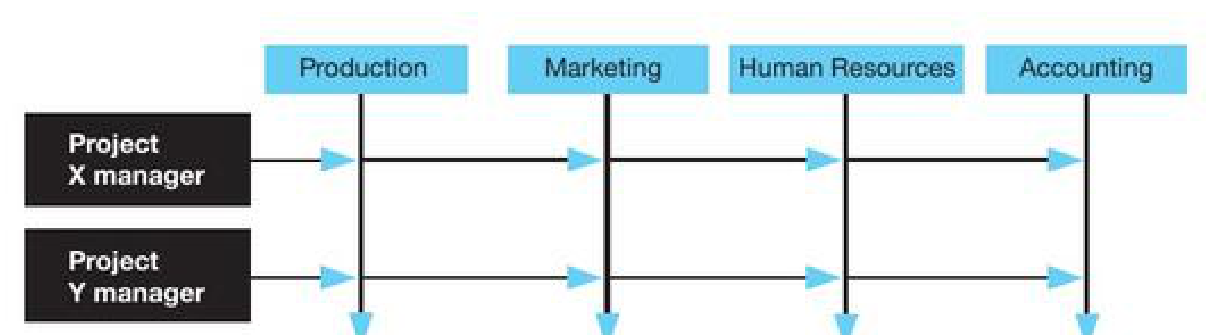
A matrix structure can bring together specialist skills for a project, but it may create confusion if employees receive conflicting instructions from different managers. The right structure depends on size, business activity and management needs.
End-of-chapter questions
Try each question before opening the suggested answer.
What is meant by the chain of command? Use a manufacturing example.
Show suggested answer
It is the route along which instructions pass down the hierarchy, for example from a production director to a manager, then a supervisor and an operative.
Distinguish a wide span of control from a narrow span of control.
Show suggested answer
A wide span means a manager directly oversees many subordinates; a narrow span means the manager directly oversees fewer employees.
Analyse one benefit and one limitation of a flat structure.
Show suggested answer
A short chain of command can make communication faster and reduce management costs. However, a manager may struggle to supervise many direct reports effectively.
Analyse one benefit and one limitation of a tall structure.
Show suggested answer
More layers can offer promotion routes and closer supervision, but they can increase management costs and slow or distort messages.
Explain delegation and identify who remains accountable.
Show suggested answer
Delegation transfers tasks and suitable authority to a subordinate. The original manager remains accountable for the overall task and outcome.
Give two advantages of centralised decision making.
Show suggested answer
Senior managers maintain control over resources, and decisions can be coordinated across departments. Experienced decision makers may also improve consistency.
Why might Mphasis have benefited from decentralising decisions to executives closer to customers?
Show suggested answer
Staff dealing with customers can act without waiting for senior approval, reducing delays and allowing services to respond more directly to customer requirements.
Explain two possible disadvantages of decentralisation.
Show suggested answer
Senior managers may lose control of resources; inconsistent or poorly informed local decisions may raise costs, and some employees may lack confidence or training.
How might an organisation chart change as a small entrepreneurial business grows?
Show suggested answer
A few people reporting to an owner may become a hierarchy with departments, managers and supervisors; some expanding firms may also use project-based matrix teams.
An operations director directly supervises production, finance, logistics and HR managers. The production manager directly oversees three team leaders. State each manager’s span of control.
Show suggested answer
Operations director: 4 direct reports. Production manager: 3 direct reports. Span of control counts direct subordinates, not everybody further down the hierarchy.
Evaluate whether a growing business should adopt a flatter organisational structure.
Show suggested answer
A flatter structure may speed communication, reduce management costs and increase employee responsibility. However, fewer layers can overload managers and reduce close supervision. The best choice depends on staff skills, workload and the need for control.
Chapter 23 recap
Organisational charts show how employees, managers and departments relate to each other. The chain of command describes the path of instructions; span of control counts direct subordinates; and delegation gives workers tasks and authority while managers remain accountable. Flat and tall and centralised and decentralised structures each have advantages and limitations. As businesses grow, their structures may shift from entrepreneurial to traditional or matrix approaches.
Educational adaptation of Pearson Edexcel International GCSE (9–1) Business, Chapter 23 (source pp. 192–199). Examples and figures are for revision; historical figures do not describe current company performance. IGCSE360 is an independent learning resource and is not affiliated with Pearson.