
Chapter 22 · Methods of Motivation at Work
Learn how financial rewards and meaningful work can encourage employees—and why the best method depends on the job.
Learning objectives
- Understand financial methods of motivation: remuneration, bonuses, commission, promotion and fringe benefits.
- Understand non-financial methods: job rotation, job enrichment and autonomy.
- Choose and evaluate suitable reward systems in business situations.
Remuneration
Remuneration means the money employees receive for doing their work. Businesses choose payment systems that fit the job and encourage employees to contribute. Financial rewards matter because workers need earnings for living costs; however, employees may also want interesting work, recognition and responsibility. The most suitable system depends on whether time, individual output or performance can be measured fairly.
Time Rates
Workers receive pay according to time spent at work—usually an hourly or weekly time rate. Many manual workers are paid by the hour. A salary is generally stated as an annual amount and commonly paid monthly, especially for non-manual workers. Salary may not be linked directly to hours worked or individual output.
Example: at US$20 an hour for 37 hours, gross pay is US$740. At time-and-a-half overtime, the additional rate is US$30 per hour. Pay can be reduced by income tax, pension contributions and other deductions.
- Advantage: straightforward to calculate and predictable for employees; sensible where quality, safety or output are difficult to measure.
- Disadvantage: employees who work faster may receive the same basic pay as less productive staff, so time pay alone may not reward extra output.
Piece Rates
With a piece rate, workers are paid for the number of completed units. For example, when picking grapes, at US$0.50 per kilogram, collecting 120 kg earns US$60. This can reward higher output directly and encourage effort where units are measurable.
- Advantages: greater effort can raise earnings and output; the business can link labour costs to production.
- Limitations: unsuitable when individual output is hard to count (for example, research or reception work); rushing can cause mistakes, damaged products and unsafe working practices.
Performance-related Pay
Performance-related pay (PRP) increases earnings when an employee meets or exceeds agreed performance targets. It is commonly used where output is not simply a count of identical units. An appraisal reviews progress, checks targets and sets new goals. PRP may reward strong performance and help retain effective staff.
- Managers’ assessments may seem unfair or inconsistent; workers could dispute the appraisal.
- An incentive may be too small to influence behaviour, or targets may be unrealistic.
- A worker may miss a target because equipment, IT systems or other factors are outside their control.
Bonus Payments
A bonus is money paid in addition to basic pay or salary for meeting a target, rewarding service, or recognising performance. Bonuses may reward an individual or a team, such as a sales department that achieves a quarterly target. Some businesses offer annual loyalty bonuses.
The possibility of a bonus can focus effort on measurable objectives. However, targets should be realistic and transparent; otherwise rewards may cause stress or rivalry. Bonuses raise wage costs when paid.
Commission
Commission is pay based on the value of sales made, usually a percentage. It is used for sales staff and may be their only payment or an addition to a fixed salary. For example, 5% commission on US$8,000 of sales is US$400. Higher sales can raise the salesperson’s earnings, although income may become uncertain and pressure to sell may be high.
Nasir Gul earns a basic salary of US$400 per month and US$200 commission for every insurance policy sold. Selling 11 policies gives US$2,600 for that month (US$400 + 11 × US$200). Although Nasir responds to these incentives, working to reach high earnings can be stressful; other sales workers may not respond as positively.
The taxi repair business pays mechanics US$20 per hour and time-and-a-half for hours beyond 35 per week. A mechanic working 50 hours earns US$1,150 gross: 35 × US$20 = US$700, plus 15 × US$30 = US$450. The manager receives an annual salary of US$62,000 without overtime.
Promotion
Promotion means moving to a more senior role, often with increased pay, authority and responsibility. Employees may work harder to gain new skills and progress in their careers. A business can encourage this by offering a clear path for development, internal recruitment and opportunities to demonstrate ability.
Promotion may motivate staff who value recognition or status, and it can encourage experienced employees to stay. Nevertheless, there may be few vacancies at higher levels; promoting one person may disappoint others. A promotion also requires the employee to be ready for new responsibilities.
Herzberg treats opportunities for advancement as a motivator that can help create job satisfaction. Promotion may also help employees meet Maslow’s esteem needs. These links build on Chapter 21.
Fringe Benefits
Fringe benefits are rewards workers receive in addition to their normal wage or salary. They are sometimes called the “perks” of a job. Benefits vary with the industry, worker needs, and affordability to the business. They may have a financial value even if paid without cash.
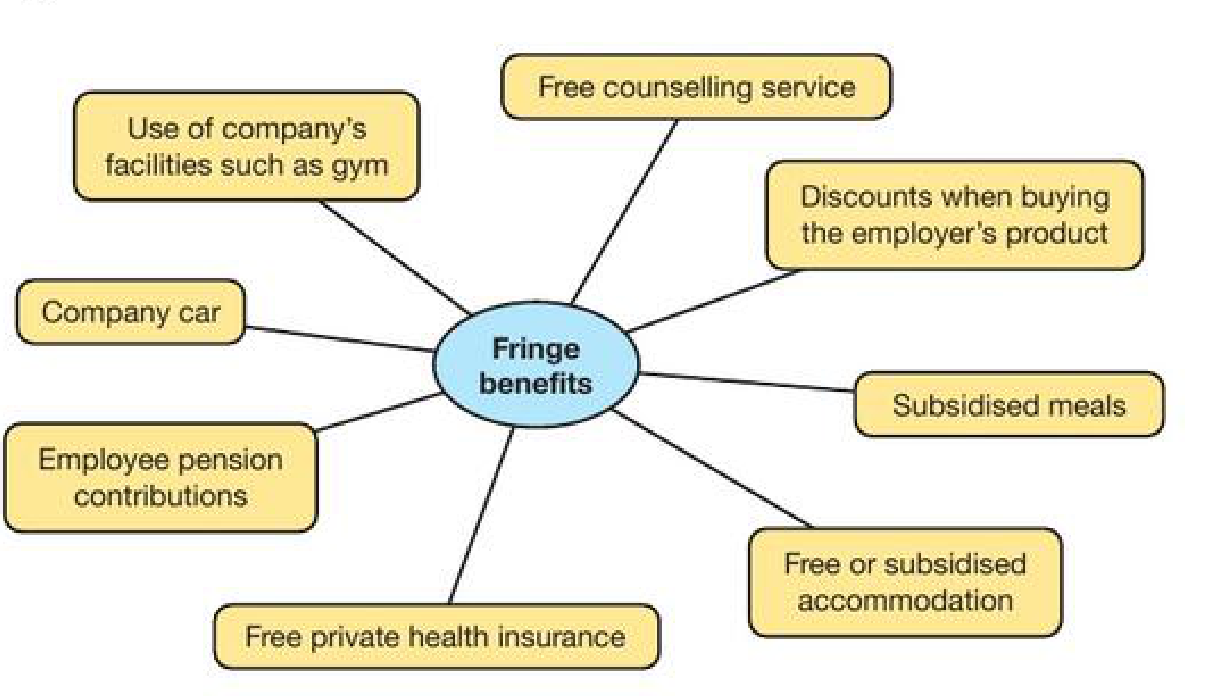
- Benefits can include company cars, pension contributions, private health insurance, subsidised meals, accommodation, counselling services, discounts and use of company facilities.
- Benefits may cost a business less than an equivalent wage rise, particularly where it can negotiate discounts; employee and employer tax treatment varies.
- Health care, counselling and recreational facilities may support staff wellbeing and attendance.
- Attractive benefit packages may help recruit and retain employees, especially when similar firms compete for skilled staff.
- Some benefits are linked to seniority or performance and can encourage progression, but costly or poorly targeted perks may have little motivational impact.
Evaluation: it is useful to remember that, in Herzberg’s theory, many fringe benefits are hygiene factors: they may prevent dissatisfaction, but may not by themselves create lasting motivation. Whether a benefit is valued depends on the worker’s circumstances.
Check your understanding · Halfway
Answer each question first, then reveal the suggested response.
Define remuneration and distinguish gross pay from net pay.
Show suggested answer
Remuneration is money paid for work. Gross pay is the amount earned before deductions, while net pay is what the worker receives after deductions such as income tax and pension contributions.
A worker earns US$20 per hour for 37 hours. Calculate the gross weekly pay before deductions.
Show suggested answer
37 × US$20 = US$740 gross pay.
GVS Life Assurance pays a US$400 monthly salary plus US$200 per policy. How much does an employee earn after selling 11 policies?
Show suggested answer
US$400 + (11 × US$200) = US$2,600.
Explain one advantage and one disadvantage of paying workers piece rates.
Show suggested answer
Output-based pay can encourage workers to produce more because earnings increase with each unit. However, rushing may damage quality or safety, and piece rates do not suit jobs where output is hard to count.
A Top Rank mechanic works 50 hours. Pay is US$20 per hour for the first 35 hours and time-and-a-half after that. Calculate gross pay.
Show suggested answer
Normal pay = 35 × US$20 = US$700; overtime = 15 × US$30 = US$450. Total gross pay = US$1,150.
How are a bonus and commission different?
Show suggested answer
A bonus is an additional payment for meeting targets, service or achievement. Commission is pay based on sales made, often a fixed percentage of sales value.
Non-financial Rewards
Non-financial rewards change a worker’s experience of the job rather than directly increasing money received. They can matter because not everyone is primarily motivated by pay; employees may seek variety, responsibility, recognition, autonomy, achievement or interesting work.
A financial reward may be difficult to connect to the contribution of one person in a team. In such jobs, changing responsibilities or giving workers more say in how they work can make motivation more effective. Maslow and Herzberg both help explain why such approaches may appeal to workers.
Job Rotation
Job rotation means moving employees between different tasks or roles over time. It gives employees variety and can reduce boredom caused by repetitive work. For example, in a supermarket, workers might move among online order picking, trolley collection, checkout and customer services.
- For employees: it can make work more interesting and help workers develop a wider range of skills.
- For the business: flexible staff can cover absences or busy departments; the business becomes less dependent on one person.
- Drawbacks: training costs may rise, specialisation may be lost, and some workers may dislike frequent changes or require extra supervision.
For example, Tata Steel’s employee-development approach as 70:20:10: 70% learning on the job, 20% through coaching and guidance, and 10% in the classroom. Job rotation is used to reduce repetitive factory work and give employees broader skills and experiences.
Job Enrichment
Job enrichment makes work more challenging or rewarding by adding meaningful responsibilities, choice and opportunities to develop unused skills. It is more than simply adding more routine tasks. Herzberg’s theory suggests that achievement, responsibility and interesting work are likely to motivate workers.
Johanna Jensen was an experienced manager who became bored and considered leaving. Her employer enriched her role by asking her to organise monthly meetings with other care-home managers, report to senior management, design an induction programme and attend international care conferences. These tasks used her abilities and increased her responsibility.
- Benefits: more interesting and varied work may improve satisfaction, motivation, problem solving and career development.
- Possible problems: extra responsibilities without training, time or resources can cause stress or lower productivity. Not every employee wants greater responsibility.
Distinction: job rotation changes the type of tasks undertaken; job enrichment increases the depth, challenge or responsibility of a role.
Autonomy
Autonomy, sometimes called empowerment, means giving employees authority to make choices and decisions about how they perform their work. Managers can set a goal but allow workers to decide the best way to achieve it.
- Autonomy can help motivated workers take ownership of performance, use creativity and feel valued.
- Decisions may be faster because employees do not need constant managerial approval. The business may need fewer supervisors.
- Some employees feel uncomfortable without guidance; managers may misuse autonomy to put pressure on staff to do more with the same resources. Training and clear boundaries matter.
Large vs Small Businesses
Businesses of different sizes may use different mixes of financial and non-financial rewards. A small owner-managed firm might not use formal motivation theory but may learn from experience which responsibilities, appreciation and working conditions help its employees. Large firms are more likely to employ specialist human-resource managers and design formal reward systems.
Large businesses
- More resources to develop formal performance reviews, bonus schemes and benefit packages.
- May offer clearer promotion routes across departments and locations.
- Need consistent, transparent policies across a large workforce.
- An unsuitable target system can discourage many employees.
Small businesses
- Owners may know staff individually and adapt rewards to their preferences.
- Job variety, recognition, flexible roles and autonomy may be affordable motivators.
- Cash constraints may limit bonuses and expensive benefits.
- Fewer promotion opportunities can make career development harder.
Overall judgement: a suitable method depends on the work performed, the firm’s financial resources, employee expectations and whether individual performance can be measured. A combination of fair pay and meaningful work is often more sustainable than relying on one method.
End-of-chapter questions
Answer each question first, then reveal the suggested response.
State two examples of financial methods of motivation and explain when each might be suitable.
Show suggested answer
Time rates suit work where individual output cannot be measured easily; commission suits sales jobs where sales can be identified. Piece rates, bonuses and PRP are other valid methods when targets can be assessed fairly.
Why might a company use promotion as a method of motivation?
Show suggested answer
Employees may work harder and improve their skills to gain a higher role, greater responsibility, status and possibly a higher salary. Promotion opportunities can also support retention.
Identify four fringe benefits from Figure 22.1 and explain one reason employees may value them.
Show suggested answer
Examples include pension contributions, company cars, counselling, subsidised meals, health insurance, company facilities and accommodation. A benefit can reduce personal costs, provide security or improve wellbeing.
Distinguish between job rotation and job enrichment using examples.
Show suggested answer
Job rotation involves changing tasks, such as moving supermarket staff between checkout and online picking. Job enrichment increases challenge or responsibility, as when a care-home manager organises induction and management meetings.
Explain one advantage and one disadvantage of giving employees autonomy.
Show suggested answer
Autonomy can help employees feel trusted and solve problems quickly. However, employees who lack training or confidence may find decision-making stressful, so clear guidance is needed.
Tata Steel uses a 70:20:10 development approach. Explain how job rotation may benefit the company and its workers.
Show suggested answer
Rotating roles may reduce repetitive work and let workers gain additional skills. The company may get more flexible employees, while workers gain variety; however, training costs and lost specialisation should be considered.
A salesperson earns 5% commission on US$8,000 in sales. Calculate the commission.
Show suggested answer
US$8,000 × 0.05 = US$400.
A sales employee receives a monthly salary of US$600 plus 4% commission on US$5,000 in sales. Calculate total monthly pay.
Show suggested answer
Commission = 0.04 × 5,000 = US$200. Total pay = US$600 + US$200 = US$800.
A firm introduces bonuses and later reports higher profits. Explain why the bonus scheme may not be the only cause.
Show suggested answer
Higher profit does not establish cause and effect. Changes in demand, selling prices, production costs or competition may also affect profit. Compare other evidence before judging the bonus scheme.
Compare how a small business and a large business might motivate employees.
Show suggested answer
A small firm might rely on personal recognition, flexible duties and autonomy because it has limited finance and fewer promotion opportunities. A large business might use formal PRP, training, promotion routes and benefit packages, but must ensure fairness across departments.
Evaluate whether financial or non-financial rewards are more likely to motivate an experienced employee who feels bored at work.
Show suggested answer
Fair pay remains important, but job enrichment, autonomy and recognition may address boredom more directly. The best approach combines adequate financial rewards with meaningful responsibilities and considers individual needs.
Chapter 22 recap
Financial rewards include time rates, salaries, piece rates, PRP, bonuses, commission, promotion and fringe benefits. Non-financial rewards include job rotation, job enrichment and autonomy. Good motivation systems fit the work, are fair, consider employee needs and avoid unintended consequences such as unsafe rushing or excessive stress.
Educational adaptation of Pearson Edexcel International GCSE (9–1) Business, Chapter 22 (source pp. 183–191). Examples and figures are for revision; historical figures do not describe current company performance. IGCSE360 is an independent learning resource and is not affiliated with Pearson.