
Chapter 26 · Cash Flow Forecasting
Learn to distinguish cash from profit, calculate cash inflows and outflows, and predict whether a business will have enough cash to pay its bills.
Learning objectives
- Explain why cash is essential for paying suppliers, overheads and employees and preventing insolvency.
- Distinguish cash flow from profit and identify different cash inflows and outflows.
- Prepare and interpret forecasts, including net cash flow and opening and closing balances.
The Importance of Cash
Cash flow describes money entering and leaving a business. Having enough cash available at the right time matters because even a profitable business cannot continue operating if it cannot pay bills when they fall due. Cash and bank deposits are highly liquid: they are readily available to make payments.
To Pay Suppliers, Overheads and Employees
Businesses purchase supplies, materials and components and often receive credit, meaning payment is due after delivery. The business must have enough cash by that date to pay. Rent, electricity, insurance and telephone bills also need paying, and employees expect wages or salaries on time. Missing payments can damage supplier relationships, disrupt operations and cause employees to leave.
To Prevent Business Failure
Without cash to pay debts as they become due, a firm can become insolvent and may have to close. To reduce the risk, it should keep accurate transaction records, prepare realistic cash flow forecasts and collect money owed by credit customers promptly. A forecast is not a guarantee, but it can provide early warning of difficulties.
Hiren and Thomas Aga established a small brick-making business near Mombasa. In June 2016 they received KES 155,000 from customers and spent KES 43,000 on raw materials, KES 20,000 on rent, KES 12,000 on fuel, KES 11,000 on other expenses, and KES 20,000 each for personal use. Total cash payments = KES 126,000. Net cash flow = 155,000 − 126,000 = KES +29,000. The owners’ withdrawals are cash outflows, not automatically operating costs used in calculating profit.
The Difference Between Cash and Profit
Profit and cash are not the same thing. Profit is calculated from revenue earned less expenses incurred over a period. Cash flow records when money actually moves. A business can report a profit while having very little money in its bank account.
- Credit sales: revenue may be earned before customers pay. Profit may rise while cash does not arrive until later.
- Payments for earlier sales: collecting money owed from an earlier month increases current cash but does not mean extra revenue was earned this month.
- Borrowing: receiving a loan increases available cash but does not create sales revenue or profit.
- Buying fixed assets: paying for a machine reduces cash immediately, but the full purchase cost is not normally treated as an expense in the same period when calculating profit.
- Opening cash: a business may start a month with cash from an earlier period, so its closing cash balance need not equal its profit.
Suppose a business sells services worth $5,000 on credit in June but collects the payment in July. June may include the $5,000 as sales revenue for profit calculations, even though it receives no cash then. July cash inflow includes the collection, although the revenue was earned in June.
Cash Inflows and Outflows
Business owners group the cash they expect to receive and pay into two categories. Comparing these totals shows whether the cash position is improving or deteriorating in a particular month.
Cash Inflows
A cash inflow is money received by the business. Examples include cash sales, payments from credit customers, bank loans, additional capital from owners, interest received and proceeds from selling assets. A cash flow forecast should record the inflow in the period when cash is expected to arrive—not when a sale is first agreed.
Cash Outflows
A cash outflow is money the business pays out. Examples include wages, rent, raw materials, petrol, loan repayments, purchases of equipment, tax and owner drawings. Some payments, such as repaying the principal of a loan, affect cash without being treated as an expense when calculating profit.
Net Cash Flow
Net cash flow = Total cash inflows − Total cash outflows. A positive net cash flow means more cash entered than left in that month. A negative net cash flow means payments exceeded receipts; it does not necessarily mean the business has run out of money, because it may have cash carried forward from earlier months.
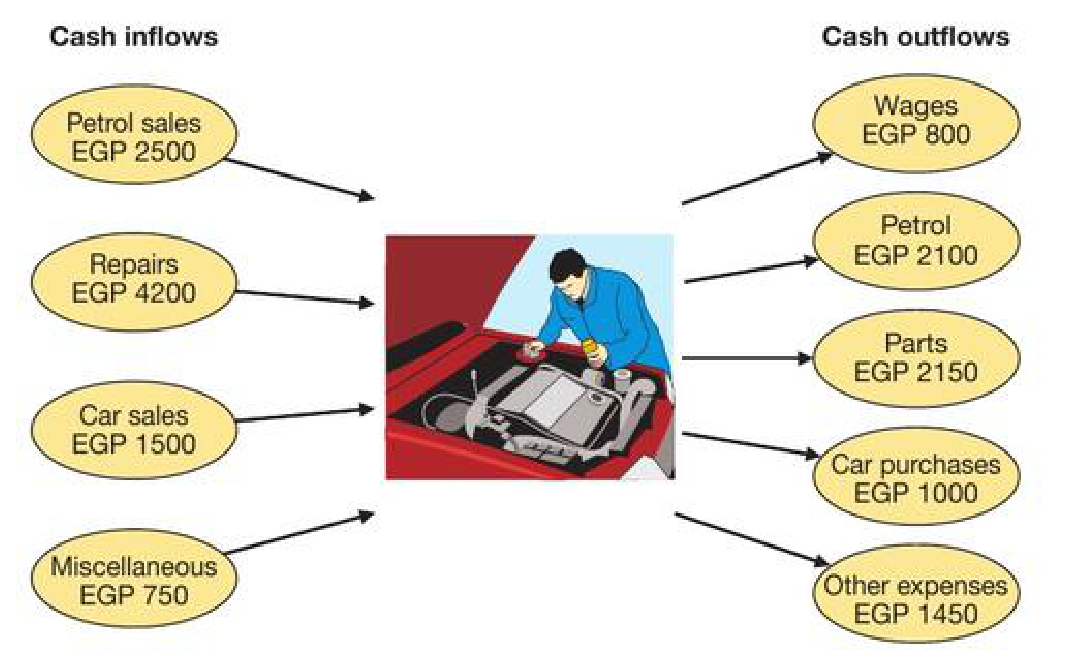
In a June 2015 worked example, cash receipts from petrol sales (EGP 2,500), repairs (EGP 4,200), car sales (EGP 1,500) and miscellaneous sources (EGP 750). These total EGP 8,950. Payments for wages, petrol, parts, cars and other expenses total EGP 7,500. Therefore net cash flow is EGP +1,450.
Abdul expects US$1,400 in immediate receipts and US$5,400 collected from customers whose laundry was completed 60 days previously. Both are cash inflows in July, totalling US$6,800. His forecast payments are wages $2,500, cleaning materials $400, motor expenses $700, utilities $400, advertising $100, other overheads $500 and owner drawings $1,000: total $5,600. Thus July net cash flow is +$1,200. Money received for earlier work demonstrates why net cash flow differs from current-month profit.
Check your understanding · Halfway
Try each question before opening the suggested answer.
Define cash flow and explain why a profitable business can still fail.
Show suggested answer
Cash flow is money entering and leaving a business. A profitable firm might still be unable to pay urgent bills because customers have not yet paid or because it has spent too much cash on assets.
Use Aga Brick Making’s June figures to calculate net cash flow.
Show suggested answer
KES 155,000 inflows − (43,000 + 20,000 + 12,000 + 11,000 + 20,000 + 20,000) outflows = +KES 29,000.
Give two cash inflows and two cash outflows for a garage.
Show suggested answer
Inflows: payments for repairs and car sales. Outflows: wages and purchases of parts (other valid business cash items accepted).
Calculate Salah Motor Services’ June net cash flow from EGP 8,950 inflows and EGP 7,500 outflows.
Show suggested answer
EGP 8,950 − EGP 7,500 = +EGP 1,450.
Explain one difference between an owner’s loan and sales revenue.
Show suggested answer
Cash from a loan increases cash available but is not revenue earned by selling goods or services. The principal must generally be repaid.
Abdul Hassan expects July cash receipts of US$1,400 plus US$5,400 collected from older credit customers, and payments of US$5,600. Find the net cash flow.
Show suggested answer
Total July cash inflows = 1,400 + 5,400 = $6,800. Net cash flow = 6,800 − 5,600 = +$1,200.
Cash Flow Forecasts
A cash flow forecast is a financial document estimating future cash inflows and outflows over a period, often divided into months. Businesses use forecasts to plan ahead and check whether they will have enough cash to meet payments. Figures are estimates, so the forecast should be reviewed when circumstances change.
| Calculation | Formula / meaning |
|---|---|
| Total cash inflows | Add the cash expected to be received in the month |
| Total cash outflows | Add the cash expected to be paid in the month |
| Net cash flow | Total inflows − Total outflows |
| Closing cash balance | Opening balance + Net cash flow |
| Next month’s opening balance | Previous month’s closing balance |
A negative net cash flow indicates that payments exceed receipts during a particular month. A negative closing balance is a more urgent warning: the forecast shows that the business needs additional cash or must alter its plans to meet its commitments.
Consider a three-month forecast drawn up in May 2015 for June, July and August. In June, an opening balance of EGP 450 and net cash flow of EGP +1,450 give a closing balance of EGP 1,900. This becomes July’s opening balance. By August the net cash flow is EGP −500, but the business still expects a positive EGP 3,150 closing balance.
| Salah Motor Services (EGP) | June | July | August |
|---|---|---|---|
| Total cash inflows | 8,950 | 9,350 | 9,500 |
| Total cash outflows | 7,500 | 7,600 | 10,000 |
| Net cash flow | +1,450 | +1,750 | −500 |
| Opening cash balance | 450 | 1,900 | 3,650 |
| Closing cash balance | 1,900 | 3,650 | 3,150 |
The following calculations complete a January–March 2016 forecast for Priscila’s university bookshop. The calculations below assume the missing entries in the table are zero: no interest in January or March, and no fresh capital in January or February. For January, outflows = 1,700 + 500 + 1,000 + 230 = €3,430. Net cash flow = €3,000 − €3,430 = −€430. Starting with €230, the January closing balance is −€200.
| Priscila’s bookshop (€) | January | February | March |
|---|---|---|---|
| Book sales | 3,000 | 3,500 | 3,100 |
| Interest | 0 | 150 | 0 |
| Fresh capital | 0 | 0 | 2,000 |
| Total cash inflows | 3,000 | 3,650 | 5,100 |
| Stock | 1,700 | 1,790 | 1,900 |
| Casual labour | 500 | 500 | 500 |
| Rent | 1,000 | 1,000 | 1,000 |
| Other expenses | 230 | 240 | 230 |
| Total cash outflows | 3,430 | 3,530 | 3,630 |
| Net cash flow | −430 | +120 | +1,470 |
| Opening balance | 230 | −200 | −80 |
| Closing balance | −200 | −80 | 1,390 |
Priscila’s forecast shows a cash shortage at the end of January and February. The extra €2,000 capital in March improves her position, but it is not profit from selling books. A sensible response would be to plan temporary funding or change when stock is purchased, while checking whether expected sales will be achieved.
Why Are Cash Flow Forecasts Important?
Preparing a forecast helps managers make decisions before they run into cash difficulties. Key examples include four key uses:
Identifying Cash Shortages
A forecast shows months when expected payments exceed receipts and whether the closing balance may fall below zero. This gives the business time to arrange an overdraft, collect debts sooner, delay a purchase or reduce avoidable spending. Cash-flow planning is particularly important when sales are seasonal.
Supporting Applications for Funding
Banks and other lenders may require evidence that a business can meet future repayments. A clear cash flow forecast can show when money should be available and what funding gap a loan or overdraft would cover. A forecast alone is not proof that finance will be approved; assumptions must be credible.
Help When Planning the Business
Managers can test whether proposed purchases, recruitment, advertising or expansion are affordable. By comparing possible timings and amounts, they can plan activities around the periods when sufficient cash is expected to be available.
Monitoring Cash Flow
Once each month finishes, managers should compare actual receipts and payments with the forecast. Differences may arise because customers paid late, costs were higher than expected or sales changed. Investigating these differences helps improve later forecasts and actions.
Large vs Small Businesses
Every business needs to control cash, whatever its size. Small firms may have fewer cash reserves and less access to borrowing, making one large unpaid invoice especially damaging. Large firms can also experience serious cash-flow problems if they pay their smaller suppliers late or have large repayment obligations.
In practice, some powerful large firms delay paying small suppliers, shifting cash pressure onto those suppliers. Forecasting helps both sides manage the timing of payments, but small businesses may have less negotiating power to demand prompt settlement.
Small businesses
- Often have thinner cash reserves and limited credit facilities.
- Need to watch late customer payments closely.
- May use a simple monthly spreadsheet forecast.
Large businesses
- May have more sophisticated treasury and forecasting systems.
- Can spread cash risks across customers and operations.
- Still need to manage supplier payments, investments and loan commitments.
Overall judgement: cash flow forecasts are useful for every size of business. Their value depends on realistic estimates and regular comparison with actual cash movements.
End-of-chapter questions
Try each question before opening the suggested answer.
State the formula for net cash flow and explain what a negative figure indicates.
Show suggested answer
Net cash flow = cash inflows − cash outflows. A negative figure means the business paid more cash than it received in that period, but it may still have a positive closing balance.
State the formula for closing cash balance and explain why next month’s opening balance matters.
Show suggested answer
Closing balance = opening balance + net cash flow. The closing balance becomes the opening balance for the next period, carrying forward the business’s cash position.
Complete Salah Motor Services’ August closing balance using EGP 3,650 opening cash and EGP −500 net flow.
Show suggested answer
EGP 3,650 − EGP 500 = EGP 3,150. The month’s cash flow is negative but the closing balance remains positive.
Calculate Priscila Landa’s January cash outflows and closing balance.
Show suggested answer
Outflows = €1,700 + €500 + €1,000 + €230 = €3,430. Net cash flow = €3,000 − €3,430 = −€430. Closing = €230 − €430 = −€200.
Complete Priscila Landa’s February closing balance from her January balance and February inflows and outflows.
Show suggested answer
February inflows = €3,650, outflows = €3,530, net cash flow = +€120. Opening = January closing €−200, so closing = €−80.
How does Priscila’s additional €2,000 of fresh capital affect her March forecast?
Show suggested answer
It adds €2,000 of cash inflow, contributing to March total inflows of €5,100 and a closing balance of €1,390. It is financing, not sales profit.
Explain two ways a cash flow forecast can help a business avoid financial problems.
Show suggested answer
It warns managers about future cash shortages, giving time to arrange finance or control payments. It also allows comparison of actual cash flows against plans so managers can respond to late receipts and unexpected costs.
Why might a bank ask to see a cash flow forecast before lending?
Show suggested answer
To assess the firm’s predicted cash position and its capacity to make interest and capital repayments when due. The bank also needs realistic assumptions and other evidence.
A shop expects €4,500 of customer receipts, €2,000 from a bank loan and €700 of owner capital in April. Cash payments will be €3,900 for supplies, €1,500 wages, €500 rent and €300 loan repayment. Calculate April net cash flow.
Show suggested answer
Inflows = €4,500 + €2,000 + €700 = €7,200. Outflows = €3,900 + €1,500 + €500 + €300 = €6,200. Net cash flow = +€1,000.
The shop opens May with €1,000 in cash. May receipts total €5,400 and payments total €6,000; June receipts are €6,300 and payments are €5,700. Calculate each month’s closing balance.
Show suggested answer
May: net cash flow = −€600; closing balance = €1,000 − €600 = €400. June: net cash flow = +€600; closing balance = €400 + €600 = €1,000.
Evaluate whether a cash flow forecast is more important for a small seasonal shop or a large supermarket group.
Show suggested answer
Both need forecasts. The small shop may have little spare cash and large seasonal changes, so a forecast can be essential for survival. The large group must coordinate cash across many locations and suppliers, but may have more reserves and credit access. Importance depends on payment terms, liquidity and forecast accuracy, not just size.
Chapter 26 recap
Cash flow is about timing. Inflows and outflows determine net cash flow, which is added to the opening balance to produce the closing balance. A forecast helps identify when cash shortages may occur, supporting finance decisions, planning and monitoring. A negative net flow need not mean a negative cash balance, and cash flow is not the same as profit.
Educational adaptation of Pearson Edexcel International GCSE (9–1) Business, Chapter 26 (source pp. 218–224). Examples and figures are for revision; historical figures do not describe current company performance. IGCSE360 is an independent learning resource and is not affiliated with Pearson.