
Chapter 27 · Costs
Understand what costs businesses face, how costs change with output, and how to calculate total costs, average costs, revenue, profit and loss.
Learning objectives
- Explain and calculate fixed, variable, total and average costs.
- Calculate total revenue using price and quantity sold.
- Calculate and interpret profit or loss in different business situations.
Why Does Production Generate Costs?
Every business uses resources to make goods or provide services. Those resources are not free: firms pay for materials, employees, premises, transport, machinery, energy, marketing and administration. These payments are called costs. A business needs to identify and calculate its costs so it can set prices, plan production, monitor spending and work out whether it makes a profit.
For example, making tyres requires rubber, synthetic fabric, steel, machines, factory space, labour and electricity. The producer also pays for advertising, administration and distribution. Some expenses stay the same when output rises, while others increase as more goods are produced.
AmPat Construction, a specialist family housebuilder, employed around 140 people and built about 350 houses a year. Building costs included bricks, cement, timber, labour and machinery, alongside office equipment and other expenses. In 2016 the business reported total costs of US$56,450,200 and revenue of US$63,440,700. Profit = US$63,440,700 − US$56,450,200 = US$6,990,500. These are historical figures, not current results.
Business costs can be classified by how they change when output changes. The two key categories are fixed costs and variable costs.
Fixed Costs
Fixed costs (FC) do not change with the level of output over the period being considered. Rent, business rates, certain insurance premiums, loan interest and some research and development spending are examples . A firm can incur these costs even when it produces nothing.
Fixed Costs and Output
If a firm doubles its output while its rent and other fixed expenses stay the same, total fixed costs remain unchanged. This does not mean they can never change: a move to a larger factory, a rent increase or a longer time period may raise fixed costs. This is also known as fixed costs overheads.
The fixed-cost graph is labelled Frampton Training. It shows annual fixed costs of US$40,000 whether the business provides 100, 150 or a different number of HGV-training course places. The flat horizontal graph reflects unchanged fixed costs.
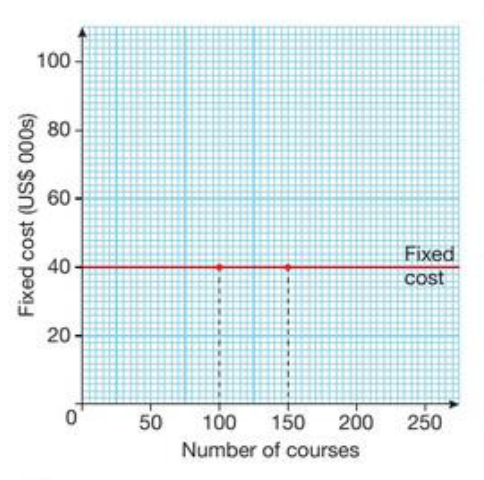
Interpreting the graph: when output changes from 100 to 150 course places, the fixed-cost line remains at US$40,000. Fixed cost per course would fall if more courses were provided, but the total fixed cost remains the same.
Variable Costs
Variable costs (VC) change when output changes. The more a firm produces, the more it may spend on raw materials, packaging, fuel and production labour. Producing fewer units usually reduces variable costs. In the simple model used in this chapter, variable costs are zero at zero output.
Variable Cost Per Unit
If variable cost per unit stays constant, total variable cost = variable cost per unit × quantity produced. A straight upward-sloping line on a graph shows variable costs increasing in direct proportion to output. Actual costs can be less predictable, but a practical example involves this simplified relationship for calculations.
The training example uses variable costs of US$500 per course. At 100 places: 100 × US$500 = US$50,000. At 150 places: 150 × US$500 = US$75,000. An extra 50 places therefore increases total variable costs by US$25,000.
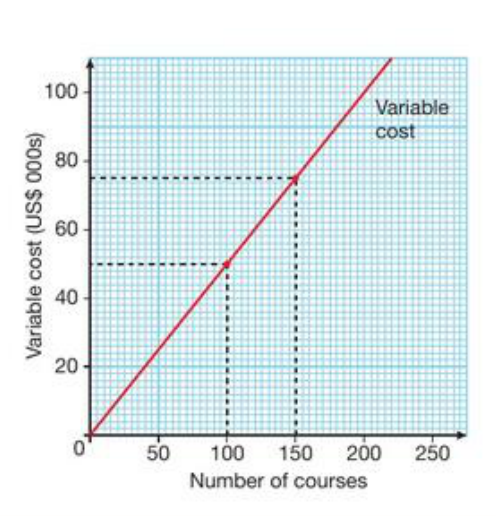
The diagram is taken from the Frampton Training graph; the later worked calculations refer to Millhouse Training. The underlying cost relationship is the same, but the names are retained as printed in the book.
Total Costs
Total costs (TC) are all the costs of producing a given level of output during a period. They combine fixed costs and variable costs:
If variable cost per unit is constant: TC = FC + (VC per unit × quantity).
Calculating Total Costs
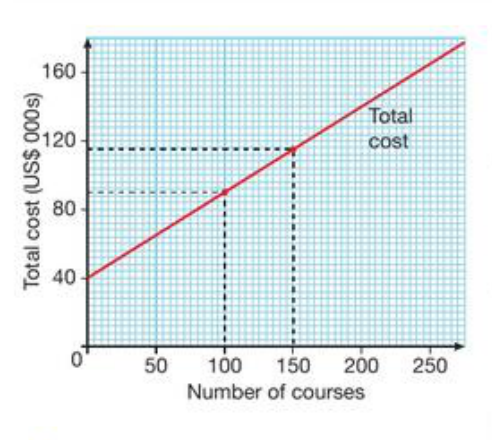
Using the training-course values, total fixed costs are US$40,000 and variable costs are US$500 for each place. For 100 places: TC = 40,000 + (100 × 500) = US$90,000. For 150 places: TC = 40,000 + (150 × 500) = US$115,000. The cost of one more course place is US$500 in this simplified example.
Reading Cost Graphs
The total-cost line begins above zero because the business has to meet fixed costs even when no course places are provided. As output rises, the line slopes upward because variable costs are added. The vertical intercept is the total fixed cost.
Kandasan Cricket Bats
Kandasan Cricket Bats in Colombo, Sri Lanka employed six skilled craftspeople. The book gives fixed costs of LKR 50,000 rent, LKR 5,000 business rates and LKR 25,000 other fixed costs, totalling LKR 80,000. Per-bat variable costs are LKR 30 wood + 10 other materials + 50 labour + 10 other variable costs = LKR 100.
| Year | Bat output | Fixed cost | Variable cost | Total cost |
|---|---|---|---|---|
| 2015 | 4,800 | LKR 80,000 | 4,800 × 100 = LKR 480,000 | LKR 560,000 |
| 2016 | 6,000 | LKR 90,000 (rent increased) | 6,000 × 100 = LKR 600,000 | LKR 690,000 |
The total cost increased by LKR 130,000 (690,000 − 560,000). The rise comes from 1,200 additional bats costing LKR 120,000 in variable costs, plus LKR 10,000 extra rent.
Check your understanding · Halfway
Attempt each question before revealing the suggested answer.
What is a business cost? Give two examples from AmPat Construction.
Show suggested answer
A cost is an expense of running or setting up a business. AmPat pays for materials such as bricks and timber and for resources such as labour and machinery.
Distinguish fixed costs from variable costs.
Show suggested answer
Fixed costs do not change as output changes over the relevant period, such as rent. Variable costs change with output, such as raw materials needed per unit.
If a training business has annual fixed costs of US$40,000, what are the fixed costs at 100 and 150 course places?
Show suggested answer
US$40,000 in both cases. Total fixed costs do not increase solely because output rises.
Calculate variable costs for 150 training places at US$500 per place.
Show suggested answer
150 × US$500 = US$75,000.
A firm has fixed costs of US$40,000 and variable costs of US$75,000. Calculate total costs.
Show suggested answer
TC = FC + VC = 40,000 + 75,000 = US$115,000.
Kandasan Cricket Bats makes 4,800 bats at LKR 100 variable cost each, with fixed costs of LKR 80,000. Find total cost.
Show suggested answer
Variable cost = 4,800 × 100 = LKR 480,000. Total cost = 480,000 + 80,000 = LKR 560,000.
Average Costs
Average cost (AC) is the cost of producing a single unit of output. It is found by dividing all production costs by the number of units produced. Average cost is useful when a business compares efficiency or considers whether a selling price will cover production costs.
Average Cost Formula
In a worked example, the figures are total costs of US$90,000 for 100 training places. Average cost = 90,000 ÷ 100 = US$900 per place. The company needs enough selling revenue to cover these costs if it is to avoid making a loss on those course places.
Average cost can fall when fixed costs are spread over more units. Using the same model, at 150 places TC is US$115,000, so average cost ≈ US$766.67. This comparison assumes the same fixed and unit variable costs; it is not a claim that costs always fall as output expands.
Total Revenue
Total revenue (TR) is the money generated from sales of goods or services. This can be calculated it by multiplying the selling price by the quantity sold. The units sold matter: output produced is not automatically the same as output sold.
Revenue Formula
In the worked example, Millhouse Training charges US$1,500 for each training place and sells 100 places. Total revenue = US$1,500 × 100 = US$150,000. If the price or the number of places sold changes, revenue changes accordingly.
Revenue is not the same as profit. A high sales figure does not prove that the business has performed well until the costs incurred are taken into account.
Calculating Profit
Profit is the money left from total revenue after deducting total costs. If costs exceed revenue, the difference is a loss. Businesses calculate profit to assess performance, decide whether their operations are sustainable and judge possible changes in output, costs and prices.
Profit and Loss
Loss = Total cost − Total revenue (where costs exceed revenue).
TR = 100 training places × US$1,500 = US$150,000. TC = US$40,000 fixed costs + (100 × US$500 variable costs) = US$90,000. Therefore profit = 150,000 − 90,000 = US$60,000.
Jenkins Ltd Worked Example
Jenkins Ltd makes electronic gate-control systems and sells each system for US$250. Fixed costs were US$160,000. Its 2015 variable cost was US$120 per system, and it produced and sold 4,500 systems. In the follow-up calculation, 5,200 systems were sold in 2016 and variable costs increased to US$140 per system; fixed costs and selling price remained unchanged.
| Year | Output sold | Total costs | Total revenue | Profit |
|---|---|---|---|---|
| 2015 | 4,500 | 160,000 + (4,500 × 120) = US$700,000 | 4,500 × 250 = US$1,125,000 | US$425,000 |
| 2016 | 5,200 | 160,000 + (5,200 × 140) = US$888,000 | 5,200 × 250 = US$1,300,000 | US$412,000 |
Even though Jenkins sold more systems in 2016, its profit was US$13,000 lower because the rise in unit variable costs more than offset the extra revenue. This shows why output and sales alone do not measure success.
End-of-chapter questions
Attempt each question before revealing the suggested answer.
Give two examples each of fixed and variable costs for a furniture manufacturer.
Show suggested answer
Fixed: factory rent and insurance. Variable: wood and fabric used per unit. Some labour costs may vary with production arrangements.
Explain why a firm may incur fixed costs when it produces nothing.
Show suggested answer
The business can still owe rent, insurance and other contractual overheads even when production stops.
Calculate the total cost of producing 400 units with fixed costs of $12,000 and variable cost $25 per unit.
Show suggested answer
Variable costs = 400 × $25 = $10,000; total costs = 12,000 + 10,000 = $22,000.
What are average costs when total costs are US$90,000 and output is 100 places?
Show suggested answer
AC = 90,000 ÷ 100 = US$900 per place.
Calculate total revenue if a business sells 350 units at $80 each.
Show suggested answer
TR = 350 × 80 = $28,000.
Calculate AmPat Construction’s 2016 profit from revenue of US$63,440,700 and costs of US$56,450,200.
Show suggested answer
Profit = 63,440,700 − 56,450,200 = US$6,990,500.
Calculate Kandasan Cricket Bats’ 2016 total cost for 6,000 bats when fixed costs are LKR 90,000 and variable cost per bat is LKR 100.
Show suggested answer
VC = 6000 × 100 = LKR 600,000. TC = 90,000 + 600,000 = LKR 690,000.
Explain why a manufacturer’s profit could fall even though it sold more units than in the previous year.
Show suggested answer
If variable costs per unit rise sufficiently, total costs can increase faster than revenue. A higher sales volume does not guarantee higher profit.
A manufacturer sells 1,000 items for Rs 2,500 each. Fixed costs are Rs 600,000 and variable costs are Rs 1,400 per item. Calculate total costs and profit.
Show suggested answer
Total costs = Rs 600,000 + (1,000 × Rs 1,400) = Rs 2,000,000. Total revenue = 1,000 × Rs 2,500 = Rs 2,500,000. Profit = Rs 500,000.
A separate order for 1,500 items would earn Rs 1,500 per unit, with fixed costs of Rs 200,000 and variable costs of Rs 1,400 per unit. Calculate its profit or loss.
Show suggested answer
Variable costs = Rs 2,100,000; total costs = Rs 2,300,000; revenue = Rs 2,250,000. The order makes a Rs 50,000 loss.
Evaluate whether the manufacturer should accept the additional order described in Question 10.
Show suggested answer
The order is forecast to make a Rs 50,000 loss and would not normally be attractive on the stated assumptions. Managers should check whether costs can be reduced, prices improved or spare capacity used profitably, and consider strategic benefits before deciding.
Chapter 27 recap
Fixed costs stay the same over the relevant range of output; variable costs change with output. Total cost = fixed + variable costs; average cost = total costs ÷ output; total revenue = price × quantity sold; and profit = total revenue − total cost. Always show the formula, substitute the figures and give a clear judgement when assessing a business decision.
Educational adaptation of Pearson Edexcel International GCSE (9–1) Business, Chapter 27 (source pp. 225–230). Examples and figures are for revision; historical figures do not describe current company performance. IGCSE360 is an independent learning resource and is not affiliated with Pearson.