
Chapter 29 · Statement of Comprehensive Income
Read a business income statement, calculate gross and operating profit, and use historical financial results to support business decisions.
Learning objectives
- Explain the purpose and main items in a statement of comprehensive income.
- Calculate gross profit, operating profit, profit after tax and retained profit.
- Use income statements when making business decisions, and explain why profit matters.
The Purpose of a Statement of Comprehensive Income
At the end of a financial year, businesses need to establish whether their trading activities generated a profit. A statement of comprehensive income summarises the business’s income and expenditure over a stated period, usually one year. In practice, it is also commonly called a profit and loss account. It measures performance during a period, rather than assets owned on one particular day.
The statement first calculates gross profit, the difference between revenue and cost of sales. It then calculates operating profit, the balance after operating expenses are deducted. Finance costs and tax may subsequently be deducted to obtain profit after taxation.
Operating profit = Gross profit − Operating expenses
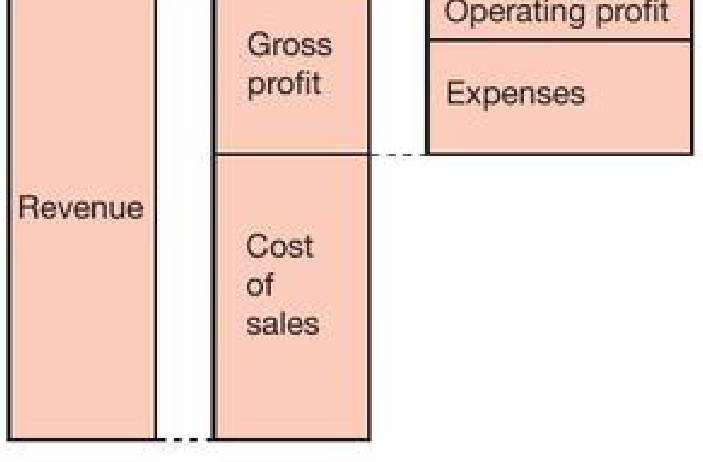
Musab Assad and his family operate a grocery store in Doha. For the financial year, the example uses revenue of US$256,400, cost of sales of US$137,100, expenses of US$77,900 and finance costs of US$600.
| Item | Calculation | US$ |
|---|---|---|
| Revenue | Given | 256,400 |
| Cost of sales | Given | (137,100) |
| Gross profit | 256,400 − 137,100 | 119,300 |
| Operating expenses | Given | (77,900) |
| Operating profit | 119,300 − 77,900 | 41,400 |
| Finance costs | Given | (600) |
| Profit for the year | 41,400 − 600 | 40,800 |
The store could compare this result with earlier years, examine whether operating expenses are affordable and decide how much profit can be used to improve the business. Remember that profit is not the same as cash held in the bank: sales may be made on credit and some payments may occur at different times.
Retained and Distributed Profit
A business does not necessarily distribute every dollar of profit to its owners. After any tax due, profit may be distributed to the owners or retained in the business. A limited company can distribute part of its profit to shareholders through a dividend.
- Why retain profit? To buy equipment, fund expansion, pay for future research, or protect the business against difficult trading conditions.
- Why distribute profit? To reward owners and shareholders who have invested their money and taken a risk.
- Trade-off: Paying a larger dividend leaves less profit available for reinvestment, while retaining more may disappoint shareholders seeking an immediate return.
Format 66 develops software for automated production lines. For 2015, the business reported revenue of US$12.56 million, cost of sales of US$7.60 million and expenses of US$2.56 million. Gross profit = 12.56 − 7.60 = US$4.96m. Operating profit = 4.96 − 2.56 = US$2.40m. If the simplified exercise assumes no other deductions and distributes US$0.80m, the remaining profit is US$1.60m, which may be retained.
In a real set of accounts, interest, tax and other items can affect the amount available for distribution. This calculation uses simplified assumptions and excludes other potential charges.
Check your understanding · Halfway
Answer each question before revealing the suggested answer.
What is a statement of comprehensive income, and what time period does it cover?
Show suggested answer
It summarises a business’s income and expenditure for a specified period, typically a financial year, and helps to calculate profit. It is not a snapshot of assets and liabilities on one date.
Doha Food Store earned US$256,400 revenue and had US$137,100 cost of sales. Calculate gross profit.
Show suggested answer
Gross profit = 256,400 − 137,100 = US$119,300.
Doha Food Store paid operating expenses of US$77,900. Calculate operating profit.
Show suggested answer
Operating profit = 119,300 − 77,900 = US$41,400. Its US$600 finance cost is deducted afterwards.
Explain the difference between gross profit and operating profit, using Figure 29.1.
Show suggested answer
Gross profit is revenue less cost of sales. Operating profit is gross profit less operating expenses. The diagram shows part of revenue covering cost of sales, then operating expenses, leaving operating profit.
Format 66 earned US$12.56m revenue, had US$7.60m cost of sales and US$2.56m expenses. Calculate operating profit.
Show suggested answer
Gross profit = 12.56 − 7.60 = US$4.96m. Operating profit = 4.96 − 2.56 = US$2.40m.
If Format 66 distributes US$0.80m to shareholders from the simplified US$2.40m profit, how much remains and what might it be used for?
Show suggested answer
US$1.60m remains, assuming no further deductions; the business might retain this money to buy equipment, fund expansion or build a financial reserve.
The Statement of Comprehensive Income
The statement has a standard layout so that owners, managers, investors and lenders can understand and compare performance. Consider Walnut Soaps, a soap and toiletries manufacturer, illustrates the usual sequence from revenue to profit after taxation.
| Statement line (US$000) | 2016 | 2015 |
|---|---|---|
| Revenue | 5,400 | 4,900 |
| Cost of sales | (3,500) | (3,100) |
| Gross profit | 1,900 | 1,800 |
| Administrative expenses | (750) | (700) |
| Other operating expenses | (160) | (150) |
| Operating profit | 990 | 950 |
| Finance costs | (100) | (100) |
| Profit for the year | 890 | 850 |
| Taxation | (160) | (150) |
| Profit for the year after taxation | 730 | 700 |
The sections below explain the main entries in an income statement.
Revenue
Revenue is income from selling goods and services, excluding VAT collected on behalf of the government. Walnut Soaps earned US$5.4m in 2016. Revenue is not the same as profit because producing and running the business creates costs.
Cost of Sales
Cost of sales includes costs directly associated with producing goods or providing a service. For a manufacturer this may include raw materials and factory workers’ wages; for a retailer it commonly includes inventory bought for resale. For a taxi service, fuel and drivers’ wages are examples. Walnut Soaps’ 2016 cost of sales was US$3.5m.
Gross Profit
Gross profit = Revenue − Cost of sales. Walnut Soaps’ 2016 gross profit is US$5.4m − US$3.5m = US$1.9m. This is before the business deducts administrative and other operating expenses.
Administrative Expenses
These are general running costs, often called overheads. Examples include office salaries, administrative stationery, accounting fees, telephone bills and IT costs. In 2016, Walnut Soaps recorded US$750,000 of administrative expenses.
Other Operating Expenses
These are day-to-day business expenses not grouped as administrative costs, for example minor subscriptions, postage or stationery where accounted for separately. Walnut Soaps reported US$160,000 in 2016. An expense should not be counted twice in the statement.
Selling Expenses
Costs of marketing and distributing the product can include sales commissions, advertising, distribution and promotion. They may be reported as a separate operating expense category. The Walnut Soaps example does not show a separate selling-expenses line; do not invent one when reproducing the table.
Operating Profit
Operating profit = Gross profit − Operating expenses. For 2016, Walnut Soaps’ operating expenses in the table total US$910,000 (US$750,000 + US$160,000), giving US$990,000 operating profit. It indicates how much profit the business generated from its normal operating activities before finance costs and tax.
Finance Costs
Finance costs mainly mean interest paid on borrowed funds. Another item is finance income, such as interest received on deposit accounts. Walnut Soaps’ finance costs were US$100,000 in 2016. Finance income, if included, is added rather than subtracted.
Profit for the Year
To calculate profit for the year before tax, subtract finance costs from operating profit. For Walnut Soaps in 2016: US$990,000 − US$100,000 = US$890,000. More complex company statements may also include other income and adjustments.
Profit for the Year After Taxation
Finally, the relevant tax is deducted. Walnut Soaps’ profit after tax in 2016 was US$890,000 − US$160,000 = US$730,000. The comparable 2015 result was US$700,000, so after-tax profit rose by US$30,000, around 4.3%. Some of this final profit may be distributed and some retained.
An example includes 2016 revenue of US$26.9m, cost of sales US$17.4m, gross profit US$9.5m and expenses US$4.4m. Its missing 2016 operating profit is US$5.1m. For 2015, revenue is US$29.2m and gross profit US$11.1m, so missing cost of sales = US$18.1m. With profit before tax US$4.7m and tax US$1.6m, missing 2015 profit after tax is US$3.1m.
| Sanchez Supersoft (US$m) | 2016 | 2015 |
|---|---|---|
| Revenue | 26.9 | 29.2 |
| Cost of sales | 17.4 | 18.1 |
| Gross profit | 9.5 | 11.1 |
| Expenses | 4.4 | 4.8 |
| Operating profit | 5.1 | 6.3 |
| Finance costs | 1.8 | 1.5 |
| Profit before tax | 3.3 | 4.7 |
| Taxation | 1.1 | 1.6 |
| Profit after tax | 2.2 | 3.1 |
The business is less profitable in 2016: after-tax profit fell from US$3.1m to US$2.2m. Although expenses decreased, revenue and gross profit declined, so this did not prevent profits from falling.
How Might the Statement of Comprehensive Income Be Used in Decision Making?
A statement of comprehensive income is useful beyond simply calculating an annual profit. Managers, owners and investors can examine changes between financial years and decide how to respond. There are four important uses.
Investment Decisions
Rising profits may encourage a business to invest in machines, stores, technology or additional staff because it may have more internally generated resources. Weak or falling profits may lead managers to delay expansion. Example: A toiletries producer may use stronger earnings to justify replacing an inefficient production line, while also checking its cash flow and investment cost.
Cost Analysis
Comparing cost of sales and expenses with previous years can reveal cost pressures. If raw-material expenses rise sharply, managers might negotiate with suppliers, seek lower-cost materials or improve efficiency. Example: Walnut Soaps’ cost of sales rose from US$3.1m to US$3.5m between 2015 and 2016, a rise of US$0.4m; managers should compare this with revenue growth and changes in output before concluding that efficiency worsened.
Basis for Future Forecasts
Businesses may use past revenue and profit trends as a starting point for budgets, profit forecasts or future investment plans. However, past growth is not guaranteed to continue. Example: If earnings have risen for two years, a business may forecast further growth but should account for competition and changes in demand.
Making Comparisons
Owners and investors can compare a company’s results between years or assess different businesses before investing. Such comparisons work best when accounting periods, business sizes and the measures being compared are similar. Example: A potential investor could compare the profit performance of two vehicle manufacturers rather than judging each company by revenue alone.
A single statement cannot show the business’s complete position. To judge whether it can pay bills when due, users also need cash-flow and financial-position information. Competition and changes in market conditions may also affect interpretation.
The Nature and Importance of Profit
Most businesses seek to earn profit because owners put their time and money at risk. The prospect of a financial return motivates entrepreneurs to start and maintain enterprises. Profit also provides evidence of how well a business is performing and may supply funding for expansion.
- Reward for risk: entrepreneurs need an incentive to invest and face the possibility of losses.
- Measure of performance: sustained profit can suggest a business has controlled costs and served customers successfully, although one year’s result does not tell the whole story.
- Source of future finance: retained profit can support new products, training or equipment purchases.
- Resource allocation: investors may direct funds toward growing, profitable industries and away from industries experiencing prolonged decline.
Consider the contrast between expanding activities, such as social media and smartphone-related industries, with declining traditional activities, such as photographic-film production. These are examples of the chapter period, rather than claims about the current performance of those sectors.
Large vs Small Businesses
In practice, many small businesses, especially sole traders, do not prepare an elaborate formal statement. They may ask an accountant to calculate annual profit, monitor expenses and determine tax liabilities. Large businesses, particularly limited companies, generally need more detailed formal accounts and may be required by local law to publish financial statements.
| Small businesses | Large businesses |
|---|---|
| Usually fewer income and cost categories; owners may maintain simpler records. | Often several departments and revenue streams require detailed financial reporting. |
| An accountant may prepare the annual figures for the owner. | Finance teams, executives and investors use year-on-year financial statements. |
| Results assist personal decisions on costs, prices and reinvestment. | Results support shareholder communication, investment plans and comparisons. |
| Legal reporting obligations vary with jurisdiction and business form. | Reporting and disclosure requirements are often more extensive. |
Regardless of size, understanding gross profit, operating profit and profit after taxation helps managers decide whether the business can continue successfully.
End-of-chapter questions
Answer each question before revealing the suggested answer.
Define revenue and cost of sales, and give an example of each for Walnut Soaps.
Show suggested answer
Revenue is income from sales of goods and services, excluding VAT collected for the government. For Walnut Soaps, revenue comes from selling soaps; cost of sales includes raw ingredients and production workers’ wages.
Walnut Soaps’ 2016 revenue was US$5.4m, cost of sales US$3.5m, administrative expenses US$0.75m and other operating expenses US$0.16m. Calculate gross and operating profit.
Show suggested answer
Gross profit = 5.4 − 3.5 = US$1.90m. Operating expenses = 0.75 + 0.16 = 0.91m; operating profit = 1.90 − 0.91 = US$0.99m.
Walnut Soaps paid finance costs of US$0.10m and tax of US$0.16m. Calculate profit before tax and profit after tax for 2016.
Show suggested answer
Profit before tax = 0.99 − 0.10 = US$0.89m; profit after tax = 0.89 − 0.16 = US$0.73m.
Explain two differences between administrative expenses and selling expenses.
Show suggested answer
Administrative expenses pay for general business administration, such as office staff and accounting. Selling expenses are linked to getting products sold, such as advertising, sales commission and distribution; they may be presented in different categories.
Sanchez Supersoft reported revenue of US$29.2m and gross profit of US$11.1m in 2015. Find the missing cost of sales.
Show suggested answer
Cost of sales = 29.2 − 11.1 = US$18.1m.
Sanchez Supersoft reported US$9.5m gross profit and US$4.4m expenses in 2016. Find operating profit.
Show suggested answer
Operating profit = 9.5 − 4.4 = US$5.1m.
Sanchez Supersoft made US$4.7m profit before taxation and paid US$1.6m tax in 2015. Calculate profit after tax and comment on its 2016 result of US$2.2m.
Show suggested answer
2015 profit after tax = 4.7 − 1.6 = US$3.1m. The 2016 result of US$2.2m is US$0.9m lower, indicating a significant deterioration in after-tax profit.
Describe two ways a statement of comprehensive income might support a manager’s decisions.
Show suggested answer
Investment decisions: growing profit may support a new production line. Cost analysis: rising overheads may signal a need for efficiency improvements or new suppliers. It can also support forecasts and comparisons.
Explain normal profit and why retaining profit may matter for a growing business.
Show suggested answer
Normal profit is the minimum reward needed to maintain owners’ interest in a business. Retained profit can finance machinery, expansion or contingencies without immediately seeking additional external funding.
A retailer has revenue of £250,000 and cost of sales of £145,000. Profit before tax is £35,000 and profit after tax is £27,000. Calculate gross profit and the tax charge.
Show suggested answer
Gross profit = £250,000 − £145,000 = £105,000. Tax charge = £35,000 − £27,000 = £8,000.
A company’s annual revenue rises from £500,000 to £530,000, but profit after tax falls from £65,000 to £52,000. Evaluate its financial performance.
Show suggested answer
Revenue grew by 6%, but profit after tax fell by 20%. This could indicate higher costs or reduced profit margins. Managers should examine costs, prices and cash flow before concluding whether overall financial performance improved.
Chapter 29 recap
Gross profit = Revenue − Cost of sales; Operating profit = Gross profit − Operating expenses. Finance costs and tax are then accounted for to arrive at profit after taxation. Businesses may distribute or retain profit. Income statements inform investment, cost control, future forecasts and comparisons, but must be read alongside other business information.
Educational adaptation of Pearson Edexcel International GCSE (9–1) Business, Chapter 29 (source pp. 238–245). Examples and figures are for revision; historical figures do not describe current company performance. IGCSE360 is an independent learning resource and is not affiliated with Pearson.