
Chapter 34 · The Importance of Marketing
Understand how marketing builds loyal customers, develops products around customer needs, measures market share and helps firms respond when markets change.
Learning objectives
- Explain the role of marketing in meeting needs, building relationships and keeping customer loyalty.
- Distinguish product-oriented and market-oriented businesses, and niche and mass marketing.
- Calculate and interpret market shares using the example’s Kenya, Ferrari and oil-market figures.
- Assess why firms respond to changing customer needs, spending and competition.
Markets and Marketing
Most firms operate in markets where customers can choose between rival products. A market exists when buyers and sellers can communicate and exchange goods and services for money. A market is not necessarily a physical building: buyers can trade in shops, by telephone or through the internet. Examples in this example include consumer-goods markets, services, property and commodities such as coffee, oil and copper.
Marketing helps a business understand and serve buyers. activities such as finding out what customers need, developing suitable products, studying competitors, communicating with buyers, selecting prices, encouraging purchases and making products conveniently available. These decisions work together: excellent advertising is unlikely to rescue a product that does not meet customer needs.
- Consumer-goods markets: groceries, cosmetics, household products and other goods bought for use.
- Service markets: banking, cleaning, tourism and other activities performed for customers.
- Housing market: the buying and selling of property.
- Commodity markets: raw materials such as oil, metals, coffee and wheat.
Example: Hasan’s Restaurant
Aftab Hasan, whose Indian restaurant has strong demand at weekends. The case credits fairly priced, high-quality food and excellent service. About 80% of the customers are regulars. Hasan also responds to workers finishing late at a nearby factory by staying open until 2 a.m. on Thursday nights, rather than closing at his usual 10.30 p.m.
The business succeeds by understanding what particular customers value: convenient opening hours, dependable food, a friendly experience and suitable prices. Rather than simply trying to attract new customers through promotion, Hasan creates repeat purchases by building relationships with existing customers.
Satisfying Customer Needs
Satisfying customer needs means offering goods and services that people are willing and able to buy, at a price and in a place that suits them. Needs may concern quality, speed, reliability, appearance, safety or convenience. A business must not simply assume customers want a product because the firm can make it.
Market research, introduced in Chapter 33, helps identify these needs before product development or major expenditure. Businesses should also anticipate new preferences by monitoring lifestyles, fashions and technological change. Customers may prefer more environmentally friendly packaging, easier mobile ordering or faster delivery than in the past.
Suppose customers at a neighbourhood shop increasingly want online ordering and evening collection. The shop could offer a click-and-collect service. This is marketing because the business has identified what buyers require and changed how its products are made available.
Meeting needs does not guarantee success. Rivals can offer alternatives, costs may rise, and customers may have different preferences. A firm needs to keep listening to customers and reviewing its product, price, promotion and distribution decisions.
Building Customer Relationships
A customer relationship is the ongoing connection between a business and its customers. Strong relationships can lead to trust, positive recommendations, repeat purchases and better information about changing needs. Communication is especially important: the business should listen, respond and solve problems, not just send sales messages.
Social media allows a two-way conversation with customers rather than only sending promotional announcements. In one historical survey, 87% of satisfied customers said positive online interactions made them more likely to buy from a company. This finding is illustrative and does not guarantee the same result for every business.
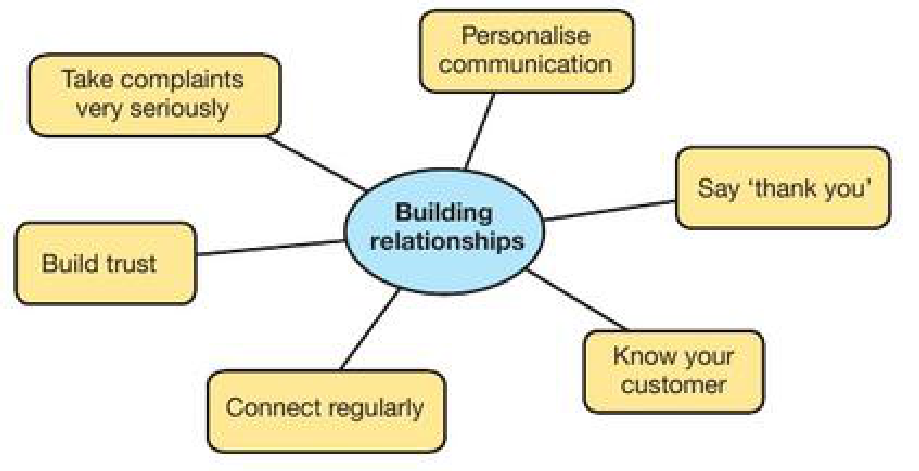
- Listen and solve problems: respond seriously to complaints and correct service failures.
- Personalise communication: offer relevant information rather than identical messages to everyone.
- Build trust: deliver on promises and treat customers fairly.
- Stay connected: make it easy to ask questions, give feedback and obtain help.
- Show appreciation: thank customers and recognise their loyalty.
Aftab Hasan considers long-standing customers personal friends and adjusts his opening hours for their needs. This may create a stronger relationship than a one-off price discount because customers feel understood.
Keeping Customer Loyalty
Customer loyalty exists when buyers continue to purchase from the same business instead of switching to rivals. Keeping existing customers may be less expensive than constantly attracting new ones, although any quoted cost comparisons depend on the business and circumstances. Loyal customers may provide regular revenue, recommend the business and make sales more predictable.
Customer loyalty does not mean a business can ignore quality. A reward scheme is most effective when it supports good service, product reliability and fair value. several loyalty methods:
Reward Cards
Customers earn points, discounts or vouchers when making purchases. A supermarket or coffee shop might offer a reward after a number of visits. The scheme encourages repeat purchasing, but it also costs money to administer and may attract people interested only in discounts.
Free Gifts
A business may give something extra when customers spend a specified amount. a historical Amazon example involving free Kindle books; the marketing principle is rewarding customers with an item they value. A poorly chosen gift could be costly without creating longer-term loyalty.
Charitable Donations
A business can promise a donation to a social or environmental cause linked to customer purchases. This may appeal to customers who value responsible business behaviour, but the donation and the cause should be genuine and communicated transparently.
Partnership Deals
Two businesses may cooperate to give customers special discounts or rewards, sharing promotion costs and reaching each other’s audiences. a historical American Express–Twitter promotion as an example of this approach.
Example: InterContinental Hotels Group
An example of a hotel loyalty scheme is IHG Rewards Club, associated with brands such as Holiday Inn and Crowne Plaza. Historically, members could earn points or miles and receive benefits such as special offers, later checkout and room upgrades. Current programme terms may differ.
For the hotel group, repeat bookings and reliable customer relationships can help reduce the need for expensive advertising each time a traveller needs accommodation. However, free benefits reduce the profit from some visits, so the programme must attract enough additional profitable business to justify its cost.
| Loyalty method | Potential benefit | Possible limitation |
|---|---|---|
| Reward cards | Encourage repeat purchases | Discounts and administration reduce margins |
| Free gifts | Make customers feel valued | Gifts may attract bargain hunters only |
| Charitable donations | Strengthen associations with shared values | Needs transparent and credible implementation |
| Partnership deals | Reach customers of both firms | Partners share control of the customer experience |
Check your understanding · Halfway
Try each question independently, then select “Show suggested answer” to check your reasoning.
Distinguish between a market and marketing.
Show suggested answer
A market allows buyers and sellers to exchange goods or services. Marketing is identifying, anticipating and satisfying customer requirements profitably, including products, prices, promotion and distribution—not simply selling.
Using Hasan’s restaurant, explain two reasons why customer needs should guide marketing.
Show suggested answer
Hasan provides reasonably priced, good-quality food and stays open late for local factory workers. These choices meet needs for value, quality and convenience, helping create repeat customers.
Identify three ways a business can build strong customer relationships.
Show suggested answer
It can listen to complaints, personalise communication and deliver reliable service. The relationship diagram also highlights building trust, thanking customers and keeping in touch.
Explain the difference between reward cards and partnership deals as loyalty methods.
Show suggested answer
Reward cards give customers points or discounts based on purchases. Partnership deals involve two firms offering joint benefits or discounts to each other’s customers. Both encourage repeat business but have costs.
Compare product orientation and market orientation using one business example of each.
Show suggested answer
A product-oriented pharmaceutical firm might develop a drug using specialist scientific knowledge. A market-oriented retailer could research customers’ preferred prices and product features before creating a new range.
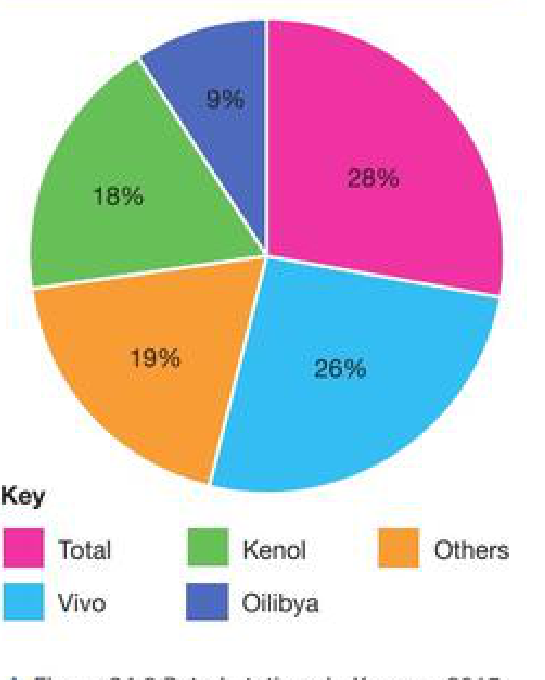
In the Kenyan petrol-station market, Total held 28%, Vivo 26% and Kenol 18%. Calculate their combined market share.
Show suggested answer
Combined share = 28 + 26 + 18 = 72%. Together the three named suppliers controlled almost three quarters of the market shown in the 2015 chart.
Product and Market Orientation
A business may be product oriented or market oriented. The distinction concerns where product decisions begin: the product and the firm’s expertise, or the customers and their needs.
pharmaceutical firms such as Pfizer and Bayer can be product oriented when they concentrate on developing new drugs for an established medical need. A market-oriented firm might first research customers’ desired features and price range and then develop an appropriate product.
| Product-oriented approach | Market-oriented approach |
|---|---|
| Begins with technical expertise, inventions or product quality. | Begins by identifying and researching customer needs. |
| May lead to innovative, technically advanced goods. | May reduce the risk of creating goods consumers do not want. |
| Risks neglecting how much customers value or can afford the product. | Risks too much imitation of existing preferences and costly research. |
| Example: a firm develops a new medicine using its scientific capabilities. | Example: a company researches what local shoppers want before designing a service. |
Neither approach is automatically best for every situation. A scientific breakthrough can create new opportunities, while market research is especially important when deciding product design, service details or distribution in a highly competitive market.
Market Share and Market Analysis
Market share is the proportion of total sales in a market accounted for by a particular business or product. It can be calculated using sales value or sales volume, but the same measure must be used for the firm and the whole market.
Figure 34.2 shows petrol-station market shares in Kenya in 2015. Total at 28%, Vivo at 26%, Kenol at 18%, Oilibya at 9% and others at 19%. The three largest named suppliers together controlled 72% of this market.
If a business sells US$35 million of products in a market worth US$100 million, its market share is US$35m ÷ US$100m × 100 = 35%. If the market expands, a firm’s sales may rise while its share falls if rivals grow faster.
Market analysis is the quantitative and qualitative examination of a market’s characteristics. It can help managers judge whether a market is attractive, profitable, competitive or likely to change. Information should be gathered on market size, growth, existing rivals, possible entry costs, future profitability and consumer behaviour.
- Size and growth: how much the whole market sells and whether demand is rising or falling.
- Competition: how many rivals operate and which hold the largest shares.
- External influences: economic, political, technological, environmental and social changes.
- Costs and opportunities: likely investment, market segments and potential profit.
- Customer habits: where, how and why customers buy and use products.
Market analysis must be repeated: a previously strong position can weaken when substitutes, new technologies or changing consumer priorities appear. the example of petrol-powered vehicles facing growing demand for electric alternatives.
Niche Marketing and Mass Marketing
Mass marketing targets a very large market with products that appeal broadly to many consumers. Cereals, confectionery and soft drinks are among common examples. Mass markets can allow a business to make and distribute large quantities and potentially benefit from economies of scale, but typically involve strong competition and substantial advertising costs.
Niche marketing targets a relatively small, specialised segment whose needs may not be served effectively by larger firms. Examples include graduation gifts, dog training, wedding planning and classical-music radio. A niche business can focus closely on customer needs and may charge a premium, but it is dependent on a smaller customer group.
| Mass market | Niche market |
|---|---|
| Very large potential customer base | Smaller, clearly defined customer group |
| Standardised products with broad appeal | Specialised products or services |
| Potential economies of scale | Closer understanding of specific needs |
| Usually intense competition and promotion costs | May face fewer direct rivals but smaller demand |
| Example: widely sold breakfast cereal | Example: premium performance supercars |
Example: Ferrari
Ferrari as a prestige supercar manufacturer selling performance, quality and exclusivity. In 2015 it made 7,664 cars, while global production was reported at 72.37 million cars. Prices in this example ranged from US$200,000 to US$400,000. Its target audience is far smaller than that of ordinary mass-market car producers.
Worked calculation: Ferrari’s share of global vehicle production in this example example = 7,664 ÷ 72,370,000 × 100 = 0.0106% (about 0.011%). This is a very small share of all cars, but it does not by itself show whether Ferrari is profitable: specialist producers may charge high prices for valued exclusivity.
A niche can make customers easier to understand because their needs are more specific; however, dependence on a limited number of wealthy buyers may expose the firm to changes in luxury spending.
Responding to Changes in the Market
Most markets are dynamic: customer preferences, total demand, competitors and available technologies change over time. Marketing is important because businesses must monitor those changes and adapt their products, prices, communications and distribution channels. Three important market changes are explained below.
Changing Customer Needs
Needs evolve as income, education, social habits, fashion and technology change. Rising incomes can increase demand for expensive cars. New environmental concerns can encourage recycling or lower-emission products. Online streaming can change how people access entertainment. Firms that anticipate these shifts may develop attractive products earlier; those that fail to respond can lose market share.
how demand in the United States shifted from frozen concentrated orange juice towards freshly squeezed juice. A supplier that continued making only the older product would risk losing sales even if its quality remained unchanged.
Changing Customer/Consumer Spending Patterns
A business needs to know how much customers spend, on what, and whether spending is rising or falling. It can use surveys, government statistics, previous sales and professional market reports. Figure 34.3 displays Canadian consumer spending from 2011 to 2016, rising from roughly CAD 910,000 million to just over CAD 1,010,000 million in this example chart.

Higher total spending may signal market opportunities, but a business still needs to know which customer groups and products are growing. These are historical figures and should not be treated as current national data.
Increased Competition
New competitors or improved rival products can reduce a firm’s sales and market share. several responses: lowering prices, differentiating products, improving quality, strengthening advertising and offering better customer service. Each response has costs. Lower prices may reduce profit per sale, while extra promotional spending is only worthwhile if it generates enough sales.
Competition Puts Businesses Under Some Pressure
The chapter gives a historical example of Tesco facing stronger competition from Aldi and Lidl. Tesco responded by spending approximately £1 billion on store improvements, employing more staff to improve service and lowering the prices of more than 30 popular products. The intended marketing response was to make its offer more attractive to customers, although such actions can reduce short-term profitability.
The best response depends on why customers are leaving. If buyers value low prices, selective price cuts may work. If they are dissatisfied with service, additional staff or training may be more effective. The business should check evidence before spending heavily on changes.
Large vs Small Businesses
Marketing matters to firms of all sizes: customers must know about products, find them appealing and be willing to buy. However, the available resources and appropriate methods differ. A large company can maintain a specialist marketing department, commission market research and advertise nationally; a small local business may rely more heavily on personal relationships, local recommendations and low-cost digital communication.
| Small business | Large business |
|---|---|
| Often learns directly from customers and can respond flexibly. | May employ specialist analysts, marketing departments and research agencies. |
| Can focus on a local or niche market. | Often sells into several markets or regions at once. |
| Limited budget for promotion and research. | Greater funding for campaigns, but bigger investments at risk. |
| May build loyalty through personal service, like Hasan’s restaurant. | May use extensive loyalty programmes, like the hotel group in this example. |
Failing to understand customers and market changes can cause businesses of any size to struggle. Spending more on promotion alone is not enough; both small and large businesses must understand customer requirements and adapt to market change.
End-of-chapter questions
Try each question independently, then select “Show suggested answer” to check your reasoning.
Explain two reasons why marketing involves more than advertising.
Show suggested answer
Marketing includes researching what customers need and designing appropriate goods and services. It also includes setting prices and choosing distribution channels. Advertising is only one communication activity.
Assess how Hasan’s restaurant benefits from loyal customers.
Show suggested answer
Repeat customers provide more predictable sales and may recommend the restaurant. Hasan’s service and late opening meet their needs. However, loyal customers may still leave if food quality or prices deteriorate, so the business must continue offering value.
Explain two benefits and one cost of a hotel loyalty scheme such as the IHG example.
Show suggested answer
Benefits include repeat hotel bookings and stronger customer relationships; the hotel may also learn which services guests value. Costs include discounts, free benefits and programme administration. The net value depends on the extra profitable bookings generated.
A business sells US$35 million in a market worth US$100 million. Calculate its market share.
Show suggested answer
Market share = US$35 million ÷ US$100 million × 100 = 35%.
The 2015 Kenyan petrol-station figure shows a 9% share for Oilibya. What does this mean?
Show suggested answer
Oilibya accounted for 9% of the specified petrol-station market in the 2015 chart. It does not mean 9% of all products, customers or every petroleum-related market.
Using Ferrari’s 2015 output of 7,664 cars and global production of 72.37 million, calculate the percentage share.
Show suggested answer
7,664 ÷ 72,370,000 × 100 = 0.0106%, or about 0.011%. Ferrari is targeting a specialised prestige niche rather than the mass market.
Evaluate one advantage and one disadvantage of operating in a niche market.
Show suggested answer
A niche firm may understand customers well and face fewer direct rivals, allowing specialist pricing. However, limited demand and dependence on a small customer group create risks if their preferences or spending change.
Explain how a rise in consumer spending might create opportunities for businesses.
Show suggested answer
Greater spending can increase potential demand and encourage investment or expansion. However, a firm should examine which product categories and customer groups are growing rather than assuming every business will benefit.
Describe three ways a firm might respond to stronger competition, and one disadvantage of each.
Show suggested answer
Lower prices may reduce margins; improve product quality may increase production costs; invest in promotion may be expensive without guaranteeing sales. Better service or differentiation are additional options.
A commodity price falls from US$115 to US$45. Calculate the percentage change and explain one possible implication for sellers.
Show suggested answer
Percentage change = (45 − 115) ÷ 115 × 100 = −60.9% approximately. Sellers may see revenue fall sharply unless the quantity they sell increases enough to compensate.
Evaluate why a business must respond to changes in consumer spending, competitors and market conditions. Give a justified conclusion.
Show suggested answer
Changes in incomes and consumer preferences affect demand, while competitors can influence market share and prices. Firms may need to improve service, redesign products or target a new segment. Adapting is usually important, but managers must weigh the expected benefits against the cost and risk of change.
Chapter 34 recap
Marketing is about identifying, anticipating and satisfying customer needs profitably. Firms should cultivate relationships and loyalty, decide whether to begin with product capabilities or researched market needs, monitor market share, understand the differences between mass and niche marketing, and adapt to changes in spending, tastes and competition. Good marketing is relevant to both small and large businesses, and should be backed by reliable information and careful evaluation of costs.
Source reference: Pearson Edexcel International GCSE Business (9–1), Chapter 34. Historical figures are included for educational illustration. IGCSE360 is an independent learning website and is not affiliated with Pearson.