
Chapter 36 · Product
Learn how businesses plan and develop products, design packaging, manage each stage of a product’s life and use the Boston matrix to balance their product portfolio.
Learning objectives
- Understand what the marketing mix means and why product decisions matter.
- Explain the stages of developing a new good or service and distinguish goods and services.
- Evaluate how packaging meets customer, cost and environmental requirements.
- Explain the product life cycle and how businesses use extension strategies.
- Use the Boston matrix to assess product portfolios and apply the example.
The Marketing Mix
A marketing strategy should help a business meet customers’ needs. four connected marketing decisions into the marketing mix, often called the 4 Ps.
| Element | What it means | Example |
|---|---|---|
| Product | Design and supply a good or service customers want. | An appliance with features customers value. |
| Price | Set a price customers will accept and that supports business objectives. | A price that covers costs and suits the target market. |
| Promotion | Communicate product benefits to potential buyers. | Advertising and product demonstrations. |
| Place | Make the product available where and when customers need it. | Stores, online ordering and suitable distribution. |
These choices must work together. A premium product in attractive packaging may be undermined by poor distribution or promotion aimed at the wrong customers. This chapter concentrates on the product element; later chapters consider the other Ps.
If a shop launches a durable, eco-friendly cleaning product, the packaging should communicate those benefits, the price should fit the intended market, and customers must be able to find it in suitable shops or online.
Product Development
Products do not stay suitable forever. Tastes, technology and competitors change, so businesses develop new products and improve old ones. Development can be slow, expensive and risky, particularly when a business invests heavily before knowing whether customers will buy the result.
Example: Product Development at BestHome
BestHome, a German multinational selling furniture, appliances and other household products. In the historical case it operated about 430 stores in 43 countries, offered some 8,000 product lines, and introduced around 1,500 new or modified products each year. It reports 2017 revenue of €23.7 billion and profit of €2.98 billion.
- Designers visit people’s homes to investigate current and future needs.
- Multidisciplinary teams include designers, materials specialists, product developers and engineers.
- Open design spaces encourage information-sharing and allow prototypes to be viewed.
- A prototype workshop and 3D printing facility help staff test new ideas.
- Designers study competitors and international trade fairs; small design changes can reduce costs and prices.
The case illustrates how continuous product development helps a retailer keep its range fresh. However, having many ideas does not guarantee success: each one needs scrutiny before resources are committed.
Generating Ideas
Ideas may come from the owners, customers, employees, competitors or research and development. Studying a rival’s product may reveal useful features, but a business must also consider originality and legal rights. Example: customer complaints about a heavy travel case might inspire a lighter design.
Analysis
The business screens ideas for commercial demand, technical feasibility, fit with its existing range and legal acceptability. An idea that customers like may still be rejected if it is too costly to produce or impossible to manufacture reliably.
Development
The chosen concept is turned into a working product. This may involve research, prototypes, models, simulations, testing and repeated changes. The purpose is to solve design and production problems before launch.
Test Marketing
The product is offered to a small, representative part of the target market. Feedback on quality, appearance, price and usefulness helps the business identify weaknesses. Testing cannot remove every risk: the test group may react differently from the full market.
Commercialisation and Launch
After final adjustments, the business prepares full production and a launch campaign. Packaging, price, promotion and distribution must be coordinated. some businesses use high-profile launch events. Ideas may be rejected at any stage, but the number rejected tends to fall as development proceeds.
A manufacturer discovers during test marketing that customers cannot open a bottle easily. Modifying its lid before commercialisation may prevent complaints and costly product returns later.
Goods and Services
A product can be a physical good or a service. Both can be developed, improved, branded and marketed, but they satisfy customer needs in different ways.
- Consumer goods: items bought by individuals for their own use, such as clothing, groceries or smartphones.
- Producer goods: machines, tools and equipment sold for use by other businesses.
- Consumer services: holiday bookings, banking, car washing, restaurants or healthcare.
- Business services: accounting, consultancy, maintenance, printing and business insurance.
Unlike a physical good, many services are experienced as they are delivered. A business may therefore place particular emphasis on the skills of its staff and the reliability of its service. For example, a hair salon sells an experience and outcome, while a manufacturer sells a physical hairdryer.
Packaging
Packaging is part of the product because buyers may judge a good by its appearance, convenience and quality. It can also help a product stand out alongside competing goods. six factors affecting packaging decisions.
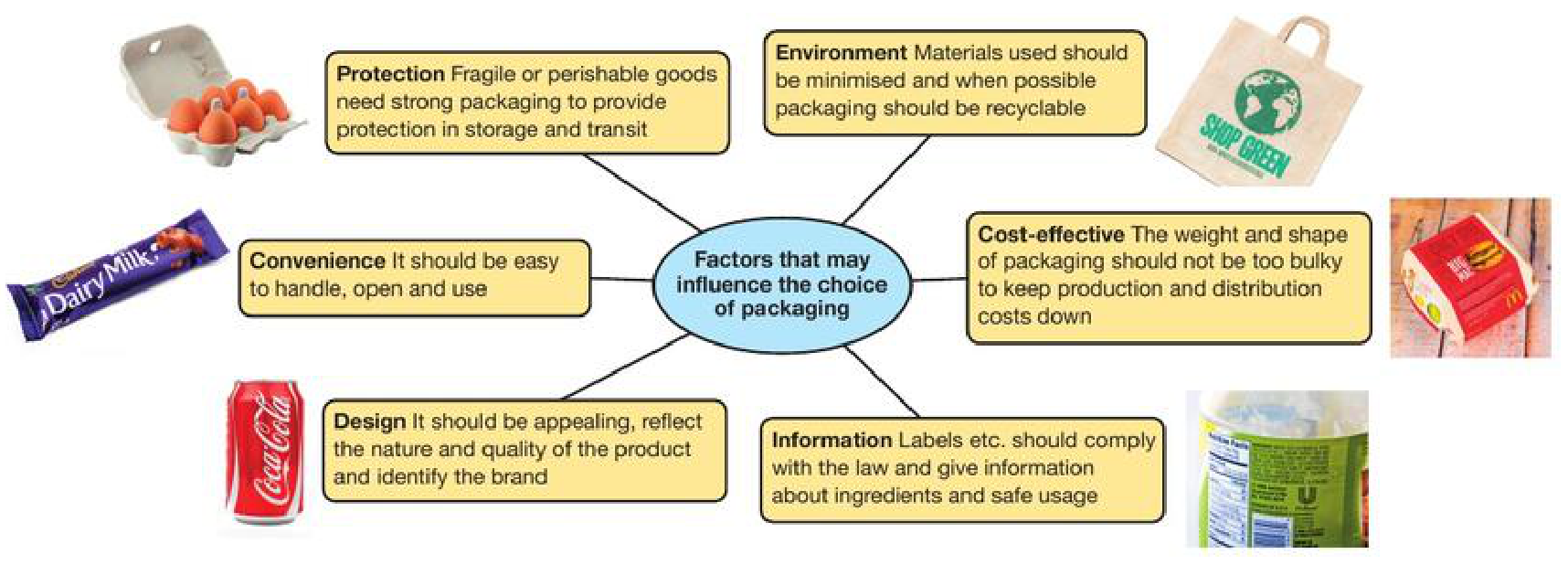
| Factor | Why it matters |
|---|---|
| Protection | Prevents fragile or perishable goods being damaged in storage and transport. |
| Environment | Reduce unnecessary materials and use recyclable materials where possible. |
| Cost-effectiveness | Avoid bulky or heavy packs that raise production and delivery costs. |
| Information | Provide required labels and information about ingredients or safe use. |
| Design | Attract attention, communicate quality and identify the brand. |
| Convenience | Make the product straightforward to hold, open and use. |
Example 1: Packaging
Packaging for environmentally focused cleaning products may emphasise practicality and sustainability, while perfume packaging may emphasise design and presentation. Neither design is automatically better: each serves a different type of product and buyer.
A business might adapt packaging when exporting to provide information in local languages, meet labelling rules, suit local preferences or withstand longer transport routes. Such changes create costs but can help customers understand and trust the product.
Check your understanding · Halfway
Try each question first. Then select Show suggested answer to check your understanding.
Identify the four Ps of the marketing mix and explain why a business should coordinate them.
Show suggested answer
Product, price, promotion and place. They must support one marketing strategy: for instance, promotion should describe the actual product and distribution must make it available to the customers attracted by the campaign.
What is test marketing, and why should the selected consumers be representative?
Show suggested answer
It is trialling a product with a small section of the intended market to gather feedback. If participants differ greatly from intended buyers, their opinions may give a misleading impression of demand.
Using the BestHome case, explain two ways the firm finds or improves product ideas.
Show suggested answer
Designers visit homes to learn customers’ needs and study competitors and trade fairs. Multidisciplinary design teams, prototypes and a 3D printing facility help turn ideas into products and improve the designs.
Distinguish consumer goods from producer goods, giving one example of each.
Show suggested answer
Consumer goods are bought for individuals’ own use (for example groceries). Producer goods are purchased for use in business production (for example factory machinery).
From Figure 36.1, explain why packaging for eggs and packaging for perfume might have different priorities.
Show suggested answer
Egg packaging should protect fragile items and keep costs reasonable. Perfume packaging may place more emphasis on attractive design and communicating a premium brand, while still protecting the product and meeting labelling rules.
Evaluate whether expensive packaging is always worthwhile.
Show suggested answer
No. Attractive, protective packaging can help sales and reduce damage, but higher materials and distribution costs can raise price or reduce profit. It is worthwhile only when the benefit to customers and the business justifies the extra expense.
Product Life Cycle
The product life cycle describes the pattern of a product’s sales as it moves through different stages over time. Knowing the likely stage can help a business plan production, marketing, cash flow and possible replacements. The stages may be grouped as maturity and saturation or shown separately.
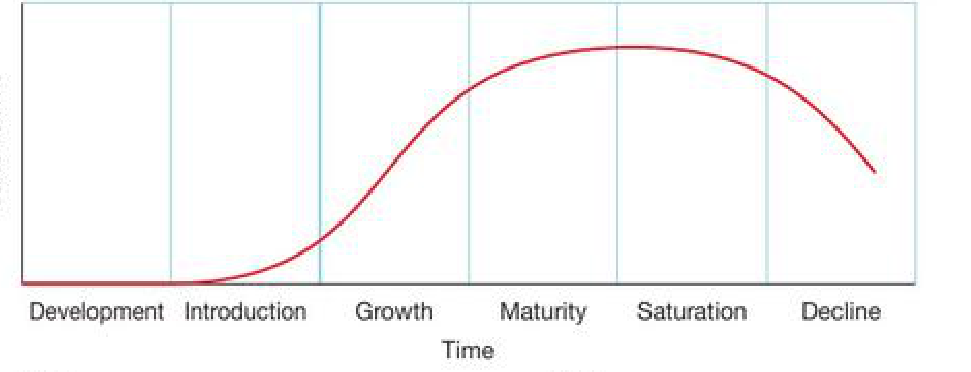
Development
A new product is researched, designed and tested before sales begin. Development can absorb cash without generating revenue, and some ideas never reach the market. A firm must decide whether the potential opportunity is worth this risk.
Introduction
The product is launched. Initial sales may be low while production facilities and promotion require substantial spending. A business may choose skimming (a high introductory price) or penetration pricing (a relatively low price to gain market acceptance). Pricing strategies are explored in Chapter 37.
Growth
If consumers accept the product, sales rise, revenue increases and the business may start to cover earlier investment and earn a profit. Competitors may introduce rival products, and towards the end of this stage sales growth can begin to slow.
Maturity and Saturation
Sales growth levels off as many potential consumers already own or use the product. The firm may earn strong cash flow, but competition can intensify, causing prices or promotional methods to change. This is often the time to consider extension strategies.
Decline
Sales fall because customers change preferences, new technology arrives or better alternatives appear. Businesses may withdraw, replace or refresh the product. Examples of products affected by technological change include CDs, cheques and fax machines.
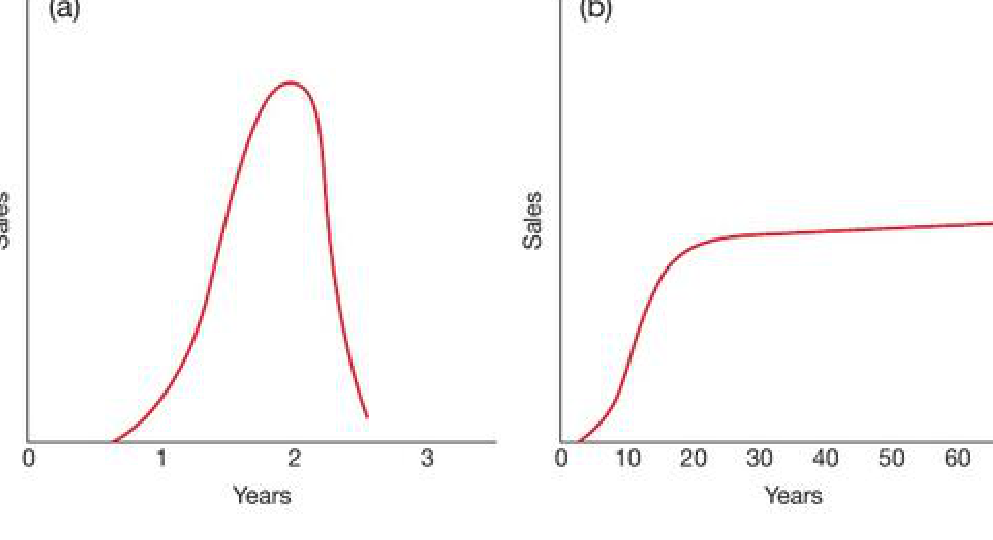
Not all products follow the same pattern. A fashionable toy may rise and fall rapidly, while well-known products such as Coca-Cola, Heinz foods, Kellogg’s Corn Flakes and Cadbury’s Dairy Milk can remain on sale for decades. The shape of the life-cycle graph is a model, not a guarantee for every product.
Extension Strategies
Extension strategies are methods intended to prolong a product’s useful life, particularly before it goes into serious decline. They may help a business earn more revenue from a product whose development costs have already been incurred.
- Find new markets: sell the product in other countries or to new customer groups.
- Find new uses: for example, Ralph Lauren extending its Polo name from clothing into towels and bedding.
- Modify or improve the product: the Volkswagen Golf has been updated repeatedly.
- Develop the range: add new flavours or versions, such as a snack manufacturer introducing new flavours.
- Change packaging or appearance: refresh bottle shapes, pack sizes or branding.
- Encourage more frequent use: an example is promoting breakfast cereals as foods for other times of day.
An extension strategy may keep the business competitive and make it more difficult for rivals to attract customers. However, it costs money, may confuse existing buyers, and cannot rescue every product. The business should research whether demand really exists.
Example 2: Microsoft
the evolution of Microsoft Windows as an example of repeated product improvements and updated versions. Its historical timeline begins with Windows 1 in 1985 and ends with Windows 10 in 2015; these are dates in this example, not a list of current Windows releases.
Updating Windows could persuade existing customers to upgrade, attract new buyers and maintain relevance as computing needs change. However, each release requires research, development, testing and support; improved versions still need to meet users’ expectations.
Managing and Reviewing the Product Portfolio
A business’s product portfolio (or product mix) is the range of products it currently markets. Some products may grow, others mature, and others decline. Management should review their performance and avoid relying too heavily on a single product.
The Boston Matrix
The Boston matrix classifies products using two dimensions: market share and market growth. There are four categories.
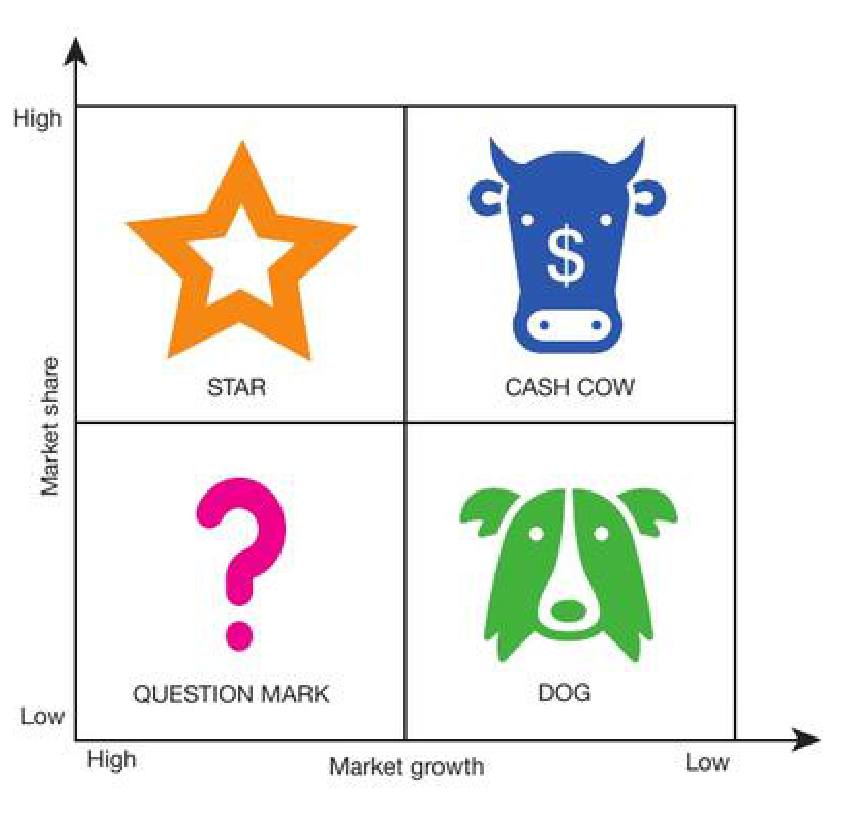
| Category | Market share | Market growth | Likely management issue |
|---|---|---|---|
| Star | High | High | A successful product in a growing market; may need investment to sustain growth. |
| Cash cow | High | Low | An established product generating a steady income in a slower-growing market. |
| Question mark | Low | High | Potential for growth, but success is uncertain and investment must be judged carefully. |
| Dog | Low | Low | May be declining and a candidate for replacement or withdrawal. |
A balanced portfolio can use cash generated by cash cows to support promising question marks and stars. Too many dogs may tie up resources. Yet a matrix is only a guide: market share and growth do not reveal all product costs, profitability, customer loyalty or strategic value.
Large vs Small Businesses
The marketing mix matters to businesses of every size, but the resources available for product development are different. Large firms are more likely to invest heavily in specialist staff, extensive research, prototypes and multiple product lines. If a successful product is launched across a large market, potential rewards can also be substantial.
Small businesses may have fewer funds for testing, but can listen closely to customers, make adjustments rapidly and specialise in a particular product or local market. Their main risk is that a failed launch may consume a large share of available cash.
| Issue | Large business | Small business |
|---|---|---|
| Development budget | May finance teams, research facilities and several trials. | Often depends on modest funding and carefully chosen ideas. |
| Portfolio | Can spread risks across multiple products and market segments. | May focus on a small number of products and depend on each one. |
| Decision-making | May require coordination between departments. | Can be quicker to respond directly to customer feedback. |
| Potential impact of failure | Losses may be spread across a larger organisation. | One failed product may significantly strain cash flow. |
End-of-chapter questions
Try each question first. Then select Show suggested answer to check your understanding.
Define the term product life cycle. Name its main stages in this example.
Show suggested answer
It shows the pattern of sales at different stages over time. Development, introduction, growth, maturity and saturation, and decline. The chart labels maturity and saturation separately while the explanatory text groups them together.
Explain two reasons a business might develop a replacement product.
Show suggested answer
An existing product may become technologically outdated or lose demand as consumer tastes change. A new version could protect competitiveness, attract sales or reach new customer needs, although the development process is risky.
Compare the introduction and maturity/saturation stages in terms of sales and marketing spending.
Show suggested answer
At introduction sales may be low while launch and promotional costs are high. At maturity sales may be much higher but growth levels off; the business may adjust price or promotion and consider extension strategies.
Using Figure 36.3, explain why a fad needs a different marketing approach from a product sold for decades.
Show suggested answer
A fad may have a very short sales window, so timing, stock and promotion are crucial; an established product can be refreshed and supported over many years. Businesses should avoid treating every product as having the same life cycle.
Give three extension strategies and one practical example.
Show suggested answer
Examples are finding new markets, changing the design or packaging, and finding new uses. Volkswagen updating the Golf or Coca-Cola using different packaging formats.
What are the two dimensions of the Boston matrix? Distinguish a star from a question mark.
Show suggested answer
Market growth and market share. Both operate in high-growth markets, but a star has high share whereas a question mark has low share and may need careful investment before it becomes successful.
A well-established product has a large market share in a market with little growth. Which Boston matrix category best describes it? Explain.
Show suggested answer
It is a cash cow: high relative market share in a low-growth market. It may generate more cash than it needs for maintaining sales and can help finance other products.
Sales of a snack fall from 2.25 million packets to 1.00 million packets. Calculate the percentage fall.
Show suggested answer
(2.25 − 1.00) ÷ 2.25 × 100 = approximately 55.6%. This is a substantial decline, so managers should investigate whether the product is losing demand or approaching the end of its life cycle.
A snack maker is considering spending US$1.5 million to redesign and relaunch a declining product. Evaluate the decision.
Show suggested answer
Better packaging may attract a new group of buyers and extend the life cycle. However, the redesign may fail to reverse the decline. Managers should use research and forecasts of additional contribution to judge whether the US$1.5 million investment is justified.
A new product has a low market share in a rapidly growing market. Discuss whether a firm should invest heavily to promote it.
Show suggested answer
The product is a question mark. Promotion could increase market share and turn it into a star, but the investment is risky. Compare the growth potential and expected extra contribution with the cost, competition and available cash.
A company sells one high-share mature product, one high-share fast-growing product and one low-share fast-growing product. Explain how the Boston matrix could guide investment and state a limitation.
Show suggested answer
The mature, high-share product is a cash cow that may fund investment. The growing, high-share product is a star needing continued support. The low-share growing product is a question mark requiring selective investment or withdrawal. The matrix does not show profit, cash flow or the competitive reasons behind each position.
Chapter 36 recap
The marketing mix combines product, price, promotion and place. A product may be a good or service; its success depends on suitable development and packaging. Sales change through the product life cycle, while extension strategies aim to delay decline. The Boston matrix helps managers review stars, cash cows, question marks and dogs in the product portfolio. Product decisions must balance customer needs, business resources, expected sales and financial risk.
Source reference: Pearson Edexcel International GCSE Business (9–1), Chapter 36. Historical figures are included for educational illustration. IGCSE360 is an independent learning website and is not affiliated with Pearson.