
Chapter 37 · Price
Learn how firms select cost-plus, penetration, competition-based, skimming and promotional pricing strategies, with numerical examples.
Learning objectives
- Explain how pricing decisions fit into the marketing mix and the factors that affect price.
- Describe and apply cost-plus, penetration, competition-based, skimming and promotional pricing.
- Recognise discounts, psychological pricing and loss leaders and assess their potential effects.
- Calculate mark-ups, revenues and percentage changes using practical examples.
- Evaluate which pricing approach is appropriate for businesses of different sizes and objectives.
Pricing
Price is one of the four elements of the marketing mix. Setting it too high can discourage purchases; setting it too low may suggest poor quality or make it difficult to cover costs. The price must fit the product, customers and business objectives.
Several factors matter before a business selects a pricing strategy. A pricing strategy is a plan for setting prices to achieve a particular marketing aim.
Factors that Affect Price
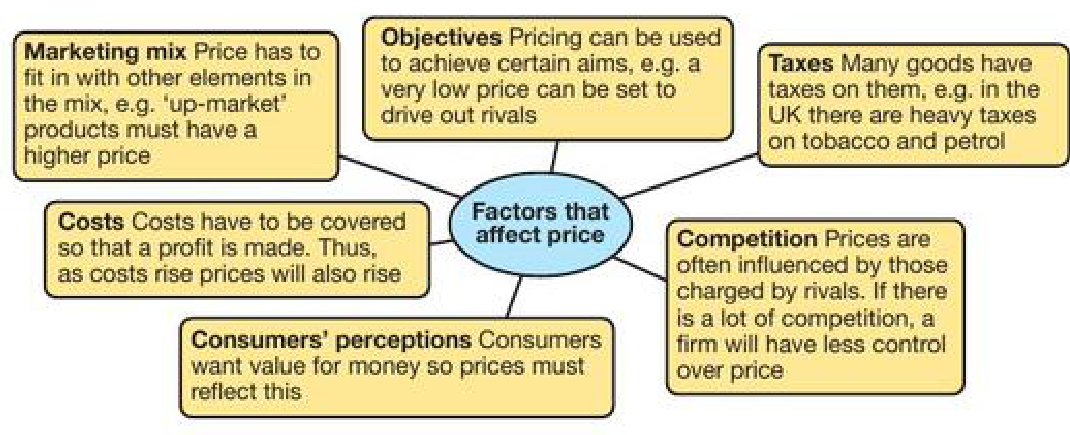
| Factor | How it influences the decision |
|---|---|
| Marketing mix | An upmarket product may need a higher price to match its positioning; promotion and distribution should support that image. |
| Objectives | A low price may help a firm win sales or discourage competitors; a higher price may support profit objectives. |
| Taxes | Sales taxes and specific product taxes can raise the price paid by customers. |
| Costs | Prices need to contribute towards covering production and other business expenses. |
| Consumers’ perceptions | Customers judge quality and value for money; prices should reflect what the target market is willing to pay. |
| Competition | Rivals’ charges constrain how far a business can increase its own prices, particularly in competitive markets. |
Example: Granite Tecco
Granite Tecco launched its space-war game Airdust in India for Rs 3,600, then charging Rs 2,600 ten months later. The price reduction is Rs 1,000, or about 27.8% of the original price. The firm initially charged keen early adopters more, then reduced the price as the game became less new. This is an example of skimming, discussed later.
Example: Kowloon Gift Shop
Yvette Cheng, who runs a gift shop at Kowloon market in Hong Kong, adds 20% to the cost of the items she buys. A product costing HKD 100 is priced at HKD 120. This straightforward method is called cost-plus pricing. The supplier cost is known, but customer demand and nearby competitors still matter.
Granite Tecco changes its price over time to earn revenue from different buyers. Yvette Cheng calculates a price from the cost of buying each item. A bottle of milk, a game and an airline ticket could each require different pricing decisions.
Cost-plus Pricing
Consider a bicycle manufacturer that makes a bicycle for €60 and adds 25% of cost. The selling price is €60 + (€60 × 0.25) = €75. The mark-up is calculated on cost, not on the selling price.
Calculating a Mark-up
| Example | Calculation | Result |
|---|---|---|
| Kowloon gift shop | HKD 100 + (20% × HKD 100) | HKD 120 |
| Bicycle manufacturer | €60 + (25% × €60) | €75 |
| Nassar’s garment | AED 240 + (40% × AED 240) | AED 336 |
Advantages: simple to apply, easy for employees to understand and helps the firm recover its known unit cost if items sell. Limitations: it can overlook competitor prices and what customers are prepared to pay. Charging €75 for the bicycle could lead to weak demand if rival bicycles are much cheaper. A mark-up on purchasing cost also does not automatically guarantee an overall net profit, because other operating expenses must be covered.
A 20% mark-up on a cost of HKD 100 gives HKD 120, but the profit as a percentage of selling price is HKD 20 ÷ HKD 120 × 100 = 16.7%. Mark-up and profit margin are not the same.
Penetration Pricing
Consumers may develop the habit of buying a new product while its introductory price is attractive. A low price can also persuade large retailers and other bulk buyers to stock or purchase it, giving the product greater exposure.
This strategy is particularly associated with mass-market, fast-moving consumer goods such as confectionery, canned drinks, shampoos and detergents. The product often has many potential buyers, and selling larger quantities matters.
- Possible benefit: helps a new product build sales quickly and compete with established brands.
- Possible cost: lower profit per unit, and the firm may not recover its initial spending quickly.
- Risk: customers may object when the introductory price rises, or the business may struggle to build loyalty.
A new shampoo might be offered at an introductory discount to encourage customers to try it. It works only if enough buyers like it to continue purchasing when the promotion ends.
Competition-based Pricing
Businesses in highly competitive markets may match their rivals’ prices to avoid losing customers or starting price wars. Sometimes the largest or lowest-cost firm becomes the price leader, with others following. Smaller followers with higher costs may earn narrower margins.
When competitors charge similar prices, firms may instead compete through non-price methods such as service, convenience, product quality or promotional activities that differentiate what they offer.
Destroyer or Predatory Pricing
A firm may cut prices for a period to make it very difficult for rivals to remain in the market. Once competitors leave, the business might raise its prices. This is called destroyer or predatory pricing. It requires substantial financial resources and can lead to losses while the price cuts continue. Such conduct may also raise competition-law concerns in practice.
Example 1: Coffee Shops
Eduardo Urondo runs a busy coffee shop in Rosario, Argentina. In this example, a multinational coffee chain opens opposite his business and charges half Eduardo’s prices. Customers begin moving to the chain. Eduardo fears that it can afford temporary losses until he closes, after which it may raise prices.
The situation resembles the example’s predatory-pricing example, although low prices alone do not establish that a competitor is acting unlawfully. The chain could have lower unit costs, stronger reserves or a deliberate expansion budget. Eduardo might respond by emphasising personal service or product differences rather than attempting an unaffordable price war.
Check your understanding · Halfway
Answer each question before selecting Show suggested answer.
Explain why a firm should consider both its costs and competitors’ prices before setting a selling price.
Show suggested answer
Costs indicate what a business needs to recover; rival prices influence what customers may be prepared to pay. A cost-covering price that is much higher than rivals’ offers may not attract enough sales.
Granite Tecco reduced the price of Airdust from Rs 3,600 to Rs 2,600. Calculate the percentage decrease.
Show suggested answer
Decrease = Rs 1,000. Percentage decrease = 1,000 ÷ 3,600 × 100 = 27.8% (approximately).
A bicycle costs €60 to make. Using a 25% mark-up, calculate its selling price.
Show suggested answer
Mark-up = 25% of €60 = €15. Selling price = €60 + €15 = €75.
State two reasons a business might choose penetration pricing for a new product.
Show suggested answer
It can encourage customers to try a product and form buying habits, and may persuade retailers to stock the product because low introductory prices generate demand.
What is meant by price leadership in a competitive market?
Show suggested answer
A dominant firm or market leader sets a price which other businesses in the market follow. Firms with higher costs may earn lower profit margins at that price.
Use the Coffee Shops case to explain why a multinational may be more able than Eduardo to sustain very low prices.
Show suggested answer
A large chain may have financial reserves, economies of scale and income from other branches that help it cover losses at one outlet. Eduardo’s smaller business is less likely to have equivalent resources.
Skimming
The aim is to earn high revenue from buyers who particularly value having a new product first. These buyers, known as early adopters, may pay premium prices for new technology or innovative goods.
When competition arrives or the product is no longer novel, the price may fall to attract more price-sensitive buyers. manufacturers of new patented medicines can charge high initial prices to help recover costly research and development; lower-cost generic competitors can enter after patent protection expires.
- Advantages: high revenue per sale early on; may recover development costs before competitors enter.
- Disadvantages: high prices restrict initial demand and can encourage competitor entry; buyers may postpone purchases until prices drop.
- Best suited to: new, distinctive or innovative products with customers willing to pay for early access.
Example 2: Pharmaceutical Companies
Historical accounts report that Pfizer spent US$7,200 million on research and development in 2014. It describes high drug prices during patent protection and a price decrease when generic competitors enter. For a historical illustration, it gives atorvastatin (40 mg) at US$191 per month, a generic atorvastatin at US$160, and lovastatin (40 mg) at US$51. Lovastatin is a different medicine, so those amounts should not be treated as identical-product prices.
A firm considering skimming needs sufficient initial demand and a reason customers will pay extra, such as innovation or temporary exclusivity. As competitors enter, the strategy becomes harder to sustain.
Promotional Pricing
Common motives include: clear old stock before a new season, generate cash quickly, renew interest in an existing product or encourage buyers to switch from competing brands. Promotional pricing can increase footfall but reduces the amount earned per unit.
Discounts and Sales
For a limited period, products are sold below their usual price. Seasonal promotions, including Black Friday sales, are common examples. A sale might help a clothing shop clear last season’s goods and release funds to buy the next collection. Lower prices do not guarantee higher profit: the quantity sold must be considered.
Psychological Pricing
A firm sets a price slightly below a round figure, such as £99.99 instead of £100, in the hope that customers perceive it as significantly cheaper. The actual difference is only £0.01, so the effect is about buyer perception, not a large cost saving. Prices ending in 9 are a common psychological-pricing technique.
Loss Leaders
A loss leader is an item sold below its cost to attract customers to the store. Supermarkets may make a loss on the promoted item but hope shoppers also buy other goods on which the store earns a profit. If customers buy only the loss leader, the promotion may be unprofitable.
Large vs Small Businesses
Both large and small businesses have to decide what prices to charge. large firms often have greater control because of their market dominance, brand influence and financial resources. Smaller businesses may have to accept prices set by larger rivals or leading retailers.
| Large businesses | Small businesses |
|---|---|
| May act as price leader where market power allows | Often follow market prices, especially when facing larger rivals |
| Can spread research and promotional costs across many products | May find simple cost-plus methods easier to administer |
| May have reserves to support short-term introductory pricing | May struggle to survive a prolonged price war |
| May benefit from buying at scale and lower unit costs | Can sometimes charge premium prices for specialist service or differentiation |
Smaller businesses often use cost-plus pricing because it is straightforward, although they must still be willing to accept market prices offered by major buyers. Size does not automatically determine the best pricing strategy: objectives, competition, customer needs and costs must all be considered.
A small, distinctive café may avoid a price war by emphasising quality or customer service. A large retailer may use a seasonal promotion to clear a large stock of goods. Both must consider whether the expected extra sales justify the price change.
End-of-chapter questions
Answer each question before selecting Show suggested answer.
Define cost-plus pricing and identify one limitation.
Show suggested answer
Cost-plus pricing means adding a percentage mark-up to unit cost to calculate selling price. A limitation is that it ignores the prices competitors charge and what consumers may be willing to pay.
A retailer buys a garment for AED 240 and adds a cost-plus mark-up of 40%. Calculate the selling price.
Show suggested answer
Mark-up = AED 240 × 40% = AED 96. Selling price = AED 240 + AED 96 = AED 336.
Discuss one advantage and one disadvantage of penetration pricing for a new shampoo.
Show suggested answer
A low launch price encourages trial and builds an initial customer base. However, the profit per unit may be small, and some customers may stop buying when prices rise.
Explain the difference between skimming and penetration pricing.
Show suggested answer
Skimming begins with a high launch price to earn revenue from early adopters; penetration begins with a low price to attract a large number of buyers and gain market acceptance.
Why might competitors follow a price leader rather than set significantly different prices?
Show suggested answer
Matching the market leader may reduce the risk of losing customers or starting a price war, particularly where the goods are similar. Followers with higher costs may nevertheless earn lower margins.
Explain how psychological pricing and loss leaders differ.
Show suggested answer
Psychological pricing aims to influence how consumers perceive a price, for example AED 239 rather than a round number. Loss leaders deliberately sell an item below its cost to bring shoppers in, hoping they purchase other profitable goods.
A shop sells 150 accessories at AED 239 each. Calculate the sales revenue.
Show suggested answer
Sales revenue = selling price × quantity = AED 239 × 150 = AED 35,850.
A business sells 65 items at AED 899 each and 140 other items at AED 519 each. Calculate its combined revenue.
Show suggested answer
First product: AED 899 × 65 = AED 58,435. Second product: AED 519 × 140 = AED 72,660. Combined revenue = AED 131,095.
A shop’s monthly revenue increases from AED 162,400 to AED 214,645. Calculate the percentage change.
Show suggested answer
Increase = AED 214,645 − AED 162,400 = AED 52,245. Percentage change = AED 52,245 ÷ AED 162,400 × 100 ≈ 32.2%.
A product costs AED 160 per unit. Compare total contribution when 100 units sell for AED 280 each versus 150 units at AED 239 each.
Show suggested answer
Initial contribution = (AED 280 − AED 160) × 100 = AED 12,000. At the lower price, contribution = (AED 239 − AED 160) × 150 = AED 11,850. Revenue rises, but contribution falls by AED 150; this excludes other expenses.
Evaluate whether a retailer should switch permanently from cost-plus pricing to psychological pricing.
Show suggested answer
Psychological prices may attract more buyers, but reducing unit price can lower margins even if volume increases. A trial should measure contribution, repeat purchases and competitor reactions. A permanent change is sensible only if extra sales and longer-term benefits justify lower margins and other costs.
Chapter 37 recap
Businesses must balance costs, consumer perceptions, competition, and marketing objectives when setting prices. Cost-plus pricing adds a mark-up; penetration starts low; skimming starts high; competition-based pricing follows the market; and promotional methods aim to stimulate sales. Nassar’s shows why higher revenue is not always higher profit.
Source reference: Pearson Edexcel International GCSE Business (9–1), Chapter 37. Historical figures are included for educational illustration. IGCSE360 is an independent learning website and is not affiliated with Pearson.