
Chapter 40 · Economies and Diseconomies of Scale
Learn how growth may lower average costs, when expanding firms become inefficient, and why some businesses remain small—using worked examples and diagrams.
Learning objectives
- Understand internal and external economies of scale.
- Understand diseconomies of scale.
- Understand the limits of business growth.
Economies of Scale
The scale of a business means its size. A business may measure its scale using the number of workers it employs or the quantity of goods it produces. As production increases, a business may become more efficient and its average cost per unit may fall. These cost advantages are called economies of scale.
Getting Started: Gilly’s Snack Shack and Grant Finch Foods
Two sandwich businesses illustrate scale differences: Gilly’s Snack Shack, a Chicago kiosk, sold about 900 sandwiches weekly, while Grant Finch Foods supplied supermarkets with approximately one million sandwiches per week and employed 110 workers. The larger operation could purchase ingredients in much greater quantities.
| Measure | Gilly’s Snack Shack | Grant Finch Foods |
|---|---|---|
| Sandwiches sold | About 900 weekly | About 1,000,000 weekly |
| Loaf of bread | US$1.80 | US$1.10 |
| Tomatoes per kg | US$2.50 | US$1.50 |
| Cheese per kg | US$7.00 | US$5.00 |
| Selling price | US$2.00 per sandwich | US$1.40 per packet |
| Loan | US$5,000 at 8.9% | US$1,000,000 at 7.5% |
Grant Finch Foods has a lower purchase price for the ingredients listed, allowing it to supply sandwiches at a lower selling price. This is evidence of purchasing and financial economies, although these prices alone do not calculate each firm’s complete cost per sandwich.
Bread is US$1.80 at Gilly’s but US$1.10 at Grant Finch: a difference of US$0.70 per loaf, or around 38.9% of Gilly’s price. Differences in loan interest rates provide another advantage, although the larger company borrows a much greater total amount.
How Average Costs Change with Output
The average-cost curve shows unit costs falling as output rises, reaching approximately US$10 at 70,000 units, then increasing beyond the most efficient scale. The example uses US$25 at 20,000 units, US$15 at 40,000 units and US$12.50 at 90,000 units.
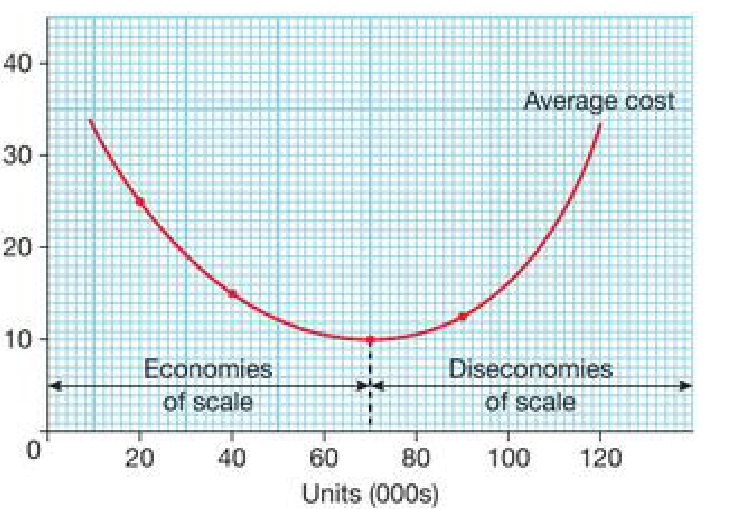
| Output | Average cost per unit | Interpretation |
|---|---|---|
| 20,000 | US$25 | Higher average costs at small scale |
| 40,000 | US$15 | Economies of scale: costs fall |
| 70,000 | US$10 | Lowest average cost in the example |
| 90,000 | US$12.50 | Diseconomies: costs rise again |
Average cost = total cost ÷ quantity produced. An increase in total production costs does not necessarily mean the business has diseconomies: the relevant measure is the cost per unit. The best scale is the output with the lowest achievable average cost, not necessarily the largest possible output.
Internal Economies of Scale
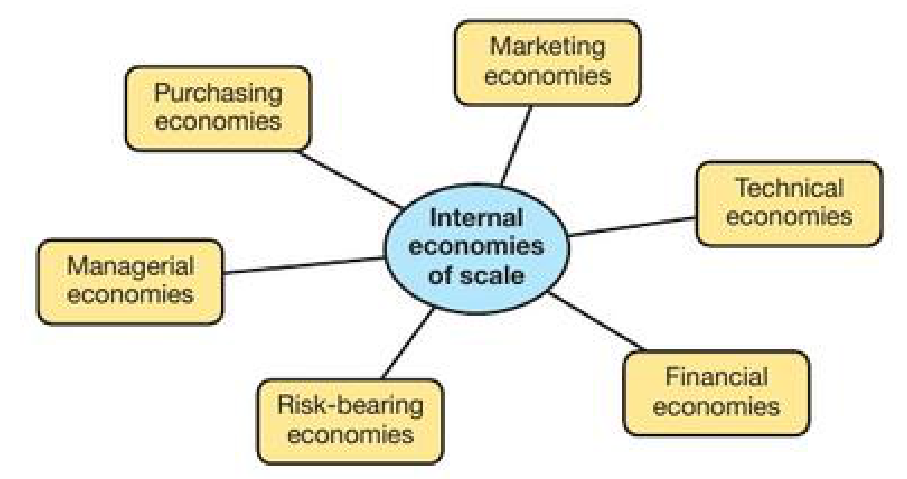
Internal economies of scale are cost advantages enjoyed by an individual firm when it expands. This chapter identifies six types. They can arise from larger orders, improved technology, better use of specialists and spreading certain costs over more units.
Purchasing Economies
Large businesses purchase raw materials and components in bulk and may negotiate quantity discounts. Suppliers may offer lower prices because serving one large order can be cheaper than serving many small ones. Grant Finch Foods’ lower prices for bread, tomatoes and cheese illustrate this advantage.
Marketing Economies
Some marketing costs, such as making a television advertisement, can be spread across a much larger sales volume. Large businesses may also run their own delivery fleets when regular large-scale deliveries are more economical than paying a distributor. This reduces marketing or distribution costs per unit, although the total marketing bill can still be high.
If a US$12,000 advertisement supports sales of 6,000 products, the advertising cost is US$2 per item. At 24,000 items, the same total spending costs only US$0.50 per item. This illustrative calculation shows a marketing economy.
Technical Economies
Large businesses can use specialist machinery more fully and invest in equipment that would be too expensive for a small operation. Suppose design software costs US$1,000: a small engineering firm might use it weekly, while a large firm could use it daily. Greater use spreads the cost across more output.
Financial Economies
Larger businesses can often access more sources of finance and negotiate lower interest rates. Banks may consider large established businesses more creditworthy, and limited companies may raise finance through share issues. In the opening case, Grant Finch Foods pays 7.5% interest while Gilly’s pays 8.9%.
Managerial Economies
Growth allows a business to employ specialist managers in areas such as finance, HR, marketing and production. A small business manager may have to carry out all these roles, whereas specialists can make decisions more efficiently. However, management becomes costly if too many layers are introduced.
Risk-bearing Economies
Larger firms may operate across multiple products and regions. If demand weakens in one market, sales elsewhere can help offset losses. For example, supermarkets may diversify into clothing, household goods, cafés and financial services.
Activity 1: DIB (Do-It-Better)
DIB illustrates internal economies in a large hardware retailer. The historical example reports 212 branches and US$24.5 billion in 2017 revenue. Its specialist employees, research and development and machinery helped create technical economies, while its varied product range spread risks.
Buying machinery that can be used intensively is a technical economy. Operating across several product markets is a risk-bearing economy. These are internal advantages because they arise within DIB as it grows.
External Economies of Scale
External economies of scale reduce costs for businesses because the whole industry grows, often concentrated in one geographical area. An individual firm may benefit even if it has not itself expanded as much as its neighbours.
Skilled Labour
An industry concentrated in one region can attract people with relevant skills. Local training providers and colleges may offer suitable vocational courses, reducing recruitment and training costs. New businesses may find experienced workers nearby.
Infrastructure
An important regional industry may lead to investment in roads, railways, ports, buildings and other facilities. An industrial estate or specialised transport network may lower costs for many businesses located in that area—not just for the largest individual producer.
Ancillary and Commercial Services
Ancillary suppliers support a larger industry. Specialist maintenance, cleaning, banking, waste disposal, component production and transport providers may establish themselves nearby. For example, the car industry in England’s Midlands, where businesses benefit from specialist services.
Cooperation
Businesses located close together may collaborate on research, shared facilities or information exchange. One example involves high-technology businesses in Silicon Valley, California as an example. Cooperation can reduce the cost and risk of developing technology for several firms.
| Internal economies | External economies |
|---|---|
| Arise when one particular business grows | Arise when the industry or regional cluster grows |
| Purchasing discounts, marketing, technical, finance, management and spreading risk | Skilled labour, infrastructure, supporting services and cooperation |
| Mainly enjoyed by the expanding firm | Potentially available to many firms in the industry |
Halfway questions
Try each question before selecting Show suggested answer. Explain the reason behind your answer, especially when evaluating a business decision.
What does the scale of a business mean?
Show suggested answer
Its size, for example measured by output or the number of employees.
Using Figure 40.1, what is the lowest average cost and at what output is it achieved?
Show suggested answer
About US$10 per unit at 70,000 units in the worked example.
Gilly’s pays US$1.80 for a loaf and Grant Finch pays US$1.10. What is the difference and which economy explains it?
Show suggested answer
A difference of US$0.70 per loaf. Purchasing economies of scale explain how buying in bulk may secure lower prices.
Explain one difference between a technical and managerial economy.
Show suggested answer
Technical economies arise from efficient plant, machinery or technology. Managerial economies arise from employing specialist managers to improve decision-making.
Why is DIB’s diversification an example of risk-bearing economies?
Show suggested answer
DIB sells to several markets, so weak demand in one area may be offset by stronger sales in another, reducing dependence on a single product.
Give two examples of external economies of scale and explain why they are external.
Show suggested answer
A pool of skilled workers and improved regional transport are external because multiple firms in the growing industry can benefit, not just the firm that pays for expansion.
Diseconomies of Scale
As a business grows too large, average costs may start to increase. This is known as diseconomies of scale. The problem is not simply that the business spends more in total: it becomes less efficient in organising the people and resources needed to produce each unit.
Bureaucracy
Very large businesses can develop excessive administration, reporting requirements and management layers. Approvals may take too long and managers may spend resources filling forms rather than improving products or services. Delayed decisions and wasted time can raise average costs.
Labour Relations
Managers may become remote from frontline workers in a huge organisation. Misunderstandings, lower morale and workplace conflicts can make production less efficient. Disputes can create delays and management time may be diverted into resolving problems.
Control and Coordination
Coordinating thousands of employees, many production facilities and geographically dispersed operations is difficult. The business may need more supervisors, information systems, meetings and management layers to maintain common standards, which adds costs.
Activity 2: Volkswagen
The 2015 Volkswagen diesel-emissions scandal raised questions about oversight in complex organisations. Software altered emissions-test results, and approximately 11 million vehicles were affected. The episode caused financial and reputational damage, although company size alone does not prove that diseconomies of scale caused it.
The case illustrates the potential difficulty of control and coordination in a large company. However, the size of Volkswagen alone does not prove that diseconomies caused the scandal. Students should distinguish between the historical figures’ suggested explanation and an established causal finding.
A large business may benefit from efficient mass production and international purchasing, but also face difficulties with communication, oversight and consistent behaviour. A reasoned judgement weighs both economies and diseconomies.
Other Limits to Growth
Diseconomies may discourage further growth, but businesses can also choose to stay small because of limited finance, specialist customer demand, owners’ lifestyle preferences or a desire to control risk.
Lack of Finance
Growth may require new machinery, premises, stock, equipment and workers. A business may not have the retained profit to pay for this and lenders may consider expansion risky. Unable to raise sufficient funds, it may stay small.
Nature of the Market
Some markets have too few customers to support a very large business. One example involves luxury yachts as an example: only a limited group can afford such an expensive product. Large-scale output might produce more goods than the market can absorb.
Lack of Managerial Skills
Running a single grocery shop needs different capabilities from overseeing a large chain. Growth can demand better leadership, delegation, communication, planning and financial control. Owners may lack those skills or resist giving responsibility to managers.
Lack of Motivation
Some owners are happy with the profit, independence and flexibility of a small operation. They may operate a lifestyle business, balancing work with other interests. They may choose not to take on additional workers, financial risks and management responsibilities, even if expansion is possible.
| Limit to growth | Why it matters | Illustrative example |
|---|---|---|
| Finance | Funds may be inadequate for equipment, premises or staff | A bakery cannot afford another oven |
| Nature of market | Demand may be too small for mass output | A specialist luxury-yacht producer |
| Managerial skills | Owners cannot delegate or supervise a larger organisation well | A single-store owner struggles to manage several branches |
| Motivation | Owners value a manageable business and flexibility | A family-run café chooses not to expand |
Large vs Small Businesses
Large businesses are more likely to obtain internal economies of scale through bulk orders, specialist machinery, management and cheaper access to finance. They may also be better placed to exploit economies from a growing industrial cluster. However, if they become excessively complex, diseconomies can push average costs upward.
Small businesses generally purchase in smaller quantities and cannot spread fixed costs over as many units. Nevertheless, they may offer flexibility, quick decisions, close customer relationships and simpler supervision. Some remain small because the market is limited or the owners do not want to expand.
End-of-chapter questions
Try each question before selecting Show suggested answer. Explain the reason behind your answer, especially when evaluating a business decision.
Define economies of scale and explain their effect on average costs.
Show suggested answer
They are cost advantages that arise as output or the size of a business increases. They reduce the average cost per unit, even if total costs increase.
Explain why hiring a specialist accountant can be an economy of scale.
Show suggested answer
It is a managerial economy: the specialist accountant may manage records and financial decisions more efficiently than a generalist, spreading the benefits of expertise across a large firm.
Average cost is US$10 at an output of 70,000 units and US$12.50 at 90,000 units. Calculate the increase in average cost per unit.
Show suggested answer
Increase = US$12.50 − US$10.00 = US$2.50 per unit, or 25% of the original average cost.
Explain how marketing economies may lower the average cost of an advertisement.
Show suggested answer
An advertising campaign may cost roughly the same amount regardless of the number of products sold. Higher output spreads the fixed campaign cost across more units, lowering advertising cost per item.
Identify one internal economy and one external economy available to a growing car manufacturer.
Show suggested answer
Internal: technical economies from specialised machinery. External: specialist component suppliers or skilled engineers available in a regional car-industry cluster.
Give two ways a business can suffer diseconomies of scale.
Show suggested answer
Too much bureaucracy may delay decisions and increase administrative costs. Poor coordination between factories and workers may cause errors, extra supervision and inefficiency.
Explain why lack of finance can prevent a small firm from growing.
Show suggested answer
Expansion needs premises, equipment, staff and working capital. If retained profits are insufficient and lenders see the project as risky, the business may be unable to raise the necessary funds.
How can a lifestyle business limit its own growth?
Show suggested answer
Its owner may prefer time, independence and a manageable workload rather than the risks and responsibilities of expanding. This can keep the firm small by choice.
Apply the concept of risk-bearing economies to DIB.
Show suggested answer
DIB operated across fitted kitchens, garden products, building supplies, restaurants and other markets. A fall in sales in one may be partly offset by stronger demand in another.
Explain how expanding into several countries could create both economies and diseconomies of scale for a retailer.
Show suggested answer
A retailer might gain purchasing and managerial economies by placing larger orders and employing specialists, but encounter communication problems, bureaucracy and coordination costs across countries.
Evaluate whether a small family-run business should expand to seek economies of scale.
Show suggested answer
Growth may allow bulk discounts, specialist staff and more efficient machinery. However, it may require borrowing, face a limited market and reduce the owner’s flexibility. Expansion is sensible if reliable demand and affordable finance exist and expected savings outweigh the risks and coordination costs.
Chapter 40 recap
Economies of scale arise when larger production brings lower average costs. Internal economies are advantages to an individual expanding business; external economies arise from growth in an industry. When a business becomes overly large and difficult to manage, diseconomies may raise average costs. Finance, market size, management skills and owners’ goals can also limit growth.