
Chapter 39 · Promotion
Explore the promotional mix, advertising, sales promotions, public relations, digital channels and branding, with practical business examples and worked data.
Learning objectives
- Understand above-the-line and below-the-line promotion methods.
- Understand public relations and its effect on company image.
- Understand technology in promotion: online targeted advertising, viral advertising, social media and e-newsletters.
- Understand the importance of a brand.
- Explain how promotion differs between market segments.
What Is Promotion?
Promotion is one of the four Ps of the marketing mix. Businesses use it to communicate with customers, make people aware of products, explain their benefits and encourage purchases. Effective promotion supports the decisions made about product, price and place.
Case Studies: Sky Television and Blake Street Blinds
Promotion differs between large and small businesses. Sky Television operated satellite broadcasting and online streaming services; its historical 2015 figures include £11,283 million in revenue and £1,400 million in operating profit. A large media company can reach national audiences through multiple channels, whereas a local business may favour targeted advertising within its area.
Blake Street Blinds, a small family business in a town of around 50,000, advertised in a local weekly newspaper for four weeks at a cost of £45. Its advert highlighted a £9.99 offer, delivery, fitting and discounts. Local print advertising could reach nearby customers without the cost of a national campaign.
Sky can use media with national or international coverage, whereas Blake Street Blinds needs customers in its immediate area. The best method is not automatically the most expensive one.
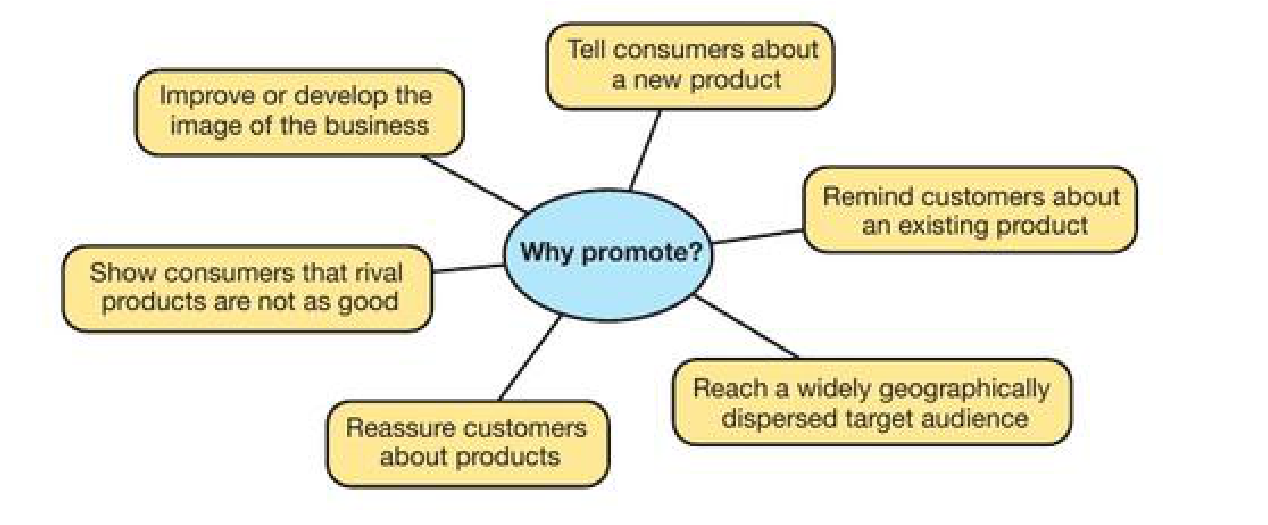
Why Businesses Promote
- Inform consumers about new products.
- Remind buyers of existing products.
- Reach consumers spread across a wide geographical area.
- Reassure customers about quality and product benefits.
- Differentiate the offering from rival products.
- Improve or develop the image of the business.
Above-the-line Promotion
Businesses pay to place their advertisements in the media. The choice depends on reach, cost, targeting, visual impact, timing and the type of product. Mass media suit broad campaigns; specialist publications and digital advertising can reach more narrowly defined audiences.
Table 39.1: Advantages and Disadvantages of Main Media
| Advertising medium | Advantages | Disadvantages |
|---|---|---|
| Television | Large audiences; moving images, sound and demonstrations; some targeting | Expensive; brief messages; viewers may avoid adverts |
| Newspapers and magazines | National or local coverage; readers can revisit adverts; specialist audiences | No sound or movement; rival adverts compete for attention; advert may be overlooked |
| Cinema | Large-screen impact, sound and movement; can target cinema audiences | Limited reach; message may only be seen once |
| Radio | Relatively inexpensive production; can target listening groups and local areas | No visuals; adverts may be ignored or irritate listeners |
| Posters and billboards | Repeated exposure; large displays with simple memorable messages | Limited detail; vandalism; difficult to evaluate response precisely |
| Internet | Ads can be adjusted and targeted; clicks and responses measurable; potentially lower setup costs | Intrusive adverts, technical problems and unwanted exposure |
Advertising Expenditure: Historical Example
Worldwide advertising spending was estimated at US$579,000 million in 2016, 4.9% higher than in 2015. Television accounted for a substantial share, although expenditure patterns differed between countries. These figures are historical.
China’s estimated television advertising spending increased from US$4,950 million in 2010 to US$7,870 million in 2016.
| Calculation | Working | Result |
|---|---|---|
| Increase, 2010–2016 | 7,870 − 4,950 | US$2,920 million |
| Percentage increase | 2,920 ÷ 4,950 × 100 | 59.0% approximately |
Growing consumer demand and entry by international firms could help explain increased television advertising expenditure. The numbers are historical estimates from an earlier example, not current spending figures.
Below-the-line Promotion
Below-the-line promotion is generally organised by the business without buying conventional mass-media advertising space. It is often used to generate a response quickly, encourage customers to try a product, or reward existing buyers. Some methods can be measured directly—for example, by counting redeemed coupons.
Sales Promotions
- Free gifts: a gift is offered with a purchase to attract attention or encourage trial.
- Coupons: a voucher or digital code gives a discount on a future or current purchase.
- Loyalty cards: reward customers for repeat purchases by awarding points or other benefits.
- Competitions: offer a chance to win prizes, sometimes linked to buying a product.
- BOGOF: buy one get one free, encouraging larger purchases.
- Money-off deals: temporary reductions such as 30% off a product.
These techniques may create immediate sales, but excessive use can lower margins or train customers to wait for discounts. Businesses should compare the extra contribution generated with the cost of gifts, coupons or discounts.
Merchandising and Packaging
- Product layout: locating prominent or high-margin products where they will be seen.
- Display material: attractive windows, posters, leaflets, lighting and special displays.
- Stock: keeping shelves supplied to prevent lost sales and a poor impression.
Direct Mailing
Businesses send leaflets, letters or emails to selected customers, sometimes using purchase histories or mailing lists. Messages can announce a new product, a discount, or a change in prices. Targeted mailing can be effective when relevant, but unwanted messages may be ignored or treated as spam.
Direct Selling or Personal Selling
Salespeople may contact customers personally, by telephone or through visits. This allows them to explain product features and respond to questions. It is useful for complex products, but may require substantial staff time and can irritate people who have not invited contact.
Exhibitions and Trade Fairs
Businesses display and demonstrate products to prospective customers and buyers. Trade fairs may allow testing, direct discussion, media attention and access to overseas markets. Costs can include travel, exhibition space, displays and staffing.
Activity 2: Coupons
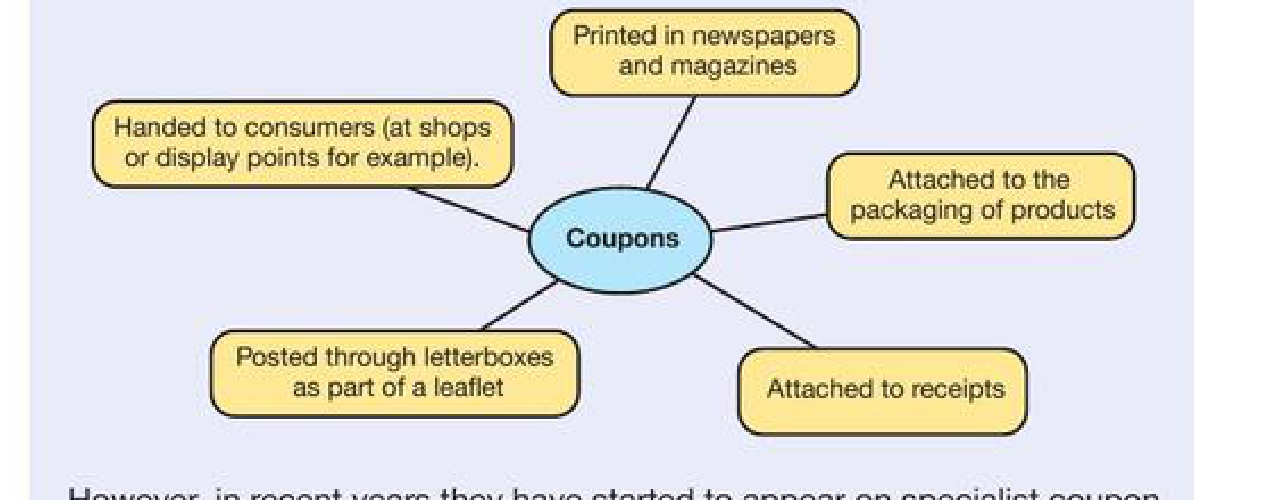
Coupons may appear in newspapers, magazines, product packaging, receipts, post or stores. Digital codes and specialist websites make them available online. They can attract price-conscious customers and encourage repeat purchases.
In historical US estimates, the share of companies using mobile coupons rose from 36.5% in 2014 to 48% in 2017. This is an increase of 11.5 percentage points, or approximately 31.5% relative to the starting share.
Halfway questions
Answer independently first, then open Show suggested answer to check your reasoning.
State two aims of promotion from an earlier example.
Show suggested answer
Businesses may inform consumers about a new product, remind customers about existing products, reassure customers, reach a wider audience, differentiate products or strengthen a business image.
Explain the difference between above-the-line and below-the-line promotion.
Show suggested answer
Above-the-line uses media advertising such as television and radio. Below-the-line includes other techniques such as coupons, loyalty cards, merchandising and direct mailing.
Why might Blake Street Blinds use a local newspaper rather than national television advertising?
Show suggested answer
It serves customers in one small town. Local print media is cheaper, more geographically relevant and suited to its limited advertising budget.
Using the chart, calculate China’s percentage increase in estimated television advertising expenditure from 2010 to 2016.
Show suggested answer
(US$7,870m − US$4,950m) ÷ US$4,950m × 100 = 59.0% approximately.
Explain one advantage and one limitation of BOGOF promotions.
Show suggested answer
BOGOF can encourage customers to buy more or try a product, but providing two items for one payment can reduce contribution per transaction.
Mobile-coupon use among US companies increased from 36.5% to 48%. Calculate the change in percentage points.
Show suggested answer
48 − 36.5 = 11.5 percentage points. The relative percentage increase is about 31.5%, which is a different measure.
Public Relations
PR can gain exposure without the same direct advertising-space costs as media advertising. However, publicity is not completely controllable, and attempts to attract attention through controversy may damage reputation.
Press Release
A business sends a written announcement to the media, such as details of a new product, a new factory or new employment opportunities. Journalists decide whether to publish or use the information; coverage is not guaranteed.
Press Conference
Business representatives meet journalists, make an announcement and respond to questions. This offers a chance to explain important developments directly, but difficult questions can arise.
Sponsorship
Examples include major companies sponsoring the Rio 2016 Olympic Games. Sponsors can gain visibility on television and in print coverage, helping people associate the brand with the event, although sponsorship rights can be costly.
Donations
Donations to charities and local communities may support a good cause while helping a business develop favourable relationships. The effect depends on whether customers regard the involvement as genuine and relevant.
Using Technology in Promotion
Online platforms, smartphones and social networks have changed promotion. Businesses can target smaller groups, update messages quickly and measure responses. Common methods include targeted advertising, viral content, social-media promotion and email newsletters.
Online Targeted Advertising
Online adverts can be selected for people with interests or browsing behaviour likely to make the advertised product relevant. This reduces some wasted expenditure compared with an advert seen by many people outside the target market. However, the use of personal information creates important privacy and trust considerations.
Viral Advertising
Humorous or surprising videos and messages can spread when users share them. For example, an entertaining campaign involving familiar film characters may reach people who would not notice a conventional advert. Viral reach is unpredictable.
Social Media
- Social platforms may cost less to use than traditional national advertisements.
- Businesses can respond quickly to customers and trends.
- Messages can be targeted by interests and reach international audiences.
- Links can send visitors to business websites.
- Customer engagement can be measured through interactions and responses.
Historical social-network figures from 2015–2016 illustrate rapid adoption. They should not be treated as current usage statistics.
E-newsletters
Email newsletters send news, offers, product information and practical tips to existing customers or interested subscribers. Personalised content can strengthen relationships and encourage repeat business. Businesses should ensure messages remain useful and are sent appropriately to people who want them.
Historical comparisons of television and digital advertising spending for 2012–2018 illustrate digital advertising’s rapid growth in that period; the 2018 figure was a projection.
Branding
- Product differentiation: distinguish an offering from rival products.
- Customer loyalty: encourage repeat purchasing when consumers trust the brand.
- Recognition: help customers identify a product quickly.
- Image: create associations with quality, value or status.
- Pricing power: a strong brand may support higher prices where customers value it.
Table 39.2: Top Global Brands in 2016
The BrandZ figures in the table are historical estimates of brand value, not a company’s market capitalisation or annual sales.
| Rank (2016) | Brand | Brand value (US$ million) |
|---|---|---|
| 1 | 229,200 | |
| 2 | Apple | 228,500 |
| 3 | Microsoft | 121,800 |
| 4 | AT&T | 107,400 |
| 5 | 102,600 | |
| 6 | Visa | 100,800 |
| 7 | Amazon | 98,900 |
| 8 | Verizon | 93,200 |
| 9 | McDonald’s | 88,600 |
| 10 | IBM | 86,200 |
The values indicate that well-known names can be highly valuable in their own right. A strong brand may help persuade customers to try related products, but expensive promotion does not guarantee lasting loyalty.
The Use of Promotion Strategies in Different Market Segments
Businesses often combine several methods, but the balance should match the target market. Audience size, customer income, interests, spending habits and the desired brand image all influence the choice.
Advertising
Mass-market products may use broad television and social-media campaigns. Specialist or luxury products may be promoted through selected websites or magazines that reach a smaller but more relevant audience.
Sponsorship
Sponsoring sporting events or public figures can connect a brand to values customers admire. Rolex sponsorship of golf events, for instance, may reinforce a premium image; sportswear brands may sponsor athletes who use their equipment.
Product Trials
Product trials allow customers to test a service at a reduced price or for a limited period. For example, a fitness centre could offer a discounted three-month membership before customers commit to the full price.
Special Offers
Discounts can attract attention, clear old stock and encourage shoppers to make other purchases. For fast-moving products, a supermarket may reduce a limited selection of items to draw customers into the store.
Branding
A recognised brand can be extended into new markets. For example, Virgin has been associated with music, travel and other services. This can reduce the cost of establishing recognition, but a disappointing new product could damage the brand.
| Target group | Possible promotion | Why it could fit |
|---|---|---|
| Local households | Local newspaper, leaflets, community social pages | Geographically concentrated customers and modest budget |
| Mass market | Television, wide-reaching digital adverts | High reach and repeated exposure |
| Premium niche | Specialist publications and prestigious sponsorship | Relevant audience and brand positioning |
| Current subscribers | E-newsletter and loyalty rewards | Maintain repeat purchases and relationships |
| New customers | Introductory trials and coupons | Reduce barriers to trying a product |
Large vs Small Businesses
All businesses need to communicate with customers. Large businesses generally have larger budgets and can combine nationwide adverts, sponsorship, dedicated PR teams and several online campaigns. They may promote multiple products to different segments.
Small businesses may focus on their immediate local market, with leaflets, community events, customer recommendations, local media and low-cost digital promotion. Online platforms can enable a small business to reach wider groups, but it still needs to use its limited budget carefully.
End-of-chapter questions
Answer independently first, then open Show suggested answer to check your reasoning.
Explain two purposes of promotion for a new business.
Show suggested answer
Promotion informs potential customers that the product exists and explains its features or benefits. It can also attract first-time buyers and help the business build a recognisable image.
Differentiate between advertising and public relations.
Show suggested answer
Advertising normally involves paying to place a message in media. PR seeks to build a business’s image and relationships, for instance through press releases, conferences, sponsorship or donations. PR coverage may be less controllable.
Explain why a business might use merchandising rather than a national television advert.
Show suggested answer
Merchandising influences customers when they are already in a shop and deciding what to buy; it can be targeted and less expensive, but has a smaller reach outside the shop.
In a historical survey, business use of mobile coupons rose from 36.5% to 48%. Calculate the increase in percentage points and the relative percentage increase.
Show suggested answer
Increase = 48 − 36.5 = 11.5 percentage points. Relative percentage increase = 11.5 ÷ 36.5 × 100 ≈ 31.5%.
Discuss one advantage and one limitation of viral advertising.
Show suggested answer
Social sharing can spread a message rapidly and at relatively low media cost. However, businesses cannot guarantee that people will share it or control how it is interpreted.
Identify two ways that sponsorship might help the image of a business.
Show suggested answer
A sponsor gains visibility among an event’s audience and can associate its brand with desirable qualities such as skill, prestige or excitement.
Explain how online targeted advertising differs from broad television promotion.
Show suggested answer
Online targeting seeks people with particular interests or characteristics, potentially reducing wasted views. Broad television campaigns can reach a very large audience but may include many people unlikely to buy.
Using Table 39.2, calculate how much more the Google brand was valued at than the Apple brand in 2016.
Show suggested answer
US$229,200m − US$228,500m = US$700 million. These are historical estimated brand values.
Apply the idea of product trials to a new fitness club.
Show suggested answer
The club could offer a reduced-cost trial membership for three months so customers can experience the facilities before paying the regular subscription. It may build membership but costs must be controlled.
Explain two advantages a sportswear company might gain from sponsoring a major sporting event.
Show suggested answer
Sponsorship can raise brand awareness through media exposure and link the brand to sport, fitness and high performance. The benefit depends on how closely the event audience matches target customers.
Evaluate whether social media advertising would be the best promotional method for a small local retailer.
Show suggested answer
Social media is often low cost, easy to target locally and allows customer interaction. However, it may not reach people who are not active online, and posts may be overlooked. A combination with shop displays, local publicity and loyalty offers could be better, depending on the target customers.
Chapter 39 recap
Promotion aims to inform, persuade and remind customers. Businesses may use media advertising, below-the-line offers, PR, online communication and branding. The most suitable methods depend on the target segment, product, budget and desired image. Their effectiveness should be judged against costs and objectives—not reach alone.