
Chapter 44 · Factors of Production
Explore the resources businesses use, how specialisation improves productivity and why firms choose different mixes of labour and machinery.
Learning objectives
- Understand the four factors of production: land, labour, capital and enterprise.
- Understand the difference between capital-intensive and labour-intensive business activities.
- Understand the changing relationships between enterprise, capital, land and labour.
Four Factors of Production
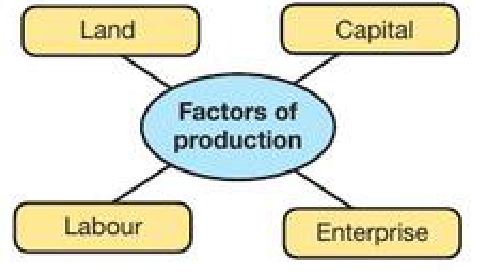
Businesses combine resources to produce goods and services. A banana farmer uses land and labour; a bakery needs ingredients, equipment, premises and business decisions. These resources can be grouped into four factors of production.
Getting Started: Banana Farming in Uganda
Robert Oloya farms bananas in the Insigiro district of western Uganda. After working in financial services, he returned at age 42 to take over his parents’ farm, used savings to buy neighbouring land, employed six local workers and began exporting some produce to South Sudan. The case illustrates all four factors: land and soil, labour to grow the crop, tools or equipment as capital, and Robert’s enterprise in financing and organising expansion.
Example: Hiring a tractor to prepare land could speed up cultivation, although its rental or purchase costs might be too high for a small farm. Whether mechanisation is worthwhile depends on the farm’s size, labour availability and demand.
Land
Land does not mean only the plot occupied by a factory or shop. It also includes the natural inputs businesses extract or use. A shopping centre requires a site and parking space; a farming business needs fertile soil and water. Some resources, such as coal and iron ore, are non-renewable. Fish, forests and water can be renewable if managed sustainably, although overuse can exhaust them.
Labour
The workforce includes manual workers, skilled tradespeople, managers and specialists. Workers differ in ability, qualifications, experience, motivation and creativity. The banana-farming example employs six local people; Angela’s Bakery later employs specialist staff to meet increasing demand.
Capital
- Working or circulating capital: stocks of raw materials and components that are used up in production, and finished goods awaiting sale. Bakery flour and cake ingredients are examples.
- Fixed capital: longer-lasting resources, such as buildings, ovens, machinery, tools, factory equipment, shop fittings and furniture used repeatedly in production.
These meanings should not be confused with financial capital, the funds used to purchase resources. For instance, Angela’s own investment funded the bakery, while her oven is a fixed capital resource.
Enterprise
- Entrepreneurs develop a business idea or identify an unmet need.
- They act as owners and decision-makers, deciding how the business will operate.
- They accept risk: they may lose money if the venture fails, but may earn profit if it succeeds.
- They organise resources, recruiting staff, obtaining equipment and managing finance, production and time.
Activity 1: Angela’s Bakery
Angela Collier, a pastry chef trained in Madrid, opened a bakery in Gijón, Spain. She invested €40,000 of her own money, supplied cakes to local cafés and hotels and accepted online orders for special occasions. Growth eventually enabled her to employ three staff.
Applying the factors: her premises are land; the cake-makers’ skills are labour; the ovens, mixers and kitchen equipment are fixed capital; ingredients are working capital; and Angela’s decisions, investment and risk-taking represent enterprise.
Specialisation and the Division of Labour
Examples include Coca-Cola specialising in soft drinks, Toyota in cars and Emirates in air travel. Within a business, departments may specialise in production, purchasing, finance or marketing.
Specialisation and Division of Labour
Construction provides a clear example: an architect designs the building, a bricklayer constructs walls and a roofer installs the roof. Concentrating on fewer tasks can increase output per worker and help employees become more proficient.
- Greater skill: practice and repetition make workers quicker and more accurate at a task.
- Less switching time: employees avoid repeatedly moving between jobs or tools.
- Easier coordination: managers can allocate tasks and organise the production process more clearly.
- Better matching of skills: each worker focuses on work they perform well.
Limitations: repeated work can become tedious and reduce job satisfaction. An entire production sequence may also be delayed if one specialist or department cannot finish its stage on time. Specialisation improves productivity only when coordination and motivation are maintained.
Halfway questions
Try each question first. Open Show suggested answer to check your work; for calculations, write out your steps.
Name the four factors of production and give one bakery example of each.
Show suggested answer
Land: the bakery site; labour: cake-makers; fixed capital: ovens or mixers; enterprise: Angela organising, financing and risking money in the venture.
Why is coal classed as land even though it can be transported to a factory?
Show suggested answer
In economics, land includes all natural resources used in production, not only the physical site. Coal is a non-renewable natural resource.
Distinguish working capital from fixed capital in the context of business production resources.
Show suggested answer
Working capital includes ingredients, raw materials or components used up in production, and goods awaiting sale; fixed capital includes durable ovens, factories, machines and tools used repeatedly.
Explain two ways Angela Collier demonstrated enterprise.
Show suggested answer
She invested €40,000 of her own money, founded a bakery, organised staff and resources, expanded to online custom orders, and accepted the risk of losing her investment. Any two well-explained examples are valid.
Give two reasons why the division of labour can improve productivity.
Show suggested answer
Repeated practice improves specialist skill; less time is wasted switching tasks; workers focus on what they do best; and production becomes easier to organise.
Explain one disadvantage of specialisation for a construction company.
Show suggested answer
A specialist may become bored with repetitive work, or delays in one trade can postpone later work such as roofing, even if other employees are ready.
Labour-intensive and Capital-intensive Production
Businesses select a suitable combination of workers and equipment. Labour-intensive methods may be appropriate for customised work or where wages are relatively low. Capital-intensive production often suits large volumes of standardised products, especially where machinery improves precision, speed and consistency. Neither method is automatically best for every business.
The Type of Product
Mass-produced, fast-moving consumer goods often need automated assembly and large-scale machinery. Labour-intensive methods may suit personalised goods, repair services and jobs requiring judgement or customer attention. It is also worth noting that many services can remain labour-intensive even in advanced economies.
Example: a custom wedding dress may depend on a skilled dressmaker, while a high-volume smartphone assembly plant can justify extensive equipment. The business should consider what the customer values, including quality, speed and flexibility.
The Relative Prices of the Two Factors
The relative cost of wages and machines helps determine the resource mix. Where labour is cheaper, the firm may prefer additional workers. If wages rise sharply or machinery becomes relatively cheaper and more productive, investment in machines may be attractive. Businesses must consider installation, maintenance and breakdown costs alongside purchase price.
Table 44.1: Labour-intensive and Capital-intensive Production
| Method | Advantages | Disadvantages |
|---|---|---|
| Capital-intensive | More cost-effective for large quantities; precise and consistent output; can operate around the clock; equipment can be easier to manage. | High setup costs; breakdowns may interrupt production; specialised equipment can reduce flexibility; redundancies can harm morale. |
| Labour-intensive | Flexible workers who can be retrained; often suitable for small batches or where labour is cheap; employees can solve problems and improve methods. | Workers need breaks and leave; attendance can be unpredictable; managing people requires motivation and consideration of their needs. |
Important judgement: the example does not suggest that labour-intensive methods are universally cheaper. Small production runs can favour skilled labour; large output can make machinery more economical because its high setup cost is spread across many units.
Activity 2: Moon Brothers Construction Company
Moon Brothers Construction Company operates in Ireland with 37 employees. Eight are general labourers and the remainder are skilled workers. Examples of skilled roles include Brendan O’Hagan, a bricklayer who learned through work; Mary O’Mara, a qualified electrician who attended college; and Ahab Patel, a self-taught plumber who previously worked independently.
Their specialisation allows each person to contribute trained or experienced skills. A skilled team may finish a project more efficiently and to a better standard, but construction work still depends on cooperation: a delay to one trade can hold up the next. The case also illustrates different routes into specialist work.
The Changing Relationships Between Enterprise, Capital and Labour
The mix of productive resources changes over time. As businesses adopt advanced machinery to make standardised goods, many production processes become more capital-intensive, although skilled labour remains important.
More machinery does not remove the need for labour or enterprise. Instead, workers may need a different combination of skills: handling computerised equipment, diagnosing faults, working flexibly, solving problems or making decisions. An entrepreneur still has to decide which technologies to purchase and how to finance and organise their use.
Changing Production: Jaguar Land Rover
In 2014, Jaguar Land Rover opened a £1,000 million plant in Changshu with Chery Automobile. Its planned output of up to 130,000 vehicles a year illustrates how major capital investment supports mass production. These are historical plans, not current operating figures.
Interpretation: as factories expand and automate, fewer people may be needed for repetitive tasks, while technicians, engineers and supervisors become more important. Where output grows, businesses may still increase total employment even if each worker produces more.
Illustrative calculation from the historical figures: £1,000 million ÷ 130,000 planned annual vehicles ≈ £7,692 of investment per unit of planned annual capacity. This is not a manufacturing unit cost: investment is a capital expenditure spread over multiple years and capacity may not equal actual output.
Large vs Small Businesses
Historical information states that as businesses grow, they often use more capital relative to labour. High-volume output can justify machinery and allow its initial cost to be spread across more units. Smaller businesses may rely more on skilled workers and flexible techniques, particularly when products are customised or demand is uncertain.
Business size alone does not decide the best method. The type of product, wage costs, demand, access to finance, employee skills and the risk of machine breakdowns all matter. Small firms can also use specialised machinery where affordable or necessary.
End-of-chapter questions
Try each question first. Open Show suggested answer to check your work; for calculations, write out your steps.
Define labour-intensive production and identify a suitable example.
Show suggested answer
Using relatively more workers than capital equipment, such as handmade wedding gowns, specialist repairs or made-to-order cakes.
Define capital-intensive production and explain one reason a business may prefer it.
Show suggested answer
Production relying relatively more on machines and other capital; it may reduce costs for large volumes or deliver consistent, precise output.
Identify the two factors businesses consider most affect a choice between labour- and capital-intensive production.
Show suggested answer
The type of product being made and the relative prices (costs) of labour and capital.
Explain two advantages and two disadvantages of capital-intensive production.
Show suggested answer
Advantages include fast, consistent, precise output and operation around the clock. Disadvantages include large setup costs, costly breakdowns, inflexible specialist machinery and potential job losses.
Why might a small specialist bakery favour labour-intensive methods over fully automated production?
Show suggested answer
Its products may be customised and its sales volume too low to spread expensive machinery costs; skilled workers may offer more flexibility and personal attention.
Use Moon Brothers Construction Company to explain how the division of labour supports building projects.
Show suggested answer
The 37-employee business employs bricklayers, electricians and plumbers, allowing workers to use specialist skills and improve quality and productivity, provided tasks are coordinated.
In the historical figures’ Jaguar Land Rover example, what does an investment in a large advanced plant show about the relationship between labour and capital?
Show suggested answer
It shows how higher-volume car production may rely more on expensive machinery, while still needing trained employees to operate, maintain and supervise production.
A workshop increases its workforce from 12 to 160 employees. Calculate the increase in the number of workers.
Show suggested answer
Increase = 160 − 12 = 148 workers.
Calculate the percentage increase when a business expands from 12 to 160 workers.
Show suggested answer
Percentage increase = (160 − 12) ÷ 12 × 100 = 1,233.3% (approximately).
Explain why borrowing more than CNY 7 million for machinery could be risky for a small manufacturer.
Show suggested answer
The business must pay interest and repay the loan even if sales fall. Expensive equipment may also become underused or obsolete, putting pressure on cash flow.
Assess whether a toy manufacturer should invest in automated equipment to fulfil a large one-off order.
Show suggested answer
Automation may improve speed and unit costs, but a one-off order might not justify a large fixed investment. Compare demand after the order, expected profit, borrowing costs and alternatives such as outsourcing or temporary labour.
Chapter 44 recap
Businesses organise land, labour, capital and enterprise to produce goods and services. Specialisation and the division of labour can improve productivity but may cause boredom or delays. Choosing labour-intensive or capital-intensive methods depends on the type of product, relative costs, output and business size. The best resource mix can change as technology and demand develop.