
Chapter 45 · Quality
Learn why quality matters, how businesses check and prevent defects, and how total quality management and standards support customer satisfaction.
Learning objectives
- Understand the concept of quality and why customers judge it differently.
- Explain the importance of quality in goods and services.
- Understand quality control and the preventive role of quality assurance.
- Explain the features of total quality management (TQM).
- Analyse how quality and standards give a business competitive advantage.
What Is Quality?
Different customers value different characteristics, so quality is not simply a high price or luxurious appearance. A family buying a car may judge comfort and seating capacity, while another customer prioritises reliability, safety or low repair costs. For services, speed, courtesy, consistency and helpfulness are particularly important.
Getting Started: Quality at the Albannach Hotel
The Albannach Hotel in Scotland’s northwest Highlands provides an example of quality-based competition. Its owners built a reputation for high-quality food, accommodation and friendly service. The hotel was awarded a Michelin star in 2009; that is historical context rather than a statement about its current rating.
Its renovated historic property, locally sourced seafood, organic vegetables and free-range meat contribute to the overall customer experience. It illustrates how a small service business can compete on quality rather than only low prices. The Michelin-star information is part of historical case.
Features of Quality
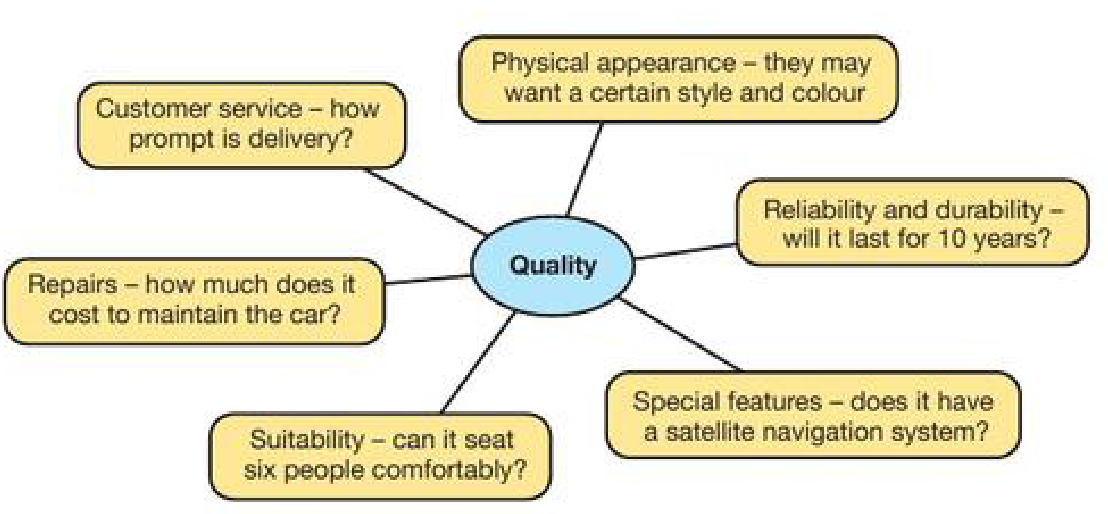
The figure lists appearance, reliability and durability, special features, suitability, repair costs and customer service. A business needs to find out which of these matter most to its particular customers. For example, a repairable, dependable product may be valued more than an attractive product that breaks down frequently.
The Importance of Quality
Customer expectations have risen as people can compare businesses, read reviews and access more information. This chapter identifies three reasons for improving quality:
- Competition: customers can switch to rivals when a business consistently disappoints them.
- Legislation: firms must meet consumer protection and health-and-safety requirements; food producers, for example, must maintain hygiene standards.
- Costs of faults: repairs, waste, missed deliveries, recalls and lost sales can be very expensive.
A reputation for quality can encourage repeat purchases and word-of-mouth recommendations. Poor quality may damage future sales long after a product has been withdrawn.
Activity 1: Samsung Galaxy Note 7
Samsung’s Galaxy Note 7 was recalled in 2016 after reports of batteries overheating and catching fire. Production ended and customers were asked to return devices using special protective packaging. The incident demonstrates how faults can damage reputation and increase costs.
This case illustrates the connections among product safety, recall and replacement costs, compensation risks, brand reputation and lost consumer confidence. Market-value losses are not the same as cash costs or net profit losses; they reflect changes in investors’ valuation.
Traditional Quality Control
Inspection and Faulty Products
Traditionally, production departments employed specialist inspectors or quality controllers to test finished products and check whether they worked properly, met legal safety standards, suited customer needs and were economical to repair. Defective goods could be rejected before reaching customers.
Strength: inspection can prevent visibly faulty items being sold. Limitation: finding a defect after production means the business may already have spent money on materials and labour; it then faces reworking or scrapping items. Inspecting a sample may also miss some faults.
Example: if a guitar is only tested after final assembly, faulty tuning hardware may require disassembly. Checking the component before it is fitted would save time and materials.
Quality Assurance
Preventing Defects
Rather than waiting until the end to find a faulty product, quality assurance aims to prevent mistakes during each stage of production. Workers check their materials, equipment and outputs before handing work to the next stage. A problem can therefore be corrected when it is smaller and cheaper to solve.
This links this preventive approach with total quality management (TQM), which makes quality a responsibility throughout the organisation. Customer feedback should help the business decide which standards to maintain or improve.
| Traditional quality control | Quality assurance |
|---|---|
| Checks completed products or final output | Builds quality checks into the production process |
| Often relies on inspectors | Requires staff at every stage to take responsibility |
| Finds faults after they have occurred | Seeks to prevent faults before the item is finished |
| May result in waste or rework | Can reduce waste but requires training and good coordination |
Halfway questions
Answer each question before expanding Show suggested answer. Use case-study evidence in longer answers.
Define quality and describe two features that might matter to someone buying a family car.
Show suggested answer
Quality means features that enable a product or service to satisfy customer wants. Reliability and durability, passenger space, appearance, after-sales repairs, special features or delivery service may matter to a car buyer.
Give two pieces of evidence that the Albannach Hotel offered high-quality products and services.
Show suggested answer
It had a Michelin star, prepared locally sourced ingredients, invested in renovation and attracted repeat guests through its food, accommodation and friendly service. Any two supported points earn credit.
Explain why providing consistent quality can help a business increase revenue.
Show suggested answer
Satisfied customers are more likely to return and recommend the business. A reputation for quality can also attract new customers and sometimes justify higher prices, boosting sales revenue.
What is a product recall? Use the Samsung Galaxy Note 7 example.
Show suggested answer
A recall asks customers to return an unsafe or defective product. Samsung halted Note 7 production and arranged returns after batteries presented overheating and fire risks.
Distinguish traditional quality control from quality assurance.
Show suggested answer
Traditional quality control checks completed items and identifies defects after production. Quality assurance monitors and improves work during production to prevent faults before products are finished.
Explain one reason why quality checks are particularly important for health and safety.
Show suggested answer
Dangerous faults can injure customers and lead to recalls, compensation claims, damage to reputation and legal consequences. Examples include faulty phone batteries or unsafe food.
Total Quality Management
TQM is not just an inspection department. It is a way of organising work so employees, managers, suppliers and processes consistently meet customer requirements. This chapter identifies six connected features:
Quality Chains
Every worker is both a customer of the previous stage and a supplier to the next stage. Accepting and passing on work only when it meets agreed standards avoids spreading faults through production.
Everyone Is Involved
Every department and employee is responsible for quality, not just a specialist inspector. Senior management must set the example and support the system with time, training and resources.
Quality Audits
Audits use measurements and records to check quality and identify variations. For example, a manufacturer may track defect rates, delays, material faults or complaints to locate where a process is failing.
Teamwork
Working together combines different skills and experience, often identifying a practical solution more effectively than a worker acting alone.
Customer Focused
Customers’ needs and expectations guide the standards. Feedback should influence product design, customer service and the work carried out at every stage.
Zero Defects
The aim is to prevent defects rather than tolerate them. It is a demanding target requiring regular monitoring; it should not be interpreted as a guarantee that faults are literally impossible.
Table 45.1: Advantages and Disadvantages of TQM
| Potential benefits | Potential drawbacks |
|---|---|
| Higher customer satisfaction and consistent standards | High training and implementation costs |
| Less waste, fewer inefficiencies and clearer performance measures | Works only when staff and managers are committed |
| Better communication and problem solving | Can become bureaucratic or document-heavy |
| Quality improves throughout the business | May focus on procedures more than the final product |
Paraphrased from an earlier example’s Table 45.1; the editable comparison appears above.
Activity 2: Santa Cruz Guitar Company
Santa Cruz Guitar Company offers an example of skilled, quality-focused production. In the historical example, it made around 500 handcrafted guitars a year across six workstations, with checks at each stage, worker training and attention to individual customer specifications.
Although it does not formally follow a written TQM policy, its working practices show quality chains, teamwork, skilled staff, employee commitment and customer focus. This demonstrates that a small business can apply TQM principles without the bureaucracy of a large formal scheme.
Quality Standards
Businesses can demonstrate their commitment to quality through recognised standards, codes of practice and independent assessment. Examples include the British Standards Institution (BSI), ISO 9000 family of quality-management standards and the BSI kitemark.
Accreditation can help customers judge the consistency of a firm’s systems and encourage staff to follow documented procedures. It is important to distinguish a quality-management system standard from a guarantee that every individual product has no defects. In the chapter review, ADS holds ISO 9001 certification.
Benefits of ISO Accreditation
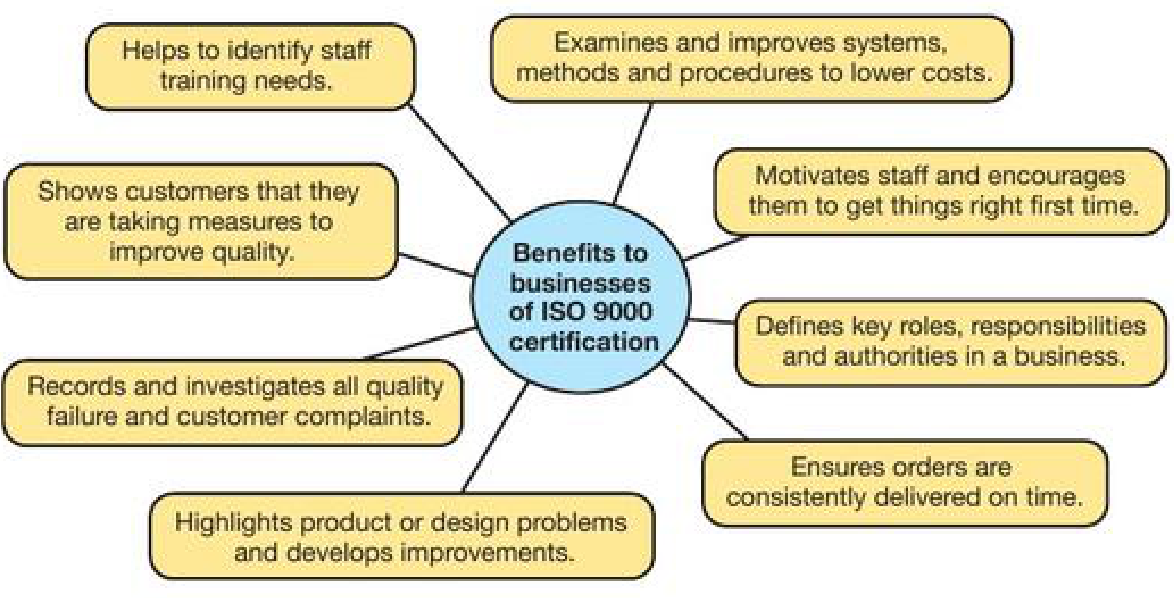
Possible advantages include identifying training needs, clarifying roles, improving procedures, investigating complaints, maintaining delivery reliability and showing customers that the business takes quality seriously. However, documenting systems and preparing for assessments involves time and expense.
Quality and Competitive Advantage
Quality can help businesses differentiate their products when customers value durability, reliable performance and service. Premium brands such as Rolex and Rolls-Royce illustrate how perceived quality can support positioning and customer loyalty.
Quality as a Unique Selling Point
Better design, durability, craftsmanship or customer service can become a USP. A strong reputation may support repeat sales, customer loyalty and a price premium, potentially raising profit margins. However, superior quality often requires investment in skilled people, materials, equipment and reliable systems; firms must judge whether their customers will pay enough to cover those costs.
Application: for a handmade-guitar producer, carefully inspected construction and long product life may justify charging more than a mass-market competitor. For a software company, reliability and secure customer data may be more important than appearance.
Large vs Small Businesses
A key point is that quality matters to businesses of all sizes. Large firms may be more able to fund extensive training, quality departments and formal TQM programmes. Small firms can still offer exceptional quality by paying close attention to individual customers, maintaining skilled workmanship and using straightforward checks.
Neither business size guarantees quality nor removes the need for it. What matters is choosing a quality system that suits the firm’s products, resources and customers.
End-of-chapter questions
Answer each question before expanding Show suggested answer. Use case-study evidence in longer answers.
State two possible benefits and two possible limitations of total quality management (TQM).
Show suggested answer
Benefits: less waste and rework, better communication, improved customer satisfaction, clearer performance measures. Limitations: costly training and implementation, employee commitment is essential, bureaucracy or excessive focus on process.
Describe the idea of a quality chain using the Santa Cruz Guitar Company.
Show suggested answer
Each workstation is both a supplier to the next stage and a customer of the previous one. A skilled worker checks their own work before passing the guitar along, helping prevent defects from spreading.
What does zero defects mean in TQM, and why can achieving it be difficult?
Show suggested answer
It is the aim of making products without defects by preventing errors throughout production. Achieving it can be difficult because materials, machines and human performance vary, so continuous monitoring and improvement remain essential.
Explain why quality audits use statistical data.
Show suggested answer
Statistical data help businesses detect variation in delivery times, materials, worker performance and defect rates, investigate causes and check whether improvements are effective.
Explain two ways in which Santa Cruz Guitar Company uses TQM-like principles despite not having a formal written policy.
Show suggested answer
Skilled luthiers inspect every guitar at each workstation; they emphasise teamwork and training, follow detailed customer specifications and allow direct customer communication. Any two explained points earn credit.
What is the purpose of a recognised quality standard such as ISO 9000?
Show suggested answer
It provides a recognised framework for documented, consistent quality management systems. A company can use accreditation to demonstrate its systems and reassure customers; it does not automatically guarantee that every product is flawless.
Identify two advantages of quality accreditation shown in Figure 45.3.
Show suggested answer
Possible answers: identify training needs; improve systems and reduce costs; increase staff motivation; clarify roles; improve on-time delivery; investigate complaints; find design problems; reassure customers that quality is being addressed.
Explain how quality might become a unique selling point (USP) for a small business.
Show suggested answer
If its products are noticeably more durable, carefully made or better supported than rivals, the difference becomes a reason for customers to choose it and sometimes accept a higher price. Handmade premium guitars are an example.
Explain how a software business can monitor and maintain the quality of its products and customer service.
Show suggested answer
It can use testing, defect logs, customer feedback, staff training, documented procedures and periodic quality audits to identify and correct faults before they disrupt customers.
Why is maintaining quality especially important for a business whose software manages customers’ databases?
Show suggested answer
Errors or outages may interrupt operations, damage data and reduce trust. High reliability, secure processes and responsive support can improve customer loyalty.
Evaluate whether a software provider with ISO 9001 certification should also adopt full total quality management (TQM).
Show suggested answer
Certification provides a structured quality-management framework; broader TQM could encourage continuous improvement and employee involvement. The additional training and coordination costs must be justified by fewer faults and stronger customer satisfaction.
Chapter 45 recap
Quality means meeting customers’ wants through reliable goods and services. Traditional quality control looks for faults, whereas quality assurance tries to prevent them. TQM involves everyone in preventing defects and making ongoing improvements; quality standards may demonstrate consistent management systems. Businesses of any size can use quality as a competitive advantage, but they must weigh the costs and benefits.