Worked example · Easy
Nearest centimetre
A length is 43 cm correct to the nearest centimetre. State its bounds.
The rounding unit is 1 cm, so half a unit is 0.5 cm.
\[43-0.5=42.5,\qquad43+0.5=43.5\]\[\boxed{42.5\le L<43.5}\]Measurements that have been rounded are not exact. Learn to turn each rounded measurement into a range, then use the correct ends of those ranges to find the greatest and least possible results.
Subtopic 1
A rounded measurement stands for a whole interval of possible true values. The lower bound (LB) is the smallest possible value in the interval; the upper bound (UB) is the boundary at the top of the interval.
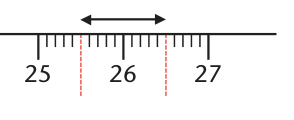
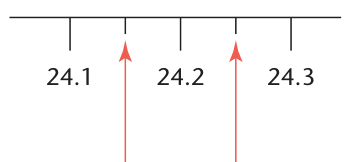
If a value has been rounded to the nearest unit of size \\(u\\), then:
\[\text{LB}=\text{rounded value}-\frac{u}{2},\qquad \text{UB}=\text{rounded value}+\frac{u}{2}.\]The true value \\(x\\) lies in the error interval
\[\boxed{\text{LB}\le x<\text{UB}}.\]| Rounded to | Half-unit to subtract/add | Example |
|---|---|---|
| nearest 1 | 0.5 | 57 → 56.5 to 57.5 |
| nearest 0.1 | 0.05 | 4.7 → 4.65 to 4.75 |
| nearest 0.01 | 0.005 | 3.28 → 3.275 to 3.285 |
| nearest 10 | 5 | 340 → 335 to 345 |
| nearest 100 | 50 | 5600 → 5550 to 5650 |
A length is 43 cm correct to the nearest centimetre. State its bounds.
The rounding unit is 1 cm, so half a unit is 0.5 cm.
\[43-0.5=42.5,\qquad43+0.5=43.5\]\[\boxed{42.5\le L<43.5}\]A race time is 18.4 s correct to 1 decimal place. Find the error interval.
1 d.p. means nearest 0.1 s, so half the unit is 0.05 s.
\[18.4-0.05=18.35\]\[18.4+0.05=18.45\]\[\boxed{18.35\le t<18.45}\]A population is stated as 48 000 correct to 2 significant figures. Find its lower and upper bounds.
The second significant figure is the thousands digit, so the number was rounded to the nearest 1000.
Half of 1000 is 500.
\[48\,000-500=47\,500\]\[48\,000+500=48\,500\]\[\boxed{47\,500\le P<48\,500}\]Do not use the final written zero to decide the rounding unit. For significant figures, first identify the place value of the last significant digit.
A distance is 480 m, correct to the nearest 10 metres. Express the true distance \(d\) as an inequality.
Half the rounding unit is 5 m. \[\boxed{475\le d<485\text{ m}}\] The upper boundary is not included.
Work each question first, then select Show Answer to reveal the steps.
Give the bounds of 36 cm measured to the nearest centimetre.
Steps: Half a centimetre is 0.5 cm: \(\boxed{35.5\le L<36.5\text{ cm}}\).
A time is 8.2 s to the nearest 0.1 s. State its lower bound.
Steps: Half of 0.1 is 0.05. \(8.2-0.05=\boxed{8.15\text{ s}}\).
Write the error interval for 6.38 kg correct to 2 decimal places.
Steps: Half of 0.01 is 0.005: \(\boxed{6.375\le m<6.385\text{ kg}}\).
A length rounds to 320 mm to the nearest 10 mm. What is the greatest boundary value?
Steps: \[320+5=\boxed{325\text{ mm}}\] This is the upper boundary, not an included possible exact length.
A race time is shown as 14.6 s, correct to 1 decimal place. Can its actual time be 14.65 s? Explain.
Steps: The interval is \(14.55\le t<14.65\). The upper endpoint rounds to 14.7 s, so \(\boxed{\text{no}}\).
Subtopic 2
For addition, the largest total comes from adding the largest possible values and the smallest total comes from adding the smallest possible values. Subtraction is different because making the number being subtracted larger makes the result smaller.
Two lengths are 12.4 cm and 8.7 cm, each correct to the nearest 0.1 cm. Find the bounds of their total.
First length: \\(12.35\le a<12.45\\).
Second length: \\(8.65\le b<8.75\\).
\[\mathrm{LB}(a+b)=12.35+8.65=21.00\]\[\mathrm{UB}(a+b)=12.45+8.75=21.20\]So \\(\boxed{21.00\le a+b<21.20}\\).
A longer ribbon is 35.2 cm and a shorter ribbon is 12.6 cm, both correct to the nearest millimetre. Find the lower and upper bounds of their difference.
Nearest millimetre = nearest 0.1 cm.
Long ribbon: LB 35.15, UB 35.25.
Short ribbon: LB 12.55, UB 12.65.
Smallest difference:
\[35.15-12.65=22.50\text{ cm}\]Largest difference:
\[35.25-12.55=22.70\text{ cm}\]Therefore \\(\boxed{22.50\le d<22.70}\\).
A shelf opening is 60 cm wide, correct to the nearest centimetre. A box is 595 mm wide, correct to the nearest millimetre. Will the box definitely fit?
Opening lower bound:
\[60\text{ cm}\Rightarrow59.5\text{ cm}=595\text{ mm}\]Box upper bound:
\[595\text{ mm}\Rightarrow595.5\text{ mm}\]In the worst case the opening can be 595 mm while the box can be almost 595.5 mm.
So the box is not guaranteed to fit. \\(\boxed{\text{No}}\\)
For a “definitely fits?” question, compare the largest possible object with the smallest possible opening.
Two planks are 2.4 m and 1.7 m long, each to the nearest 0.1 m. Find the greatest possible difference between their lengths.
The first length is below 2.45 m; the second is at least 1.65 m. Max difference approaches \[2.45-1.65=\boxed{0.80\text{ m}}\]
Work each question first, then select Show Answer to reveal the steps.
Lengths 12 cm and 9 cm are each correct to the nearest cm. Find the lower bound of their sum.
Steps: \[11.5+8.5=\boxed{20\text{ cm}}\]
Two masses are 3.4 kg and 2.1 kg, each to 1 d.p. Find the upper bound of their total.
Steps: \[3.45+2.15=\boxed{5.60\text{ kg}}\] (an upper boundary).
Two lengths are 18 cm and 11 cm, each to the nearest cm. Find the lower bound of their difference.
Steps: \[17.5-11.5=\boxed{6\text{ cm}}\] Minimum first minus maximum second.
Times of 6.8 s and 4.3 s are to 1 d.p. Find the upper bound of their difference.
Steps: \[6.85-4.25=\boxed{2.60\text{ s}}\]
Three timber lengths are 1.25, 2.36 and 0.94 m, each to nearest cm. Find the lower bound of their combined length.
Steps: Each was rounded to 0.01 m, so subtract 0.005 m from each: \[1.245+2.355+0.935=\boxed{4.535\text{ m}}\]
Subtopic 3
For positive measurements, products are straightforward: use upper bounds together for the greatest product and lower bounds together for the least product. Quotients need opposite bounds in the denominator.
A rectangle is 8.0 cm by 5.0 cm, each measurement correct to the nearest 0.1 cm. Find the area bounds.
Width: \\(7.95\le w<8.05\\). Height: \\(4.95\le h<5.05\\).
\[A_{\min}=7.95\times4.95=39.3525\text{ cm}^2\]\[A_{\max}=8.05\times5.05=40.6525\text{ cm}^2\]So \\(\boxed{39.3525\le A<40.6525}\\).
A cyclist travels 14.2 km correct to 3 significant figures in 46 minutes correct to the nearest minute. Find the speed bounds in km/h to 3 significant figures.
Distance: \\(14.15\le d<14.25\\) km.
Time: \\(45.5\le t<46.5\\) minutes.
Fastest speed uses greatest distance and shortest time:
\[v_{\max}=\frac{14.25}{45.5}\times60\approx18.8\text{ km/h}\]Slowest speed uses shortest distance and longest time:
\[v_{\min}=\frac{14.15}{46.5}\times60\approx18.3\text{ km/h}\]\(\boxed{18.3\le v<18.8\text{ km/h}}\) to 3 s.f.
A town has population 108 000 to the nearest 1000 and area 129 km² to the nearest km². Find the lower and upper bounds of its population density to 3 significant figures.
Population: LB 107 500, UB 108 500.
Area: LB 128.5, UB 129.5.
Lower density:
\[\frac{107500}{129.5}\approx830\text{ people/km}^2\]Upper density:
\[\frac{108500}{128.5}\approx844\text{ people/km}^2\]So the density is approximately \\(\boxed{830\le D<844}\\) people/km².
A car travels 125 km (nearest km) in 2.5 h (nearest 0.1 h). Find an upper bound for its average speed.
The distance is below 125.5 km and the time is at least 2.45 h. For the largest speed use UB(distance)/LB(time): \[\frac{125.5}{2.45}=\boxed{51.22\text{ km/h}}\text{ (approx.)}\]
Work each question first, then select Show Answer to reveal the steps.
A rectangle is 5 cm by 4 cm, both to nearest cm. Find its smallest possible area.
Steps: \[A_{\min}=4.5\times3.5=\boxed{15.75\text{ cm}^2}\]
A rectangle is 5 cm by 4 cm, both to nearest cm. Find its upper area bound.
Steps: \[A_{\max}\to5.5\times4.5=\boxed{24.75\text{ cm}^2}\]
A rectangle measures 8.0 cm by 3.0 cm (nearest 0.1 cm). Give the lower bound of its area.
Steps: \[7.95\times2.95=\boxed{23.4525\text{ cm}^2}\]
A journey covers 100 km (nearest km) in 2 h (nearest hour). Find the lower bound of average speed.
Steps: Smallest distance: 99.5 km. Largest time boundary: 2.5 h. \(\dfrac{99.5}{2.5}=\boxed{39.8\text{ km/h}}\).
A cuboid is 3.2 cm × 4.5 cm × 2.6 cm, each correct to 1 d.p. Find its lower volume bound.
Steps: Use all three lower bounds: \[V_{\min}=3.15\times4.45\times2.55=\boxed{35.744625\text{ cm}^3}\]
The first questions build confidence with error intervals. The later questions require you to decide which combination of bounds gives the largest or smallest possible result.
A length is 71 cm correct to the nearest centimetre. State its lower and upper bounds.
Half of 1 cm is 0.5 cm.
\[\boxed{70.5\le L<71.5}\]A mass is 6.3 kg correct to 1 decimal place. Write its error interval.
Half of 0.1 is 0.05.
\[\boxed{6.25\le m<6.35}\]A time is 12.48 s correct to 2 decimal places. State its bounds.
Half of 0.01 is 0.005.
\[\boxed{12.475\le t<12.485}\]A distance is 7300 m correct to 2 significant figures. Find its bounds.
The second significant figure is the hundreds digit, so the value was rounded to the nearest 100 m. Half of 100 is 50.
\[\boxed{7250\le d<7350}\]Lengths 7.2 m and 4.5 m are each correct to the nearest 0.1 m. Find the bounds of their sum.
First length: 7.15 to 7.25. Second: 4.45 to 4.55.
\[\mathrm{LB}=7.15+4.45=11.60\]\[\mathrm{UB}=7.25+4.55=11.80\]\(\boxed{11.60\le S<11.80}\\).
Two rods measure 18.6 cm and 11.4 cm to the nearest 0.1 cm. Find the lower bound of the difference.
For the smallest difference, use the lower bound of the longer rod and the upper bound of the shorter rod.
\[18.55-11.45=\boxed{7.10\text{ cm}}\]A rectangle is 12 cm by 5 cm, both measurements correct to the nearest centimetre. Find the lower and upper bounds of its perimeter.
Length: 11.5 to 12.5; width: 4.5 to 5.5.
\[P_{\min}=2(11.5+4.5)=32\text{ cm}\]\[P_{\max}=2(12.5+5.5)=36\text{ cm}\]\(\boxed{32\le P<36}\\).
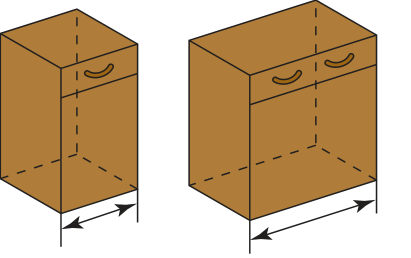
A cupboard is 79.6 cm wide correct to the nearest 0.1 cm. A recess is 80 cm wide correct to the nearest centimetre. Is the cupboard guaranteed to fit?
Cupboard UB = 79.65 cm.
Recess LB = 79.5 cm.
Since 79.65 > 79.5, there are possible true measurements for which the cupboard is wider than the recess.
\(\boxed{\text{No, it is not guaranteed to fit.}}\\)
A rectangle measures 6.2 m by 3.8 m, both correct to 1 decimal place. Find the lower and upper bounds of its area.
Dimensions: 6.15 to 6.25 and 3.75 to 3.85.
\[A_{\min}=6.15\times3.75=23.0625\]\[A_{\max}=6.25\times3.85=24.0625\]\(\boxed{23.0625\le A<24.0625\text{ m}^2}\\).
Each of 10 identical pencils has width 8 mm correct to the nearest millimetre. What is the smallest possible total width?
One pencil LB = 7.5 mm.
\[10\times7.5=\boxed{75\text{ mm}}\]A runner covers 100 m correct to the nearest metre in 12.4 s correct to 1 decimal place. Find the lower and upper bounds of the average speed.
Distance: 99.5 to 100.5 m. Time: 12.35 to 12.45 s.
\[v_{\min}=\frac{99.5}{12.45}\approx7.99\text{ m/s}\]\[v_{\max}=\frac{100.5}{12.35}\approx8.14\text{ m/s}\]So approximately \\(\boxed{7.99\le v<8.14\text{ m/s}}\\).
A block has mass 520 g correct to the nearest 10 g and volume 65 cm³ correct to the nearest cm³. Find the greatest possible density.
Mass UB = 525 g. Volume LB = 64.5 cm³.
\[\rho_{\max}=\frac{525}{64.5}\approx\boxed{8.14\text{ g/cm}^3}\]A cuboid measures 8.6 cm by 4.1 cm by 2.4 cm, each correct to the nearest 0.1 cm. Find the largest possible volume.
Use all upper bounds:
\[8.65\times4.15\times2.45\approx\boxed{87.96\text{ cm}^3}\]A rectangle has area 210 cm² correct to 3 significant figures and length 17.8 cm correct to the nearest millimetre. Find the minimum possible width.
210 to 3 s.f. is to the nearest 1 cm², so area LB = 209.5 cm².
17.8 cm to nearest mm means length UB = 17.85 cm.
Minimum width uses smallest area and greatest length:
\[w_{\min}=\frac{209.5}{17.85}\approx\boxed{11.7\text{ cm}}\]Runner A is recorded as 9.9 s correct to 1 d.p. Runner B is recorded as 9.93 s correct to 2 d.p. Can you be certain which runner was faster?
A: \\(9.85\le t_A<9.95\\).
B: \\(9.925\le t_B<9.935\\).
The intervals overlap, for example A could have run 9.90 s while B ran 9.93 s, but A could also have run 9.94 s while B ran 9.93 s.
\(\boxed{\text{No, the rounded data are not enough to be certain.}}\\)
A tank measures 80 cm by 75 cm by 90 cm, each correct to the nearest centimetre. Could its true capacity be exactly 550 litres? (1000 cm³ = 1 litre.)
Lower volume:
\[79.5\times74.5\times89.5\approx530\,105\text{ cm}^3\approx530\text{ L}\]Upper volume:
\[80.5\times75.5\times90.5\approx550\,207\text{ cm}^3\approx550.2\text{ L}\]Since 550 L lies between the lower and upper possible capacities, \\(\boxed{\text{yes, it could}}\\).
\(P=\frac{V^2}{R}\), where \\(V=6\\) and \\(R=1\\), each correct to the nearest whole number. Find the greatest possible value of \\(P\\).
V has UB 6.5. R has LB 0.5.
To maximise \\(P\\), maximise the numerator and minimise the denominator:
\[P_{\max}=\frac{6.5^2}{0.5}=\frac{42.25}{0.5}=\boxed{84.5}\]A density is calculated from \\(\rho=\frac{m}{V}\\). Explain, without calculating, which bounds of mass and volume are needed for a) the greatest density and b) the least density.
a) Greatest density: make the numerator as large as possible and denominator as small as possible, so use \\(\boxed{\mathrm{UB}(m)/\mathrm{LB}(V)}\\).
b) Least density: make the numerator as small as possible and denominator as large as possible, so use \\(\boxed{\mathrm{LB}(m)/\mathrm{UB}(V)}\\).
I identify the rounding unit and add/subtract half of it.
I write LB ≤ value < UB and remember that the upper bound is not included.
Smallest total uses all lower bounds; largest total uses all upper bounds.
Smallest difference uses LB − UB; largest difference uses UB − LB.
For positive measurements, multiply lower bounds for the minimum and upper bounds for the maximum.
For the greatest quotient I use UB numerator ÷ LB denominator, and reverse this for the least.