Worked example · Easy
Simplify a ratio
Simplify \(24:36\).
HCF\((24,36)=12\).
\[24:36=2:3\]Answer: \(\boxed{2:3}\)
Learn to compare quantities using ratios, scale ratios reliably, divide totals into unequal shares, and recognise whether a situation uses direct or inverse proportion.
Subtopic 1
A ratio compares quantities. The order matters: \(2:5\) does not mean the same as \(5:2\). Ratios can be simplified in the same way as fractions by dividing every part by a common factor.
Divide both parts by 2
3 : 2Simplify \(24:36\).
HCF\((24,36)=12\).
\[24:36=2:3\]Answer: \(\boxed{2:3}\)
Simplify 2.4 m : 60 cm.
Convert 2.4 m to centimetres:
\[2.4\text{ m}=240\text{ cm}\]\[240:60=4:1\]Answer: \(\boxed{4:1}\)
Simplify \(42:63:105\).
The HCF of 42, 63 and 105 is 21.
\[42:63:105=2:3:5\]To make the left-hand part equal to 1, divide every part by the left-hand value.
Write 8 mm : 2 km in the form \(1:n\).
Use the same unit:
\[2\text{ km}=2\,000\,000\text{ mm}\]\[8:2\,000\,000=1:250\,000\]Answer: \(\boxed{1:250\,000}\)
Do not cancel quantities with different units. Convert first. In map scales, a surprisingly large value of \(n\) is normal because centimetres on a map represent metres or kilometres on the ground.
Simplify the ratio \(\frac34:\frac58\).
Multiply both quantities by 8 to remove denominators: \[\frac34:\frac58=6:5\] Answer \(\boxed{6:5}\).
Work each question first, then select Show Answer to reveal the steps.
Simplify 35:49.
Steps: Divide both by 7: \(35:49=\boxed{5:7}\).
Simplify 18:24:30.
Steps: Divide each part by 6: \(\boxed{3:4:5}\).
Simplify 75 cm : 1.5 m.
Steps: Convert 1.5 m to 150 cm: \(75:150=\boxed{1:2}\).
Write 24:40 in the form 1:n.
Steps: Divide both parts by 24: \(1:40/24=\boxed{1:5/3}\) or \(1:1.667\) approximately.
The ratio of boys to girls is 8:12. What fraction of all students are girls?
Steps: Total parts \(8+12=20\). Fraction girls \(\frac{12}{20}=\boxed{\frac35}\).
Subtopic 2
Equivalent ratios are produced by multiplying or dividing every part by the same number. If one actual quantity is known, use it to find the multiplier, then apply that multiplier to the other part.
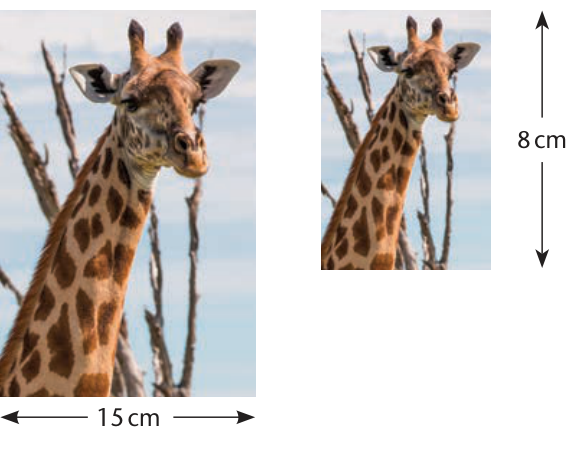
| Ratio | 2 | 5 |
|---|---|---|
| × 4 | 8 | 20 |
The ratio of red to white paint is \(1:3\). If 4 litres of red paint are used, how much white paint is needed?
The red quantity has been multiplied by 4, so multiply the white quantity by 4.
\[1:3\quad\to\quad4:12\]Answer: \(\boxed{12\text{ litres}}\)
A map uses 1 cm : 2.5 km. Two places are 6.8 cm apart on the map. Find the real distance.
Answer: \(\boxed{17\text{ km}}\)
Two similar photographs have corresponding side lengths in the ratio \(3:7\). The smaller width is 12 cm. Find the corresponding larger width.
From 3 to 12, multiply by 4.
\[7\times4=28\]Answer: \(\boxed{28\text{ cm}}\)
If the ratio is \(2:5\), the second quantity must be \(\frac52=2.5\) times the first. Use that relationship to check your answer.
In a mixture, red:blue is 5:8. If there are 3.2 litres of blue, find the red paint needed.
One ratio part represents \(3.2\div8=0.4\) L. Red uses 5 parts: \(5\times0.4=\boxed{2.0\text{ L}}\).
Work each question first, then select Show Answer to reveal the steps.
The ratio of pencils to pens is 4:3. There are 20 pencils. How many pens?
Steps: A factor of 5 turns 4 into 20, so \(3\times5=\boxed{15}\) pens.
A drink uses juice:water = 2:5. How much water goes with 6 L of juice?
Steps: Juice was multiplied by 3: \(5\times3=\boxed{15\text{ L}}\).
A map scale is 1 cm:4 km. A route measures 7.5 cm. Find its real distance.
Steps: \[7.5\times4=\boxed{30\text{ km}}\]
Two photos have height ratio small:large = 3:8. The large photo is 40 cm tall. Find the small height.
Steps: One part is \(40\div8=5\) cm; small height \(3\times5=\boxed{15\text{ cm}}\).
The ratio of adults to children is 5:7. If there are 84 children, how many people are there altogether?
Steps: One part is \(84\div7=12\). Adults \(5\times12=60\). Total \(60+84=\boxed{144}\).
Subtopic 3
A ratio gives the number of equal shares. To divide a total, first find the total number of shares, then the value of one share.
Share $360 in the ratio \(2:3\).
Total shares: \(2+3=5\).
\[360\div5=72\]Amounts:
\[2\times72=144,\qquad3\times72=216\]Answer: \(\boxed{\$144\text{ and }\$216}\)
Check: \(144+216=360\).
Share 1.8 kg in the ratio \(2:3:4\). Give each amount in grams.
Convert: \(1.8\text{ kg}=1800\text{ g}\).
Total shares: \(2+3+4=9\).
\[1800\div9=200\text{ g per share}\]\[2\times200=400,\quad3\times200=600,\quad4\times200=800\]Answer: \(\boxed{400\text{ g},600\text{ g},800\text{ g}}\)
Sweets are shared between A and B in the ratio \(5:2\). A receives 35 sweets. How many sweets are shared altogether?
5 shares correspond to 35 sweets.
\[35\div5=7\text{ sweets per share}\]Total shares: \(5+2=7\).
\[7\times7=\boxed{49}\]Three friends divide $1 680 in the ratio 2:5:7. Find the difference between the largest and smallest shares.
Total parts \(2+5+7=14\); one part \(1680\div14=120\). Largest \(7\times120=840\); smallest \(2\times120=240\). Difference \(840-240=\boxed{\$600}\).
Work each question first, then select Show Answer to reveal the steps.
Share $240 in the ratio 1:3.
Steps: Four parts; one part \(240\div4=60\). Shares \(\boxed{\$60,\ \$180}\).
Divide 72 sweets in the ratio 4:5.
Steps: Nine parts; one part \(72\div9=8\). Shares \(\boxed{32,40}\).
Share 650 g in the ratio 2:3:5.
Steps: Ten parts; one part 65 g. Shares \(\boxed{130\text{ g},195\text{ g},325\text{ g}}\).
A total of 54 pupils has boys:girls = 4:5. Find numbers of each.
Steps: Nine parts; one part 6 pupils. Boys \(4\times6=\boxed{24}\), girls \(5\times6=\boxed{30}\).
A prize of $875 is shared in ratio 3:4. By how much does the larger share exceed the smaller?
Steps: Seven parts; one part $125. Larger $500, smaller $375; difference \(\boxed{\$125}\).
Subtopic 4
Proportion describes how two quantities change together. In this chapter, the key distinction is between direct proportion and inverse proportion.
If one quantity is multiplied by a factor, the other is multiplied by the same factor.
Example: more cupcakes → more flour.
If one quantity is multiplied by a factor, the other is divided by that factor.
Example: more workers → less time for the same job.
5 notebooks cost $12. How much do 15 notebooks cost at the same rate?
15 is 3 times 5.
\[12\times3=\boxed{\$36}\]A car uses 18 litres of fuel for 144 km. Estimate the fuel needed for a similar 360 km journey.
Multiplier:
\[\frac{360}{144}=2.5\]\[18\times2.5=\boxed{45\text{ litres}}\]6 workers can complete a job in 10 days. How long would 15 workers take, assuming they all work at the same rate?
Workers are multiplied by
\[\frac{15}{6}=2.5\]Time is divided by 2.5:
\[10\div2.5=\boxed{4\text{ days}}\]A journey takes 54 minutes at 40 km/h. How long would the same journey take at 60 km/h?
Speed multiplier:
\[\frac{60}{40}=1.5\]For the same distance, time is inversely proportional to speed:
\[54\div1.5=\boxed{36\text{ minutes}}\]8 taps fill a tank in 15 hours. How long would 12 identical taps take?
More taps means less time, so this is inverse proportion.
Multiplier in number of taps:
\[\frac{12}{8}=1.5\]\[15\div1.5=\boxed{10\text{ hours}}\]Ask what should happen physically. If one quantity increases, should the other also increase? That suggests direct proportion. If it should decrease for the same job, distance or supply, that suggests inverse proportion.
Eight pumps empty a pool in 15 h, all working at the same rate. How long do 12 pumps need?
For fixed work, pumps × time stays constant (inverse proportion). \[8\times15=12\times t\Rightarrow t=\frac{120}{12}=\boxed{10\text{ h}}\]
Work each question first, then select Show Answer to reveal the steps.
3 notebooks cost $7.50. How much do 6 cost at the same price?
Steps: Twice as many notebooks: \(7.50\times2=\boxed{\$15.00}\).
4 kg of fruit cost $18. Find the cost of 10 kg.
Steps: Cost per kilogram \(18\div4=\$4.50\). For 10 kg: \(4.50\times10=\boxed{\$45}\).
A recipe for 5 people needs 350 g of rice. How much is needed for 8?
Steps: Direct proportion: \(350\times8/5=\boxed{560\text{ g}}\).
6 workers complete a job in 9 days. How long for 3 equally efficient workers?
Steps: Inverse proportion: \(6\times9=3\times t\Rightarrow t=\boxed{18\text{ days}}\).
A car takes 4 h at 60 km/h for a fixed journey. What constant speed is required to finish in 3 h?
Steps: Distance \(60\times4=240\) km. Required speed \(240\div3=\boxed{80\text{ km/h}}\).
Start with straightforward ratio fluency, then move into scale, sharing, direct proportion and inverse-proportion problems. Keep each answer closed until you have attempted the question.
Simplify \(42:56\).
HCF\((42,56)=14\).
\[42:56=3:4\]\(\boxed{3:4}\)
Simplify 1.5 kg : 450 g.
Convert 1.5 kg to 1500 g.
\[1500:450=10:3\]\(\boxed{10:3}\)
Simplify \(18:30:42\).
Divide every part by 6.
\[18:30:42=\boxed{3:5:7}\]Write \(4:15\) in the form \(1:n\).
Divide both parts by 4.
\[4:15=1:\frac{15}{4}=\boxed{1:3.75}\]The ratio of boys to girls is \(3:5\). If there are 18 boys, how many girls are there?
3 parts become 18, so the multiplier is 6.
\[5\times6=\boxed{30}\]A map scale is 1 cm : 4 km. Two towns are 7.5 cm apart on the map. Find the actual distance.
Share $540 in the ratio \(4:5\).
Total shares: \(4+5=9\).
\[540\div9=60\]\[4\times60=240,\qquad5\times60=300\]\(\boxed{\$240\text{ and }\$300}\)
Divide 960 g in the ratio \(2:3:7\).
Total shares: \(2+3+7=12\).
\[960\div12=80\text{ g}\]Amounts:
\[160\text{ g},\ 240\text{ g},\ 560\text{ g}\]A and B share money in the ratio \(7:3\). A receives $189. Find the total amount shared.
One share:
\[189\div7=27\]Total shares = 10.
\[10\times27=\boxed{\$270}\]12 metres of cable has a mass of 7.8 kg. Find the mass of 30 metres of the same cable.
Multiplier:
\[30\div12=2.5\]\[7.8\times2.5=\boxed{19.5\text{ kg}}\]£40 is worth $52 at a fixed exchange rate. How many dollars is £150 worth?
Multiplier:
\[150\div40=3.75\]\[52\times3.75=\boxed{\$195}\]10 workers take 18 days to complete a job. How long would 15 workers take at the same rate?
Worker multiplier:
\[15\div10=1.5\]Divide the time by 1.5:
\[18\div1.5=\boxed{12\text{ days}}\]A supply of food feeds 24 animals for 15 days. How long will the same supply feed 30 animals?
Animal multiplier:
\[30\div24=1.25\]\[15\div1.25=\boxed{12\text{ days}}\]On a plan, 6 mm represents 1.8 m. Write the scale in the form \(1:n\).
Convert 1.8 m to 1800 mm.
\[6:1800=\boxed{1:300}\]The ratio of red, blue and green counters is \(4:5:3\). There are 24 green counters. Find the total number of counters.
3 shares correspond to 24, so one share is 8.
Total shares:
\[4+5+3=12\]\[12\times8=\boxed{96}\]A drink is made by mixing concentrate and water in the ratio \(2:7\). A bottle contains 1.35 litres of drink. Find the volume of concentrate in millilitres.
Total shares = 9.
Convert 1.35 L to 1350 ml.
\[1350\div9=150\text{ ml per share}\]\[2\times150=\boxed{300\text{ ml}}\]At a constant speed, a machine produces 840 components in 6 hours. a) How many components will it produce in 9 hours? b) State whether this is direct or inverse proportion.
a) Time multiplier:
\[9\div6=1.5\]\[840\times1.5=\boxed{1260}\]b) More time gives more output at the same rate, so it is \(\boxed{\text{direct proportion}}\).
A journey takes 72 minutes at an average speed of 50 km/h. The same distance is travelled at 80 km/h. Find the new journey time.
For a fixed distance, speed and time are inversely proportional.
Speed multiplier:
\[80\div50=1.6\]\[72\div1.6=\boxed{45\text{ minutes}}\]I convert measurement ratios to the same units before simplifying.
I divide every part by the same common factor and check that no further simplification is possible.
I apply exactly the same multiplier to every part of a ratio.
I add the parts, find one share, then multiply back—and check the shares sum to the total.
I multiply both quantities by the same factor.
For the same job, distance or supply, if one quantity is multiplied by a factor, I divide the other by that factor.