Worked example · Easy
Missing angle around a point
Three angles around a point are \(124^\circ\), \(76^\circ\) and \(x\).
\(x=360-124-76=\boxed{160^\circ}\), angles at a point total \(360^\circ\).
Source-matched teaching notes, visual explanations, graduated worked examples and independent examination-style practice.
Use the key facts confidently, select an appropriate method, communicate each working step, and check the reasonableness of the final result.
Subtopic 1
Mark the vertex and the exact angle being requested. A full turn at a point is \(360^\circ\); adjacent angles on a straight line total \(180^\circ\); vertically opposite angles formed by crossing lines are equal.
Explain the rule in words next to your equation. Never trust the visual scale of an exam diagram, and avoid confusing neighbouring angles with opposite ones.
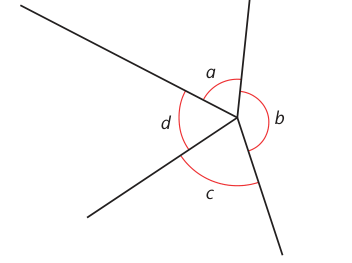
Study the reason for each step; in an examination the method and relevant geometric explanation can earn marks even if a later calculation goes wrong.
Three angles around a point are \(124^\circ\), \(76^\circ\) and \(x\).
\(x=360-124-76=\boxed{160^\circ}\), angles at a point total \(360^\circ\).
Two adjacent angles on a line are \(3x\) and \(2x\).
\(3x+2x=180\); \(5x=180\); \(\boxed{x=36^\circ}\).
Opposite angles at an intersection are \((5x+8)^\circ\) and \((3x+44)^\circ\). Find \(x\).
Opposite angles are equal: \(5x+8=3x+44\); \(2x=36\); \(\boxed{x=18}\).
Adjacent angles on a straight line are in the ratio \(4:5\). Find both.
Nine equal parts make \(180^\circ\). One part \(=20^\circ\); angles \(=\boxed{80^\circ,100^\circ}\).
Four angles around a point are \(x,2x,(x+30),(3x-20)\) degrees. Find \(x\) and the largest angle.
\(x+2x+x+30+3x-20=360\), so \(7x+10=360\), \(x=50\). Largest \(3(50)-20=\boxed{130^\circ}\).
Subtopic 2
A transversal crosses two parallel lines. Corresponding angles (matching corners) are equal; alternate interior angles (opposite sides inside the parallels) are equal; co-interior angles (same side inside) add to \(180^\circ\).
The three interior angles add to \(180^\circ\). An exterior angle equals the sum of the two opposite interior angles. Isosceles triangles have equal base angles; equilateral triangles have three angles of \(60^\circ\); right-angled triangles contain \(90^\circ\).
Do not assume corresponding or alternate angles are equal unless the lines really are marked parallel. In proofs, state the correct pair of angles and the parallel-line reason.
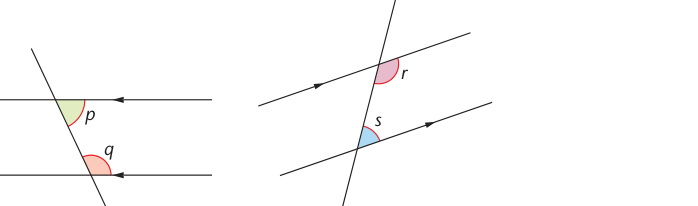

Study the reason for each step; in an examination the method and relevant geometric explanation can earn marks even if a later calculation goes wrong.
Two parallel lines are crossed by a transversal; an angle of \(68^\circ\) corresponds to \(x\).
Corresponding angles are equal: \(\boxed{x=68^\circ}\).
Co-interior angles are \(112^\circ\) and \(x\).
\(x=180-112=\boxed{68^\circ}\).
An isosceles triangle has vertex angle \(42^\circ\). Find each base angle.
Equal base angles each \((180-42)/2=\boxed{69^\circ}\).
Opposite interior angles are \(46^\circ\) and \(58^\circ\). Find the exterior angle.
Exterior angle \(=46+58=\boxed{104^\circ}\).
Triangle \(ABC\) has \(\angle A=53^\circ\), \(\angle B=72^\circ\). A line through C parallel to AB creates a corresponding angle equal to \(\angle A\). Find that angle and \(\angle C\).
Corresponding angle \(=\boxed{53^\circ}\). Triangle sum gives \(\angle C=180-53-72=\boxed{55^\circ}\).
Subtopic 3
The four interior angles of any quadrilateral add to \(360^\circ\). In a parallelogram, opposite angles are equal and adjacent angles add to \(180^\circ\). A rectangle has four right angles; an isosceles trapezium has equal base angles at each parallel side.
Identify right angles, parallel lines, equal sides or equal angles from given markings. Form an equation using \(360^\circ\) or one of the special-shape facts; then calculate, and give a reason.
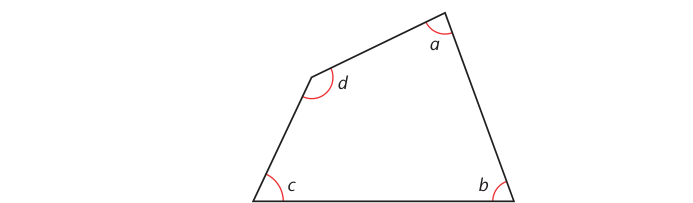
Study the reason for each step; in an examination the method and relevant geometric explanation can earn marks even if a later calculation goes wrong.
Three interior angles are \(90^\circ,108^\circ,77^\circ\). Find the fourth.
\(x=360-90-108-77=\boxed{85^\circ}\).
One angle of a parallelogram is \(74^\circ\). Find its adjacent angle.
Adjacent parallelogram angles are supplementary: \(180-74=\boxed{106^\circ}\).
Quadrilateral angles are \(x,2x,(x+20),(2x+40)\). Find \(x\).
\(6x+60=360\), so \(\boxed{x=50}\).
An isosceles trapezium has one angle of \(116^\circ\). Find the other three.
The matching angle on that base is \(116^\circ\). Each adjacent angle on a leg is \(180-116=64^\circ\). Other three: \(\boxed{116^\circ,64^\circ,64^\circ}\).
A quadrilateral is divided by a diagonal. One triangle has angles \(37^\circ,65^\circ,x\); the other has \(82^\circ,45^\circ,y\). Find \(x+y\).
\(x=180-37-65=78^\circ\); \(y=180-82-45=53^\circ\). Thus \(\boxed{x+y=131^\circ}\).
Subtopic 4
For any simple polygon with \(n\) sides, draw diagonals from one vertex to divide it into \(n-2\) triangles. The sum of its interior angles is therefore \((n-2)180^\circ\).
For a regular \(n\)-gon, each exterior angle is \(\frac{360^\circ}{n}\); each interior angle is \(180^\circ-\frac{360^\circ}{n}\). For a convex polygon the exterior angles, one at each vertex and measured consistently, total \(360^\circ\). At a vertex, an interior angle and the adjacent exterior angle add to \(180^\circ\).
Use the total exterior-angle fact to find the number of sides of a regular polygon. An irregular polygon still has the same total interior angle sum, but its individual angles need not match.
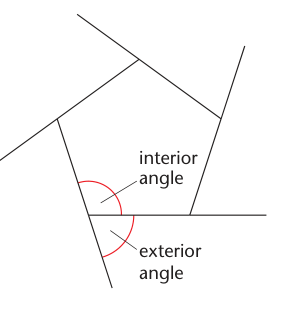
Study the reason for each step; in an examination the method and relevant geometric explanation can earn marks even if a later calculation goes wrong.
Find the total interior angle sum of a heptagon.
\((7-2)180=\boxed{900^\circ}\).
Find the exterior angle of a regular 12-gon.
\(360/12=\boxed{30^\circ}\).
Find the interior angle of a regular octagon.
Exterior \(360/8=45^\circ\), interior \(180-45=\boxed{135^\circ}\).
A regular polygon has exterior angle \(18^\circ\). Find its number of sides.
\(n=360/18=\boxed{20}\).
Five angles of an irregular hexagon are \(95^\circ,112^\circ,124^\circ,137^\circ,108^\circ\). Find the sixth.
Total for six sides \(=720^\circ\). Known sum \(=576^\circ\). Missing \(=720-576=\boxed{144^\circ}\).
Independent practice
Questions in each subtopic progress from confidence-building to developed methods and original exam-style problems. The problems are original practice, not copied past-paper questions. Answers stay closed until selected.
Work through the basics first; save the examination-style questions for last.
Two adjacent angles on a line are \(115^\circ\) and \(x\). Find \(x\).
Step-by-step solution: \(x=180-115=\boxed{65^\circ}\) (straight line).
An angle vertically opposite \(73^\circ\) is \(x\). Find \(x\).
Step-by-step solution: Vertically opposite angles are equal: \(\boxed{x=73^\circ}\).
Angles \(90^\circ,110^\circ\) and \(x\) meet at a point. Find \(x\).
Step-by-step solution: \(x=360-90-110=\boxed{160^\circ}\).
Adjacent angles are \((2x+10)^\circ\) and \((x+20)^\circ\) on a straight line. Find \(x\).
Step-by-step solution: \(2x+10+x+20=180\), hence \(3x=150\), \(\boxed{x=50}\).
Vertically opposite angles are \((4x-15)^\circ\) and \((2x+29)^\circ\). Find \(x\).
Step-by-step solution: \(4x-15=2x+29\); \(2x=44\); \(\boxed{x=22}\).
Angles at a point are \(2x,3x,4x\) degrees. Find the smallest.
Step-by-step solution: \(9x=360\), \(x=40\); smallest \(2x=\boxed{80^\circ}\).
Two adjacent angles are in ratio \(7:8\) on a straight line. Find the smaller.
Step-by-step solution: \(15\) parts give \(180^\circ\), each \(12^\circ\). Smaller \(7\times12=\boxed{84^\circ}\).
Four angles around a point are \(3x,(2x+30),(x+15),(2x-5)\). Find \(x\).
Step-by-step solution: \(8x+40=360\), so \(\boxed{x=40}\).
One angle at a crossing is \(138^\circ\). Find the other three.
Step-by-step solution: Opposite angle \(=138^\circ\). Adjacent each \(180-138=42^\circ\). Other three: \(\boxed{138^\circ,42^\circ,42^\circ}\).
Work through the basics first; save the examination-style questions for last.
An alternate interior angle to \(82^\circ\) is \(x\). Find \(x\).
Step-by-step solution: Alternate angles between parallel lines are equal: \(\boxed{82^\circ}\).
Find an angle co-interior with \(131^\circ\).
Step-by-step solution: \(180-131=\boxed{49^\circ}\).
A triangle has angles \(65^\circ,45^\circ,x\). Find \(x\).
Step-by-step solution: \(x=180-65-45=\boxed{70^\circ}\).
Corresponding angles are \((3x+10)^\circ\) and \((5x-30)^\circ\). Find \(x\).
Step-by-step solution: \(3x+10=5x-30\); \(2x=40\); \(\boxed{x=20}\).
Co-interior angles are \((4x+12)^\circ\) and \((2x+18)^\circ\). Find \(x\).
Step-by-step solution: \(6x+30=180\), so \(\boxed{x=25}\).
An equilateral triangle has one angle labelled \((2x+14)^\circ\). Find \(x\).
Step-by-step solution: Each angle is \(60^\circ\); \(2x+14=60\), so \(\boxed{x=23}\).
An isosceles triangle has equal base angles \((3x-9)^\circ\) and a vertex angle \((2x+18)^\circ\). Find \(x\).
Step-by-step solution: \(2(3x-9)+2x+18=180\); \(8x=180\); \(\boxed{x=22.5}\).
At a triangle vertex, the exterior angle is \(127^\circ\) and one opposite interior angle is \(68^\circ\). Find the other opposite angle.
Step-by-step solution: Exterior angle \(=\) sum of remote interiors, so \(127-68=\boxed{59^\circ}\).
An exterior angle of a triangle is \((5x+8)^\circ\); its opposite interiors are \((2x+20)^\circ\) and \((x+42)^\circ\). Find \(x\).
Step-by-step solution: \(5x+8=2x+20+x+42\); \(2x=54\), hence \(\boxed{x=27}\).
Work through the basics first; save the examination-style questions for last.
Interior angles are \(100^\circ,85^\circ,95^\circ,x\). Find \(x\).
Step-by-step solution: \(360-100-85-95=\boxed{80^\circ}\).
One parallelogram angle is \(125^\circ\). Find its opposite angle.
Step-by-step solution: Opposite angles in a parallelogram are equal: \(\boxed{125^\circ}\).
What is the sum of the interior angles of any quadrilateral?
Step-by-step solution: Divide into two triangles: \(2\times180=\boxed{360^\circ}\).
Quadrilateral angles are \(x,2x,3x,4x\). Find \(x\).
Step-by-step solution: \(10x=360\), so \(\boxed{x=36^\circ}\).
Three quadrilateral angles are \((2x+10)^\circ\), \((x+30)^\circ\) and \(100^\circ\); the fourth is \(80^\circ\). Find \(x\).
Step-by-step solution: \(3x+220=360\), so \(3x=140\), \(\boxed{x=46\tfrac23}\).
Adjacent angles of a parallelogram are \((3x-15)^\circ\) and \((2x+20)^\circ\). Find \(x\).
Step-by-step solution: \(3x-15+2x+20=180\); \(5x=175\), \(\boxed{x=35}\).
An isosceles trapezium has an upper angle \(73^\circ\). Find the two lower angles.
Step-by-step solution: Base angles at the upper base both \(73^\circ\). Along each leg, \(180-73=\boxed{107^\circ}\).
A quadrilateral has two right angles, one angle \((4x-10)^\circ\), and the last \((2x+40)^\circ\). Find \(x\).
Step-by-step solution: \(90+90+4x-10+2x+40=360\); \(6x+210=360\); \(\boxed{x=25}\).
A quadrilateral interior-angle ratio is \(2:3:4:6\). Find the largest.
Step-by-step solution: Fifteen parts sum to \(360^\circ\), so one part \(24^\circ\). Largest \(6\times24=\boxed{144^\circ}\).
Work through the basics first; save the examination-style questions for last.
Find the interior angle sum of a pentagon.
Step-by-step solution: \((5-2)180=\boxed{540^\circ}\).
Find each exterior angle of a regular hexagon.
Step-by-step solution: \(360/6=\boxed{60^\circ}\).
Find each interior angle of a regular hexagon.
Step-by-step solution: \(180-360/6=\boxed{120^\circ}\).
A regular polygon has 15 sides. Find each interior angle.
Step-by-step solution: Exterior \(360/15=24^\circ\), interior \(180-24=\boxed{156^\circ}\).
A regular polygon has exterior angle \(45^\circ\). Find its number of sides.
Step-by-step solution: \(n=360/45=\boxed{8}\).
The interior sum of a polygon is \(1440^\circ\). Find the number of sides.
Step-by-step solution: \((n-2)180=1440\) gives \(n-2=8\), so \(\boxed{n=10}\).
A regular polygon has interior angle \(165^\circ\). How many sides?
Step-by-step solution: Exterior \(180-165=15^\circ\); \(n=360/15=\boxed{24}\).
A pentagon has four angles \(102^\circ,119^\circ,108^\circ,126^\circ\). Find the fifth.
Step-by-step solution: Total \(540^\circ\). Known sum \(455^\circ\), so fifth \(=\boxed{85^\circ}\).
An irregular octagon has seven known interior angles totalling \(930^\circ\). Find the eighth.
Step-by-step solution: Total \((8-2)180=1080^\circ\), remaining \(1080-930=\boxed{150^\circ}\).
A convex polygon has exterior angles \(30^\circ,45^\circ,65^\circ,80^\circ,70^\circ\) and one unknown. Find the unknown.
Step-by-step solution: Total exterior angles \(=360^\circ\). Known sum \(290^\circ\); unknown \(=\boxed{70^\circ}\).