Worked example · Easy
Halve the chord
A perpendicular from the centre meets a chord of length \(22\text{ cm}\) at \(M\). Find each half.
The perpendicular bisects the chord: \(22/2=\boxed{11\text{ cm}}\).
Source-matched teaching notes, visual explanations, graduated worked examples and independent examination-style practice.
Use the key facts confidently, select an appropriate method, communicate each working step, and check the reasonableness of the final result.
Subtopic 1
A chord joins two points on a circle. The perpendicular from the centre to a chord bisects the chord. Equal chords are equally distant from the centre. These properties follow from equal radii and congruent right triangles.
A tangent touches the circle once. At the touching point its radius is perpendicular to it. The two tangent segments from the same external point are equal in length. Radius, perpendicular distance and half-chord often form a right triangle, so use Pythagoras.
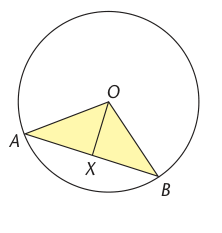
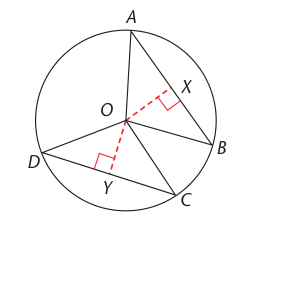
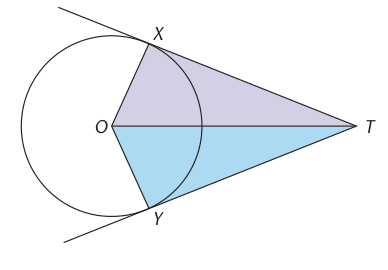
Study the reason for each step; in an examination the method and relevant geometric explanation can earn marks even if a later calculation goes wrong.
A perpendicular from the centre meets a chord of length \(22\text{ cm}\) at \(M\). Find each half.
The perpendicular bisects the chord: \(22/2=\boxed{11\text{ cm}}\).
Two tangents \(PA\) and \(PB\) start at P. Given \(PA=13\text{ cm}\), find \(PB\).
Tangents from the same point are equal: \(\boxed{PB=13\text{ cm}}\).
A circle has radius \(10\text{ cm}\) and chord length \(12\text{ cm}\). Find its perpendicular distance from the centre.
Half-chord \(=6\text{ cm}\); by Pythagoras, distance \(=\sqrt{10^2-6^2}=\sqrt{64}=\boxed{8\text{ cm}}\).
Point P is \(17\text{ cm}\) from the centre of a circle of radius \(8\text{ cm}\). Find tangent length.
Radius to contact makes \(90^\circ\). Length \(=\sqrt{17^2-8^2}=\sqrt{225}=\boxed{15\text{ cm}}\).
Tangents PA and PB have lengths \((4x+5)\) and \((6x-9)\text{ cm}\). Find \(x\) and both lengths.
Equal tangents: \(4x+5=6x-9\). Then \(2x=14\), \(x=7\). Each length \(=4(7)+5=\boxed{33\text{ cm}}\).
A chord is \(5\text{ cm}\) from the centre of a circle of radius \(13\text{ cm}\). Find the full chord length.
Half-chord \(=\sqrt{13^2-5^2}=\sqrt{144}=12\). Full chord \(=\boxed{24\text{ cm}}\).
Subtopic 2
Before using a theorem, check that the angle is subtended by the correct arc. The angle at the centre is twice the angle at the circumference on the same arc. The angle in a semicircle is \(90^\circ\) because the central angle on a diameter is \(180^\circ\).
Pay attention to reflex central angles and major/minor segments. If the diagram shows a chord that looks like a diameter, it is not a diameter unless stated or clearly marked as passing through the centre.
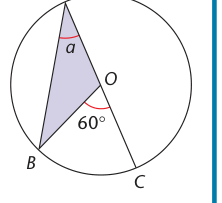
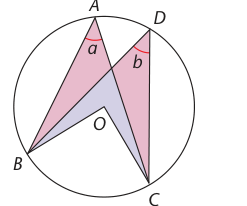
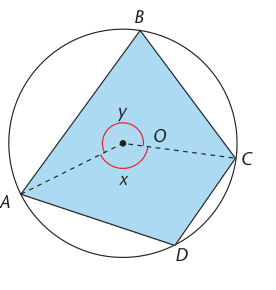
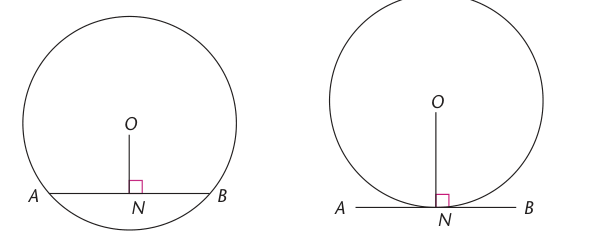
Study the reason for each step; in an examination the method and relevant geometric explanation can earn marks even if a later calculation goes wrong.
An angle at the circumference is \(35^\circ\). Find the angle at the centre on the same arc.
Centre is double: \(2\times35=\boxed{70^\circ}\).
Angles subtended by chord AB in the same segment are \(48^\circ\) and \(x\).
Angles in the same segment are equal: \(\boxed{x=48^\circ}\).
ABC is a triangle drawn in a semicircle with AB the diameter. Given \(\angle A=38^\circ\), find \(\angle B\).
\(\angle C=90^\circ\). Hence \(\angle B=180-90-38=\boxed{52^\circ}\).
Opposite angles of a cyclic quadrilateral are \((3x+12)^\circ\) and \((2x+18)^\circ\). Find \(x\).
Opposite angles sum to \(180\): \(5x+30=180\); \(\boxed{x=30}\).
In triangle OAB, \(OA=OB\), and central angle \(\angle AOB=104^\circ\). Find each base angle.
\((180-104)/2=\boxed{38^\circ}\).
The minor central angle subtended by AB is \(140^\circ\). Find the angle at the circumference on the other arc, subtended by the reflex arc AB.
Reflex central angle \(=360-140=220^\circ\). Corresponding circumference angle \(=220/2=\boxed{110^\circ}\).
A cyclic quadrilateral has \(\angle A=118^\circ\). An exterior angle adjacent to \(\angle B\) is \(74^\circ\). Find \(\angle C\) and \(\angle B\).
Opposite cyclic angles \(A+C=180\), so \(C=62^\circ\). Straight line at B: \(B=180-74=106^\circ\). Answers: \(\boxed{62^\circ,106^\circ}\).
Subtopic 3
The alternate segment theorem states that the angle between a tangent and a chord through the point of contact equals the angle in the opposite segment of the circle subtended by that chord.
Identify the point of tangency, trace the chord, and locate the inscribed angle on the other side of that chord. Mark the pair equal. In multi-step problems, combine it with the \(90^\circ\) radius–tangent angle, triangle sum and isosceles radii. State the theorem as your geometric reason.
The angle on the correct side of a tangent matters. Do not confuse the angle between tangent and chord with the one between tangent and radius.
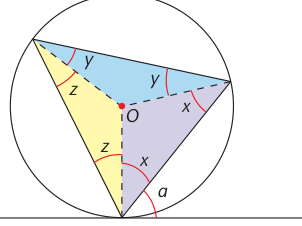
Study the reason for each step; in an examination the method and relevant geometric explanation can earn marks even if a later calculation goes wrong.
At A, the tangent makes \(64^\circ\) with chord AB. Find the angle at C in the alternate segment subtended by AB.
By the alternate segment theorem, \(\angle ACB=\boxed{64^\circ}\).
An angle at the circumference subtended by chord PQ is \(38^\circ\). Find the matching angle between PQ and the tangent at P.
By the alternate segment theorem, \(\boxed{38^\circ}\).
At one tangent contact A, angles between the tangent and two chords AB, AC on appropriate sides are \(52^\circ\) and \(73^\circ\). Find angles \(ACB\) and \(ABC\).
By the alternate segment theorem, \(\angle ACB=52^\circ\) and \(\angle ABC=73^\circ\).
A triangle ABC lies on a circle with tangent at A. The alternate-segment angle to AB is \(46^\circ\), and \(\angle ABC=61^\circ\). Find \(\angle BAC\).
\(\angle ACB=46^\circ\); triangle sum gives \(A=180-46-61=\boxed{73^\circ}\).
Tangent–chord angle at A is \((3x+7)^\circ\), and its matching alternate-segment angle is \((5x-25)^\circ\). Find \(x\) and that angle.
\(3x+7=5x-25\); \(2x=32\); \(x=16\). Angle \(=3(16)+7=\boxed{55^\circ}\).
Chord AB subtends \(56^\circ\) at point C, and \(OA=OB\). Find the angle between the tangent at A and AB, then the central angle AOB.
Alternate-segment angle \(=56^\circ\). Central angle on same minor arc \(=2\times56=\boxed{112^\circ}\).
Independent practice
Questions in each subtopic progress from confidence-building to developed methods and original exam-style problems. The problems are original practice, not copied past-paper questions. Answers stay closed until selected.
Work through the basics first; save the examination-style questions for last.
A chord is \(18\text{ cm}\). A radius through its midpoint meets it at right angles. Find each half.
Step-by-step solution: \(18/2=\boxed{9\text{ cm}}\).
From point P, tangent PA has length \(9\text{ cm}\). Find tangent PB to the same circle.
Step-by-step solution: Equal tangents from P: \(\boxed{9\text{ cm}}\).
What angle does a radius make with a tangent at the point of contact?
Step-by-step solution: The radius is perpendicular to the tangent: \(\boxed{90^\circ}\).
A circle has radius \(5\text{ cm}\). A chord is \(6\text{ cm}\) long. Find its distance from the centre.
Step-by-step solution: Half-chord \(3\), distance \(\sqrt{5^2-3^2}=\boxed{4\text{ cm}}\).
A circle has radius \(15\text{ cm}\), chord distance \(9\text{ cm}\). Find chord length.
Step-by-step solution: Half-chord \(\sqrt{15^2-9^2}=12\); full chord \(\boxed{24\text{ cm}}\).
Point P is \(10\text{ cm}\) from centre O of a circle radius \(6\text{ cm}\). Find the tangent from P.
Step-by-step solution: Right triangle: \(\sqrt{10^2-6^2}=\boxed{8\text{ cm}}\).
Tangents from P are \((5x-2)\text{ cm}\) and \((3x+14)\text{ cm}\). Find \(x\).
Step-by-step solution: \(5x-2=3x+14\); \(2x=16\); \(\boxed{x=8}\).
From a point P, \(OP=26\text{ cm}\), radius \(OA=10\text{ cm}\), and PA is tangent. Find PA.
Step-by-step solution: \(PA=\sqrt{26^2-10^2}=\sqrt{576}=\boxed{24\text{ cm}}\).
Two chords in the same circle are equal. One lies \(7\text{ cm}\) from the centre. How far is the other?
Step-by-step solution: Equal chords are equally distant from the centre: \(\boxed{7\text{ cm}}\).
Work through the basics first; save the examination-style questions for last.
A circumference angle is \(27^\circ\). Find the central angle subtending the same arc.
Step-by-step solution: \(2\times27=\boxed{54^\circ}\).
An angle at the centre is \(118^\circ\). Find the angle at the circumference on the same arc.
Step-by-step solution: \(118/2=\boxed{59^\circ}\).
A triangle is inscribed in a semicircle with its longest side as diameter. Find the opposite angle.
Step-by-step solution: Angle in a semicircle \(=\boxed{90^\circ}\).
Two angles in the same segment subtend one chord. One is \(41^\circ\). Find the other.
Step-by-step solution: Equal angles in the same segment: \(\boxed{41^\circ}\).
In a cyclic quadrilateral one angle is \(124^\circ\). Find its opposite.
Step-by-step solution: \(180-124=\boxed{56^\circ}\).
A central angle is \(86^\circ\). OA and OB are radii. Find each base angle of OAB.
Step-by-step solution: \(OA=OB\); base angles \((180-86)/2=\boxed{47^\circ}\).
In a triangle inscribed in a semicircle, one acute angle is \(31^\circ\). Find the other.
Step-by-step solution: Other acute angle \(=180-90-31=\boxed{59^\circ}\).
Two opposite angles of a cyclic quadrilateral are \((x+18)^\circ\) and \((2x+12)^\circ\). Find \(x\).
Step-by-step solution: \(3x+30=180\), so \(\boxed{x=50}\).
An arc subtends \(144^\circ\) at the centre. Find the circumference angle on the same arc.
Step-by-step solution: \(144/2=\boxed{72^\circ}\).
A minor central angle measures \(100^\circ\). Find the angle at the circumference in the corresponding opposite (major) segment.
Step-by-step solution: The required angle subtends the minor arc, so \(100/2=\boxed{50^\circ}\). State which arc is subtended.
A cyclic quadrilateral has opposite angles \((4x+5)^\circ\) and \((3x+28)^\circ\). Find \(x\).
Step-by-step solution: \(7x+33=180\), so \(7x=147\) and \(\boxed{x=21}\).
At a point on a circle, a tangent and radius meet. The angle between the tangent and a chord is \(36^\circ\) on one side. Find the remaining angle between the radius and chord on that side.
Step-by-step solution: Tangent–radius is \(90^\circ\), so angle \(=90-36=\boxed{54^\circ}\).
Work through the basics first; save the examination-style questions for last.
A tangent–chord angle is \(28^\circ\). Find its alternate-segment angle.
Step-by-step solution: Equal by alternate segment theorem: \(\boxed{28^\circ}\).
An inscribed angle is \(67^\circ\). Find the corresponding angle between the tangent and chord.
Step-by-step solution: Equal by alternate segment theorem: \(\boxed{67^\circ}\).
Tangent–chord angle is \(49^\circ\); name the theorem that makes the inscribed angle equal.
Step-by-step solution: The alternate segment theorem: inscribed angle \(=\boxed{49^\circ}\).
A tangent–chord angle is \((2x+15)^\circ\), and the alternate angle is \(73^\circ\). Find \(x\).
Step-by-step solution: \(2x+15=73\); \(2x=58\); \(\boxed{x=29}\).
Triangle ABC inscribed in a circle has a tangent at A. The tangent–AB angle is \(42^\circ\), and \(\angle ABC=76^\circ\). Find \(\angle BAC\).
Step-by-step solution: \(\angle ACB=42^\circ\). Then \(A=180-76-42=\boxed{62^\circ}\).
Tangent makes \(35^\circ\) with a chord at the touching point; find the angle between the chord and radius on the same side.
Step-by-step solution: Radius–tangent \(90^\circ\). So chord–radius \(=90-35=\boxed{55^\circ}\).
Alternate angles subtended by the same chord are \((5x-4)^\circ\) and \((2x+44)^\circ\). Find \(x\).
Step-by-step solution: Equate: \(5x-4=2x+44\); \(3x=48\); \(\boxed{x=16}\).
In a circle tangent–chord angle is \(58^\circ\) and the other non-adjacent triangle angle is \(47^\circ\). Find the triangle angle at the tangent point.
Step-by-step solution: Alternate angle is \(58^\circ\). Triangle sum \(=180-58-47=\boxed{75^\circ}\).
At a circle, a tangent meets chords AB and AC; the opposite angles in triangle ABC are \(45^\circ\) and \(75^\circ\). Find the third triangle angle.
Step-by-step solution: Angles in a triangle sum to \(180^\circ\), so \(180-45-75=\boxed{60^\circ}\). The tangent–chord angles match the opposite angles by the alternate segment theorem.
Tangent at A makes \(68^\circ\) with chord AB. The central angle on the minor arc AB is required. Find it.
Step-by-step solution: Alternate segment angle \(ACB=68^\circ\); centre angle subtending same arc \(=2(68)=\boxed{136^\circ}\).