Worked example · Easy
A rectangular field
Find the perimeter of a \(12\text{ m}\) by \(7\text{ m}\) field.
Add all four edges: \(P=12+7+12+7=\boxed{38\text{ m}}\).
Clear explanations, original worked examples and a full graded exercise set, mapped to the textbook.
Measure and convert lengths, areas and volumes; calculate perimeters, areas, arc lengths, surface areas and volumes for simple and compound figures; select and rearrange relevant formulas.
Begin with the easy examples, then attempt the medium and exam-style examples before using the hidden solutions.
Subtopic 1
Perimeter means the total distance round the outside of a 2-D shape. Measure only the outer boundary. For an L-shape, use the known horizontal and vertical totals to recover any missing side lengths before adding.
Every length must be in the same unit, and a perimeter answer has length units, such as \(\text{cm}\), not \(\text{cm}^2\).
\(P=\text{sum of all outside side lengths}\). For a rectangle, \(P=2(l+w)\). A missing stepped-edge length often comes from subtraction.
Exam tip: Do not count shared internal edges or add centimetres to metres before converting.
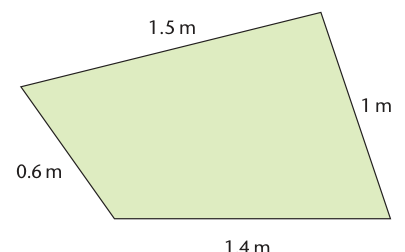
Every solution explains the mathematical method and gives the result.
Find the perimeter of a \(12\text{ m}\) by \(7\text{ m}\) field.
Add all four edges: \(P=12+7+12+7=\boxed{38\text{ m}}\).
An L-shape has total width \(14\text{ cm}\), and its shorter horizontal part is \(9\text{ cm}\). Find the missing horizontal step.
The horizontal parts must total the full width: \(14-9=\boxed{5\text{ cm}}\).
A rectangular noticeboard is \(1.5\text{ m}\) wide and \(80\text{ cm}\) high. Find the total edging in centimetres.
Convert \(1.5\text{ m}=150\text{ cm}\); perimeter \(=2(150+80)=\boxed{460\text{ cm}}\).
Subtopic 2
Area measures the space inside a shape. Multiply two perpendicular dimensions; if the measurements are in centimetres, the answer is in square centimetres. Work backwards by dividing a known area by one side.
\(A=lw\), so \(l=A/w\) and \(w=A/l\).
Exam tip: Always square the unit, not the number.
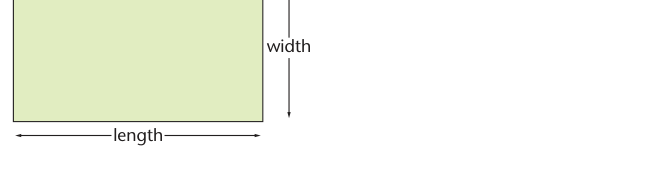
Every solution explains the mathematical method and gives the result.
Find the area of a floor measuring \(6\text{ m}\) by \(4\text{ m}\).
\(A=6\times4=\boxed{24\text{ m}^2}\).
A poster has area \(180\text{ cm}^2\) and width \(12\text{ cm}\). Find its length.
\(l=A/w=180/12=\boxed{15\text{ cm}}\).
A rectangular surface is \(1.2\text{ m}\) by \(75\text{ cm}\). Material costs $20 per \(\text{m}^2\). Find the material cost.
\(75\text{ cm}=0.75\text{ m}\), so \(A=1.2\times0.75=0.9\text{ m}^2\); cost \(=0.9\times20=\boxed{\$18}\).
Subtopic 3
Any triangle is half of a parallelogram with the same base and perpendicular height. The height may fall outside an obtuse triangle. A sloping side is not automatically the height.
\(A=\tfrac12 bh\), where \(h\) is measured at \(90^\circ\) to the chosen base.
Exam tip: Use a perpendicular height, never simply another edge.
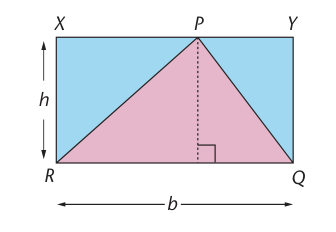
Every solution explains the mathematical method and gives the result.
A right triangle has base \(8\text{ cm}\) and perpendicular height \(5\text{ cm}\). Find the area.
\(A=\tfrac12\times8\times5=\boxed{20\text{ cm}^2}\).
A triangle has area \(42\text{ cm}^2\) and base \(12\text{ cm}\). Find the perpendicular height.
\(42=\tfrac12(12)h=6h\), so \(h=\boxed{7\text{ cm}}\).
A triangular park has a base of \(0.3\text{ km}\) and perpendicular height \(240\text{ m}\). Calculate its area in \(\text{m}^2\).
Convert \(0.3\text{ km}=300\text{ m}\). \(A=\tfrac12(300)(240)=\boxed{36\,000\text{ m}^2}\).
Subtopic 4
Move the triangular corner of a parallelogram to the other side and it forms a rectangle. This explains why we multiply the base by the perpendicular height rather than the sloping edge.
\(A=bh\).
Exam tip: Check the given height really meets the base at a right angle.
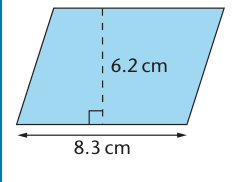
Every solution explains the mathematical method and gives the result.
A parallelogram has base \(9\text{ cm}\) and perpendicular height \(4\text{ cm}\).
\(A=9\times4=\boxed{36\text{ cm}^2}\).
Its area is \(84\text{ cm}^2\), with base \(12\text{ cm}\).
\(h=84/12=\boxed{7\text{ cm}}\).
A parallelogram has base \(14\text{ m}\), sloping edge \(8\text{ m}\), and perpendicular height \(6\text{ m}\). Find its area.
The sloping \(8\text{ m}\) is irrelevant. \(A=14\times6=\boxed{84\text{ m}^2}\).
Subtopic 5
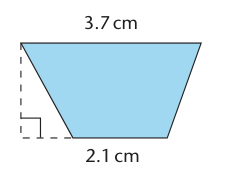
A trapezium has one pair of parallel sides. Its area is the average length of these parallel sides, multiplied by the perpendicular distance between them.
\(A=\tfrac12(a+b)h\), where \(a,b\) are the parallel sides.
Exam tip: Do not use the sloping side in place of the perpendicular height.
Every solution explains the mathematical method and gives the result.
The parallel sides are 8 cm and 12 cm, and the height is 5 cm.
\(A=\tfrac12(8+12)\times5=\boxed{50\text{ cm}^2}\).
A trapezium has area 72 cm² and parallel sides 10 cm and 14 cm.
\(72=\tfrac12(10+14)h=12h\), so \(h=\boxed{6\text{ cm}}\).
A trapezoidal section has widths 4.4 m and 7.6 m and depth 1.5 m. Find the cross-sectional area.
\(A=\tfrac12(4.4+7.6)\times1.5=\boxed{9\text{ m}^2}\).
Subtopic 6
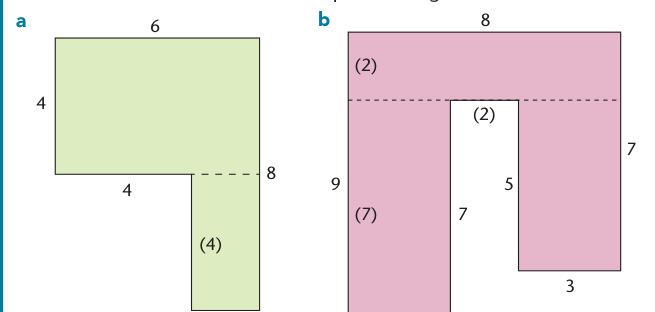
Divide a compound figure into rectangles, triangles or other familiar shapes; find the parts and add. Alternatively, enclose the shape in a large rectangle and subtract the area of each gap. Both approaches should agree.
\(A_{\mathrm{compound}}=\sum A_{\mathrm{pieces}}\), or \(A_{\mathrm{outer}}-\sum A_{\mathrm{removed}}\).
Exam tip: Use a sketch to ensure pieces do not overlap or leave gaps.
Every solution explains the mathematical method and gives the result.
A 10 by 8 cm rectangle has a 4 by 3 cm corner removed. Find its area.
Outer area \(=10\times8=80\). Gap \(=4\times3=12\). Remaining \(=\boxed{68\text{ cm}^2}\).
A rectangle of area 36 cm² has a triangle of base 9 cm and height 4 cm attached without overlap.
Triangle area \(=\tfrac12(9)(4)=18\). Total \(=36+18=\boxed{54\text{ cm}^2}\).
A patio is 12 m by 9 m, but a triangular region with base 6 m and height 5 m is unpaved. Find the paved area.
\(12(9)-\tfrac12(6)(5)=108-15=\boxed{93\text{ m}^2}\).
Subtopic 7
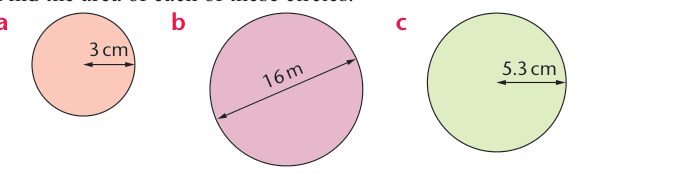
A circle’s circumference is the distance all the way round. Its diameter is twice the radius. Circumference is a length, and \(\pi\) should be kept on the calculator until the end.
\(C=2\pi r=\pi d\). To find the diameter from circumference, \(d=C/\pi\).
Exam tip: Check whether a figure gives diameter or radius.
Every solution explains the mathematical method and gives the result.
A wheel has radius \(7\text{ cm}\). Find its circumference in terms of \(\pi\).
\(C=2\pi(7)=\boxed{14\pi\text{ cm}}\).
A circular track has diameter \(24\text{ m}\). Find its circumference to 1 decimal place.
\(C=\pi(24)=\boxed{75.4\text{ m}}\) (1 d.p.).
A wheel moves 1.5 m per full revolution. Estimate the number of revolutions in a 120 m journey.
Each revolution covers 1.5 m, so \(120/1.5=\boxed{80}\) revolutions.
Subtopic 8
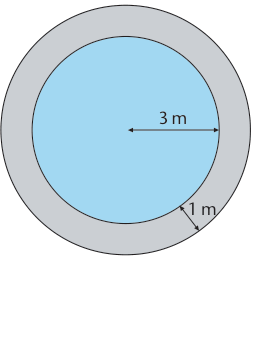
A circle’s area is proportional to the square of its radius. A ring (annulus) has the area of a large disk minus the small disk. Never use the circumference formula to calculate area.
\(A=\pi r^2\), and \(A_{\mathrm{ring}}=\pi(R^2-r^2)\).
Exam tip: Convert diameter to radius before squaring.
Every solution explains the mathematical method and gives the result.
Find the area of a circle of radius 5 cm, in terms of \(\pi\).
\(A=\pi(5)^2=\boxed{25\pi\text{ cm}^2}\).
A circle has diameter 18 cm. Find its area.
Radius \(=9\text{ cm}\). Area \(=81\pi\approx\boxed{254.5\text{ cm}^2}\).
A pond of radius 3 m has a surrounding path 1 m wide. Find the path area.
Outer radius \(4\text{ m}\); path area \(=\pi(4^2-3^2)=\boxed{7\pi\text{ m}^2}\).
Subtopic 9
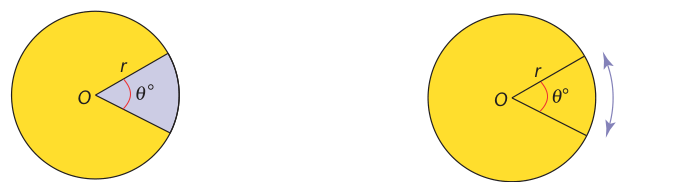
A sector is a fraction of a whole circle. Its angle \(\theta\) must be measured at the centre. The fraction of a complete turn is \(\theta/360\). Its perimeter includes both radii as well as the curved arc.
\(L=\frac{\theta}{360}\,2\pi r\), \(A=\frac{\theta}{360}\,\pi r^2\), \(P_{\rm sector}=2r+L\).
Exam tip: For a major sector use the major angle (or subtract the minor sector from a complete circle).
Every solution explains the mathematical method and gives the result.
Find the arc length for \(r=6\text{ cm},\theta=90^\circ\).
\(L=(90/360)2\pi(6)=\boxed{3\pi\text{ cm}}\).
Find the area of a \(60^\circ\) sector of radius 9 cm.
\(A=(60/360)\pi(9^2)=\boxed{13.5\pi\text{ cm}^2}\).
A \(135^\circ\) sector has radius 8 cm. Find its perimeter.
Arc \(=(135/360)2\pi(8)=6\pi\). Add two radii: \(P=16+6\pi\approx\boxed{34.8\text{ cm}}\).
Subtopic 10
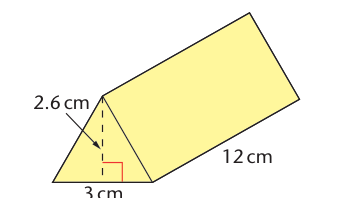
A prism has the same cross-section all along its length. This includes cuboids and cylinders. Find the area of the cross-section, then multiply by the perpendicular length of the prism.
\(V=A_{\rm cross-section}\times l\). For a cylinder, \(V=\pi r^2h\).
Exam tip: Volume has cubic units. For cylinders, square the radius, not the height.
Every solution explains the mathematical method and gives the result.
Find the volume of a 6 by 4 by 3 cm cuboid.
\(V=6\times4\times3=\boxed{72\text{ cm}^3}\).
A prism has triangular cross-section base 8 cm and height 5 cm, and length 12 cm.
Cross-section \(=\tfrac12(8)(5)=20\text{ cm}^2\). Volume \(=20(12)=\boxed{240\text{ cm}^3}\).
A cylindrical tank has radius 0.4 m and height 1.2 m. Find its capacity in litres, to the nearest litre.
\(V=\pi(0.4)^2(1.2)=0.192\pi\text{ m}^3\). Since \(1\text{ m}^3=1000\text{ L}\), capacity \(=192\pi\approx\boxed{603\text{ L}}\).
Subtopic 11
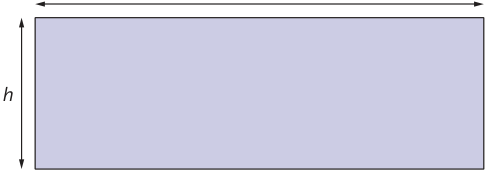
Surface area is the sum of the exposed faces. For a closed prism, include both congruent end faces as well as every side face. For a cylinder, the curved surface unwraps to a rectangle of width equal to the circumference.
For a closed prism, \(S=2A_{\rm end}+P_{\rm cross-section}\,l\). Closed cylinder: \(S=2\pi rh+2\pi r^2\).
Exam tip: Exclude faces that are not exposed, such as the missing top of an open container.
Every solution explains the mathematical method and gives the result.
A cuboid measures 2 cm by 3 cm by 5 cm. Find its total surface area.
\(S=2(2\times3+3\times5+2\times5)=2(6+15+10)=\boxed{62\text{ cm}^2}\).
A cylinder has radius 4 cm and height 10 cm. Find curved surface area.
\(S_{\rm curved}=2\pi(4)(10)=\boxed{80\pi\text{ cm}^2}\).
A cylindrical tin without a lid has radius 5 cm and height 12 cm. Find total metal area.
Curved area \(=2\pi(5)(12)=120\pi\); base \(=25\pi\); total \(=\boxed{145\pi\text{ cm}^2}\).
Subtopic 12
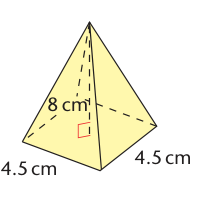
A pyramid or cone occupies one third of the volume of a prism or cylinder having the same base area and perpendicular height. Sphere volume depends on the cube of its radius.
\(V_{\rm pyramid}=\tfrac13 A_{\rm base}h\); \(V_{\rm cone}=\tfrac13\pi r^2h\); \(V_{\rm sphere}=\tfrac43\pi r^3\).
Exam tip: For cones and pyramids use the perpendicular vertical height, not the slant length.
Every solution explains the mathematical method and gives the result.
A pyramid has base 6 cm by 6 cm and perpendicular height 9 cm.
\(V=\tfrac13(6\times6)(9)=\boxed{108\text{ cm}^3}\).
A cone has radius 3 cm and height 8 cm. Find its volume in terms of \(\pi\).
\(V=\tfrac13\pi(3^2)(8)=\boxed{24\pi\text{ cm}^3}\).
A solid ball has diameter 12 cm. Find its volume in terms of \(\pi\).
Radius \(6\text{ cm}\); \(V=\tfrac43\pi(6^3)=\boxed{288\pi\text{ cm}^3}\).
Subtopic 13
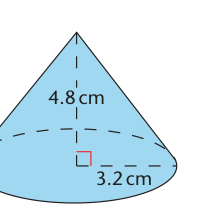
For a pyramid, add the base and all triangular faces. For a cone, the curved area uses the slant height \(l\); if only perpendicular height \(h\) is given, find \(l\) with Pythagoras. A sphere has one continuous curved surface.
\(S_{\rm cone,curved}=\pi rl\), \(S_{\rm cone,total}=\pi rl+\pi r^2\), \(l=\sqrt{r^2+h^2}\); \(S_{\rm sphere}=4\pi r^2\).
Exam tip: For total cone area include the base unless the question says “curved” or “open”.
Every solution explains the mathematical method and gives the result.
Find the surface area of a sphere with radius 5 cm.
\(S=4\pi(5^2)=\boxed{100\pi\text{ cm}^2}\).
A cone has radius 4 cm and slant height 9 cm. Find its curved area.
\(S=\pi(4)(9)=\boxed{36\pi\text{ cm}^2}\).
A closed cone has base radius 5 cm and height 12 cm. Find total surface area.
\(l=\sqrt{5^2+12^2}=13\). Curved area \(=65\pi\), base \(=25\pi\), so \(\boxed{90\pi\text{ cm}^2}\).
Subtopic 14
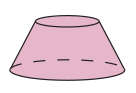
For solids built by joining or removing simple solids, add or subtract volumes. For surface area, include only the outer faces left visible. A frustum can be calculated by subtracting the smaller similar cone from the original; similarity finds missing radii or heights.
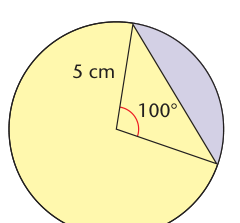
A circular segment is the region between a chord and its arc: its area is the sector area minus the central triangle for a minor segment.
\(V_{\rm frustum}=\tfrac13\pi R^2H-\tfrac13\pi r^2h\); \(A_{\rm segment}=\frac{\theta}{360}\pi r^2-\frac12r^2\sin\theta\). Segment perimeter \(=\text{arc length}+\text{chord length}\).
Exam tip: Use consistent length units, account for all exposed surfaces, and round only the final value.
Every solution explains the mathematical method and gives the result.
A solid contains two non-overlapping cuboids of volumes 120 and 75 cm³. Find its volume.
Add volumes: \(120+75=\boxed{195\text{ cm}^3}\).
A cylinder of radius 5 cm and height 10 cm has a cylindrical hole radius 2 cm drilled all the way through. Find remaining volume.
\(V=\pi(5^2)(10)-\pi(2^2)(10)=(250-40)\pi=\boxed{210\pi\text{ cm}^3}\).
A cone has height 12 cm and radius 6 cm. A smaller similar cone of height 4 cm is removed from the tip. Find the remaining volume.
By similarity, small radius \(=6(4/12)=2\text{ cm}\). \(V=\tfrac13\pi(6^2)(12)-\tfrac13\pi(2^2)(4)=144\pi-\tfrac{16\pi}{3}=\boxed{\tfrac{416\pi}{3}\text{ cm}^3}\).
Questions are arranged by textbook subtopic. Within each section they start with confidence-building tasks and finish with extended examination-style reasoning. Try each question before opening its solution.
A square has side \(8\text{ cm}\). Find its perimeter.
Step-by-step solution: Four equal sides: \(4\times8=\boxed{32\text{ cm}}\).
A rectangle is \(9\text{ m}\) long and \(4\text{ m}\) wide. Find its perimeter.
Step-by-step solution: \(2(9+4)=\boxed{26\text{ m}}\).
An L-shaped path has six exposed edges measuring \(8,3,2,4,6,7\text{ m}\). Find its perimeter.
Step-by-step solution: Add all six lengths: \(8+3+2+4+6+7=\boxed{30\text{ m}}\).
An edging strip surrounds a \(2.4\text{ m}\) by \(75\text{ cm}\) tabletop. How many metres of strip are needed?
Step-by-step solution: Convert \(75\text{ cm}=0.75\text{ m}\). \(2(2.4+0.75)=\boxed{6.3\text{ m}}\).
Find the area of a \(9\text{ cm}\) by \(5\text{ cm}\) rectangle.
Step-by-step solution: \(A=9\times5=\boxed{45\text{ cm}^2}\).
A square has side \(11\text{ m}\). Find its area.
Step-by-step solution: \(11^2=\boxed{121\text{ m}^2}\).
A rectangle has area \(96\text{ m}^2\) and length \(12\text{ m}\). Find its width.
Step-by-step solution: Width \(=96/12=\boxed{8\text{ m}}\).
A garden is \(250\text{ cm}\) by \(4\text{ m}\). Find its area in \(\text{m}^2\).
Step-by-step solution: Convert \(250\text{ cm}=2.5\text{ m}\); area \(=2.5\times4=\boxed{10\text{ m}^2}\).
Find the area of a triangle with base \(10\text{ cm}\) and height \(6\text{ cm}\).
Step-by-step solution: \(\tfrac12(10)(6)=\boxed{30\text{ cm}^2}\).
A triangle has base \(7\text{ m}\) and height \(4\text{ m}\). Find its area.
Step-by-step solution: \(\tfrac12(7)(4)=\boxed{14\text{ m}^2}\).
Find the base of a triangle with area \(45\text{ cm}^2\) and perpendicular height \(9\text{ cm}\).
Step-by-step solution: \(45=\tfrac12 b(9)\), so \(b=90/9=\boxed{10\text{ cm}}\).
A triangular fabric panel has base \(1.8\text{ m}\) and height \(95\text{ cm}\). Find its area in \(\text{m}^2\).
Step-by-step solution: \(95\text{ cm}=0.95\text{ m}\); \(A=\tfrac12(1.8)(0.95)=\boxed{0.855\text{ m}^2}\).
A parallelogram has base 11 cm and perpendicular height 3 cm. Find its area.
Step-by-step solution: \(11\times3=\boxed{33\text{ cm}^2}\).
The area of a parallelogram is \(72\text{ cm}^2\) and its base is 8 cm. Find the height.
Step-by-step solution: \(h=72/8=\boxed{9\text{ cm}}\).
A parallelogram has base 4.5 m and height 2.2 m. Find its area.
Step-by-step solution: \(4.5\times2.2=\boxed{9.9\text{ m}^2}\).
A field is a parallelogram with base 32 m, height 18 m and side length 25 m. Find the area and perimeter.
Step-by-step solution: Area \(=32\times18=\boxed{576\text{ m}^2}\). Perimeter \(=2(32+25)=\boxed{114\text{ m}}\).
Find the area of a trapezium with parallel sides 6 and 10 cm and height 4 cm.
Step-by-step solution: \(\tfrac12(6+10)\times4=\boxed{32\text{ cm}^2}\).
The parallel sides are 9 m and 15 m with height 3 m. Find the area.
Step-by-step solution: \(\tfrac12(9+15)3=\boxed{36\text{ m}^2}\).
Area 65 cm²; parallel sides 8 and 18 cm. Find height.
Step-by-step solution: \(65=\tfrac12(26)h=13h\), so \(h=\boxed{5\text{ cm}}\).
A trapezium has area 110 cm², height 10 cm, and one parallel side 8 cm. Find the other.
Step-by-step solution: \(110=5(8+b)\); \(22=8+b\), hence \(b=\boxed{14\text{ cm}}\).
A 7 cm by 5 cm rectangle has a 2 cm by 3 cm notch removed. Find the area.
Step-by-step solution: \(7(5)-2(3)=35-6=\boxed{29\text{ cm}^2}\).
A shape is made from non-overlapping rectangles of area 24 and 18 cm². Find total area.
Step-by-step solution: Add: \(24+18=\boxed{42\text{ cm}^2}\).
A triangle of base 8 cm and height 6 cm sits on a 10 by 6 cm rectangle. Find total area.
Step-by-step solution: \(10(6)+\tfrac12(8)(6)=60+24=\boxed{84\text{ cm}^2}\).
From a 20 m by 12 m garden, remove two triangular flower beds, each of base 5 m and height 4 m. Find the remaining area.
Step-by-step solution: Whole area \(240\); two triangles each \(10\), so \(240-2(10)=\boxed{220\text{ m}^2}\).
Find the circumference of a circle of radius 5 cm in terms of \(\pi\).
Step-by-step solution: \(2\pi(5)=\boxed{10\pi\text{ cm}}\).
Find the circumference of a circle with diameter 12 cm, correct to 1 d.p.
Step-by-step solution: \(C=12\pi=\boxed{37.7\text{ cm}}\).
A circle has circumference \(18\pi\) cm. Find its diameter.
Step-by-step solution: \(d=C/\pi=\boxed{18\text{ cm}}\).
A circular pond has radius 3 m. An edging strip surrounds its boundary. How long must the strip be to 1 d.p.?
Step-by-step solution: \(2\pi(3)=6\pi=\boxed{18.8\text{ m}}\).
Find the area of a circle with radius 4 cm in terms of \(\pi\).
Step-by-step solution: \(\pi 4^2=\boxed{16\pi\text{ cm}^2}\).
Diameter 10 m. Find circle area in terms of \(\pi\).
Step-by-step solution: Radius 5 m, area \(=\boxed{25\pi\text{ m}^2}\).
A circle has area \(49\pi\text{ cm}^2\). Find the radius.
Step-by-step solution: \(r^2=49\), so \(r=\boxed{7\text{ cm}}\).
A circular lawn has radius 8 m. A circular flowerbed of radius 2 m is removed. Find the remaining area in terms of \(\pi\).
Step-by-step solution: \(\pi(8^2-2^2)=\pi(64-4)=\boxed{60\pi\text{ m}^2}\).
Find the arc length of a semicircle of radius 5 cm in terms of \(\pi\).
Step-by-step solution: \((180/360)2\pi(5)=\boxed{5\pi\text{ cm}}\).
A sector has angle 120° and radius 3 cm. Find its area in terms of \(\pi\).
Step-by-step solution: \((120/360)\pi(3^2)=\boxed{3\pi\text{ cm}^2}\).
A 45° sector of radius 8 cm has what arc length?
Step-by-step solution: \((45/360)2\pi(8)=\boxed{2\pi\text{ cm}}\).
A major sector has angle 300° and radius 6 cm. Find its area and perimeter.
Step-by-step solution: Area \(=(300/360)36\pi=\boxed{30\pi\text{ cm}^2}\). Arc \(=(300/360)12\pi=10\pi\), perimeter \(=12+10\pi\approx\boxed{43.4\text{ cm}}\).
Find the volume of a cuboid 5 cm by 3 cm by 2 cm.
Step-by-step solution: \(5(3)(2)=\boxed{30\text{ cm}^3}\).
A prism has cross-sectional area 18 cm² and length 9 cm. Find volume.
Step-by-step solution: \(18(9)=\boxed{162\text{ cm}^3}\).
Find the exact volume of a cylinder with radius 3 cm and height 7 cm.
Step-by-step solution: \(\pi(3)^2(7)=\boxed{63\pi\text{ cm}^3}\).
A triangular prism has a 10 cm base, 6 cm perpendicular cross-sectional height and length 2 m. Find volume in cm³.
Step-by-step solution: Convert 2 m = 200 cm; cross-section \(=30\text{ cm}^2\); \(V=30(200)=\boxed{6000\text{ cm}^3}\).
A cube has edge 4 cm. Find total surface area.
Step-by-step solution: 6 square faces each \(4^2=16\). \(S=6(16)=\boxed{96\text{ cm}^2}\).
A closed cylinder has radius 2 cm and height 6 cm. Find total area in terms of \(\pi\).
Step-by-step solution: \(2\pi(2)(6)+2\pi(2^2)=24\pi+8\pi=\boxed{32\pi\text{ cm}^2}\).
A triangular prism has cross-sectional area 12 cm², perimeter 16 cm and length 8 cm. Find its surface area.
Step-by-step solution: \(S=2(12)+16(8)=24+128=\boxed{152\text{ cm}^2}\).
An open box has a 10 cm by 8 cm base and height 6 cm. Find material area, ignoring thickness.
Step-by-step solution: Base \(80\); two faces \(10(6)\) and two \(8(6)\): \(80+120+96=\boxed{296\text{ cm}^2}\).
Find the volume of a cone with radius 2 cm and height 9 cm.
Step-by-step solution: \(\tfrac13\pi(4)(9)=\boxed{12\pi\text{ cm}^3}\).
A square pyramid has base side 4 cm and height 12 cm. Find its volume.
Step-by-step solution: \(\tfrac13(4^2)(12)=\boxed{64\text{ cm}^3}\).
Find the volume of a sphere of radius 3 cm in terms of \(\pi\).
Step-by-step solution: \(\tfrac43\pi(27)=\boxed{36\pi\text{ cm}^3}\).
A cone of height 15 cm has volume \(125\pi\text{ cm}^3\). Find its base radius.
Step-by-step solution: \(125\pi=\tfrac13\pi r^2(15)=5\pi r^2\). Hence \(r^2=25\) and \(r=\boxed{5\text{ cm}}\).
Find the surface area of a sphere with radius 2 cm.
Step-by-step solution: \(4\pi(2^2)=\boxed{16\pi\text{ cm}^2}\).
A cone has radius 3 cm and slant height 10 cm. Find its curved area.
Step-by-step solution: \(\pi(3)(10)=\boxed{30\pi\text{ cm}^2}\).
A closed cone has radius 3 cm and slant height 5 cm. Find its total surface area.
Step-by-step solution: \(\pi(3)(5)+\pi(3)^2=15\pi+9\pi=\boxed{24\pi\text{ cm}^2}\).
A cone has height 15 cm and radius 8 cm. Find its curved surface area.
Step-by-step solution: Slant height \(=\sqrt{8^2+15^2}=17\). Curved area \(=\boxed{136\pi\text{ cm}^2}\).
A 200 cm³ prism has a 45 cm³ piece removed. Find the remaining volume.
Step-by-step solution: \(200-45=\boxed{155\text{ cm}^3}\).
A hemisphere of radius 3 cm sits on a cylinder of radius 3 cm and height 6 cm. Find total volume in terms of \(\pi\).
Step-by-step solution: Cylinder \(=\pi(9)(6)=54\pi\). Hemisphere \(=\tfrac12\times\tfrac43\pi(27)=18\pi\). Total \(=\boxed{72\pi\text{ cm}^3}\).
A 60° minor sector in a circle of radius 6 cm forms a segment. Find segment area in exact form.
Step-by-step solution: Sector \(=(60/360)36\pi=6\pi\). Triangle \(=\tfrac12(6)(6)\sin60^\circ=9\sqrt3\). Segment \(=\boxed{6\pi-9\sqrt3\text{ cm}^2}\).
A cone of height 15 cm, radius 9 cm has its top 5 cm cut off parallel to the base. Find remaining volume.
Step-by-step solution: By similarity the small radius is \(9(5/15)=3\text{ cm}\). Subtract: \(\tfrac13\pi(9^2)(15)-\tfrac13\pi(3^2)(5)=405\pi-15\pi=\boxed{390\pi\text{ cm}^3}\).
A solid metal frustum has a vertical height of \(4\text{ cm}\), a lower radius of \(9\text{ cm}\) and an upper radius of \(6\text{ cm}\). Both circular ends are closed. Calculate its total external surface area, giving your answer in terms of \(\pi\).
Step 1 — Find the slant height: The difference between the radii is \(9-6=3\text{ cm}\). Using Pythagoras, \(s=\sqrt{4^2+3^2}=5\text{ cm}\).
Step 2 — Find the curved surface area: \(\pi(R+r)s=\pi(9+6)(5)=75\pi\text{ cm}^2\).
Step 3 — Add both circular ends: \(\pi(9^2)+\pi(6^2)=117\pi\text{ cm}^2\).
Total external surface area: \(75\pi+117\pi=\boxed{192\pi\text{ cm}^2}\).
Before the exam, practise without looking at the answers, check units and rounding, and write geometric or statistical reasons where they are needed.