Worked example · Easy
Find a hypotenuse
A right-angled triangle has shorter sides 9 cm and 12 cm. Find its longest side.
\[c^2=9^2+12^2=81+144=225\]\[c=\sqrt{225}=\boxed{15\text{ cm}}\]
From right-angled triangles to three-dimensional geometry: master Pythagoras, trigonometric ratios, obtuse angles, the sine and cosine rules, and angles between lines and planes.
Subtopic 1
In a right-angled triangle, the longest side is the hypotenuse, opposite the right angle. Pythagoras’ theorem states that the square of the hypotenuse equals the sum of the squares of the other two sides.
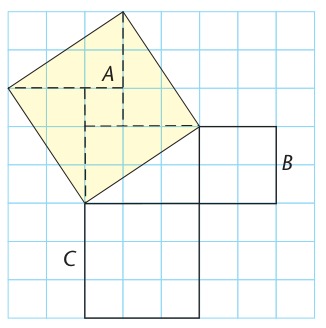
Here \(c\) is the hypotenuse; \(a\) and \(b\) are the shorter sides. To find a shorter side, subtract the other shorter side squared from the hypotenuse squared.
A right-angled triangle has shorter sides 9 cm and 12 cm. Find its longest side.
The hypotenuse is 17 m and one shorter side is 8 m. Find the remaining side.
A 6.5 m ladder leans against a vertical wall. Its foot is 2.5 m from the wall. How high up the wall does it reach?
The wall and ground meet at 90°, so the ladder is the hypotenuse.
\[h^2=6.5^2-2.5^2=42.25-6.25=36\]\[h=\boxed{6\text{ m}}\]Problem-solving method: sketch the right-angled triangle, label the right angle and known sides, decide whether to add or subtract squares, then take the positive square root. A hypotenuse must always be the longest side. In geometry problems, the perpendicular from a point to a line is its shortest distance to that line.
Subtopic 2
Trigonometry links the acute angles in a right-angled triangle to ratios of its side lengths. Choose an acute angle \(\theta\), then label the sides relative to that angle: H is the hypotenuse, O is opposite \(\theta\), and A is adjacent to \(\theta\) (but not the hypotenuse).
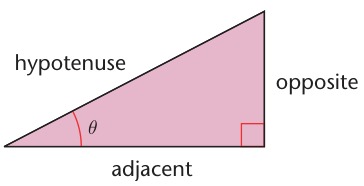
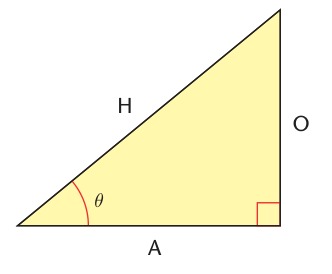
Use the calculator in degree mode for all questions in this chapter. Side ratios have no units.
Choosing the method: identify the two relevant sides and select the ratio containing them. To find a side in the numerator, multiply; to find one in the denominator, divide. To find an angle, use an inverse function: \(\sin^{-1}\), \(\cos^{-1}\), or \(\tan^{-1}\).
A right triangle has hypotenuse 14 cm and an acute angle of 30°. Find the opposite side.
A right triangle has adjacent side 12 cm to a 40° angle. Find its hypotenuse.
The opposite and adjacent sides to angle \(\theta\) are 9 cm and 12 cm. Find \(\theta\).
Isosceles triangles: if two sides are equal, draw the line of symmetry from the top vertex to the midpoint of the base. This forms two right triangles, allowing Pythagoras or SOH–CAH–TOA to be used.
An isosceles triangle has equal sides of 10 cm and a base of 12 cm. Find its vertical height.
The altitude bisects the 12 cm base into two 6 cm sections.
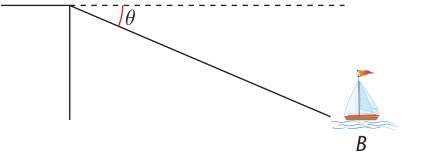
\[h^2=10^2-6^2=64\]\[h=\boxed{8\text{ cm}}\]Angles of elevation and depression: the elevation angle is measured upwards from a horizontal line, and the depression angle downwards. Alternate angles between parallel horizontal lines can help transfer a depression angle to a ground-level triangle.
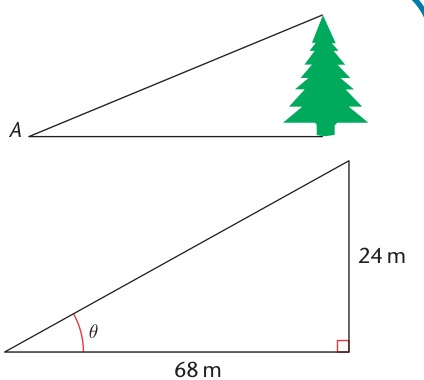
A student whose eyes are 1.6 m above the ground observes the top of a 19.6 m building at an angle of elevation of 35°. Find the horizontal distance to the building.
The vertical rise from eye level is \(19.6-1.6=18\) m.
\[\tan35^\circ=\frac{18}{d}\]\[d=\frac{18}{\tan35^\circ}=\boxed{25.7\text{ m}}\ \text{(3 s.f.)}\]Bearings: measure clockwise from North and write them as three digits. A journey on bearing \(\beta\) makes an angle \(\beta\) from North; for an acute bearing, northward displacement is \(d\cos\beta\) and eastward displacement is \(d\sin\beta\). For other quadrants, draw a compass sketch and select the correct signs/directions.
A vessel sails 120 km on a bearing of 045°. Find how far north and east it travels.
Both displacements are positive on this bearing.
Subtopic 3
The definitions of sine and cosine extend beyond acute angles. On a circle of radius 1 centred at the origin, the point reached by an angle \(\theta\) measured anticlockwise from the positive x-axis has coordinates \((\cos\theta,\sin\theta)\).
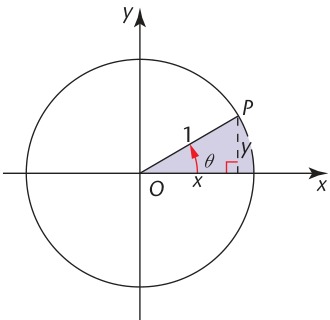
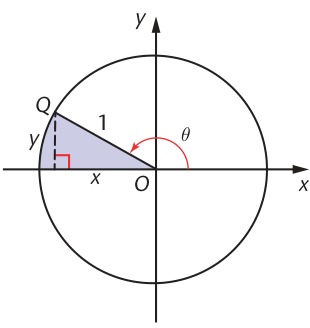
For \(90^\circ<\theta<180^\circ\), the reference angle \(180^\circ-\theta\) is acute. Tangent is negative in this quadrant, but the textbook section focuses on sine and cosine.
Find the exact values of \(\sin150^\circ\) and \(\cos150^\circ\).
Solve \(\sin x=0.6\) for \(0^\circ\le x\le180^\circ\).
Solve \(\cos x=-0.4\), where \(0^\circ\le x\le180^\circ\).
Cosine is negative in the second quadrant.
\[x=\cos^{-1}(-0.4)=\boxed{113.6^\circ}\]This is the only solution in the stated interval.
Remember: when solving \(\sin x=k\) for a range up to 180°, check both an acute solution and its supplementary angle if \(0
Subtopic 4
For a triangle \(ABC\), the angles use capital letters \(A,B,C\), and the lengths opposite them are \(a,b,c\). The three angles sum to 180°. Right-triangle trigonometric ratios by themselves are not enough when there is no 90° angle.
Use the sine rule when an angle and its opposite side are known, plus one other side or angle. Write the version that makes the unknown easier to isolate.
In triangle ABC, \(A=40^\circ\), \(B=75^\circ\) and \(a=12\) cm. Find \(b\).
In triangle ABC, \(A=42^\circ\), \(a=9\) cm and \(b=7\) cm. Find the acute angle \(B\).
If two sides and an angle not between them are given (SSA), there may be two possible triangles, one, or none. When an inverse sine gives an acute angle \(B\), also test \(180^\circ-B\). Both are valid only if the remaining triangle angle is positive and the supplied lengths are consistent.
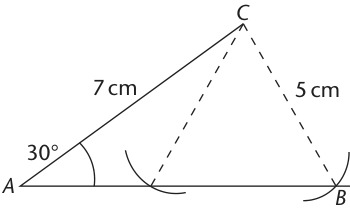
In triangle ABC, \(A=30^\circ\), \(a=6\) cm and \(b=10\) cm. Find the possible values of angle \(B\).
Both are allowed: \(30+56.4<180\) and \(30+123.6<180\).
\[\boxed{B=56.4^\circ\ \text{or}\ 123.6^\circ}\]Use the cosine rule for two sides and the included angle (SAS), or for three known sides (SSS). It also works for obtuse angles.
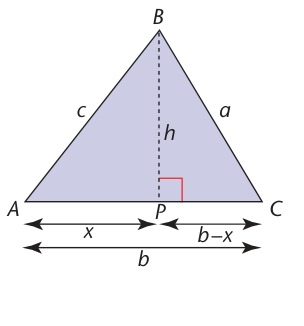
The matching angle is always opposite the matching lower-case side. For an obtuse included angle, \(\cos A\) is negative.
Two sides of a triangle are 7 cm and 9 cm, with an included angle of 60°. Find the third side.
The sides of a triangle are 7 cm, 8 cm and 9 cm. Find the angle opposite the 9 cm side.
If you know two sides and their included angle, calculate the area directly without finding a perpendicular height.
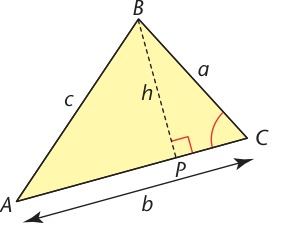
An included angle of 120° or 150° is fine: its sine is positive. Write area in square units.
Find the area of a triangle with sides 8 cm and 11 cm, enclosing an angle of 120°.
Selection checklist: right angle? → Pythagoras or SOH–CAH–TOA; opposite side–angle pair? → sine rule; SAS or SSS? → cosine rule; two sides with included angle and area required? → \(\tfrac12ab\sin C\).
Subtopic 5
Many three-dimensional problems are solved by identifying a two-dimensional right-angled triangle inside the solid. The useful triangle may lie on the base, on a face, or diagonally through the solid. Draw that triangle separately, label known lengths, and solve one stage at a time.
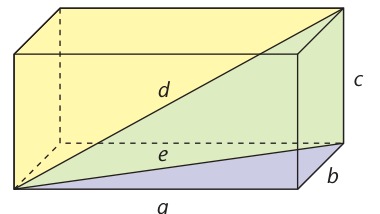
For a cuboid only: \(l,w,h\) are three mutually perpendicular edges; \(d\) is its space diagonal. This formula is Pythagoras applied twice.
A rectangular box is 3 cm wide, 4 cm deep and 12 cm high. Find its longest diagonal.
For the same 3 cm × 4 cm × 12 cm cuboid, find the angle between the space diagonal and the base.
The projection of the diagonal on the base is its 3 cm × 4 cm diagonal.
\[b=\sqrt{3^2+4^2}=5\text{ cm}\]\[\tan\theta=\frac{12}{5}\]\[\theta=\tan^{-1}(12/5)=\boxed{67.4^\circ}\]A tree stands 40 m north of a point P, and a second observation point Q is 30 m east of P. Its top is 20 m above the ground. Find the angle of elevation of the top from Q.
First find the horizontal distance from Q to the foot of the tree:
\[r=\sqrt{40^2+30^2}=50\text{ m}\]Then use the right triangle containing the tree height:
\[\tan\theta=\frac{20}{50}=0.4\]\[\theta=\tan^{-1}(0.4)=\boxed{21.8^\circ}\]Accuracy: retain exact squares and roots in intermediate steps (for example, use \(\sqrt{45}\), not 6.71) and round only at the end. When points lie on horizontal ground, first use their ground distances, then combine with a vertical height.
Subtopic 6
The angle between a line and a plane is the acute angle between the line and its perpendicular projection onto that plane. To identify the right triangle, drop a perpendicular from the raised endpoint to the plane. The projection is the horizontal/planar side; the height is perpendicular to the plane.
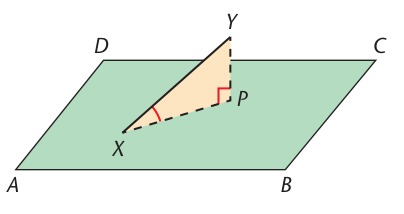
When the plane is horizontal, the familiar angle of elevation is the angle between the line of sight and the plane. For a vertical face, project the line onto that face instead: the correct projection may differ from the one on the base.
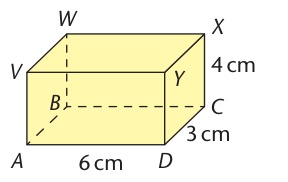
A cuboid measures 8 cm by 6 cm on its base and has height 5 cm. Find the angle between its space diagonal and its base.
First calculate the diagonal of the base.
\[p=\sqrt{8^2+6^2}=10\text{ cm}\]\[\tan\theta=\frac{5}{10}\]\[\theta=\tan^{-1}(0.5)=\boxed{26.6^\circ}\]A cuboid has width 8 cm, depth 6 cm and height 5 cm. Find the angle between its space diagonal and the vertical face of width 8 cm and height 5 cm.
The perpendicular distance from the far corner to that face is the depth, 6 cm. The projection of the diagonal onto the face is
\[p=\sqrt{8^2+5^2}=\sqrt{89}\]\[\tan\theta=\frac{6}{\sqrt{89}}\]\[\theta=\tan^{-1}\left(\frac6{\sqrt{89}}\right)=\boxed{32.5^\circ}\]A right pyramid has a rectangular base measuring 6 cm × 8 cm. Its apex is vertically above the centre of the base, 12 cm above it. Find the angle between an edge from the apex to a base corner and the base.
The projection of the sloping edge goes from the corner to the centre of the rectangle. The centre-to-corner ground distance is
\[r=\sqrt{3^2+4^2}=5\text{ cm}\]\[\tan\theta=\frac{12}{5}\]\[\theta=\tan^{-1}(12/5)=\boxed{67.4^\circ}\]Final check: clearly name the required plane, mark the foot of the perpendicular, and find the angle between the line and its projection—not between the line and an arbitrary edge of the solid.
Build confidence → apply skills → exam-style reasoning
Try each question before opening Show Answer. Solutions include the method, substitution and final result. Questions here are newly written in the style of the chapter, not reproductions of past papers.
A right-angled triangle has sides 5 cm and 12 cm meeting at 90°. Find the hypotenuse.
The hypotenuse of a right triangle is 10 cm and one shorter side is 6 cm. Find the other shorter side.
Relative to an acute angle, the opposite side is 6 cm and the hypotenuse is 10 cm. Write the sine ratio and find the angle.
A triangle has a right angle, hypotenuse 18 cm and acute angle 25°. Find the opposite side.
A right triangle has hypotenuse 20 cm and an acute angle of 60°. Find the adjacent side.
An opposite side is 5 cm and adjacent side is 12 cm. Find the acute angle.
Without a calculator, given \(\sin35^\circ=0.574\), find \(\sin145^\circ\).
Given \(\cos50^\circ=0.643\), write down \(\cos130^\circ\).
A rectangular plot is 24 m long and 18 m wide. Find the length of a straight diagonal footpath.
A ladder 8 m long rests against a wall. Its foot is 1.8 m from the wall. Find the height reached, to 3 significant figures.
A ramp rises 1.5 m over a horizontal run of 8 m. Find its angle of inclination.
A lookout is 30 m above sea level. The angle of depression to a boat is 20°. Find the boat’s horizontal distance from the foot of the lookout.
The boat sees the same 20° angle of elevation.
\[\tan20^\circ=\frac{30}{d}\]\[d=\frac{30}{\tan20^\circ}=\boxed{82.4\text{ m}}\]A walker travels 15 km on bearing 060°. Find the distance travelled east and north.
A triangle has \(A=50^\circ\), \(B=70^\circ\) and \(a=10\) cm. Find \(b\).
Triangle ABC has \(A=35^\circ\), \(B=95^\circ\) and \(a=8\) cm. Find \(C\) and \(c\).
Two sides of a triangle are 6 cm and 10 cm with included angle 45°. Find the third side.
The three sides of a triangle measure 5 cm, 7 cm and 8 cm. Find the angle opposite the 8 cm side.
Two sides of a triangle measure 9 cm and 12 cm, and the included angle is 50°. Find its area.
Solve \(\sin x=0.5\) for \(0^\circ\le x\le180^\circ\).
A cuboid measures 9 cm by 12 cm by 8 cm. Calculate its space diagonal.
A cuboid is 6 cm by 8 cm on its base and 10 cm high. Find the angle between its space diagonal and the base.
A point is 9 m vertically above a level ground point O. A point P is 12 m horizontally from O. Find the distance from P to the raised point and the angle of elevation.
A cuboid is 5 cm wide, 12 cm deep and 4 cm high. Find the angle between its space diagonal and the vertical face that is 12 cm by 4 cm.
The line projects onto that face to make diagonal \(p\).
\[p=\sqrt{12^2+4^2}=\sqrt{160}\]\[\tan\theta=\frac5{\sqrt{160}}\]\[\theta=\boxed{21.6^\circ}\]A tower is 36 m high. From a point on level ground its top has an angle of elevation of 28°. Find (i) the horizontal distance to the tower and (ii) the straight-line distance to the top.
(i) Use tangent with opposite 36 m:
\[d=\frac{36}{\tan28^\circ}=\boxed{67.7\text{ m}}\](ii) Use sine, avoiding rounding the intermediate value:
\[L=\frac{36}{\sin28^\circ}=\boxed{76.7\text{ m}}\]An isosceles triangle has equal sides 13 cm and base 10 cm. Find (i) its perpendicular height and (ii) its apex angle.
Symmetry divides the base into two 5 cm halves.
\[h=\sqrt{13^2-5^2}=\sqrt{144}=\boxed{12\text{ cm}}\]The half-apex angle \(\alpha\) has opposite 5, hypotenuse 13.
\[\alpha=\sin^{-1}(5/13)\approx22.62^\circ\]\[\text{Apex angle}=2\alpha=\boxed{45.2^\circ}\]For triangle ABC, \(A=35^\circ\), \(a=8\) cm and \(b=10\) cm. Determine both possible values of \(B\), and explain why both are valid.
Both are valid because adding \(A=35^\circ\) leaves a positive third angle in each case: about 99.2° or 10.8°.
\[\boxed{B=45.8^\circ\ \text{or}\ 134.2^\circ}\]Two survey points A and B are 80 m apart. A landmark C is observed with \(\angle BAC=42^\circ\) and \(\angle ABC=68^\circ\). Find AC and the area of triangle ABC.
Use sine rule; AB is opposite C.
\[AC=\frac{80\sin68^\circ}{\sin70^\circ}\approx\boxed{78.9\text{ m}}\]For area, use unrounded AC:
\[A=\frac12(80)(AC)\sin42^\circ\approx\boxed{2110\text{ m}^2}\ \text{(3 s.f.)}\]A vertical mast is 18 m tall. Its foot is 24 m north and 10 m east of an observer. Find (i) the horizontal distance to the mast and (ii) the angle of elevation to its top.
A pyramid has a horizontal square base of side 10 cm, and its apex is 12 cm vertically above the centre. Find (i) the sloping edge length to a base corner and (ii) the angle of that edge with the base.
Projection of the edge onto the base is half the base diagonal.
\[p=\sqrt{5^2+5^2}=5\sqrt2\]\[L=\sqrt{12^2+(5\sqrt2)^2}=\sqrt{194}=\boxed{13.9\text{ cm}}\]\[\theta=\tan^{-1}\left(\frac{12}{5\sqrt2}\right)=\boxed{59.5^\circ}\]A cuboid has length 12 cm, width 5 cm and height 9 cm. Find the angle its space diagonal makes with (i) the base and (ii) the vertical 12 cm by 9 cm face.
(i) The base projection has length \(\sqrt{12^2+5^2}=13\) cm.
\[\theta=\tan^{-1}(9/13)=\boxed{34.7^\circ}\](ii) The projection onto the stated face has length \(\sqrt{12^2+9^2}=15\) cm; the perpendicular offset is 5 cm.
\[\phi=\tan^{-1}(5/15)=\boxed{18.4^\circ}\]I identify the hypotenuse and use addition for it, subtraction for a shorter side.
I label sides relative to the angle, choose the correct ratio and check degree mode.
I use inverse sine/cosine/tangent when an angle is unknown.
I sketch north and horizontal lines before selecting ratios.
I remember sine stays positive and cosine becomes negative in the second quadrant.
I match each side with its opposite angle and check SSA for two solutions.
I use it for SAS or SSS, including obtuse triangles.
I choose the included angle in \(\tfrac12ab\sin C\).
I select and draw the correct 2-D right triangle within the solid.
I find the perpendicular projection of the line onto the specified plane.
I keep enough working, correct units and unrounded intermediate values.