Learn to draw, calculate, recognise and describe transformations of shapes on coordinate grids, including negative and fractional enlargements and combined transformations.
use the terms object, image, congruent, similar and invariant correctly;
reflect a shape in horizontal, vertical and diagonal mirror lines;
rotate shapes by multiples of 90° about a specified centre and in a specified direction;
translate shapes using a column vector;
enlarge shapes by positive, fractional and negative scale factors about a given centre;
identify and describe any of these transformations fully from a diagram;
apply successive transformations in the correct order and recognise equivalent single transformations.
1
Subtopic 1
The language of transformations
A transformation moves or changes a shape using a defined rule. The original shape is called the object; the result is called the image. If the object has vertices \(A,B,C\), we label the image vertices \(A',B',C'\), matching corresponding points.
To map a shape means to send each of its points to a new point by the transformation. A feature that remains unchanged is invariant.
Know what stays the same
Reflection, rotation and translation preserve length, angle and area: the object and image are congruent.
Enlargement preserves the shape and angles but usually changes lengths and area: the object and image are similar.
A point lying on the mirror line stays fixed when reflected; the centre of a rotation or enlargement stays fixed.
On coordinate grids, describe positions using ordered pairs \((x,y)\): first move horizontally, then vertically. Drawing an accurate grid makes transformation questions easier.
Worked example · Easy
Object and image
Triangle \(PQR\) becomes \(P'Q'R'\) after every vertex moves four units right. Name the object and image.
\(PQR\) is the object and \(P'Q'R'\) is the image. Each corresponding vertex is four units right of the original: the transformation is a translation. All lengths and angles are unchanged.
Worked example · Medium
Recognise an invariant property
A rectangle is enlarged by scale factor 3. Its perimeter was 14 cm and area 12 cm². Which properties stay invariant?
The angles and shape stay unchanged; length, perimeter and area do not. Perimeter becomes \(3\times14=42\) cm and area becomes \(3^2\times12=108\text{ cm}^2\).
2
Subtopic 2
Reflection
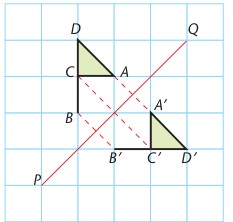
A reflection flips a shape across a mirror line. For each point, its image lies the same perpendicular distance on the opposite side of that line. The mirror line is the perpendicular bisector of the segment joining corresponding points.
Reflection preserves distances and angles, but reverses orientation: a clockwise order of labelled vertices becomes anticlockwise. Points on the mirror line stay fixed.
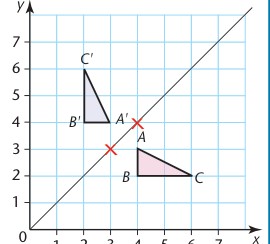
Textbook figure: Corresponding corners lie on opposite sides of the mirror line and at equal perpendicular distances.
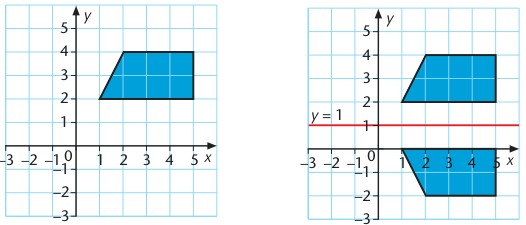
For a line \(x=a\), use \((x,y)\mapsto(2a-x,y)\). For \(y=b\), use \((x,y)\mapsto(x,2b-y)\).
Textbook figure: A mirror line need not be an axis; in this figure it is \(y=1\).
Worked example · Easy
Reflection in the y-axis
Reflect \(A(3,-2)\) in the \(y\)-axis.
\[(3,-2)\mapsto\boxed{(-3,-2)}\]
Only the \(x\)-coordinate changes sign.
Worked example · Medium
Reflection in a shifted horizontal line
Reflect \(B(-1,5)\) in the line \(y=2\).
The point is 3 units above the mirror line, so its image must be 3 units below it:
\[y'=2(2)-5=-1\]\[\boxed{B'=(-1,-1)}\]
Worked example · Exam
Reflect a whole triangle in a sloping line
Triangle \(ABC\) has vertices \(A(1,2),B(3,2),C(2,5)\). Reflect it in \(y=-x\), giving the image coordinates.
Reflect each vertex by swapping the coordinates and reversing both signs:
\[A'(-2,-1),\quad B'(-2,-3),\quad C'(-5,-2)\]
Plot these three points and join them in the original vertex order. All side lengths are preserved.
Drawing method: mark corresponding perpendicular distances for every corner, then join the image vertices with a ruler. For a diagonal mirror line, using tracing paper helps check the reversal.
3
Subtopic 3
Rotation
A rotation turns a figure about a fixed centre of rotation. You must know angle, direction and centre. Distances from the centre and the size and orientation of the shape remain unchanged.
Clockwise and anticlockwise rotations are measured as viewed on the page. A quarter-turn is \(90^\circ\), a half-turn \(180^\circ\), and three quarter-turns \(270^\circ\). For example, \(270^\circ\) anticlockwise is equivalent to \(90^\circ\) clockwise.
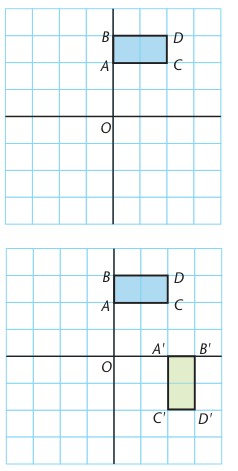
Textbook figure: The shape has been turned, not mirrored; its size and handedness are unchanged.
Drawing method: mark the centre, count the horizontal and vertical displacement of each corner, rotate that displacement, then join corresponding image points. A rotation is not a reflection: the vertex order is preserved.
4
Subtopic 4
Translation
A translation slides a figure. Every point moves by the same distance in the same direction. The image has the same size and orientation as the object.
A translation can be written as a column vector: the top number is the horizontal movement, the bottom is the vertical movement. Positive values mean right/up; negative values mean left/down.
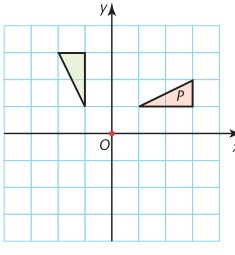
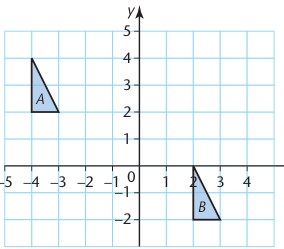
Textbook figure: The example translates each vertex 6 units right and 4 units down.
To find the translation that takes one vertex to its corresponding image, calculate \((\Delta x,\Delta y)=(x'-x,y'-y)\). Check the same vector works for the other vertices.
Worked example · Easy
Apply a translation vector
Translate \(P(-2,5)\) by \(\begin{pmatrix}4\-3\end{pmatrix}\).
\[P'=(-2+4,\;5-3)=\boxed{(2,2)}\]
Worked example · Medium
Find the translation vector
A point \(A(-3,2)\) becomes \(A'(1,-4)\). Find the translation.
Triangle \(ABC\) has \(A(0,1),B(3,1),C(1,4)\). Translate it by \(\begin{pmatrix}-2\5\end{pmatrix}\), then by \(\begin{pmatrix}6\-8\end{pmatrix}\). Find the single equivalent translation and the final vertices.
An enlargement changes the size of a shape from a fixed centre of enlargement using a scale factor \(k\). Lengths are multiplied by \(|k|\); angles stay the same. Normally the new shape is similar rather than congruent.
\(k>1\): image is larger on the same side of the centre.
\(0 image is smaller between centre and original points.
\(k<0\): image lies on the opposite side of the centre, giving an inverted image; \(|k|\) controls size.
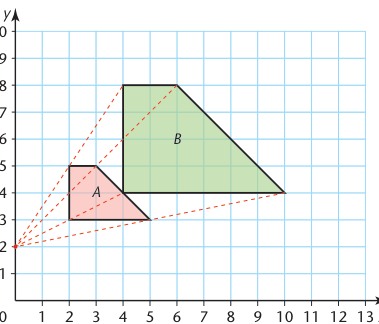
The centre itself is unchanged. To draw an image, draw rays from the centre through every vertex (extend the lines for negative factors), mark the correct distance for each image vertex, then join.
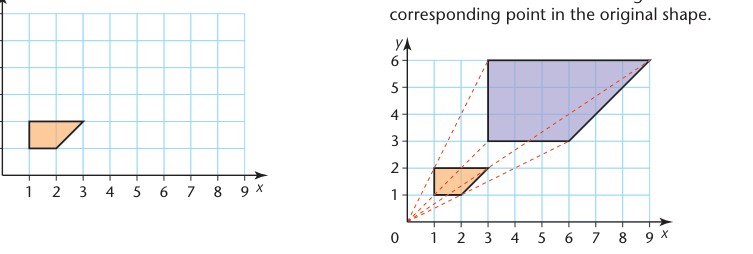
Textbook figure: The image side lengths are three times those of the object, measured from the origin.
In this formula the centre is \((h,k_0)\) and scale factor is \(k\). The subscripts just distinguish the centre’s second coordinate from the scale factor. An equivalent vector form is \(P'=C+k(P-C)\).
Scale factors: length ratio \(=|k|\); area ratio \(=k^2\). A factor of \(-2\) makes side lengths twice as large and area four times as large.
Worked example · Easy
Enlargement with centre at the origin
Enlarge \(A(2,3)\) by scale factor \(3\) about the origin.
\[(2,3)\mapsto(3\times2,3\times3)=\boxed{(6,9)}\]
Worked example · Medium
An enlargement from a non-origin centre
Enlarge \(B(5,4)\) by scale factor \(2\) about \(C(1,2)\).
First find the displacement from the centre: \((5-1,4-2)=(4,2)\). Double it and add back the centre.
\[B'=(1,2)+2(4,2)=\boxed{(9,6)}\]
Enlargement with a fractional scale factor
For a factor such as \(\tfrac12\), the image vertex is half as far from the centre along the same ray. Corresponding image sides are half as long and the area is one-quarter of the original.
Textbook figure: To find the smaller triangle, place the image vertices halfway between the centre O and original vertices.
Worked example · Medium
A fractional scale factor
An enlargement has centre \((2,2)\) and scale factor \(\tfrac12\). Find the image of \(D(8,6)\).
A negative factor places the image across the centre. For example, \(-\tfrac12\) produces a smaller image across the centre; \(-3\) produces an image three times as large across the centre. Do not confuse a negative factor with a fractional factor.
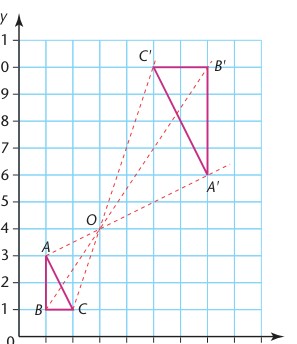
Textbook figure: Each image vertex is on the opposite side of the centre and twice as far away.
Worked example · Exam
Negative factor and area
Triangle \(ABC\) has \(A(1,1),B(3,1),C(2,4)\). Enlarge it about \((2,2)\) by factor \(-2\). Find the image vertices and the area scale factor.
Lengths multiply by 2; areas by \((-2)^2=\boxed{4}\). Both original and image triangles have the same corresponding angles.
Worked example · Exam
Find scale factor and centre
A triangle’s vertex \(A(1,2)\) maps to \(A'(3,4)\) and \(B(2,2)\) maps to \(B'(5,4)\) under an enlargement. Find the scale factor and centre.
The vector from A to B is \((1,0)\), but from \(A'\) to \(B'\) it is \((2,0)\), so \(k=2\).
Use \(A'=C+2(A-C)=2A-C\), hence \(C=2A-A'\).
\[C=(2,4)-(3,4)=\boxed{(-1,0)}\]
6
Subtopic 6
Recognising and describing transformations
When you are given an object and its image and asked to describe fully the single transformation, identify the type and give the extra information needed. Writing only “rotation” or “enlargement” is incomplete.
Minimum information for a full description
Transformation
You must state
Reflection
Mirror line, e.g. \(y=2\) or \(y=x\)
Rotation
Angle, direction and centre
Translation
Column vector
Enlargement
Scale factor and centre
Recognising by sight: if a tracing must be flipped, look for a reflection. If it must turn without flipping, look for a rotation. If it slides unchanged, look for a translation. If sizes differ, look for an enlargement.
For reflection, a mirror line passes through the midpoints of corresponding vertices at right angles. For rotation, the centre is equidistant from each point and its image. For enlargement, lines through pairs of corresponding vertices meet at the centre.
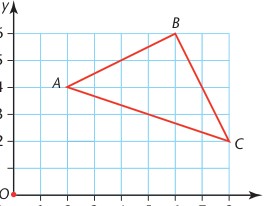
Textbook figure: The midpoints of corresponding vertices fall on the mirror line \(y=x\).Textbook figure: The lines joining corresponding vertices meet at the centre; side-length ratios give the scale factor.
Worked example · Easy
Identify a translation
A point \(P(2,3)\) moves to \(P'(6,1)\), and all other vertices move in exactly the same way. Describe the transformation fully.
\[\Delta x=6-2=4,\quad\Delta y=1-3=-2\]
Translation by \(\boxed{\begin{pmatrix}4\\-2\end{pmatrix}}\).
Worked example · Medium
Recognise a reflection line
\(A(-1,4)\) maps to \(A'(-1,-2)\) and \(B(3,5)\) maps to \(B'(3,-3)\). Describe the reflection.
Vertical midpoints: \(\frac{4+(-2)}2=1\) and \(\frac{5+(-3)}2=1\). All \(x\)-coordinates stay fixed.
It is a \(\boxed{\text{reflection in }y=1}\).
Worked example · Exam
Describe an enlargement fully
Corresponding vertices \(A(4,2)\mapsto A'(-2,5)\) and \(B(2,2)\mapsto B'(1,5)\) belong to a pair of similar triangles. Describe the enlargement.
The original horizontal edge goes 2 units left; its image goes 3 units right, so the scale factor is \(k=-\tfrac32\).
For centre \(C\), \(A'=C+k(A-C)\), so \(C=(A'-kA)/(1-k)\).
Enlargement, scale factor \(\boxed{-\tfrac32}\), centre \(\boxed{(1.6,3.2)}\).
7
Subtopic 7
Combining transformations
Two transformations may be applied successively: the first image becomes the second transformation’s object. The order matters, especially if the transformations involve reflections or rotations.
The textbook uses composition notation: \(PQ\) means apply Q first, then P, just as in composite functions. To avoid mistakes, follow the order stated in words, showing the intermediate image when necessary.
Useful special cases
Two translations combine by adding their vectors.
Two reflections in parallel lines form a translation perpendicular to those lines, by twice the distance between them.
Two reflections in intersecting lines form a rotation through twice the angle between the lines.
Some combinations of a rotation and a reflection are equivalent to a single reflection.
An enlargement followed by a translation can be a single enlargement with a different centre, provided the enlargement factor is not 1.
Worked example · Easy
Combine translations
Translate by \(\begin{pmatrix}3\-2\end{pmatrix}\), followed by \(\begin{pmatrix}-5\7\end{pmatrix}\). Give the one translation with the same effect.
Rotate \(P(x,y)\) \(90^\circ\) anticlockwise about the origin, then reflect in the y-axis. Describe the equivalent single transformation.
Rotate: \((x,y)\mapsto(-y,x)\). Reflect the result in the \(y\)-axis:
\[(-y,x)\mapsto(y,x)\]
Interchanging the two coordinates is \(\boxed{\text{reflection in }y=x}\).
Worked example · Medium
Two parallel reflection lines
Reflect a shape in \(y=3\), then in \(y=-1\). Describe the equivalent single transformation.
First: \(y\mapsto6-y\). Then: \(y\mapsto-2-(6-y)=y-8\). The horizontal coordinate is unchanged.
Translation by \(\boxed{\begin{pmatrix}0\\-8\end{pmatrix}}\).
Worked example · Exam
Enlargement followed by translation
First enlarge by factor \(3\) about \((3,3)\), then translate by \(\begin{pmatrix}2\2\end{pmatrix}\). Find the equivalent single enlargement.
The first operation sends \(P\) to \(3P-2(3,3)\). Translating gives \(3P-(4,4)\). For one enlargement of factor 3 and centre \(C\), the result is \(3P-2C\).
\[-2C=(-4,-4)\Longrightarrow C=\boxed{(2,2)}\]
So the overall transformation is an enlargement, scale factor 3, centre \(\boxed{(2,2)}\).
Worked example · Exam
A sequence with three stages
Start with \(A(2,1)\). Reflect in the x-axis, rotate the image \(90^\circ\) anticlockwise about the origin, and then translate by \(\begin{pmatrix}3\-2\end{pmatrix}\). Find the final coordinates.
After reflection: \((2,1)\mapsto(2,-1)\).
After rotation: \((2,-1)\mapsto(1,2)\).
After translation: \((1,2)+(3,-2)=\boxed{(4,0)}\).
Do not change the given order.
Chapter 42 exercises
Begin with the foundational questions before tackling the longer coordinate and reasoning problems. The exam-style questions are original practice questions, not copied past papers. Click Show Answer to reveal a complete worked solution.
A. Confidence-building questions
1Object and image[2 marks]
A triangle labelled ABC is translated to A′B′C′. Which is the object? What do primes on the labels mean?
Show Answer
The object is triangle ABC; A′B′C′ is its image. A′ is the new position of the original point A, and similarly for B and C.
2Congruent or similar?[2 marks]
State whether (i) a rotation and (ii) an enlargement with scale factor 3 preserves size.
Show Answer
(i) Rotation preserves size, so the image is congruent to the object.
(ii) Factor 3 multiplies lengths by 3, so size changes. The image is similar, not congruent.
3Reflection in x-axis[2 marks]
Reflect \(A(-4,3)\) in the x-axis.
Show Answer
\[(x,y)\mapsto(x,-y)\] \[\boxed{A'=(-4,-3)}\]
4Reflection in y-axis[2 marks]
Reflect \(B(5,-2)\) in the y-axis.
Show Answer
\[(x,y)\mapsto(-x,y)\] \[\boxed{B'=(-5,-2)}\]
5Quarter-turn[2 marks]
Rotate \(C(3,2)\) by 90° anticlockwise about the origin.
Show Answer
\[(x,y)\mapsto(-y,x)\] \[\boxed{C'=(-2,3)}\]
6Half-turn[2 marks]
Rotate \(D(-3,7)\) through 180° about the origin.
Show Answer
\[(x,y)\mapsto(-x,-y)\] \[\boxed{D'=(3,-7)}\]
7Translate one point[2 marks]
Translate \(P(4,-1)\) by the vector \(\begin{pmatrix}-6\\5\end{pmatrix}\).
Show Answer
\[P'=(4-6,-1+5)=\boxed{(-2,4)}\]
8Find the vector[2 marks]
Point \(Q(-1,2)\) is translated to \(Q'(3,8)\). State the vector.
Enlarge \(T(2,-5)\) by scale factor −1 about the origin.
Show Answer
\[T'=(-1)(2,-5)=\boxed{(-2,5)}\]
The image point is the same distance on the opposite side of the centre.
12Scale and area[3 marks]
An enlargement has scale factor \(-3\). Give the length scale factor, area scale factor and effect of the minus sign.
Show Answer
Length scale factor \(=|-3|=\boxed{3}\). Area scale factor \(=(-3)^2=\boxed{9}\). The negative sign places the image on the opposite side of the centre.
B. Developing transformation skills
13Reflect in a horizontal line[3 marks]
Reflect \(A(4,-3)\) in the line \(y=2\).
Show Answer
Distance from the point up to \(y=2\) is 5 units, so image is 5 units above the line:
\[y'=2(2)-(-3)=7\] \[\boxed{A'=(4,7)}\]
14Reflect in y = −x[3 marks]
Reflect the vertices \(A(1,4), B(3,2), C(2,5)\) in \(y=-x\).
An enlargement maps \(A(1,2)\) to \(A'(7,-2)\) and \(B(3,2)\) to \(B'(1,-2)\). Find its scale factor and centre.
Show Answer
AB has displacement \((2,0)\); A′B′ has displacement \((-6,0)\).
\[k=\frac{-6}{2}=\boxed{-3}\]
Use \(A'=C-3(A-C)=4C-3A\), so \(C=(A'+3A)/4\).
\[C=\frac{(7,-2)+(3,6)}4=\boxed{(2.5,1)}\]
29Fractional enlargement and areas[5 marks]
An L-shaped polygon has perimeter 30 cm and area 64 cm². Its image is an enlargement of scale factor \(\tfrac34\). Find the new perimeter and area; say if the shapes are congruent.
Show Answer
Lengths and perimeter multiply by \(\tfrac34\):
\[P'=30\times\tfrac34=\boxed{22.5\text{ cm}}\]
Area multiplies by \((\tfrac34)^2=\tfrac9{16}\):
\[A'=64\times\tfrac9{16}=\boxed{36\text{ cm}^2}\]
They are similar, not congruent, because their sizes differ.
30Identify a mirror line from two pairs[4 marks]
Point \(P(1,0)\) maps to \(P'(5,0)\) and \(Q(2,4)\) maps to \(Q'(4,4)\). Describe the transformation fully.
Show Answer
Midpoints are \((3,0)\) and \((3,4)\), on the vertical line \(x=3\). Segment PP′ and QQ′ are horizontal and perpendicular to it.
\(\boxed{\text{Reflection in }x=3}\).
31Two horizontal reflections[5 marks]
A shape is reflected in \(y=4\), followed by a reflection in \(y=-2\). Find the equivalent single transformation and the final image of \(P(3,1)\).
Show Answer
The lines are 6 units apart. The resulting translation is 12 units down:
\[\boxed{\begin{pmatrix}0\\-12\end{pmatrix}}\]
Check by coordinates: \(y\mapsto8-y\mapsto-4-(8-y)=y-12\).
\[P'=(3,1-12)=\boxed{(3,-11)}\]
32Rotations and reflections combine[5 marks]
Apply a 90° clockwise rotation about the origin, followed by a reflection in the x-axis. Describe the equivalent single transformation and find the image of \(P(2,5)\).
Show Answer
Rotate \((x,y)\mapsto(y,-x)\); reflect in x-axis \((y,-x)\mapsto(y,x)\).
Single transformation: \(\boxed{\text{reflection in }y=x}\). So \(P(2,5)\mapsto\boxed{(5,2)}\).
33Two perpendicular reflections[5 marks]
Reflect \(A(-2,3)\) in the x-axis and then in the y-axis. Identify the single equivalent transformation and the final coordinates.
These two perpendicular reflections equal a \(\boxed{180^\circ\text{ rotation about the origin}}\).
Image: \(\boxed{(2,-3)}\).
34Three-stage transformation[6 marks]
Triangle ABC has vertices \(A(0,1),B(2,1),C(0,3)\). First translate by \(\begin{pmatrix}3\\-1\end{pmatrix}\), then reflect in the y-axis, then rotate 180° about the origin. Give final coordinates.
Show Answer
After translation: \((3,0),(5,0),(3,2)\).
After reflection in the y-axis: \((-3,0),(-5,0),(-3,2)\).
After half-turn: \(\boxed{A'=(3,0),\ B'=(5,0),\ C'=(3,-2)}\).
35Enlarge then translate[6 marks]
Enlarge by scale factor 2 about \((4,1)\), then translate by \(\begin{pmatrix}3\\-2\end{pmatrix}\). Describe the single equivalent enlargement, showing the calculation.
Show Answer
Overall image of P is \(2P-C+v\). This equals an enlargement of scale factor 2 about \(C'=C-v\).
\[C'=(4,1)-(3,-2)=\boxed{(1,3)}\]
So it is an enlargement, scale factor \(\boxed{2}\), centre \(\boxed{(1,3)}\).
36Reverse an enlargement[6 marks]
Under an enlargement of scale factor \(-\tfrac12\) about \((2,4)\), the image of point \(P\) is \(P'=(5,1)\). Find the original point \(P\), showing each step.
Show Answer
Let \(C=(2,4)\). Then \(P'-C=(-\tfrac12)(P-C)\), so \(P-C=-2(P'-C)\).
I distinguish an object from its image and understand invariance, congruence and similarity.
Reflection
I locate the exact mirror line and count perpendicular distances on both sides.
Rotation
I give angle, direction and centre; I check which way a quarter-turn moves a point.
Translation
I write the horizontal and vertical movements as a signed column vector.
Enlargement
I identify centre and factor; I distinguish fractional and negative factors.
Area scale factor
I multiply lengths by |k| but areas by k².
Describe fully
I supply every required detail rather than just the transformation name.
Combined transformations
I follow the stated order and use intermediate images to avoid confusion.
Accuracy
I use a sharp pencil and ruler, correctly label every vertex, and keep coordinates in the right order.
Source mapping: The seven subtopics follow the textbook’s Chapter 42 table of contents in order (printed pages 408–427). The included diagrams are cropped from the supplied textbook. Explanations, worked examples and exercise questions are original IGCSE360 teaching material; exam-style questions are not actual past-paper questions.