Accounting for Depreciation and Disposal of Non-Current Assets
This chapter explains why non-current assets lose value, how depreciation is calculated, how depreciation is recorded in the accounts, and how profit or loss is calculated when an asset is sold.
DepreciationResidual valueNet book valueStraight-lineReducing balanceDisposal account
Topic 1: Meaning and Purpose of Depreciation
Depreciation is used to match the cost of a non-current asset with the years in which that asset is used.
1. What is Depreciation?
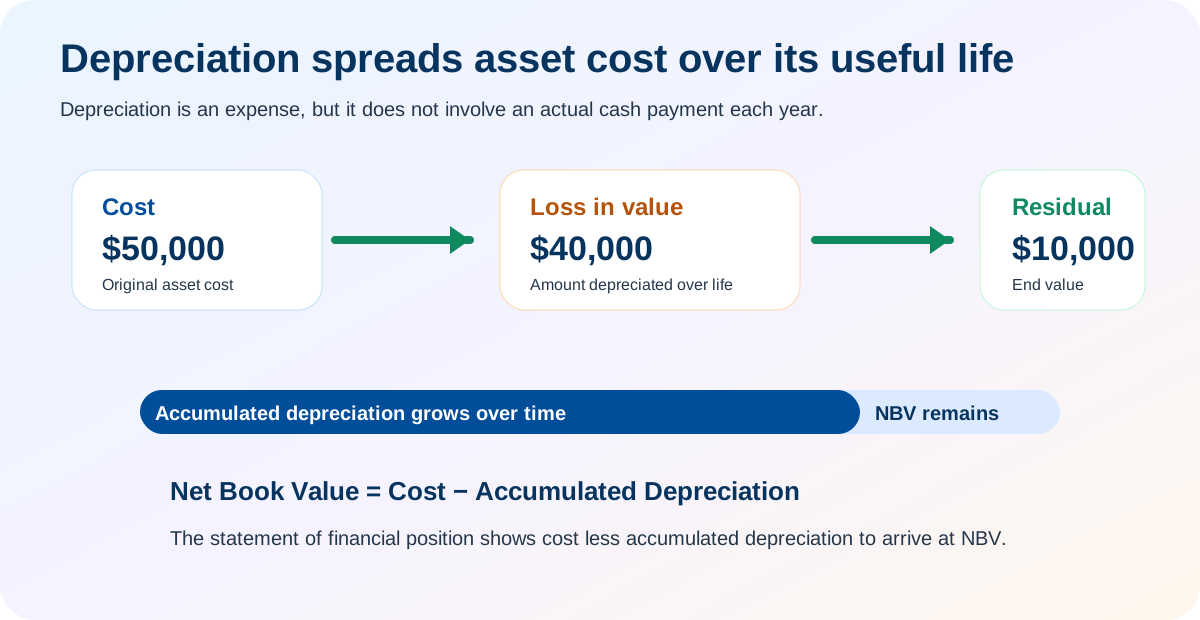
Depreciation is the estimated loss in value of a non-current asset over its useful life.
It spreads the cost of the asset over the years in which it is used.
Example
A motor vehicle costs $50,000.
Estimated value after 5 years = $10,000
A motor vehicle costs $50,000.
Estimated value after 5 years = $10,000
Loss in value$50,000 − $10,000$40,000
This $40,000 is the amount that will be depreciated over the asset's useful life.Depreciation is an expense, but it does not involve an actual cash payment each year.
2. Why Do Assets Depreciate?
The main causes are:
Physical factors
Wear and tear, rust and damage can reduce the value of an asset.
Economic factors
Newer and better technology can make an asset obsolete.
Time factors
An asset may have a limited legal or useful life.
Depletion
Natural resources are gradually used up.
Example
A computer may lose value because newer and faster computers become available. This is obsolescence.
A computer may lose value because newer and faster computers become available. This is obsolescence.
3. Why is Depreciation Provided?
Depreciation is provided to:
- spread the cost of an asset over the years it is used
- avoid overstating profit
- avoid overstating non-current assets
- give a true and fair view of the financial statements
Depreciation is charged as an expense in the income statement.
4. Important Terms
Residual ValueThe estimated value of an asset at the end of its useful life. Also called scrap value.
Accumulated DepreciationThe total depreciation charged on an asset from the time it was bought up to the present date.
Net Book ValueThe value of the asset after accumulated depreciation has been deducted.
Net Book Value = Cost − Accumulated Depreciation
Example
Machine cost = $20,000
Accumulated depreciation = $6,000
Machine cost = $20,000
Accumulated depreciation = $6,000
Net book value$20,000 − $6,000$14,000
Topic 2: Methods of Depreciation
The chapter covers three methods: straight-line, reducing balance and revaluation.
5. Methods of Depreciation
The chapter covers three methods:
- Straight-line method
- Reducing balance method
- Revaluation method
6. Straight-Line Method
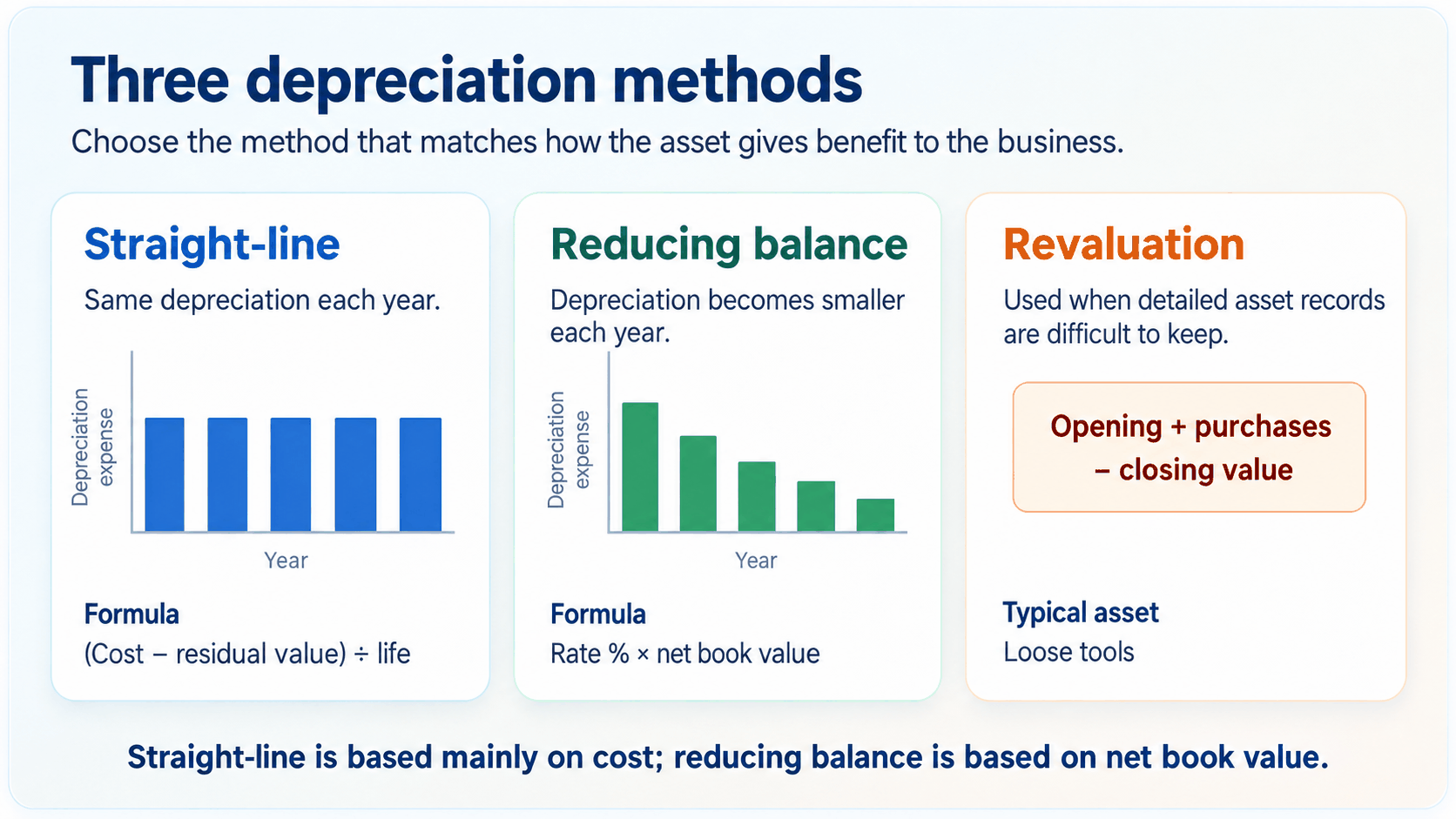
With the straight-line method, the same amount of depreciation is charged every year.
Annual Depreciation = (Cost − Residual Value) ÷ Useful Life
Example
Machine cost = $10,000
Residual value = $2,000
Useful life = 4 years
Machine cost = $10,000
Residual value = $2,000
Useful life = 4 years
Annual depreciation($10,000 − $2,000) ÷ 4$2,000
So $2,000 depreciation is charged every year.| Year | Depreciation $ | Net Book Value $ |
|---|---|---|
| Start | – | 10,000 |
| Year 1 | 2,000 | 8,000 |
| Year 2 | 2,000 | 6,000 |
| Year 3 | 2,000 | 4,000 |
| Year 4 | 2,000 | 2,000 |
7. Straight-Line as a Percentage
Depreciation may also be given as a percentage of cost.
Example
Machine cost = $20,000
Depreciation = 10% per year
Machine cost = $20,000
Depreciation = 10% per year
Annual depreciation10% × $20,000$2,000
The depreciation remains $2,000 every year.8. Reducing Balance Method
Under the reducing balance method, depreciation is calculated on the net book value each year.
Therefore, depreciation becomes smaller every year.
This method is suitable for assets such as motor vehicles and machinery which are often more useful when new.
Example
Motor vehicle cost = $10,000
Depreciation = 20% reducing balance
Year 1
Motor vehicle cost = $10,000
Depreciation = 20% reducing balance
Year 1
20% × $10,000$2,000NBV: $10,000 − $2,000 = $8,000
Year 220% × $8,000$1,600NBV: $8,000 − $1,600 = $6,400
Year 320% × $6,400$1,280NBV: $6,400 − $1,280 = $5,120
| Year | Depreciation $ | NBV $ |
|---|---|---|
| 1 | 2,000 | 8,000 |
| 2 | 1,600 | 6,400 |
| 3 | 1,280 | 5,120 |
9. Straight-Line vs Reducing Balance
| Straight-Line | Reducing Balance |
|---|---|
| Same depreciation each year | Depreciation decreases each year |
| Based mainly on cost | Based on net book value |
| Suitable when asset gives similar benefit each year | Suitable when asset is more useful in earlier years |
10. Revaluation Method
The revaluation method is commonly used for assets such as loose tools, where keeping individual records is difficult.
The asset is valued at the end of the year.
Depreciation = Opening Value + Purchases − Closing Value
Example
Loose tools at beginning = $4,000
New tools bought = $1,000
Tools valued at end = $3,500
Loose tools at beginning = $4,000
New tools bought = $1,000
Tools valued at end = $3,500
Depreciation$4,000 + $1,000 − $3,500$1,500
Topic 3: Recording Depreciation in the Accounts
Depreciation is recorded using the non-current asset account and the provision for depreciation account.
11. Recording Depreciation
Two accounts are normally used:
- Non-current asset account
- Provision for depreciation account
Non-current asset account
The asset account records the cost.
Provision for depreciation account
The provision for depreciation account records the accumulated depreciation.
Journal Entry
Dr Income StatementDepreciation expense
Cr Provision for DepreciationAccumulated depreciation
Example
Annual depreciation = $2,000
Annual depreciation = $2,000
| Account | Debit $ | Credit $ |
|---|---|---|
| Income Statement | 2,000 | |
| Provision for Depreciation | 2,000 |
12. Depreciation in the Financial Statements
Suppose:
- Cost of vehicle = $20,000
- Accumulated depreciation = $6,000
| Item | $ |
|---|---|
| Cost | 20,000 |
| Less: Accumulated depreciation | (6,000) |
| Net book value | 14,000 |
The annual depreciation charge is also shown as an expense in the income statement.
13. Depreciation for Part of a Year
A business may use either of these policies:
Method 1
Charge a full year's depreciation in the year of purchase.
Method 2
Charge depreciation according to the number of months the asset is owned.
Example
Asset bought on 1 July.
Annual depreciation = $1,200
If depreciation is calculated monthly:
Asset bought on 1 July.
Annual depreciation = $1,200
If depreciation is calculated monthly:
$1,200 × 6/12$600
The same policy should be used consistently.
Topic 4: Disposal of Non-Current Assets
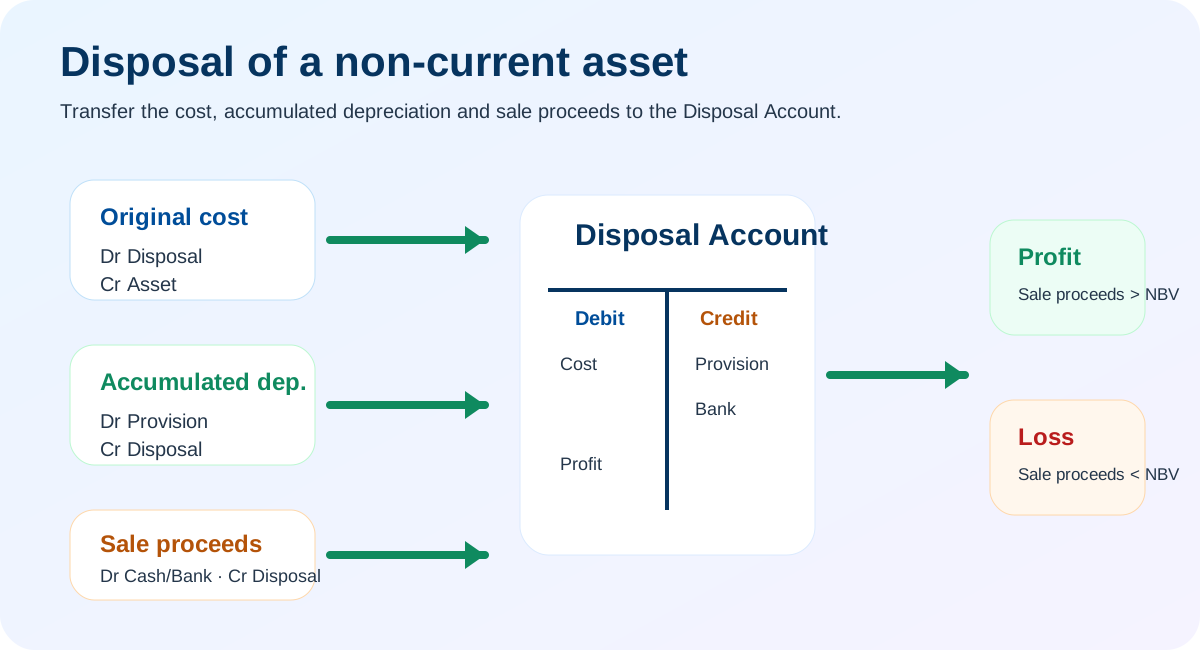
When a non-current asset is sold, the cost, accumulated depreciation and sale proceeds are transferred to a Disposal Account.
14. Disposal of a Non-Current Asset
When a non-current asset is sold, three amounts are important:
- original cost
- accumulated depreciation
- sale proceeds
These are transferred to a Disposal Account.
Transfer original cost
Dr Disposal
Cr Asset
Transfer accumulated depreciation
Dr Provision for Depreciation
Cr Disposal
Record money received
Dr Cash/Bank
Cr Disposal
15. Profit or Loss on Disposal
First calculate the asset's net book value.
NBV = Cost − Accumulated Depreciation
Then compare NBV with sale proceeds.
Sale proceeds > NBV → Profit on disposal
Sale proceeds < NBV → Loss on disposal
Example: Profit on Disposal
Machine cost = $10,000
Accumulated depreciation = $6,000
Machine cost = $10,000
Accumulated depreciation = $6,000
NBV$10,000 − $6,000$4,000
Machine sold for $5,000Profit$5,000 − $4,000$1,000 profit
Example: Loss on Disposal
Vehicle cost = $12,000
Accumulated depreciation = $7,000
Vehicle cost = $12,000
Accumulated depreciation = $7,000
NBV$12,000 − $7,000$5,000
Vehicle sold for $3,500Loss$5,000 − $3,500$1,500 loss
Profit or loss on disposal is transferred to the income statement.
16. Simple Disposal Account Example
Asset cost = $10,000
Accumulated depreciation = $6,000
Sold for = $5,000
| Debit | $ | Credit | $ |
|---|---|---|---|
| Asset cost | 10,000 | Provision for depreciation | 6,000 |
| Bank | 5,000 | ||
| Profit on disposal | 1,000 | ||
| Total | 11,000 | Total | 11,000 |
Topic 5: Examination Points and Formula Guide
The final rules help students avoid common mistakes in depreciation and disposal questions.
17. Important Examination Points
Do not confuse:
Depreciation for the year with accumulated depreciation.
Depreciation for the year with accumulated depreciation.
Example
Depreciation each year = $1,000
After 3 years:
Depreciation each year = $1,000
After 3 years:
- Depreciation for Year 3 = $1,000
- Accumulated depreciation = $3,000
Also remember:
- Depreciation is an expense
- It reduces profit
- It reduces the net book value of an asset
- It does not create cash for replacing the asset
- Land will often not be depreciated because it may not lose value in the same way as other assets
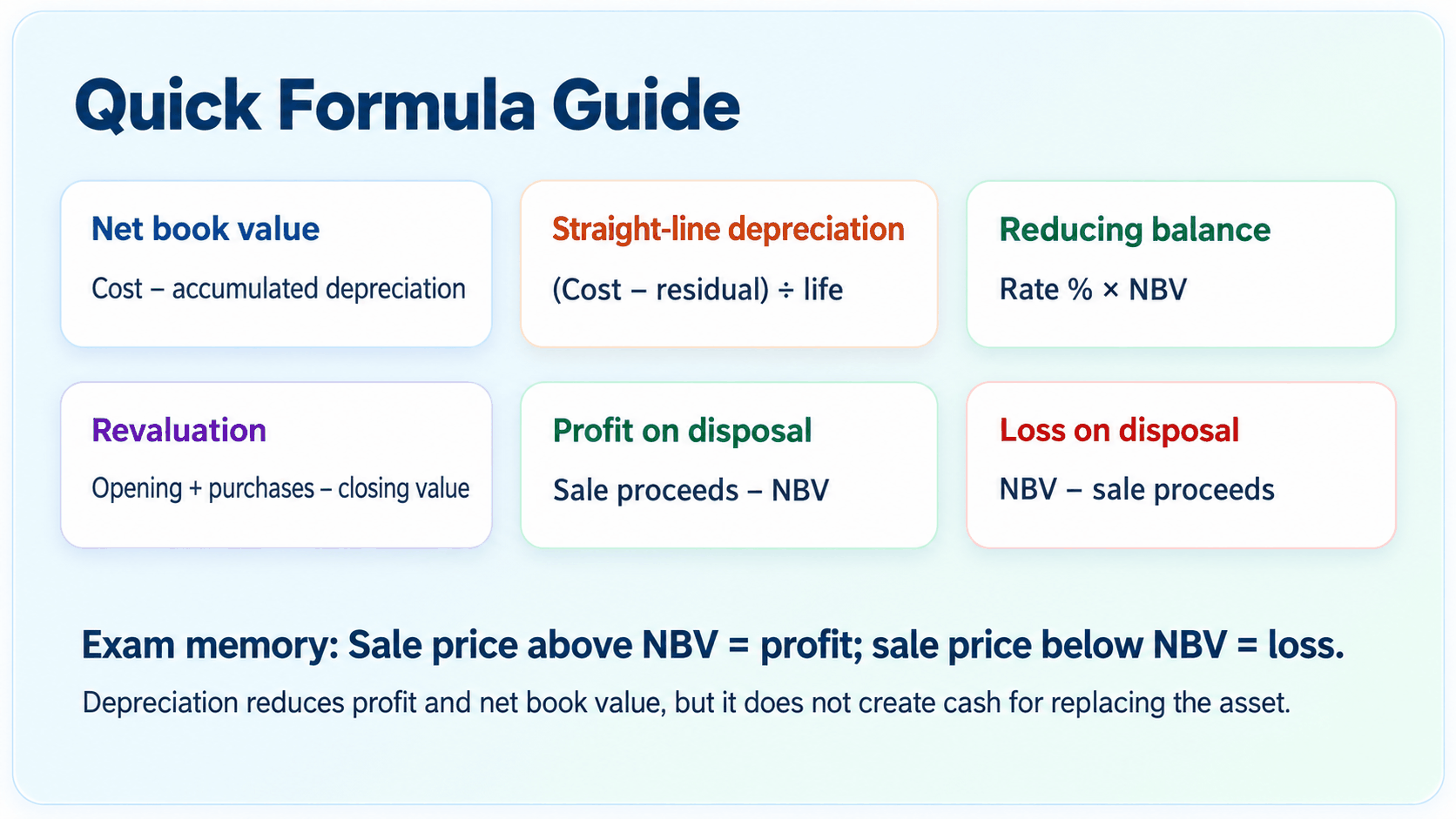
Quick Formula Guide
| Calculation | Formula |
|---|---|
| Net book value | Cost − Accumulated depreciation |
| Straight-line depreciation | (Cost − Residual value) ÷ Useful life |
| Reducing balance | Rate % × Net book value |
| Revaluation depreciation | Opening value + Purchases − Closing value |
| Profit on disposal | Sale proceeds − NBV |
| Loss on disposal | NBV − Sale proceeds |
Remember
Straight-Line
Same depreciation every year.
Reducing Balance
Depreciation gets smaller every year.
Revaluation
Opening value + purchases − closing value.
Disposal
Compare sale proceeds with net book value.
Profit
Sale price above NBV = Profit.
Loss
Sale price below NBV = Loss.