Other Payables and Other Receivables
This chapter explains how year-end adjustments make sure the financial statements include only the expenses and income that belong to the correct financial year. It covers accrued expenses, prepaid expenses, accrued income, prepaid income, other payables, other receivables, profit effects and statement of financial position effects.
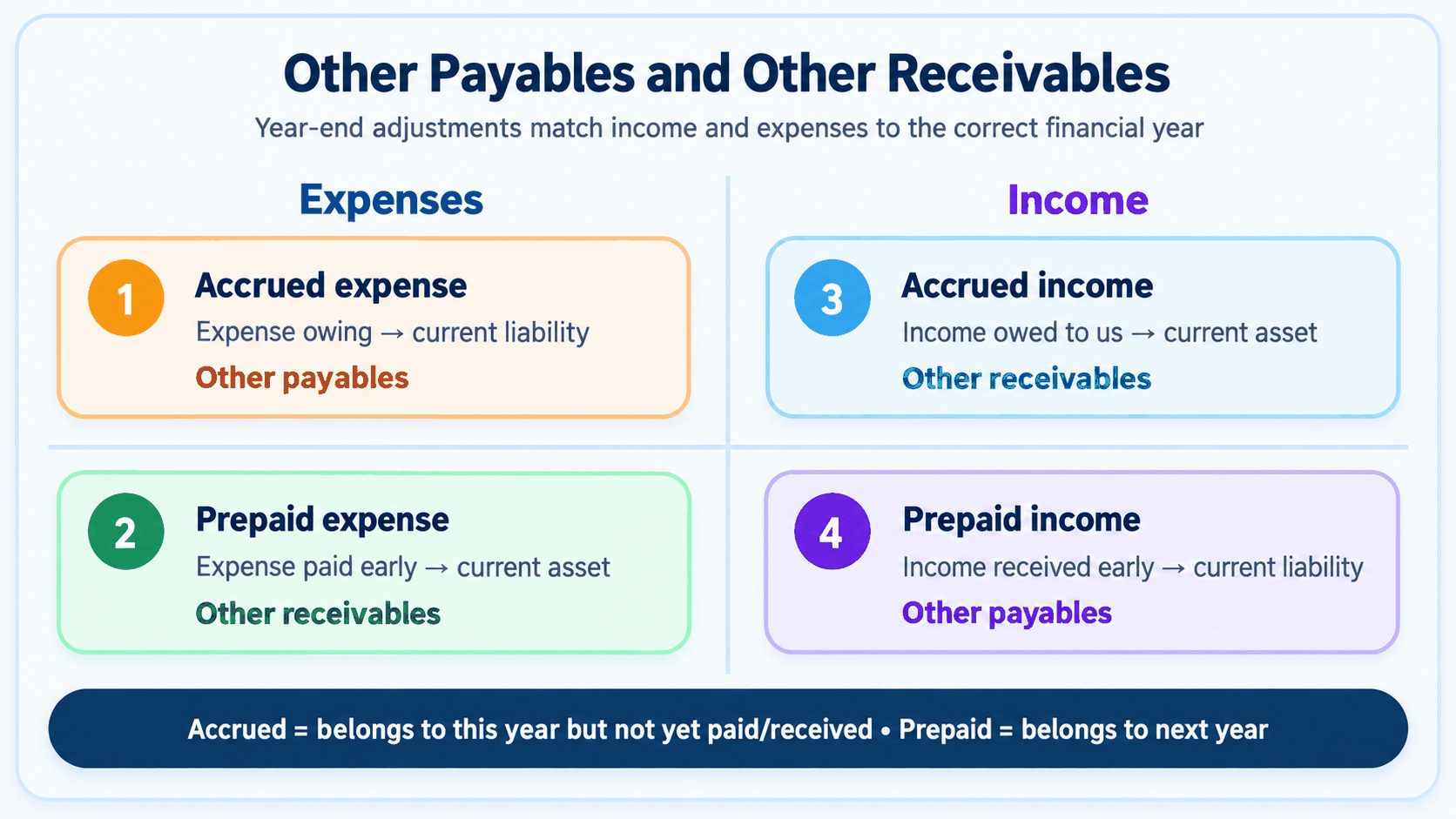
Topic 1: Matching Costs and Revenues
The aim is to match income and expenses to the correct accounting year before profit is calculated.
1. Matching Costs and Revenues
Sometimes:
- expenses are owed but not yet paid
- expenses are paid in advance
- income is earned but not yet received
- income is received in advance
2. The Four Important Adjustments
| Adjustment | Meaning | Statement of Financial Position |
|---|---|---|
| Accrued expense | Expense owing | Current liability |
| Prepaid expense | Expense paid in advance | Current asset |
| Accrued income | Income owing to the business | Current asset |
| Prepaid income | Income received in advance | Current liability |
Topic 2: Expense Adjustments
Expense adjustments decide how much expense belongs to the current year and whether an asset or liability appears in the statement of financial position.
3. Accrued Expense
Rent paid during the year = $10,000
Rent still owing = $2,000
Statement of financial position: Other payables – Rent accrued = $2,000
Effect
Accrued expense:
- increases expenses
- decreases profit
- increases current liabilities
4. Accrued Expense – Double Entry
At the year end:
| Debit | Credit |
|---|---|
| Dr Expense account | Cr Accrued expense / Other payables |
Electricity accrued = $500
| Account | Debit $ | Credit $ |
|---|---|---|
| Electricity | 500 | |
| Other Payables | 500 |
5. Opening Accrual
An accrual at the end of one year becomes an opening accrual in the next year.
Electricity owing at beginning = $100
Paid during year = $1,000
Electricity owing at end = $150
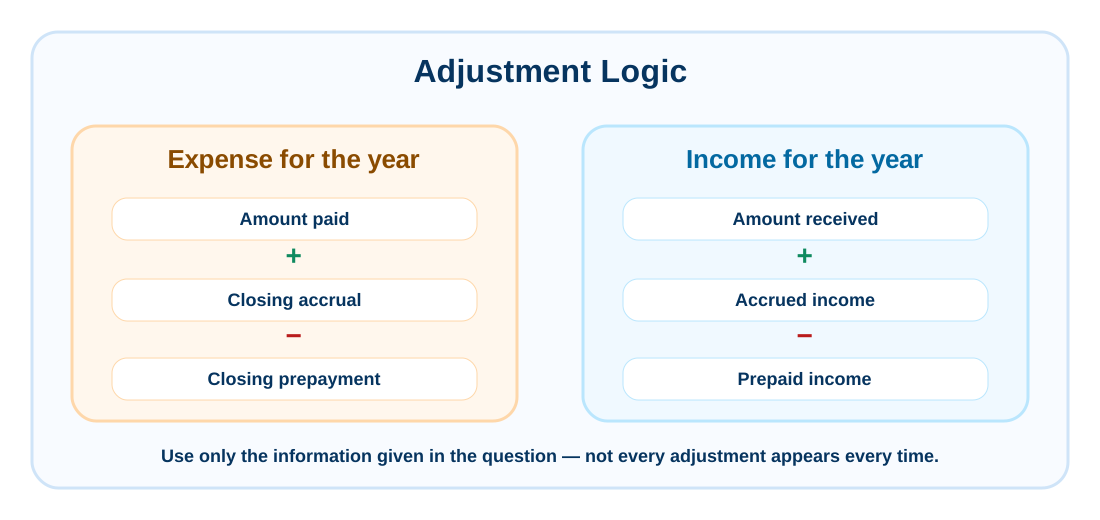
Expense for the year:
Opening accrual + Payments?
A safer formula is:
6. Prepaid Expense
It must therefore be deducted from the current year's expense.
Rent paid = $6,000
Rent prepaid = $500
Statement of financial position: Other receivables – Rent prepaid = $500
Effect
Prepaid expense:
- decreases expenses
- increases profit
- increases current assets
7. Prepaid Expense – Double Entry
At the year end:
| Debit | Credit |
|---|---|
| Dr Prepaid expense / Other receivables | Cr Expense account |
Insurance prepaid = $300
| Account | Debit $ | Credit $ |
|---|---|---|
| Other Receivables | 300 | |
| Insurance | 300 |
8. Expense Formula
Insurance paid = $4,000
Opening prepayment = $300
Closing prepayment = $500
Topic 3: Income Adjustments
Income adjustments decide how much income belongs to the current year and whether an asset or liability should be recorded.
9. Accrued Income
Rent received = $5,000
Rent still owing = $600
Statement of financial position: Other receivables – Rent accrued = $600
Effect
Accrued income:
- increases income
- increases profit
- increases current assets
10. Accrued Income – Double Entry
At the year end:
| Debit | Credit |
|---|---|
| Dr Accrued income / Other receivables | Cr Income account |
Commission owing = $200
| Account | Debit $ | Credit $ |
|---|---|---|
| Other Receivables | 200 | |
| Commission Receivable | 200 |
11. Prepaid Income
It must be deducted from the current year's income.
Commission received = $3,000
Of this, $400 relates to next year.
Statement of financial position: Other payables – Commission prepaid = $400
Effect
Prepaid income:
- decreases income
- decreases profit
- increases current liabilities
12. Prepaid Income – Double Entry
At the year end:
| Debit | Credit |
|---|---|
| Dr Income account | Cr Prepaid income / Other payables |
Rent received in advance = $500
| Account | Debit $ | Credit $ |
|---|---|---|
| Rent Receivable | 500 | |
| Other Payables | 500 |
Topic 4: Effects on Profit and Financial Position
Accruals and prepayments change both profit and the statement of financial position.
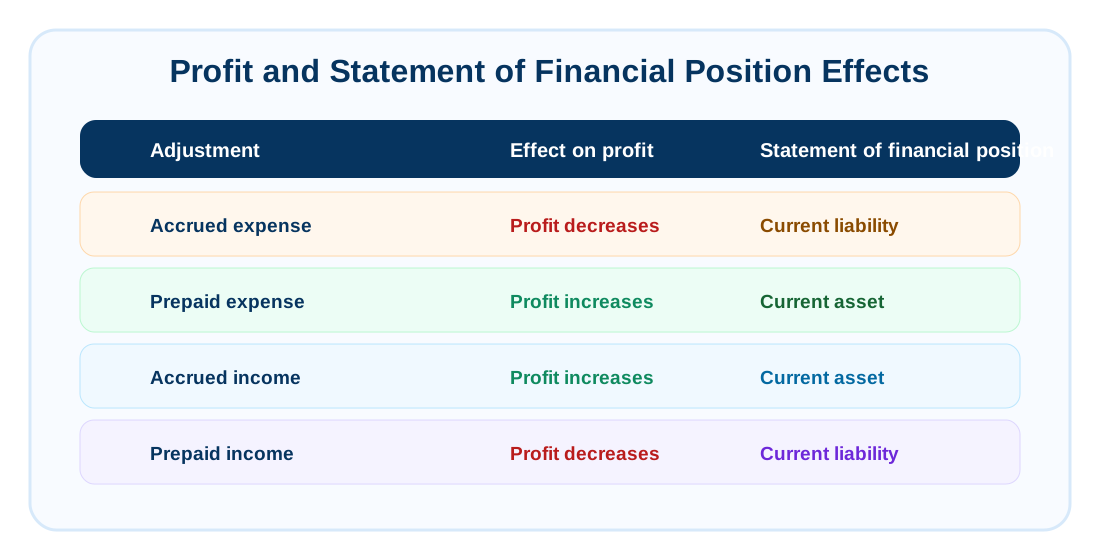
13. Quick Effect on Profit
| Adjustment | Effect on Profit |
|---|---|
| Accrued expense | Profit decreases |
| Prepaid expense | Profit increases |
| Accrued income | Profit increases |
| Prepaid income | Profit decreases |
14. Quick Effect on Statement of Financial Position
| Adjustment | Classification |
|---|---|
| Accrued expense | Current liability – Other payables |
| Prepaid expense | Current asset – Other receivables |
| Accrued income | Current asset – Other receivables |
| Prepaid income | Current liability – Other payables |
15. Example with Several Adjustments
Trial balance shows:
- Rent = $750
- Electricity = $50
- Rates = $140
At year end:
- Rent prepaid = $60
- Electricity accrued = $45
- Rates accrued = $30
Income Statement
Statement of Financial Position
Current asset:
Rent prepaid = $60
Current liabilities:
Electricity $45 + Rates $30 = $75
Topic 5: Stationery, Definitions and Exam Rules
Unused items and final rules help you quickly decide whether to add, subtract, show an asset or show a liability.
16. Stationery Account
Unused stationery at the end of the year is treated similarly to a prepaid expense because its benefit will be received in the next year.
Stationery purchased = $600
Unused stationery at year end = $100
Statement of financial position: Unused stationery = Current asset $100
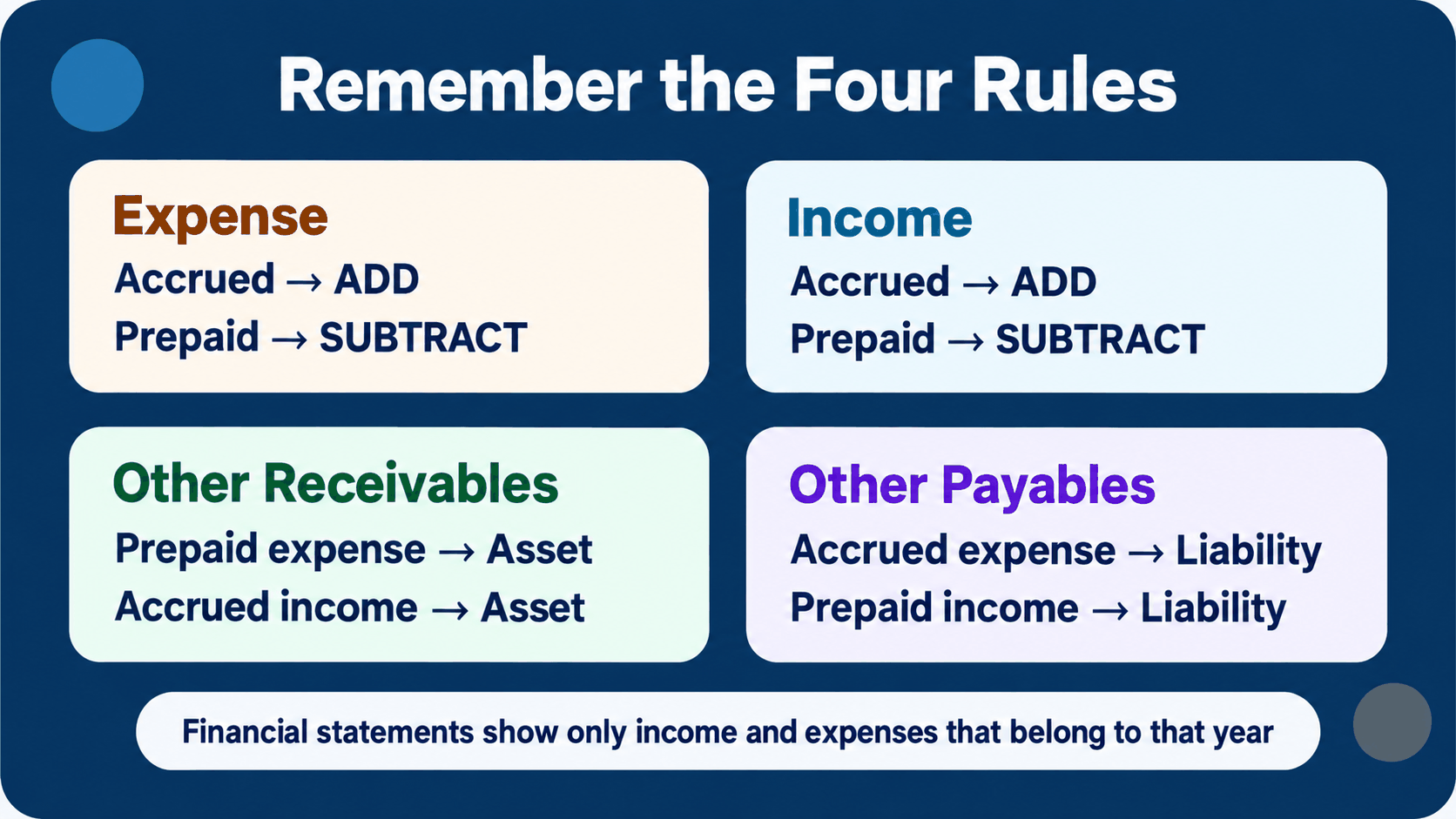
17. Most Important Exam Rules
Accrued expense → ADD
Prepaid expense → SUBTRACT
Accrued income → ADD
Prepaid income → SUBTRACT
Accrued = belongs to this year but not yet paid/received
Prepaid = already paid/received but belongs to next year
Key Terms
Remember
Expense
Accrued → Add
Prepaid → Subtract
Income
Accrued → Add
Prepaid → Subtract
Statement of Financial Position
Accrued expense → Liability
Prepaid expense → Asset
Accrued income → Asset
Prepaid income → Liability