Valuation of Inventory
This chapter explains what inventory means, how closing inventory is valued, how cost and net realisable value are compared, how inventory affects cost of sales, and how inventory errors affect profit, assets and the following year.
Topic 1: What Inventory Means
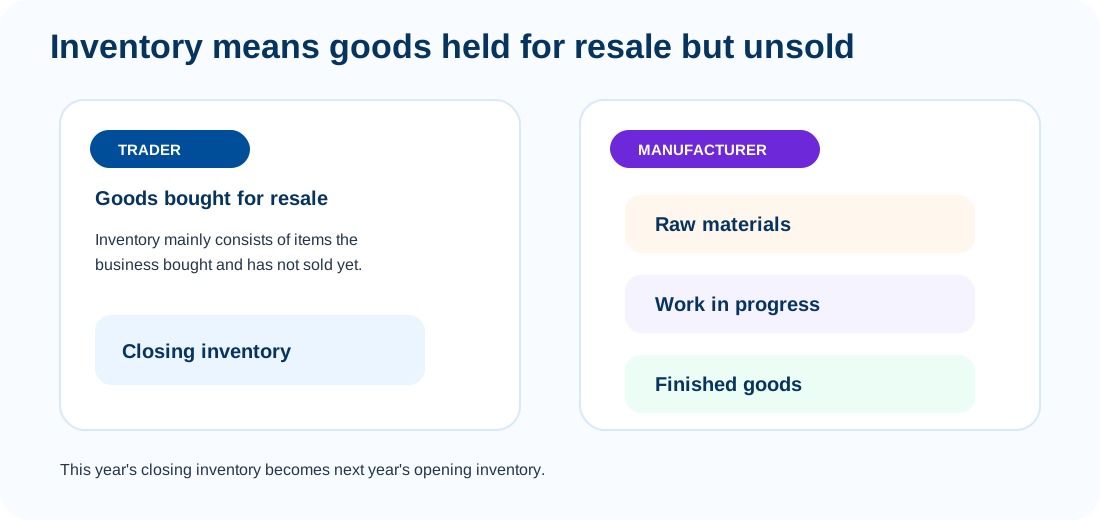
Inventory is goods held for resale that remain unsold at the end of the accounting period.
1. What is Inventory?
For a trader, inventory mainly consists of goods bought for resale.
For a manufacturer, inventory may include:
| Type | Meaning |
|---|---|
| Raw materials | Materials not yet used in production. |
| Work in progress | Goods partly completed. |
| Finished goods | Completed goods not yet sold. |
Topic 2: Lower of Cost and Net Realisable Value
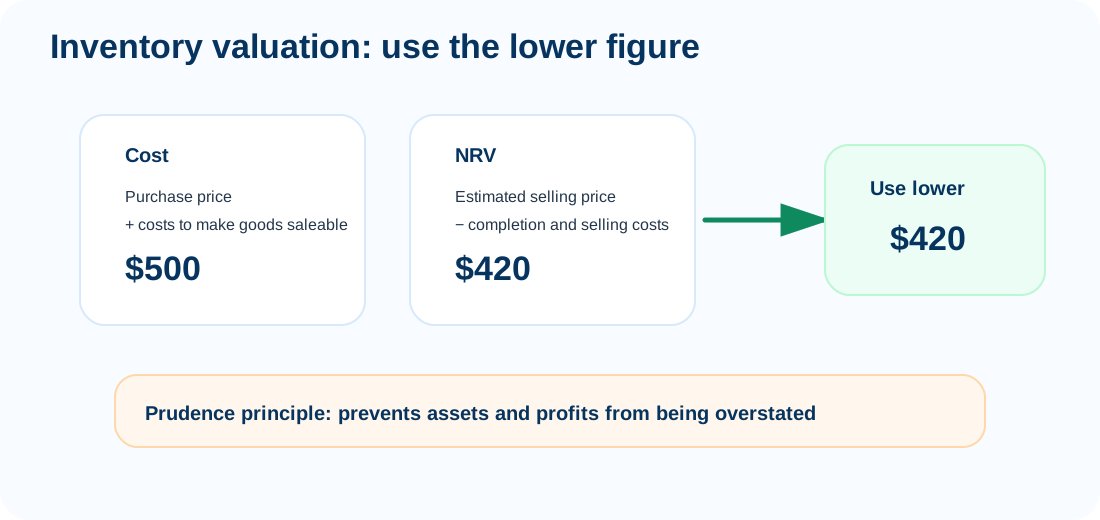
Inventory must be valued at the lower of cost and net realisable value, item by item.
2. How Should Inventory Be Valued?
This follows the prudence principle, which prevents assets and profits from being overstated.
Example 1
Cost of inventory = $500
NRV = $650
Example 2
Cost = $500
NRV = $420
3. What is Cost of Inventory?
The cost of inventory includes the purchase price plus costs necessary to bring the goods into a saleable condition.
| Included in Cost | Example |
|---|---|
| Purchase price | Cost of goods |
| Carriage inwards | Transport to bring goods to the business |
| Import duties | Duties paid when importing goods |
| Packaging and handling | Necessary costs to prepare goods |
Goods purchased = $5,000
Carriage inwards = $300
Import duty = $200
4. Net Realisable Value
Damaged goods can be sold for $700, but repairs costing $150 are required before they can be sold.
Cost = $800
NRV = $550
Therefore, inventory value = $550 because NRV is lower.
5. Why Might NRV Fall Below Cost?
NRV can fall below cost when goods become:
6. Each Inventory Item Must Be Valued Separately
| Item | Cost $ | NRV $ | Value Used $ |
|---|---|---|---|
| A | 500 | 560 | 500 |
| B | 400 | 230 | 230 |
| C | 240 | 170 | 170 |
| Total inventory | 900 | ||
Topic 3: Inventory and Cost of Sales
Closing inventory is deducted when calculating cost of sales, so valuation errors directly affect profit.
7. Cost of Sales and Closing Inventory
Closing inventory is used when calculating cost of sales.
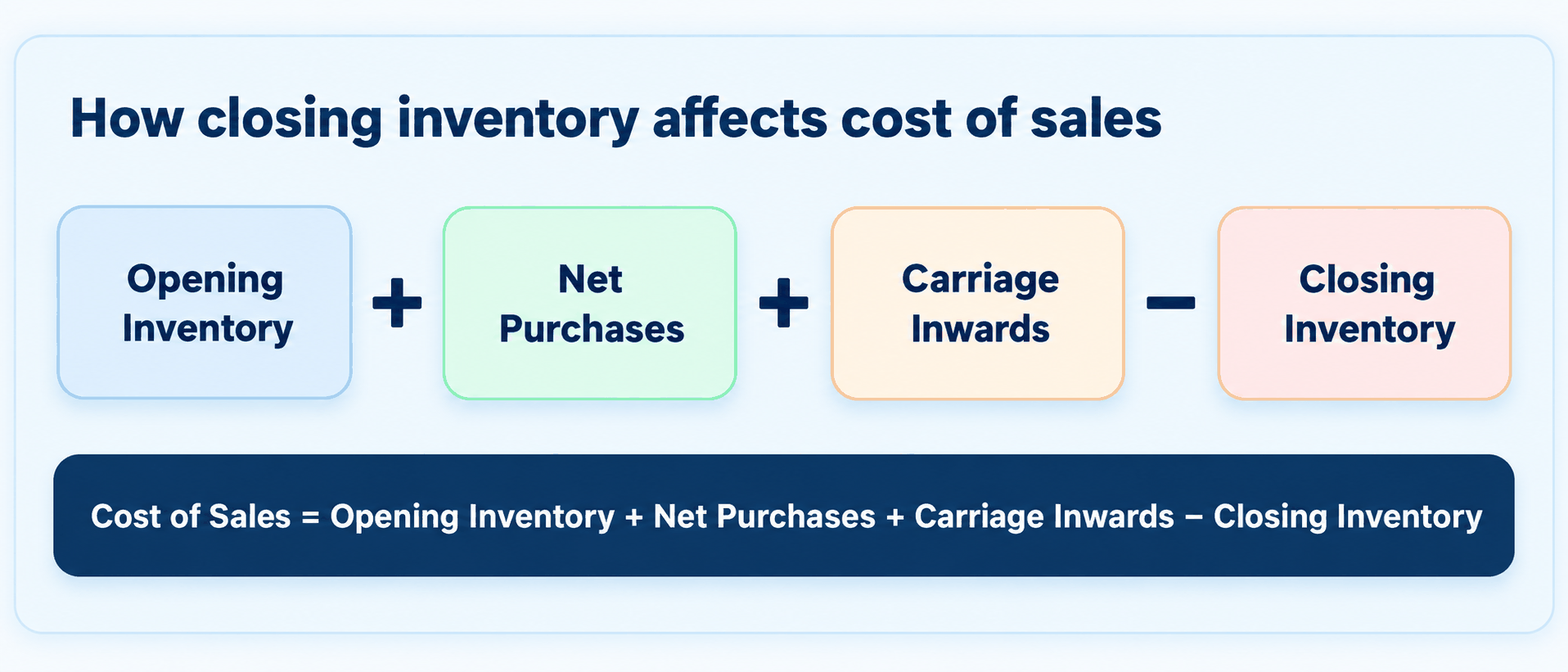
Opening inventory = $5,000
Purchases = $30,000
Carriage inwards = $1,000
Closing inventory = $6,000
8. Effect of Overvaluing Closing Inventory
Suppose actual closing inventory is $4,000, but it is incorrectly recorded as $5,000.
| Item | Effect |
|---|---|
| Cost of sales | Understated |
| Gross profit | Overstated |
| Profit for the year | Overstated |
| Current assets | Overstated |
| Total assets | Overstated |
| Owner's equity | Overstated |
Correct: Sales = $20,000, Cost of sales = $15,000, Gross profit = $5,000.
If closing inventory is overvalued by $1,000, cost of sales may incorrectly fall to $14,000. Incorrect gross profit = $20,000 − $14,000 = $6,000. Gross profit is therefore overstated by $1,000.
9. Effect of Undervaluing Closing Inventory
If closing inventory is valued too low, the opposite happens.
| Item | Effect |
|---|---|
| Cost of sales | Overstated |
| Gross profit | Understated |
| Profit for the year | Understated |
| Current assets | Understated |
| Total assets | Understated |
| Owner's equity | Understated |
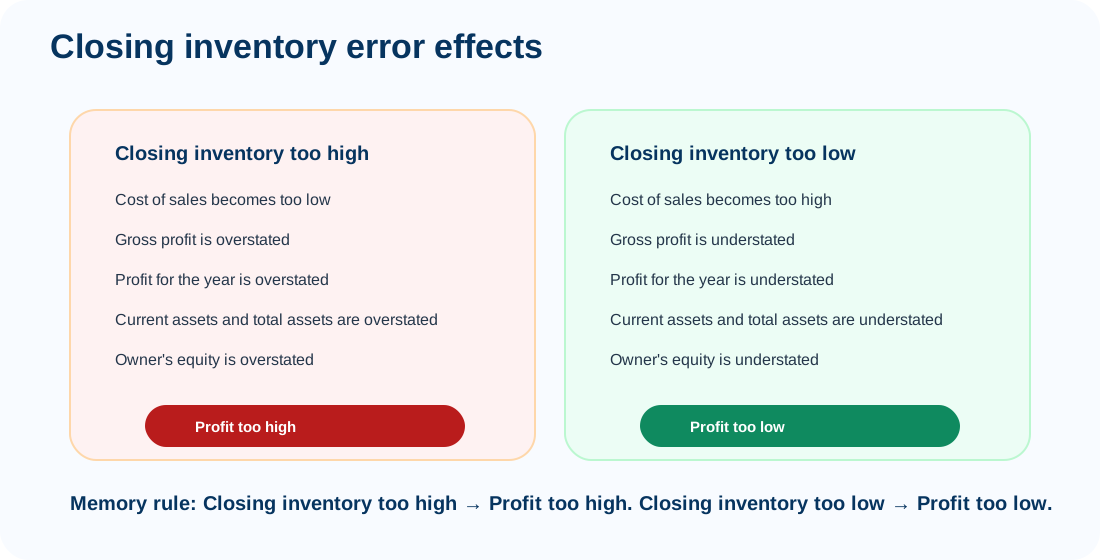
Closing inventory too low → Profit too low
Topic 4: Following Year Effects and Exam Application
An error in closing inventory affects two accounting years because it becomes the next year's opening inventory.
10. Effect on the Following Year
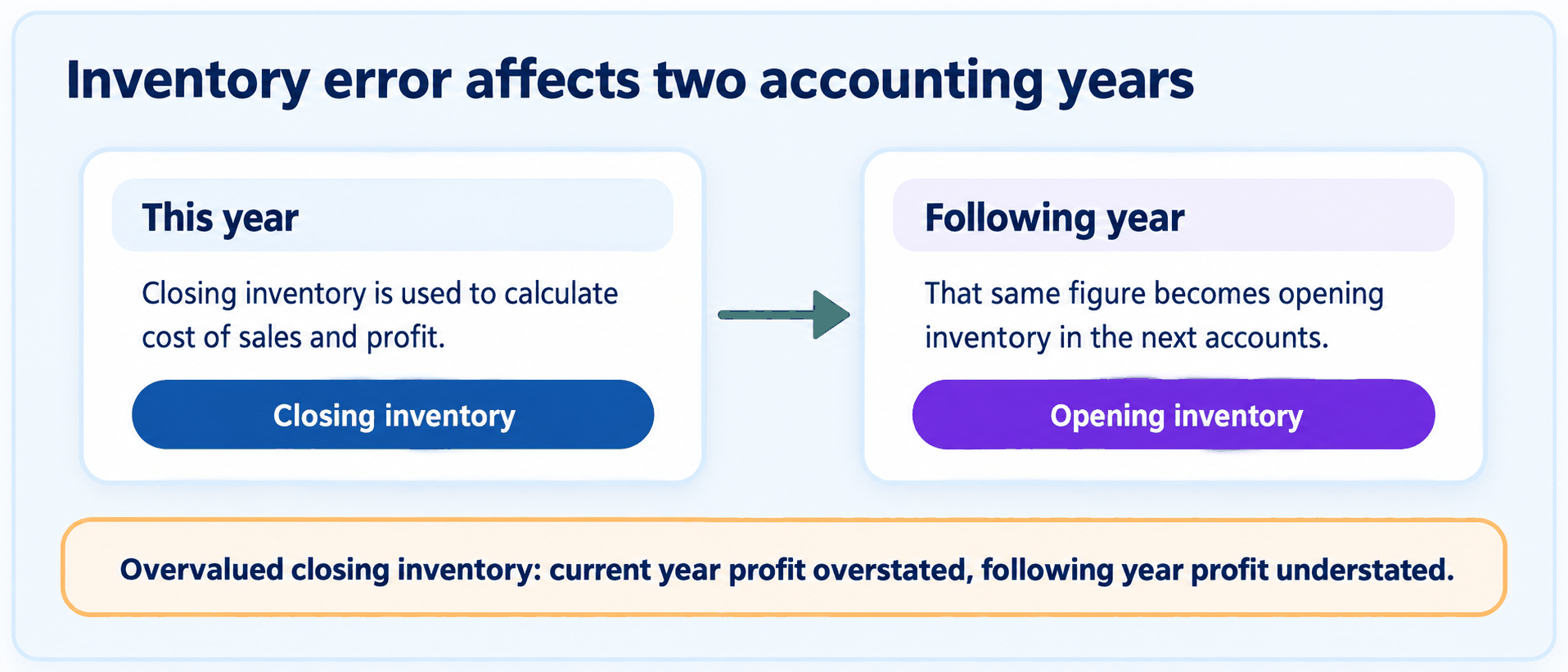
If Closing Inventory Was Overvalued
This year: Profit is overstated.
Next year: opening inventory is also overvalued. Opening inventory is added to cost of sales, so cost of sales becomes too high and next year's profit becomes understated.
If Closing Inventory Was Undervalued
This year: Profit is understated.
Next year: opening inventory is understated. Therefore, cost of sales becomes too low and next year's profit becomes overstated.
11. Quick Exam Table
| Error in Closing Inventory | Current Year's Profit | Following Year's Profit |
|---|---|---|
| Overvalued | Overstated | Understated |
| Undervalued | Understated | Overstated |
12. Full Numerical Example
Product A
A shop has 100 units of Product A.
Cost per unit = $20
Selling price per unit = $25
Selling costs per unit = $3
Compare: Cost = $20, NRV = $22. Use $20.
Product B
Product B has 50 units.
Cost = $18 each
Selling price = $17 each
Selling costs = $2 each
Compare: Cost = $18, NRV = $15. Use $15.
13. NRV and NBV are Different
Do not confuse these two terms:
NRV — Net Realisable Value
Used mainly for inventory.
Selling price − costs needed to complete/sell.
NBV — Net Book Value
Used for non-current assets.
Cost − accumulated depreciation.
Key Terms
Remember
Undervalued closing inventory → Profit understated
Undervalued opening inventory → Profit overstated