Identify objectives
Explain why governments pursue price stability, low unemployment and economic growth, and recognise that these aims can interact.

Governments use macroeconomic policy to influence economy-wide performance. This chapter links the objectives of price stability, low unemployment and economic growth to the three main policy approaches: fiscal policy, monetary policy and supply-side policy.
Explain why governments pursue price stability, low unemployment and economic growth, and recognise that these aims can interact.
Use government spending, taxation and borrowing to explain budget positions and expansionary or contractionary effects on aggregate demand.
Trace how interest rates, the money supply and credit conditions can influence consumption, investment, aggregate demand and inflation.
Explain how education, infrastructure, R&D, subsidies and labour-market reforms can raise productive capacity over the longer run.
The chapter concentrates on three central macroeconomic objectives. They are closely connected because the performance of one part of the economy can affect the others.
High and unpredictable inflation makes planning difficult and can discourage productive investment. Stable prices therefore help to create a more predictable environment for firms and households.
High unemployment means labour resources are underused and real output is below potential. It also creates costs for individuals and the government.
Growth expands the resources available to society and can raise living standards. It may be regarded as a fundamental objective because investment and productive capacity are central to long-run improvements in wellbeing.
| Policy | Main tools | Primary route | Typical purpose |
|---|---|---|---|
| Fiscal policy | Government expenditure, taxation and borrowing | Changes aggregate demand through the government budget | Stabilise real GDP and influence demand |
| Monetary policy | Interest rates, money supply and credit regulation | Changes consumption, investment and other components of aggregate demand | Often used to maintain price stability |
| Supply-side policy | Education, training, infrastructure, incentives, R&D and market reforms | Changes the quantity or productivity of factors of production | Raise long-run productive capacity and economic growth |
Fiscal policy refers to government decisions about expenditure, taxation and borrowing. Because government spending is a component of aggregate demand and taxation affects disposable income and spending, the government budget can influence the level of aggregate demand.
Government expenditure exceeds government revenue.
Government revenue exceeds government expenditure.
Government expenditure equals government revenue.
The accumulated stock of government debt arising from past borrowing, after allowing for past surpluses.
If expenditure is greater than revenue, the deficit must be financed. Continued borrowing contributes to the national debt. A high debt can create future interest-payment obligations and may restrict a government's ability to finance other expenditure. The significance of debt depends partly on its size relative to national income and the cost of borrowing.
| Type | Meaning | Distributional point |
|---|---|---|
| Direct tax | Levied directly on income or earnings. | Income tax is commonly designed to be progressive. |
| Indirect tax | Levied on expenditure on goods and services. | Can be regressive when lower-income households spend a larger share of income on taxed items. |
| Progressive tax | The tax burden rises proportionately as income rises. | Can contribute to redistribution toward lower-income groups. |
| Regressive tax | Bears proportionately more heavily on lower-income households. | Some expenditure taxes have this effect. |
| Proportional tax | The same percentage rate of income is paid at all income levels. | Neither progressive nor regressive in proportional terms. |
Spending on goods and services for current use, including wages of public employees, health and education, as well as transfer payments.
Government spending on investment projects intended to benefit the economy in the future, such as transport or communication infrastructure.
Increase government expenditure and/or reduce taxes. The budget deficit rises or the surplus falls, shifting aggregate demand to the right. It may be used when real GDP is below full employment.
Reduce government expenditure and/or raise taxes. The budget deficit falls or the surplus rises, shifting aggregate demand to the left. It may be used when demand is excessive and inflationary pressure is strong.
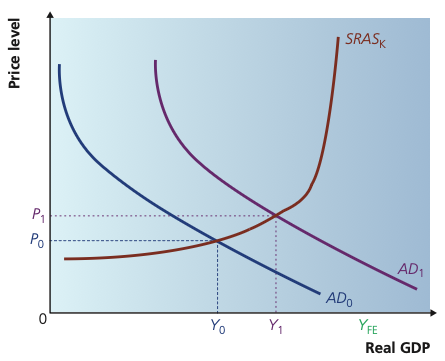
The economy begins below full employment at Y₀. Expansionary fiscal policy shifts AD right from AD₀ to AD₁, raising real GDP toward YFE. With spare capacity, the increase in output can be relatively large compared with the rise in the price level.
Adapted from Cambridge International AS & A Level Economics, Second Edition, by Peter Smith (with Adam Wilby and Mila Zasheva).
If the economy is well below full employment, expansionary fiscal policy can raise output substantially. If the economy is already close to capacity, much of the effect may appear as a higher price level instead.
Monetary policy uses monetary variables to influence aggregate demand. The principal tools identified in the chapter are the interest rate, money supply and credit regulation. Exchange-rate movements can also affect the transmission of monetary policy.
If inflationary pressure is excessive, a higher interest rate can reduce aggregate demand. Firms may undertake less investment because borrowing costs rise and fewer projects remain worthwhile. Households may save more and consume less. Weaker expected demand can further discourage investment.
Higher interest rates can reduce current investment. Because investment adds to productive capacity, prolonged weakness in investment can slow the future rightward movement of long-run aggregate supply.
When real GDP is below full employment, lower interest rates can encourage borrowing, consumption and investment, shifting AD to the right. This can raise real output when spare capacity exists, but if the economy is already close to full employment it may mainly increase the price level.
When conventional interest rates are already very low, central banks may use changes in the money supply. The chapter notes the use of quantitative easing following the financial crisis of the late 2000s as an alternative way to support an economy in recession. It also emphasises that financial regulation matters because the flow of credit must be sufficiently secure and appropriate for the economy.
Under inflation targeting, a central bank is given operational independence to set interest rates with the aim of meeting a government-set inflation target. This is intended to strengthen policy credibility by separating day-to-day interest-rate decisions from short-term political pressures.
Policy makers do not look only at current inflation. They consider financial markets, international conditions, money and credit, demand and output, labour-market conditions, costs and prices. Because the transmission process takes time, monetary policy must be forward-looking.
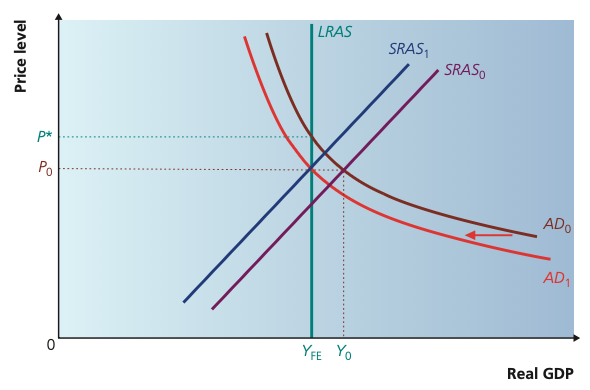
When output is temporarily above full employment at Y₀, a higher interest rate can reduce consumption and investment so that AD shifts left from AD₀ to AD₁. The economy returns to YFE and avoids the higher long-run price level P*.
Adapted from Cambridge International AS & A Level Economics, Second Edition, by Peter Smith (with Adam Wilby and Mila Zasheva).
Supply-side policies are intended to increase the economy's potential capacity output by raising the quantity of factor inputs or improving the efficiency with which those inputs are used. Their central goal is therefore a rightward shift of long-run aggregate supply (LRAS).
Many supply-side measures work slowly. Education, training, infrastructure and R&D can require years before productivity or capacity improves measurably.
Education and skills training raise human capital and labour productivity. Retraining is especially important where structural change requires workers to move from declining sectors into expanding ones. Government intervention may be needed because firms can be reluctant to finance training if trained workers may later be hired by competitors.
Efficient transport, communication and other infrastructure can reduce business costs and improve the effectiveness of markets. Because some infrastructure has public-good characteristics, the market may not provide enough of it without government intervention.
Subsidies may encourage firms to invest in disadvantaged regions or help workers move toward areas where jobs are available. Better information about vacancies can also improve labour mobility. These policies aim to reduce mismatches between labour supply and labour demand.
R&D can produce technological progress, allowing firms to use resources more efficiently. Governments can support it directly or through tax incentives, although such support has an opportunity cost because public funds could be used elsewhere.
A flexible labour market allows workers and firms to adjust more readily to changing patterns of demand. Policies may seek to reduce barriers to occupational or geographical mobility and to reduce practices that prevent productivity-improving changes. The textbook also notes arguments for limiting trade-union power or altering minimum-wage arrangements, while stressing the need to balance flexibility against protection for workers.
Very high marginal tax rates may weaken incentives to supply additional labour or effort. Similarly, benefit systems can affect decisions about labour-force participation. Supply-side reform may therefore adjust taxes and benefits to strengthen work incentives, but this must be balanced against redistribution and protection for households unable to find work.
| Supply-side measure | How it may raise LRAS | Important limitation |
|---|---|---|
| Education & training | Raises human capital and labour productivity | Long time lag; benefits depend on quality and relevance |
| Infrastructure | Reduces costs and improves market efficiency | High fiscal cost and competing spending priorities |
| Regional subsidies / information | Improves labour and capital mobility | May divert activity from other regions rather than create new activity |
| R&D support | Encourages innovation and technological progress | Returns are uncertain and may take years |
| Labour-market reforms | Improves flexibility and resource reallocation | Can conflict with worker protection or equity aims |
| Tax / benefit reform | Changes incentives to work, invest and participate | Must balance incentives against redistribution and social protection |
20 questions. Each answer is marked immediately with a short explanation of why it is correct or incorrect.