Calculate advantage
Use opportunity cost to distinguish absolute advantage from comparative advantage and identify the basis for specialisation.

International trade allows countries to specialise, exchange goods and services and widen consumption possibilities. This chapter explains why trade can create gains, why those gains are not always distributed evenly, and why governments sometimes restrict trade to protect domestic producers.
Use opportunity cost to distinguish absolute advantage from comparative advantage and identify the basis for specialisation.
Show how specialisation and exchange can allow consumption beyond a country's own production possibility curve.
Calculate a terms-of-trade index and explain why changes in relative export and import prices matter.
Analyse tariffs, quotas, embargoes, export subsidies and non-tariff barriers, including their effects on consumers, producers and welfare.
Countries trade because they differ in resources, climate, skills, technology and productive efficiency. Trade can widen consumer choice, open new markets for producers and allow countries to specialise in activities in which their relative efficiency is greatest.
The ability to produce a good more efficiently than another producer, for example by using fewer resources or less labour time.
The ability to produce a good at a lower opportunity cost than another producer.
Suppose Country A can produce either 40 units of wheat or 20 machines, while Country B can produce either 30 units of wheat or 30 machines.
Absolute advantage is not the deciding test. The key question is which country has the lower opportunity cost.
Without trade, a country is limited to consumption combinations on or inside its own PPC. With specialisation and mutually beneficial exchange, its consumption possibilities can extend beyond its domestic PPC.
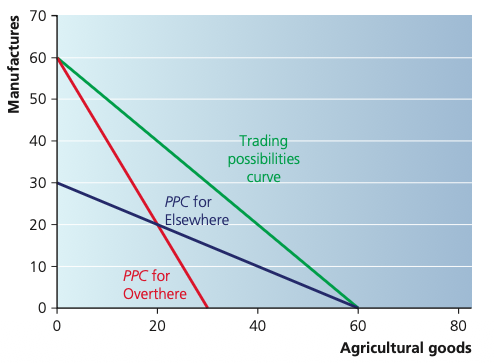
The two countries have different opportunity costs, shown by the slopes of their PPCs. After specialising according to comparative advantage and trading at a mutually beneficial exchange ratio, consumption can take place beyond each country's own production possibility curve.
Adapted from Cambridge International AS & A Level Economics, Second Edition, by Peter Smith (with Adam Wilby and Mila Zasheva).
For both countries to gain, the rate of exchange must lie between their opportunity-cost ratios. The exact exchange ratio determines how the gains from trade are shared.
| Potential benefit | Why it may occur |
|---|---|
| Greater total output | Resources are concentrated where opportunity cost is relatively low. |
| Greater consumer choice | Imports make goods and services available that may not be produced domestically. |
| Access to larger markets | Exporters can sell beyond the domestic economy and may exploit economies of scale. |
| Competitive pressure | Exposure to foreign competition can encourage firms to improve quality and efficiency. |
Specialisation also creates risks. A country may become dependent on imports of strategically important goods, or overdependent on a small range of exports whose world prices can change sharply.
The gains from trade depend partly on the prices at which exports exchange for imports. The terms of trade compare export prices with import prices.
If the export price index is 126 and the import price index is 120:
Terms of trade = 126 ÷ 120 × 100 = 105.
Relative to the base period, the terms of trade have improved. The same volume of exports can purchase a greater volume of imports than before.
Export prices rise relative to import prices. A given volume of exports can purchase more imports.
Import prices rise relative to export prices. A given volume of exports can purchase fewer imports.
The textbook also distinguishes the net barter terms of trade from the income terms of trade. The net barter measure uses relative prices only. The income terms of trade also reflect the value or volume of exports and therefore give a broader indication of the purchasing power of export earnings.
The basic theory shows potential gains, but actual trading conditions are more complicated. The pattern of comparative advantage can be influenced by a country's relative factor endowments. A labour-abundant economy may initially have an advantage in labour-intensive production, while a capital-abundant economy may be better placed in capital-intensive production.
Agricultural supply can change substantially because of weather and harvest conditions, while demand for many food products is relatively price inelastic. Small supply changes can therefore cause large price movements. For minerals and raw materials, demand may fluctuate with the economic cycle in importing economies. In both cases, export prices and export earnings can be unstable.
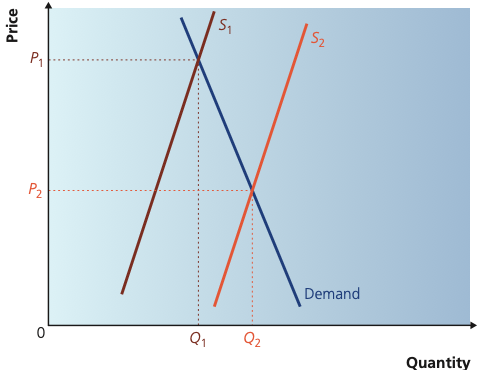
A poor harvest shifts supply left and can cause a large rise in the world price of a primary product when demand is relatively price inelastic. A good harvest does the reverse. This helps explain unstable export prices for countries dependent on agricultural commodities.
Adapted from Cambridge International AS & A Level Economics, Second Edition, by Peter Smith (with Adam Wilby and Mila Zasheva).
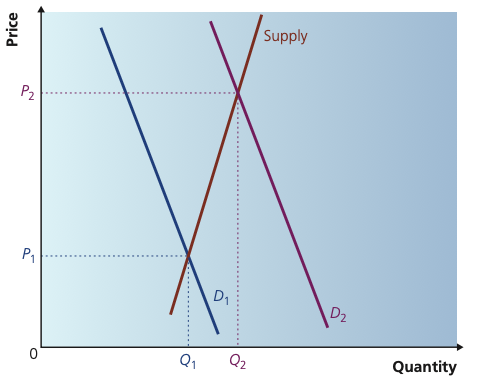
For minerals and raw materials, supply can be relatively stable while demand changes with the economic cycle in importing countries. Stronger demand raises both equilibrium price and quantity, while weaker demand can sharply reduce export prices and earnings.
Adapted from Cambridge International AS & A Level Economics, Second Edition, by Peter Smith (with Adam Wilby and Mila Zasheva).
If a country depends heavily on commodity exports, unstable prices make export earnings uncertain and can make development planning more difficult.
Demand for many primary products may grow relatively slowly as world incomes rise. Demand for agricultural goods often has a low income elasticity, while artificial substitutes and more efficient technology can weaken demand for some raw materials. If supply also expands, relative prices may fall over time.
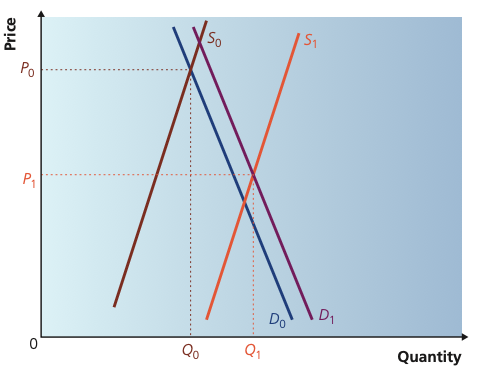
If supply of primary products expands faster than demand over time, the equilibrium price can fall even while output rises. For a country dependent on these exports, this can contribute to a long-run deterioration in its terms of trade.
Adapted from Cambridge International AS & A Level Economics, Second Edition, by Peter Smith (with Adam Wilby and Mila Zasheva).
Small exporting economies may have little power over prices set in world commodity markets and may compete against experienced producers from high-income economies. This can weaken their ability to capture the gains from trade. Countries may therefore seek to diversify and develop new specialisms rather than remain dependent on a narrow range of primary exports.
Protectionism means measures taken by a country to restrict international trade and shelter domestic producers from foreign competition. Governments may protect industries even though free trade can offer lower prices, wider choice, larger markets and stronger competitive pressure.
With free trade, an imported good may be available at the world price. A tariff raises the domestic price above the world price. Domestic demand falls, domestic supply rises and the quantity imported falls.
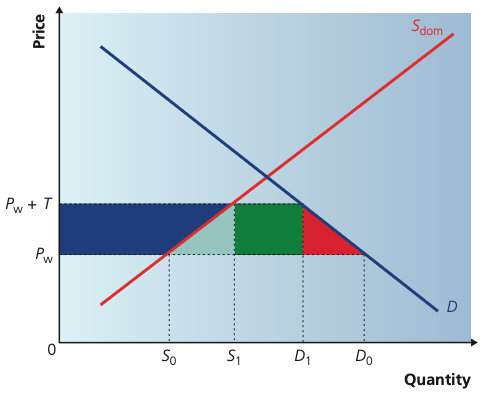
A tariff raises the domestic price above the world price. Domestic production expands, domestic consumption contracts and imports fall. Domestic producers and the government gain some surplus or revenue, but consumers lose and the two welfare-loss triangles represent an overall efficiency cost to society.
Adapted from Cambridge International AS & A Level Economics, Second Edition, by Peter Smith (with Adam Wilby and Mila Zasheva).
| Group | Likely effect of a tariff |
|---|---|
| Consumers | Pay a higher price, consume less and lose consumer surplus. |
| Domestic producers | Receive a higher price, sell more and gain producer surplus. |
| Government | Receives tariff revenue. |
| Society | Faces a net welfare loss because some mutually beneficial trade is prevented and inefficient domestic production is encouraged. |
Tariffs may also delay structural change and weaken incentives for protected firms to improve efficiency. Retaliation by trading partners can lead to a trade war in which the gains from trade are reduced for all sides.
A quota reduces total supply available in the domestic market, pushes the domestic price above the unrestricted world price and reduces consumption. Domestic producers gain from the higher price. Unlike a tariff, however, the importing government does not automatically receive tariff revenue; the benefit created by the higher price on the permitted imports may accrue to foreign exporters.
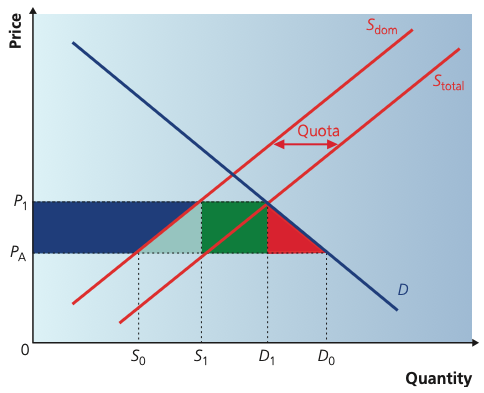
A quota restricts the quantity of imports and raises the domestic market price. Domestic producers expand output and consumers buy less. Unlike a tariff, the extra return on the permitted imports can accrue to foreign exporters rather than to the home government.
Adapted from Cambridge International AS & A Level Economics, Second Edition, by Peter Smith (with Adam Wilby and Mila Zasheva).
An embargo prohibits trade in specified goods or with specified countries. It may be imposed because a product is considered undesirable or as part of political sanctions. A possible side effect is the encouragement of smuggling or other unofficial trade.
A government may subsidise domestic producers so that they can expand output and compete more effectively with imports or in export markets. Domestic production rises and imports can fall, while consumers may still buy at the world price.
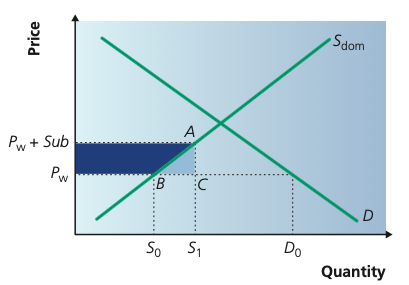
A subsidy encourages domestic producers to expand output while consumers can still buy at the world price. Imports fall, but the subsidy must be financed by the government and can support production that would otherwise be uncompetitive.
Adapted from Cambridge International AS & A Level Economics, Second Edition, by Peter Smith (with Adam Wilby and Mila Zasheva).
Some regulations have legitimate purposes, such as protecting health or the environment. Others may function mainly as trade restrictions. Complex standards and administrative requirements can be particularly difficult for producers in less developed countries to meet.
A country may want to preserve sectors considered essential for national security or self-sufficiency, such as food production.
Protection may be argued for where foreign firms sell at unfairly low prices, perhaps because they benefit from export subsidies.
Temporary protection may reduce disruption and unemployment while workers move out of industries in long-term decline.
New industries may be protected temporarily while they gain experience, improve efficiency and become able to compete internationally.
| Area | Possible effect | Evaluation |
|---|---|---|
| Consumers | Higher prices, lower consumption and less choice | Consumer surplus generally falls. |
| Domestic producers | Higher sales and producer surplus | Protection may weaken efficiency incentives. |
| Government | Tariff revenue may rise; imports may fall | Other policies such as subsidies impose fiscal costs. |
| Balance of payments | Lower imports may improve the trade position | The effect depends on responses of domestic supply, demand and trading partners. |
| Living standards | Protection can preserve some jobs or strategic capacity | Higher prices and welfare losses can lower overall wellbeing. |
| Income distribution | Resources are redistributed toward protected producers | Consumers finance part of the gain through higher prices. |
20 questions. Each answer is marked immediately with a short explanation of why it is correct or incorrect.