IGCSE360.com

Chapter 13 – The Balance of Payments and Exchange Rates

← Chapter 12AS & A Level Economics contentsChapter 14 →
AS Level · Part 6 · International economic issues

The Balance of Payments and Exchange Rates

Open economies trade goods, services and assets with the rest of the world. This chapter explains how those transactions are recorded, why current-account imbalances arise, how floating exchange rates are determined, and how exchange-rate movements interact with aggregate demand and macroeconomic policy.

Balance of paymentsCurrent accountFloating exchange rateAppreciation & depreciationForex demand & supplyMacroeconomic policy

What this chapter prepares you to do

Read the accounts

Classify credit and debit items and distinguish the current, capital and financial accounts, reserve assets and the balancing item.

Calculate the CAB

Combine trade in goods and services with primary and secondary income to calculate and interpret a current account balance.

Analyse exchange rates

Use demand and supply of currency to explain floating exchange rates, appreciation, depreciation and the forces that shift the market.

Link policy and trade

Explain how fiscal, monetary, supply-side and protectionist policies can affect competitiveness and the current account.

High-grade habit: always state the currency quotation and trace the chain of causation. For example: higher domestic interest rates → financial inflow → higher demand for the currency → appreciation → exports dearer and imports cheaper → net exports tend to fall.

Chapter sections

13.1

The balance of payments

The balance of payments is a set of accounts recording transactions between residents of a country and the rest of the world. Each transaction produces a currency flow: money flowing into the country is recorded as a credit, while money flowing out is a debit.

Credit item

A transaction causing a payment into the country, such as an export.

Debit item

A transaction causing a payment out of the country, such as an import.

Why the overall balance of payments balancesEvery international transaction has to be financed in some way. When all accounts, reserve transactions and the balancing item are included, total credits and debits sum to zero even though individual accounts may show surpluses or deficits.
Easy book example — credit versus debit: If a Malaysian car is exported, payment flows into Malaysia, so it is a credit. If Malaysian residents buy pineapples imported from Thailand, payment flows out of Malaysia, so it is a debit. The direction of the money flow determines the entry.

The main accounts

Current account

Trade in goods and services, primary income and secondary income.

Capital account

Transactions in physical capital between residents of a country and the rest of the world.

Financial account

Transactions in financial assets between residents and the rest of the world.

Reserve assets

Foreign currencies, gold and other foreign assets held by the central bank; these can help meet mismatches in currency demand and supply.

Balancing item: because international transactions cannot all be recorded perfectly, an errors and omissions item is used so that the accounts balance overall.

The current account

The current account contains three broad components. The balance on each component may be positive or negative, and together they form the current account balance (CAB).

Book-aligned calculation — Pakistan: Using the textbook’s 2018 figures, exports of goods and services were $30.1bn (24.8 + 5.3), while imports were $67.8bn (57.4 + 10.4). The balance on trade in goods and services was therefore −$37.7bn. Adding primary income of about −$5.5bn and secondary income of +$24.1bn gives an overall current-account balance of about −$19.1bn. This shows why the current account is broader than the trade balance alone.
ComponentWhat it recordsTypical examples
Trade in goods and servicesExports minus imports of goods and servicesManufactured goods, tourism, transport, banking and insurance services
Primary incomeNet income earned from employment and investments across bordersCompensation of employees, interest, profits and dividends
Secondary incomeCurrent transfers where no good or service is received in returnWorkers' remittances, bilateral aid, grants and some social transfers
Useful terminology: trade in physical goods is often called visible trade, while trade in services is called invisible trade. Both are included when calculating the balance of trade in goods and services.
Exam warning: the balance of trade is only exports minus imports of goods and services. The current account balance is broader because it also includes primary and secondary income.
Worked example — current account balance:

Suppose a country records exports of goods 80, imports of goods 100, exports of services 35, imports of services 25, primary income −8 and secondary income +12 (all in $bn).

  • Trade in goods = 80 − 100 = −20
  • Trade in services = 35 − 25 = +10
  • Trade in goods and services = −20 + 10 = −10
  • CAB = −10 − 8 + 12 = −6

The country therefore has a current account deficit of $6bn.

Why current-account imbalances arise

Structural and competitiveness factors

  • Changes in the structure of production, such as movement from manufacturing toward services.
  • Weak productivity or poor product quality can reduce exports.
  • Relatively high domestic inflation raises the price of home-produced goods compared with foreign goods.
  • Weak international competitiveness tends to reduce net exports.

Income and growth factors

  • Rapid domestic growth can raise demand for imports.
  • Foreign growth can increase demand for the country's exports.
  • A cyclical deficit may occur during a domestic boom; a structural deficit reflects deeper long-term weaknesses.

Consequences and financing of a deficit

A current account deficit must be matched by an offsetting surplus elsewhere in the balance of payments. In the short run this can happen through borrowing from abroad, selling domestic financial assets to foreign residents, attracting foreign investment or using reserve assets.

Current account deficitMore current-account debits than credits
→
Offset requiredCapital/financial-account surplus or reserve use
→
Long-run concernMore foreign ownership, future income outflows or rising financing pressure
Evaluation: a deficit is not automatically a crisis. The cause, size, duration and method of financing matter. A temporary deficit caused by strong investment may be less concerning than a persistent deficit caused by deteriorating competitiveness.
13.2

Exchange rates

Exchange rateThe price of one currency in terms of another currency.

An exchange rate affects the domestic-currency price of imports and the foreign-currency price of exports. Whenever an international transaction is made, foreign exchange is required.

Demand and supply of a currency

What creates demand?

Foreign residents demand the domestic currency when they want to buy the country's goods, services or assets. Demand for a currency is therefore a derived demand.

What creates supply?

Domestic residents supply their currency when they need foreign currency to buy foreign goods, services or assets.

Quotation matters: when a currency's quoted price rises, it has appreciated in that quotation. Always identify which currency is on the vertical axis before interpreting a graph.

Floating exchange rates

In a floating exchange rate system, market demand and supply determine the exchange rate. A rise in the market value of a currency is an appreciation; a fall is a depreciation.

Appreciation

Domestic currency becomes more valuable. Imports become cheaper in domestic currency while exports become more expensive to overseas buyers, ceteris paribus.

Depreciation

Domestic currency becomes less valuable. Imports become more expensive while exports become cheaper to overseas buyers, ceteris paribus.

Worked example — currency conversion:

If the exchange rate is €0.80 per US$1, then €60 is worth:

US$ = €60 ÷ 0.80 = US$75.

Write the quotation first. This avoids multiplying when you should divide.

Easy exchange-rate example: If demand for Malaysian exports rises, overseas buyers need more ringgits to pay Malaysian firms. Demand for ringgits therefore shifts to the right and the ringgit tends to appreciate. If Malaysians instead buy more US goods and assets, more ringgits are supplied in the foreign-exchange market and the ringgit tends to depreciate.

Causes of exchange-rate changes

Relative inflation

If domestic prices rise faster than foreign prices, domestic goods become less competitive. Demand for exports and the currency may fall, putting downward pressure on the exchange rate.

Trade balance

Higher export demand raises demand for the currency; stronger import demand raises its supply. These shifts can change the exchange rate.

Net foreign investment

Greater foreign direct investment or other investment into the economy raises demand for the currency and may cause appreciation.

Speculation

Expectations about future currency values can cause large short-run financial flows and move the exchange rate away from longer-run fundamentals.

Relative interest rates

Higher domestic interest rates may attract financial capital from abroad, increasing currency demand and producing appreciation.

Monetary policy

Because interest-rate decisions affect capital flows, the exchange rate forms part of the monetary transmission mechanism.
Extension — purchasing power parity: the purchasing power parity idea predicts that, over the long run, nominal exchange rates tend to adjust to offset differences in inflation between countries.

A shift in currency demand

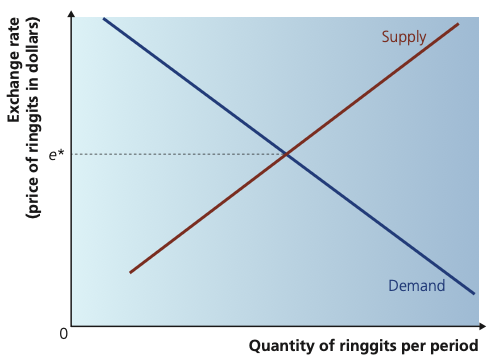
The market for ringgits

Supply and demand for ringgits showing equilibrium exchange rate e*

The vertical axis gives the US dollar price of ringgits. Demand for ringgits comes from people wanting Malaysian goods, services or assets, while supply comes from holders of ringgits wanting foreign goods, services or assets. The floating exchange rate settles at e*, where the quantity of ringgits demanded equals the quantity supplied.

Adapted from Cambridge International AS & A Level Economics, Second Edition, by Peter Smith (with Adam Wilby and Mila Zasheva).

Typical causes

  • Foreigners demand more exports.
  • Foreign investors buy more domestic assets.
  • Domestic interest rates rise relative to foreign interest rates.
  • Expectations turn favourable toward the currency.

The reverse forces can shift demand left or increase currency supply, producing depreciation.
Exchange rates and AD/AS

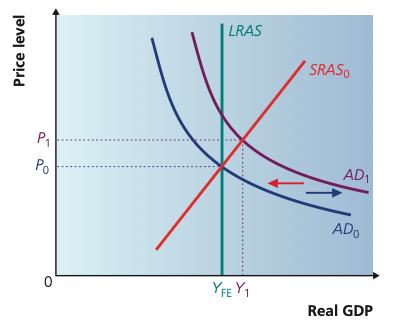
An increase in exports with a floating exchange rate

AD shifting left from AD1 to AD0 against SRAS0 and vertical LRAS at YFE

An increase in exports initially shifts aggregate demand to the right from AD₀ to AD₁, raising real GDP and the price level in the short run. Under a floating exchange rate, stronger export demand also increases demand for the currency, causing appreciation. This makes exports less price-competitive and imports cheaper, so part of the original increase in aggregate demand can be reversed.

Adapted from Cambridge International AS & A Level Economics, Second Edition, by Peter Smith (with Adam Wilby and Mila Zasheva).

But the exchange rate reacts

Higher export demand also raises demand for the domestic currency, causing appreciation. That appreciation makes exports dearer and imports cheaper, so part of the original rise in net exports may be reversed.

Key feedback effect: under floating rates, exchange-rate movements can partly stabilise changes in net exports and aggregate demand.
13.3

Macroeconomic policy and the current account

Under floating exchange rates the overall balance of payments adjusts through market forces, but a persistent imbalance in the current account can still be important. Governments therefore monitor whether deficits or surpluses are cyclical, temporary or structural.

Why persistent imbalances matter

Evaluation point: a current-account deficit is not automatically evidence that an economy is failing. The important questions are why the deficit exists, how it is financed, and whether it is sustainable. A temporary deficit caused by strong investment may have different implications from a long-running deficit caused by weak productivity and competitiveness.

Persistent deficit

  • Must be financed by financial/capital inflows or reserve use.
  • May increase foreign ownership of domestic assets.
  • Can create future outflows of investment income.
  • If foreign investors lose confidence, higher interest rates may be needed to attract finance.

Persistent surplus

  • May reflect weak domestic consumption relative to production.
  • Can create international political pressure if trading partners view the currency as undervalued.
  • Is not necessarily sustainable indefinitely.

Competitiveness at the centre

The quantity of exports depends partly on foreign income and on the competitiveness of domestic products. Imports depend partly on domestic income and the relative attractiveness of domestic and foreign goods. A structural current-account deficit can therefore arise from an overvalued currency, relatively high domestic prices or weak productivity.

How policy affects the current account

PolicyLikely transmission to the current accountEvaluation
Expansionary fiscal policyHigher G or lower taxes raise AD and incomes; imports tend to rise. Inflationary pressure may also reduce competitiveness, so the current account may deteriorate.The size of the effect depends on spare capacity, import propensity and the exchange-rate response.
Tighter monetary policyHigher interest rates may attract financial inflows and appreciate the currency. Exports become dearer and imports cheaper, tending to reduce net exports.Higher rates also reduce consumption and investment, which can reduce import demand; the final effect is therefore not purely one-directional.
Supply-side policyHigher productivity and lower unit costs improve competitiveness, tending to raise exports and reduce import penetration.Benefits often take time and depend on whether productivity actually improves.
ProtectionismTariffs or other restrictions may reduce imports in the short run.Protection can weaken efficiency, invite retaliation and sacrifice gains from trade, so long-run effects may be adverse.
Diagnose the imbalanceCyclical or structural?
→
Identify the causeIncome, prices, productivity, exchange rate or policy?
→
Select policyDemand management, supply-side reform or trade measure
→
EvaluateTime lags, side-effects, retaliation and sustainability
Exam warning: do not say that a current account deficit means the whole balance of payments is in deficit. The balance of payments balances overall; the deficit is in one component and must be offset elsewhere.

Chapter 13 revision checklist

Define the balance of payments.
Distinguish credit and debit items.
Name the current, capital and financial accounts.
Explain reserve assets and the balancing item.
Identify the three main current-account components.
Distinguish trade in goods and services from primary and secondary income.
Calculate a current account balance.
Explain why the overall balance of payments balances.
Explain causes of current-account deficits and surpluses.
Distinguish cyclical from structural imbalances.
Explain how a current-account deficit may be financed.
Define an exchange rate.
Explain derived demand for a currency.
Draw and interpret a floating foreign-exchange market.
Distinguish appreciation from depreciation.
Explain the effects of exchange-rate changes on export and import prices.
Explain how inflation, trade, investment, speculation and interest rates affect exchange rates.
Use AD/AS to analyse exchange-rate changes.
Explain why competitiveness matters for the current account.
Evaluate fiscal, monetary, supply-side and protectionist policies in relation to the current account.

20 questions. Each answer is marked immediately with a short explanation of why it is correct or incorrect.

← Chapter 12AS & A Level Economics contentsChapter 14 →