Analyse monopolistic competition
Explain product differentiation, entry, short-run supernormal profit and long-run normal profit.

Real markets often lie between perfect competition and monopoly. This chapter explains how differentiated products, strategic interdependence, entry conditions and potential competition shape the behaviour and performance of firms.
Explain product differentiation, entry, short-run supernormal profit and long-run normal profit.
Use strategic interdependence, non-price competition and game theory to explain firm behaviour.
Assess whether the threat of hit-and-run entry can constrain incumbent firms.
Calculate and interpret n-firm concentration ratios while recognising their limitations.
Monopolistic competition describes a market with many firms selling products that are close substitutes but are differentiated. Each firm therefore has a small degree of monopoly power over its own version of the product while still facing substantial competition.
Because products are differentiated, a firm can alter its own price without losing every customer. Its demand curve is therefore downward sloping.
Firms distinguish products through branding, design, quality, location, service or advertising. This can create brand loyalty and some price-setting power.
New firms can usually enter when existing firms make supernormal profit. This entry is central to the long-run outcome.
There are enough sellers that the action of one firm usually has little direct effect on any single rival.
No firm is powerful enough to dictate how the whole market operates.
Consumers can switch between rival differentiated products, so demand is typically more elastic than under monopoly.
A profit-maximising firm chooses output where MR = MC, then reads the corresponding price from its downward-sloping demand/AR curve. In the short run it may earn supernormal profit, normal profit or make a loss depending on the position of demand relative to costs.
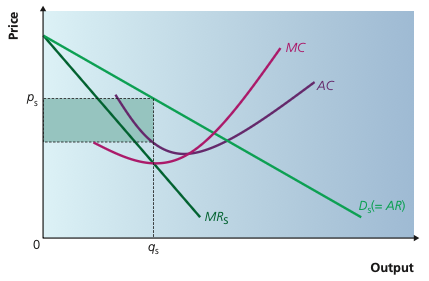
The representative firm chooses qₛ where MR = MC and then charges pₛ from its downward-sloping demand curve. Because pₛ is above average cost at that output, the firm earns supernormal profit in the short run.
Adapted from Cambridge International AS & A Level Economics, Second Edition, by Peter Smith (with Adam Wilby and Mila Zasheva).
Supernormal profit attracts entrants because barriers are low. New differentiated products take some customers from existing firms, shifting each existing firm's demand curve to the left and often making it more elastic because consumers have more alternatives. Entry continues until the representative firm's demand curve is tangent to its average cost curve at the profit-maximising output.
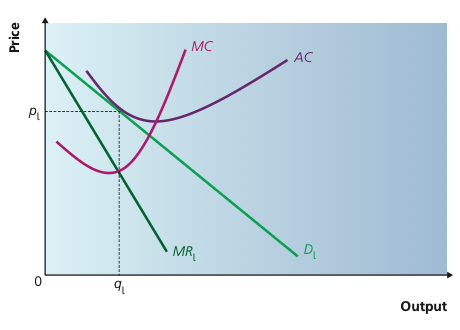
Entry of new differentiated products reduces each incumbent firm’s demand until its AR curve is tangent to AC. The firm still chooses output where MR = MC, but AR = AC at that point, so only normal profit remains in long-run equilibrium.
Adapted from Cambridge International AS & A Level Economics, Second Edition, by Peter Smith (with Adam Wilby and Mila Zasheva).
Not achieved in long-run equilibrium because the firm produces to the left of minimum AC. It has excess capacity: output could be higher at a lower average cost.
Not achieved because price exceeds marginal cost at the profit-maximising output.
Advertising and continual differentiation can raise average costs. Some resources may be used mainly to protect brand loyalty rather than lower production cost.
Consumers gain variety and choice. Competitive pressure among many firms can also reduce the risk of X-inefficiency and encourage quality improvements.
An oligopoly is a market dominated by a few firms. Its defining feature is strategic interdependence: when one firm changes price, output, advertising or product design, rivals may respond, so each firm must consider likely reactions before acting.
A small number of sellers account for a large share of market output.
One firm's decisions can materially change rivals' sales and profits, so behaviour is strategic.
Economies of scale, brand loyalty, technology, high capital requirements or strategic behaviour can make entry difficult.
Oligopoly often emerges where economies of scale are significant enough that only a limited number of firms can operate efficiently, but not so extensive that the market becomes a natural monopoly.
Oligopolists may compete aggressively or cooperate. Strong rivalry can move the outcome closer to the competitive end of the market-structure spectrum. Cooperation or collusion can move it towards the monopoly end by allowing firms to restrict output and raise joint profits.
Non-price competition occurs when firms compete without directly cutting the headline price. Common methods include advertising, branding, design, quality improvements, loyalty schemes, packaging, customer service and product innovation.
A price cut can trigger retaliation and a price war. Non-price methods may win customers while preserving the market price.
Consumers may gain better quality, innovation and choice, although intensive advertising and differentiation can increase firms' costs.
Game theory models situations where each firm's payoff depends on both its own choice and the choices of rivals. It is especially useful in oligopoly because firms are interdependent.
Suppose two firms can choose a high or low price. Each cell shows the profit of Firm A first and Firm B second, in millions.
| Firm A \ Firm B | High price | Low price |
|---|---|---|
| High price | A: 8 · B: 8 | A: 1 · B: 12 |
| Low price | A: 12 · B: 1 | A: 4 · B: 4 |
For Firm A, low price gives the higher profit whether B chooses high or low. The same is true for Firm B. Both therefore choose low, producing 4 + 4 = 8 total profit even though joint profit would have been 16 if both had chosen high.
A strategic problem in which individually rational choices can produce a worse joint outcome than cooperation would have produced.
A strategy that gives a player the best payoff regardless of what the other player chooses.
A combination of strategies in which each player's choice is best given the other player's choice, so neither has an incentive to change unilaterally.
| Possible benefits when rivalry is strong | Possible problems when firms cooperate or competition is weak |
|---|---|
| Competitive prices and pressure to control costs | Higher prices and restricted output |
| Innovation, product development and non-price competition | Collusion can create monopoly-like welfare losses |
| Potential economies of scale | Barriers to entry can protect long-run supernormal profit |
| Choice between differentiated products | Possible X-inefficiency when rivalry is weak |
A monopsony is a market with a single buyer. A powerful buyer may be able to influence the price and conditions offered to suppliers. The idea is particularly important in some input and labour markets.
The theory of contestable markets focuses on potential competition. Even a market with only one incumbent firm may behave competitively if entry and exit are sufficiently easy for credible rivals to enter whenever supernormal profit appears.
Potential entrants must be able to enter and leave rapidly without being blocked by legal, structural or strategic obstacles.
Costs incurred on entry must be recoverable on exit. Otherwise a short-lived entry attempt could be too risky.
Entrants must be able to operate with comparable costs rather than facing a built-in disadvantage.
Potential entrants need access to the same or equivalent production technology.
Hit-and-run entry means entering to capture short-run supernormal profit and then leaving again if conditions deteriorate. The threat of such entry can persuade an incumbent to keep price close to average cost and avoid obvious X-inefficiency.
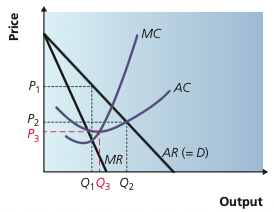
If an incumbent charges a price that creates supernormal profit, a potential entrant may enter briefly and take some of that profit. The threat of such hit-and-run entry can force the incumbent to keep price closer to average cost, provided entry and exit are genuinely easy and sunk costs are negligible.
Adapted from Cambridge International AS & A Level Economics, Second Edition, by Peter Smith (with Adam Wilby and Mila Zasheva).
No. The threat of entry can reduce supernormal profit and managerial slack, but a firm charging price equal to average cost need not be at minimum average cost, and price need not equal marginal cost. Productive and allocative efficiency therefore are not automatically achieved.
Online search, price comparison and digital selling can lower information and entry costs in some markets. This can make it easier for new firms to reach customers and increase competitive pressure on incumbents. The effect depends on whether significant sunk costs, network advantages, regulation or other barriers remain.
Market concentration describes how much of a market is accounted for by the largest firms. A common measure is the n-firm concentration ratio: the combined market share of the largest n firms.
Suppose the largest five firms have market shares of 31%, 24%, 15%, 9% and 7%.
3-firm concentration ratio = 31 + 24 + 15 = 70%
5-firm concentration ratio = 31 + 24 + 15 + 9 + 7 = 86%
This indicates substantial concentration, but the ratio alone does not tell us how strongly the largest firm dominates or how aggressively the firms compete.
A concentration figure can change sharply depending on whether the market is defined narrowly or broadly by product, geography or customer group.
A 75% five-firm ratio could mean one firm has 60% and four firms share 15%, or five firms each have 15%. Strategic behaviour would likely differ.
Employment shares can differ from sales/output shares when large firms use more capital-intensive production.
A highly concentrated market may still be strongly competitive if firms rival each other or the market is contestable.
A market can be concentrated without one firm being individually dominant. Market dominance refers to a firm holding enough market power to influence market conditions to a significant degree. When interpreting concentration data, examine the leading firm's share as well as the combined share of the largest firms, and then consider entry barriers and the behaviour of rivals.
The size of minimum efficient scale (MES) relative to total market demand helps determine how many efficient firms the market can support. If MES is small, many firms can coexist. If MES is large, only a few firms can reach low average cost; if scale economies extend across almost the whole market, a natural monopoly may result.
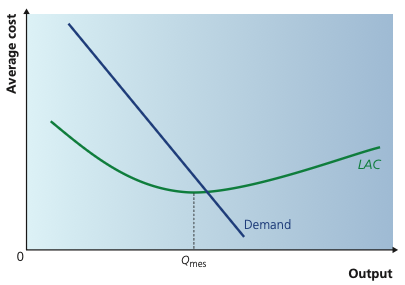
The diagram shows the minimum efficient scale (MES) at Qmes. When MES is large relative to total market demand, only a small number of firms may be able to operate at low average cost, increasing market concentration.
Adapted from Cambridge International AS & A Level Economics, Second Edition, by Peter Smith (with Adam Wilby and Mila Zasheva).
20 questions. Each answer is marked immediately with a short explanation of why it is correct or incorrect.