Classify unemployment
Distinguish equilibrium and disequilibrium unemployment and separate voluntary from involuntary unemployment.

This chapter develops the meaning of full employment, separates equilibrium from disequilibrium unemployment, explains the natural rate and labour-market patterns, and evaluates how mobility and policy affect unemployment.
Distinguish equilibrium and disequilibrium unemployment and separate voluntary from involuntary unemployment.
Explain how real-wage rigidity, an AD shock or an SRAS shock can leave the economy below full employment.
Analyse participation, sectoral employment, the informal economy, part-time work and hidden unemployment.
Match supply-side or demand-side policies to the underlying cause and assess time lags, incentives and inflation risks.
Full employment exists when people who are economically active, willing and able to work at the going wage rates can find employment. It does not mean that the measured unemployment rate is zero.
Even when aggregate output is at its full-employment level, some people will be between jobs, affected by seasonal work, or temporarily have skills that do not match available vacancies. Full employment therefore means that people willing and able to work at going wage rates can find work, not that every worker is employed at every instant.
A dynamic economy always has people moving between jobs, searching for suitable work, facing seasonal changes or temporarily mismatched with vacancies. Some unemployment therefore remains even when the economy is operating at full capacity.
There is no universal percentage that represents full employment. It depends partly on labour-market flexibility, the speed of job matching, institutions and the structure of the economy.
Equilibrium unemployment is unemployment present even when the economy overall is in equilibrium. It includes unemployment that can arise from the normal functioning and changing structure of the economy.
Workers are between jobs or searching for a better match. It is often temporary and can be voluntary.
Employment varies predictably during the year because demand for some occupations is seasonal.
The skills or location of workers do not match available jobs as the pattern of economic activity changes.
New technology changes the skills or number of workers required, leaving some workers unable to match new vacancies.
Disequilibrium unemployment occurs when the economy or a labour market is away from equilibrium. A common mechanism is real-wage inflexibility: wages remain above the level that would clear the labour market.
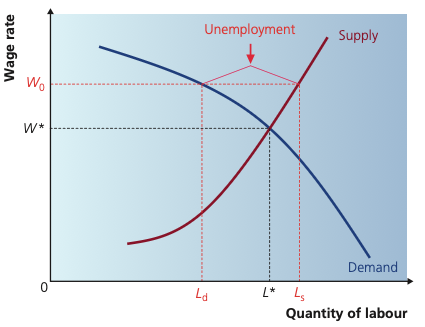
At the free-market equilibrium, wage W* clears the labour market. If the wage is held at W0 above equilibrium, labour supplied Ls exceeds labour demanded Ld; the gap is disequilibrium unemployment.
Adapted from the Cambridge International AS & A Level Economics book by Peter Smith (Second Edition, with Adam Wilby and Mila Zasheva).
If aggregate demand falls, real GDP can drop below the full-employment level. If wages and costs adjust downwards only slowly, unemployment persists. This is demand-deficient unemployment.
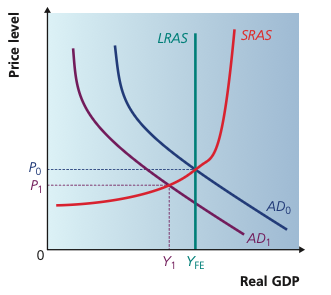
A fall in aggregate demand from AD0 to AD1 reduces real GDP from YFE to Y1. The resulting negative output gap is accompanied by higher unemployment.
Adapted from the Cambridge International AS & A Level Economics book by Peter Smith (Second Edition, with Adam Wilby and Mila Zasheva).
A supply-side shock can also create disequilibrium unemployment. If firms face a sharp increase in costs, SRAS shifts left: real GDP falls below the full-employment level while the price level rises. If wages and costs later adjust downwards, SRAS can move back towards its original position.
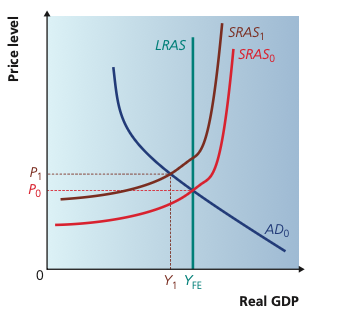
A rise in firms' costs shifts SRAS left from SRAS0 to SRAS1. Real GDP falls from YFE to Y1 while the price level rises, so unemployment and inflation can increase together.
Adapted from the Cambridge International AS & A Level Economics book by Peter Smith (Second Edition, with Adam Wilby and Mila Zasheva).
A worker who voluntarily leaves a job to search for a better one is experiencing frictional, voluntary unemployment. A worker willing to work at the going wage after an AD shock but unable to find a vacancy is experiencing involuntary unemployment. A qualified engineer working as a taxi driver illustrates underemployment, because available human capital is not being fully used.
A negative SRAS shock, such as a major rise in production costs, can also reduce real GDP and employment. If wages are inflexible downwards, the economy may not return quickly to full employment.
Unemployment caused by a downturn may continue even after aggregate demand recovers. Long periods out of work can weaken skills, confidence and employability, and employers may be reluctant to hire the long-term unemployed.
Unemployment rises as real GDP falls below its trend and full-employment level during the recession or slump phase of the business cycle.
An individual chooses not to accept a job at the going wage. Examples include leaving one job to search for a better one or choosing benefits over a low-paid job when the financial gain from employment is small.
An individual is willing and able to work at the going wage but cannot obtain a job. Demand-deficient unemployment is a clear example.
The natural rate of unemployment is the unemployment rate present when the economy is in long-run equilibrium at the full-employment level of real GDP. It mainly reflects frictional, structural and technological influences and can also be affected by regional immobility and incentives.
Policies that reduce the natural rate therefore focus on education, training, job matching, mobility and appropriate tax-and-benefit incentives rather than simply increasing aggregate demand.
The labour force participation rate is the percentage of the relevant population that is economically active — either employed or unemployed and seeking work.
Participation differs across countries and demographic groups. The textbook emphasises that female participation varies especially widely, reflecting differences in social and cultural attitudes as well as access to employment.
Workers may operate outside formal regulation and employment contracts. This can provide livelihoods where formal jobs are scarce, but workers often lack employment protection and social-security coverage.
Higher-income economies tend to have a larger share of employment in services, while agriculture remains more important in many lower-income economies.
Part-time employment is significant in some economies. It may be voluntary, but some workers are underemployed because they want more hours than employers offer.
Unemployment changes through time and across countries, but simple comparisons can mislead. Different economic structures, informal activity and measurement quality matter. A lower-income country can report a low unemployment rate if people cannot afford to remain openly unemployed and instead work informally or at subsistence level.
More people appear to be working than are actually needed to produce the output. This can occur in subsistence agriculture where family members share too little work.
A highly trained worker takes a job well below their qualification level, so human capital is not being used fully.
A part-time worker would prefer and is available to work more hours but cannot obtain them.
Labour-market flexibility depends partly on whether workers can move to where jobs exist and acquire the skills required by expanding occupations.
Workers are unable or unwilling to move between areas even when jobs are available elsewhere.
Workers cannot readily move between occupations because their skills, qualifications or information do not match available jobs.
Wage and employment differences can encourage migration between countries. Immigration can expand labour supply in the destination country and help fill skill shortages. For the country of origin, sustained emigration of skilled workers can create a brain drain.
When wage differentials encourage skilled workers to move abroad, the destination country gains labour supply but the origin country may experience a brain drain. The same movement can therefore improve labour allocation internationally while creating a skills shortage at home.
A firm may hesitate to pay for general training if another employer can later recruit the trained worker without sharing the training cost. This free-rider problem gives a reason for government support for education and retraining.
There is no single unemployment policy. The appropriate response depends on whether unemployment is part of the natural/equilibrium rate or reflects a disequilibrium such as deficient aggregate demand.
Employment-protection rules can raise firms' costs of reducing employment and may make firms more cautious about hiring. Part-time and zero-hours arrangements can give firms greater flexibility, but they may also reduce workers' income security and bargaining power. Evaluation therefore requires considering both efficiency and worker protection.
When unemployment results from a negative output gap and deficient aggregate demand, expansionary fiscal or monetary policy may raise AD and return the economy toward full employment more quickly.
20 questions. Each answer is marked immediately with a short explanation of why it is correct or incorrect.