Explain money
Use the functions and characteristics of money, distinguish liquidity from money itself and compare narrow with broad measures.

This chapter explains why money matters, how the money stock is defined and created, how banks balance liquidity, security and profit, and how money demand helps determine interest rates.
Use the functions and characteristics of money, distinguish liquidity from money itself and compare narrow with broad measures.
Use the quantity theory, credit multiplier, deficit financing, quantitative easing and exchange-rate intervention.
Distinguish retail, wholesale and central banking, and evaluate the trade-off between liquidity, security and profitability.
Use liquidity preference and the loanable-funds model to explain how money demand, money supply, saving and investment interact.
Money removes the inefficiency of barter, where exchange requires a double coincidence of wants. For a monetary economy to work, people must trust that money received today can be used again later.
The textbook's simple example is an exchange involving an apple, a banana and an ice cream. Barter works only if each person simultaneously has what the other wants — a double coincidence of wants. Money removes this requirement by providing a generally accepted medium of exchange.
Money is accepted in payment for goods and services, allowing transactions without barter.
Purchasing power can be carried from the present into the future, provided money retains reasonable value.
Prices expressed in money allow the values of goods, services and assets to be compared.
Contracts involving future payment — wages, loans or later delivery — can be stated in money terms.
Portable enough to carry and divisible into useful denominations.
Acceptable to economic agents and scarce enough that unlimited creation or counterfeiting does not destroy confidence.
Durable in use and reasonably stable in value, especially if it is to work as a store of value or deferred-payment standard.
Money supply is the quantity of money in circulation in the economy. Modern money is wider than notes and coins because bank deposits and other highly liquid financial assets can perform many of the same functions.
The ease with which an asset can be converted quickly for transactions without the holder incurring a significant cost.
Financial assets that are not cash but can be converted into spendable money relatively easily.
The textbook describes the traditional UK measure M0 as notes and coins in circulation together with commercial banks' deposits at the central bank. It was intended to capture money held mainly for transactions.
M4 includes narrow money plus sterling wholesale and retail deposits with monetary financial institutions. It therefore captures a much wider set of highly liquid balances, some held as wealth as well as for transactions.
The starting point is the Fisher equation of exchange:
Velocity of circulation is the rate at which money changes hands. Since nominal income is P × Y, velocity can be written as V = PY ÷ M.
If nominal income is $3,600 million and the money supply is $720 million, then V = PY ÷ M = 3,600 ÷ 720 = 5. Each unit of money changes hands, on average, five times over the period.
MV = PY is an accounting identity. Classical quantity theory becomes a theory only after assumptions are added — especially that V is stable and real output tends towards its full-employment/natural level. Under those assumptions, persistent excessive money growth mainly raises the price level rather than long-run real output.
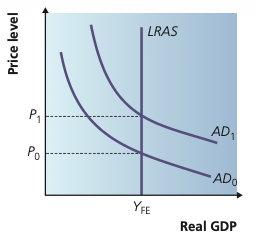
An increase in money supply raises spending and shifts aggregate demand from AD0 to AD1. In the classical long run, output remains at YFE, so the main effect is a higher price level from P0 to P1.
Adapted from the Cambridge International AS & A Level Economics book by Peter Smith (Second Edition, with Adam Wilby and Mila Zasheva).
The nominal interest rate is the stated rate. The real interest rate adjusts for inflation and can be approximated as:
If the nominal interest rate is 5% and inflation is 2%, the approximate real interest rate is 3%. Inflation reduces the purchasing-power return received by the saver.
Commercial banks are financial intermediaries: they channel funds from lenders or depositors towards borrowers. Deregulation and financial innovation have blurred older distinctions between different banking institutions.
Provide banking services to households and smaller firms, accept deposits, make loans and provide transaction services.
Operate on a larger scale with companies, other banks and financial markets. Investment banks are an example.
Operate across both retail and wholesale activities rather than remaining in only one traditional segment.
A mortgage is secured on property, giving the lender collateral if the borrower defaults. An overdraft or credit-card balance is normally unsecured and therefore carries greater risk. The textbook uses this difference to explain why unsecured borrowing usually attracts a higher interest rate.
Banks profit from lending, but they cannot lend every deposited unit because customers may want to withdraw funds. They therefore balance earning returns against holding liquid assets.
Short-run liquidity can be managed through interbank lending. A bank can also use a repo: selling a financial asset with an agreement to repurchase it later, which operates like secured short-term borrowing.
| Form | Typical feature | Why the rate may differ |
|---|---|---|
| Mortgage | Long-term loan secured on property | Collateral reduces default risk relative to unsecured lending. |
| Unsecured personal / short-term loan | No specific collateral | Higher risk normally means a higher interest rate or risk premium. |
| Overdraft | Customer can spend beyond current deposits up to an agreed limit | Flexible short-term credit usually carries a noticeable borrowing cost. |
| Credit card | Convenient revolving credit | Unsecured balances can carry high rates because of default risk and convenience. |
Hold enough liquid reserves to meet withdrawals. Failure can trigger loss of confidence and a bank run.
Assess borrowers carefully, use collateral where appropriate and maintain sufficient capital against risky assets.
Earn a margin by charging borrowers more than is paid to depositors, while controlling costs and risk.
The capital adequacy ratio relates a bank's capital to its risk-weighted assets and is intended to give a buffer against losses and loan defaults.
When commercial banks receive additional deposits, they can hold a fraction as reserves and lend the remainder. The loan is spent and may return to the banking system as another deposit, allowing further lending. This repeated process can make the increase in deposits and credit larger than the original injection.
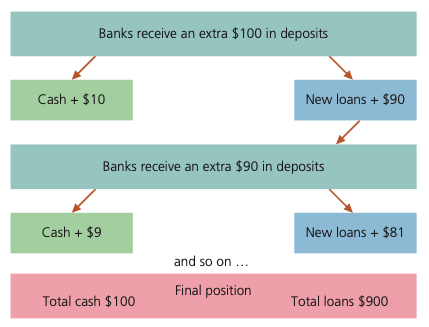
With a desired cash ratio of 10%, an extra $100 deposit allows $90 to be lent. When that is redeposited, $81 can be lent, and so on. In the simplified textbook model the final position is $100 cash and $900 loans.
Adapted from the Cambridge International AS & A Level Economics book by Peter Smith (Second Edition, with Adam Wilby and Mila Zasheva).
A central bank performs system-wide functions rather than ordinary retail banking. Depending on the country, its roles can include:
Issue notes and coins, act as banker to government and help manage government borrowing.
Provide services to commercial banks, oversee financial institutions and help maintain confidence and stability.
Manage foreign-exchange reserves and, where delegated, use interest rates or other tools to pursue inflation and wider macroeconomic objectives.
If government spending exceeds tax revenue, the deficit must be financed. The government may issue bonds. According to the textbook treatment, sales to the central bank or commercial banks can add to the base on which further credit creation occurs, whereas selling bonds to the non-bank private sector draws down existing deposits and does not create the same initial monetary effect.
Quantitative easing involves the central bank purchasing assets, especially government securities, to increase liquidity in the financial system and encourage lending when conventional interest-rate cuts have limited room.
Bank reserves / liquidity rise, which is intended to support credit and aggregate demand.
Banks may still be cautious about lending and firms or households may be unwilling to borrow.
Foreign-exchange intervention can change domestic money supply, especially under a fixed or managed exchange rate.
Under a floating exchange rate, the exchange rate carries more of the adjustment to external shocks. Under a fixed exchange rate, intervention to defend the rate changes the domestic money supply. This is why a central bank cannot independently control both a fixed exchange rate and money supply.
To support a fixed rate, the authorities can sell foreign exchange and buy domestic currency. Domestic money supply is reduced.
The authorities can buy foreign exchange and sell domestic currency. Domestic money supply rises and the banking system may multiply the increase in credit.
Monetary authorities can influence aggregate demand through interest rates and the availability of credit. Higher interest rates tend to restrain consumption and investment; lower rates or QE can support spending. The effectiveness of these policies is developed further in Chapter 28.
Money is highly liquid but usually gives up the return that could be earned on an interest-bearing asset. The interest rate can therefore be regarded as the opportunity cost, or price, of holding money balances.
When interest rates are high, holding cash means giving up a larger return that could have been earned on interest-bearing assets, so people tend to hold less money. When rates are low, that opportunity cost is smaller, so desired money holdings are higher.
Money is needed for everyday purchases and payments. It depends strongly on income and the timing/frequency of receipts and payments.
Households and firms hold liquid balances against emergencies or unexpected opportunities. Uncertainty and the interest rate influence this motive.
People may hold money instead of bonds when they expect bond prices to fall. Because bond prices and interest rates move inversely, speculative money demand is interest-sensitive.
Keynes's liquidity preference theory suggests that economic agents desire to hold money as an asset. Since the opportunity cost rises with the interest rate, the demand for money slopes downward against the interest rate.
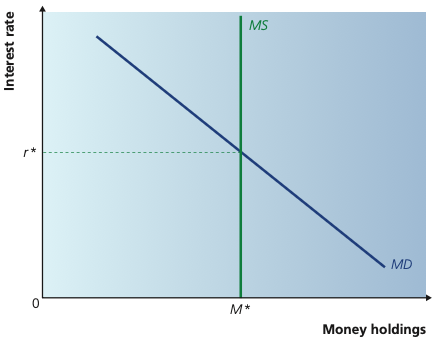
The MD curve slopes down because the interest rate is the opportunity cost of holding money. With money supply fixed at M*, equilibrium is at interest rate r*.
Adapted from the Cambridge International AS & A Level Economics book by Peter Smith (Second Edition, with Adam Wilby and Mila Zasheva).
The interest rate can also be analysed as the price that brings household saving and firms' desired investment together. Firms invest less at high borrowing costs, so investment demand slopes downward; households are generally encouraged to save more as the return rises, so the supply of loanable funds slopes upward.
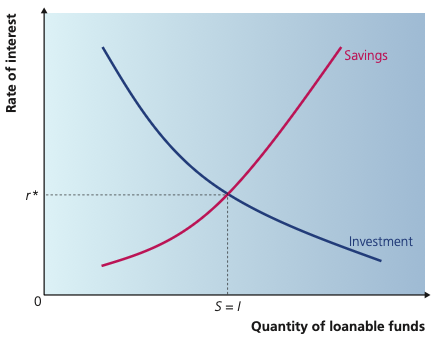
Investment demand slopes down because fewer projects are worthwhile at high borrowing costs, while saving tends to rise with the return. The equilibrium interest rate r* occurs where planned S = I.
Adapted from the Cambridge International AS & A Level Economics book by Peter Smith (Second Edition, with Adam Wilby and Mila Zasheva).
Keynes argued that saving and investment may be relatively insensitive to the interest rate and that volatile business expectations can move investment strongly. In practice, the central bank also sets or guides a policy rate, influencing a range of market interest rates. This makes actual interest-rate determination more complex than either simple diagram alone.
20 questions. Each answer is marked immediately with a short explanation of why it is correct or incorrect.