Set objectives
Explain why governments care about price stability, employment, growth, development, external balance, sustainability and distribution.

This chapter brings the major macroeconomic objectives together and asks the central policy question: which combination of fiscal, monetary, supply-side, exchange-rate and trade policies is most likely to work, and what conflicts or unintended effects may follow?
Explain why governments care about price stability, employment, growth, development, external balance, sustainability and distribution.
Analyse how inflation, unemployment, economic growth, the current account and the environment interact.
Judge fiscal, monetary, supply-side, exchange-rate and trade policies by their transmission mechanisms, time horizon and side-effects.
Recognise time lags, uncertainty, bounded rationality and conflicting outcomes that can make well-intended intervention ineffective.
Macroeconomic policy deals with economy-wide outcomes. Governments usually pursue several objectives at once, which is why policy design is difficult: progress towards one target can help, hinder or be largely unrelated to another.
Keeping inflation low and reasonably predictable supports confidence, planning and productive investment.
High unemployment wastes labour resources, lowers potential output and imposes economic and social costs on households.
Growth increases the quantity of goods and services available and can raise material living standards.
Economic and human development is broader than growth and includes poverty reduction, health, education and social infrastructure.
Governments may seek to avoid unsustainable balance-of-payments imbalances and excessive exchange-rate instability.
Growth should not undermine environmental resources or the living standards of future generations.
Macroeconomic policies can alter inequality, so distributional consequences matter even when a policy is aimed at another target.
A trade-off exists when achieving more of one desirable outcome requires accepting less of another. Macroeconomic objectives interact because the same changes in aggregate demand, aggregate supply, wages, prices, imports, exports and capital flows affect several indicators at once.
If domestic inflation is persistently higher than that of trading partners, domestic goods become relatively less competitive. Exports may fall and imports rise, worsening the current account and putting pressure on the exchange rate.
Demand-led growth can cause inflation when the economy is close to full capacity. Supply-side growth is less inflationary because productive capacity rises.
Higher income can increase import spending. If import demand rises strongly, faster growth can worsen the current account, especially under a fixed exchange rate.
Rapid expansion can increase resource depletion, emissions and waste. Sustainable growth therefore requires environmental costs to be built into policy design.
The Phillips curve describes an observed inverse relationship between unemployment and inflation in the short run. When labour demand is strong and unemployment is low, firms may bid wages upward; if higher wage costs are passed into prices, inflation rises.
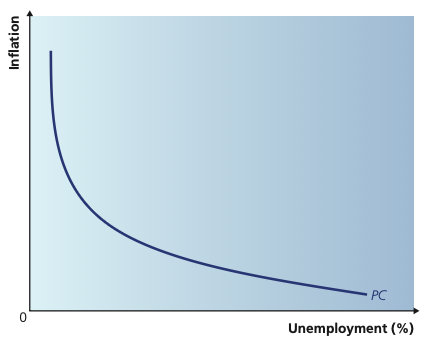
The downward-sloping curve represents the short-run inverse relationship between inflation and unemployment. Lower unemployment is associated with greater wage and price pressure, while higher unemployment is associated with lower inflation.
Adapted from the Cambridge International AS & A Level Economics book by Peter Smith (Second Edition, with Adam Wilby and Mila Zasheva).
Stagflation is the combination of high unemployment and high inflation. It showed that the short-run relationship is not fixed. If expected inflation rises, wage bargaining and price-setting adjust, shifting the short-run Phillips curve.
Suppose the economy begins at the natural rate of unemployment on SRPC0. Expansionary policy may temporarily reduce unemployment, but once higher inflation is expected it is built into wage bargaining. The short-run Phillips curve shifts upward, and unemployment returns to the natural rate at a higher inflation rate. Sustained unemployment below the natural rate is therefore not available as a permanent policy choice in this model.
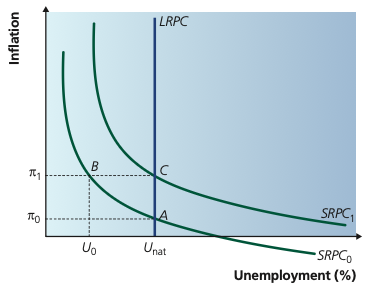
Starting from the natural rate Unat, an attempt to reduce unemployment can move the economy along a short-run curve. Once inflation expectations adjust, the SRPC shifts and unemployment returns to Unat. The long-run Phillips curve is therefore vertical.
Adapted from the Cambridge International AS & A Level Economics book by Peter Smith (Second Edition, with Adam Wilby and Mila Zasheva).
The unemployment rate consistent with a constant rate of inflation; in this framework it corresponds to the natural rate of unemployment.
Expectations are formed mainly from past experience.
Economic agents use the information available, including likely policy responses, rather than simply extrapolating the past.
Fiscal policy uses government expenditure, taxation and borrowing. It mainly operates through aggregate demand, although taxes and spending can also affect incentives and productive capacity.
Recognition, decision, implementation and impact lags mean a policy may take effect after the original problem has changed.
Deficit-financed spending can put upward pressure on interest rates, reducing private consumption or investment and weakening the rise in aggregate demand.
Expansionary fiscal policy is more likely to raise real output when spare capacity exists. Near full employment, a larger share may feed into inflation and imports.
Higher government borrowing and spending reduce private-sector activity, often through higher borrowing costs.
Lower public borrowing can reduce pressure on interest rates and leave more room for private-sector spending.
Deliberate changes in spending or taxation intended to stabilise the economy.
The Laffer curve illustrates the proposition that tax revenue may initially rise as the tax rate increases but could eventually fall if very high rates sharply reduce taxable activity or encourage avoidance/evasion. It does not show that every tax cut increases revenue.
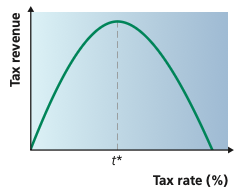
Tax revenue rises with the tax rate up to t* in the diagram. Beyond that point, the textbook model allows for incentive effects to dominate, so an even higher tax rate could reduce the total revenue raised.
Adapted from the Cambridge International AS & A Level Economics book by Peter Smith (Second Edition, with Adam Wilby and Mila Zasheva).
Monetary policy mainly aims to maintain price stability and a dependable supply of credit. Changes in the official interest rate affect consumption, investment, asset prices, confidence, the exchange rate and net exports.
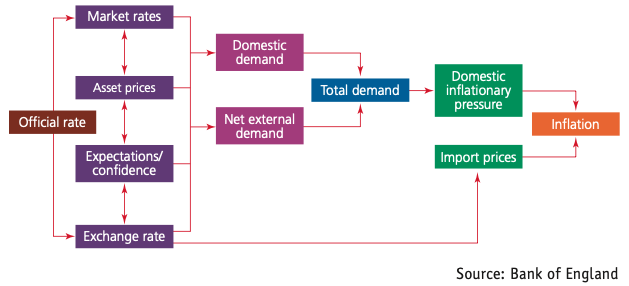
A change in the official rate affects market rates, asset prices, expectations and the exchange rate. These channels alter domestic and net external demand, which changes total demand and eventually influences inflation.
Adapted from the Cambridge International AS & A Level Economics book by Peter Smith (Second Edition, with Adam Wilby and Mila Zasheva).
Interest-rate changes can take a long time to work through to inflation, so central banks often act on forecasts rather than current inflation alone. When interest rates are already extremely low, further reductions may have little effect. Keynes described this as a liquidity trap.
The Bank of England example in the book notes that the full effect of an interest-rate change on inflation can take about two years. This helps explain why central banks must act on forecasts of future inflation rather than waiting for current inflation to move first.
At very low interest rates, people may prefer to hold additional money rather than buy low-yield financial assets, weakening conventional monetary policy.
The central bank creates money electronically to purchase financial assets, aiming to raise liquidity, support asset prices, lower borrowing costs and encourage bank lending and spending.
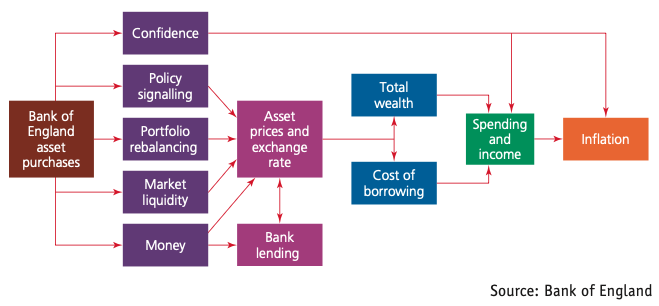
Central-bank asset purchases can influence confidence, portfolio choices, market liquidity and money, with effects on asset prices, the exchange rate and bank lending. These channels influence wealth, borrowing costs, spending, income and ultimately inflation.
Adapted from the Cambridge International AS & A Level Economics book by Peter Smith (Second Edition, with Adam Wilby and Mila Zasheva).
Supply-side policies aim to raise potential output by shifting LRAS to the right. They can be divided into market-based and interventionist approaches.
Market-based policies include privatisation/deregulation, measures to increase labour-market flexibility and reform of taxes and benefits to strengthen incentives. Interventionist policies include education and training, infrastructure and support for research and development. The textbook stresses that many of these policies take time, have opportunity costs, and may need both market incentives and government intervention to work effectively.
| Approach | Examples | Possible benefit | Evaluation |
|---|---|---|---|
| Market-based | Privatisation, deregulation, labour-market flexibility, tax and benefit reform | Stronger incentives, competition and resource mobility | Market power, inequality or under-provision may worsen if markets fail |
| Interventionist | Education, retraining, infrastructure, R&D support | Human/physical capital and productivity increase | Often costly and slow; benefits are difficult to measure in advance |
The exchange rate, money supply and interest rate are closely linked. Under a fixed exchange rate, monetary policy may need to be devoted to maintaining the peg. Under a floating exchange rate, the central bank has more monetary-policy freedom, but rate changes still affect capital flows and competitiveness.
Imports become relatively cheap and exports relatively expensive. This can reduce export competitiveness and put pressure on the current account.
Exports become more price competitive while imports become more expensive, potentially supporting net exports but also raising imported inflation.
Free trade can allow countries to exploit comparative advantage and consume beyond their domestic production possibilities, but governments sometimes use protection for strategic, infant-industry, employment or development reasons.
Import substitution protects home producers so that imported goods are replaced by domestic output, but protection can weaken the incentive to become efficient. Export promotion encourages firms to compete in world markets; the textbook highlights the experience of several East and Southeast Asian economies as examples of this outward-looking approach.
| Strategy | How it works | Main concern |
|---|---|---|
| Import substitution | Discourages imports and encourages domestic production, often through tariffs or other protection | Protected firms may become inward-looking and inefficient |
| Export promotion | Encourages domestic firms to compete in world markets | Success depends on competitiveness, market access and external demand |
| Protectionism | Restricts foreign competition to protect chosen sectors | Retaliation can trigger a trade war in which consumers and trading partners lose |
In the short run, policies that push unemployment lower may generate inflationary pressure. Reducing inflation can involve weaker demand and higher unemployment.
Industrialisation can raise incomes while increasing emissions, resource use and environmental damage unless cleaner technologies and regulation develop alongside growth.
Faster growth can raise imports and worsen the current account. Under a fixed exchange rate, corrective policy may then have to slow the economy.
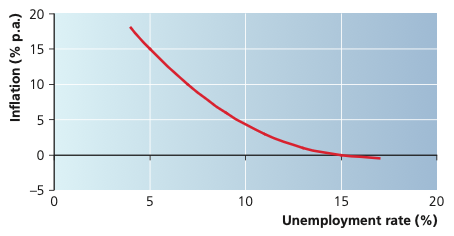
This numerical illustration makes the policy conflict clear: moving toward lower unemployment involves accepting a higher inflation rate along the curve, while reducing inflation involves higher unemployment.
Adapted from the Cambridge International AS & A Level Economics book by Peter Smith (Second Edition, with Adam Wilby and Mila Zasheva).
Government failure occurs when intervention intended to improve economic outcomes produces unintended costs or fails to achieve its objectives. Macroeconomic policy is particularly vulnerable because the whole economy is changing while policy is being designed and implemented.
Economic data arrive with delays and may later be revised, so the size and nature of the problem may be misjudged.
Recognition, decision, implementation and response lags can turn stabilising policy into destabilising policy.
Energy-price shocks, financial crises, wars or pandemics may overwhelm domestic policy or change conditions suddenly.
Households, firms and financial markets may not react as policy-makers expect, especially when confidence or expectations shift.
Governments must make decisions with incomplete knowledge about the economy and imperfect information about the future. Bounded rationality describes decision-making that is intended to be rational but is constrained by limited information, forecasting ability and knowledge.
20 questions. Each answer is marked immediately with a short explanation of why it is correct or incorrect.