Track international flows
Distinguish the current, capital and financial accounts and explain why the overall balance of payments must balance.

This chapter links international transactions to exchange-rate policy. It develops the balance-of-payments accounts, shows how macroeconomic policies affect the current and financial accounts, measures international competitiveness, and compares fixed with floating exchange-rate systems.
Distinguish the current, capital and financial accounts and explain why the overall balance of payments must balance.
Compare expenditure-reducing, expenditure-switching and supply-side approaches to a current-account deficit.
Distinguish nominal, real and real effective exchange rates and perform real-exchange-rate calculations.
Analyse fixed, floating and managed exchange rates, including devaluation, revaluation, the J-curve and the Marshall–Lerner condition.
The balance of payments records transactions between residents of a country and the rest of the world during a period. The overall accounts balance because every international transaction has a corresponding financing entry, but individual accounts may show large surpluses or deficits.
Records trade in goods and services plus primary and secondary income flows. A deficit means current-account debits exceed credits.
Records capital transfers. It is often small relative to the current and financial accounts.
Records transactions that change ownership of foreign financial assets and liabilities, including direct investment, portfolio investment, other financial assets and reserve assets.
A current-account deficit can be financed by a financial-account surplus: the country may borrow from abroad or sell domestic assets to overseas investors. This permits current spending to exceed current receipts, but it can create future outflows of interest, profits or debt repayments. A persistent current-account surplus can also involve a trade-off if resources are directed towards exports rather than domestic consumption.
| Policy/change | Main transmission | Likely balance-of-payments effect |
|---|---|---|
| Expansionary fiscal policy | AD rises → prices/incomes may rise → imports rise and competitiveness may weaken | Current account may move towards deficit |
| Lower interest rates | AD may rise; lower returns may discourage foreign financial inflows | Current account may weaken while the financial account may also face outflow pressure |
| Supply-side improvement | Productivity and quality improve; LRAS rises | Export competitiveness can improve and the current account may strengthen |
Low productivity or poor quality reduces foreign demand for exports and can encourage purchases of imports.
If domestic prices and labour costs rise faster than abroad, exports become less competitive while imports become relatively attractive.
Rising incomes can increase imports, especially when the marginal propensity to import is high.
| Approach | How it works | Evaluation |
|---|---|---|
| Expenditure reducing | Reduce aggregate demand, for example through higher taxation, so import spending falls and resources may be released for export. | Can slow economic growth and raise unemployment. |
| Expenditure switching | Switch domestic spending from imports to home-produced goods, for example through tariffs, non-tariff barriers or campaigns to buy domestic output. | Can reduce consumer welfare, distort resource allocation and provoke retaliation. |
| Supply-side measures | Improve productivity, quality and innovation so domestic firms become more internationally competitive. | Targets the underlying weakness but usually takes time. |
The nominal exchange rate is the price of one currency in terms of another. For international competitiveness, however, the nominal rate is only part of the story because relative inflation can reinforce or offset an exchange-rate movement.
The observed currency price, such as dollars per unit of domestic currency or domestic currency per dollar.
The nominal exchange rate adjusted for relative price levels between two countries.
A trade-weighted measure of the real exchange rate against multiple trading partners, giving greater weight to more important partners.
A bilateral exchange rate against one country can give a misleading picture if that country represents only a small share of total trade. The real effective exchange rate combines several bilateral rates using trade weights, so it gives a broader indication of a country's international price competitiveness.
The book compares Pakistan's rupee with the US dollar to show why the nominal exchange rate can be misleading. A nominal depreciation may appear to improve competitiveness, but if domestic prices rise faster than prices abroad, that gain can be partly or completely offset. This is why the real exchange rate and the trade-weighted real effective exchange rate are useful.
A nominal depreciation does not guarantee an improvement in international competitiveness. If domestic inflation is faster than foreign inflation, the real exchange rate may move in the opposite direction from the nominal rate.
Adapted from the Cambridge International AS & A Level Economics book by Peter Smith (Second Edition, with Adam Wilby and Mila Zasheva).
Under a floating exchange rate system, market demand and supply determine the currency's value. If demand for the currency changes, the exchange rate adjusts towards a new market equilibrium. The authorities do not promise to maintain a particular official rate.
Under a fixed exchange rate system, the authorities commit to an official currency value against another currency or standard. If the market equilibrium differs from the official rate, the central bank must intervene.
The book uses the Malaysian ringgit to illustrate a fixed exchange rate. If the official rate is above the market-clearing rate, there is an excess supply of ringgits. The Malaysian authorities must buy that excess domestic currency by selling foreign-exchange reserves. If demand for ringgits is instead stronger than supply at the official rate, the authorities buy foreign currency and reserves accumulate.
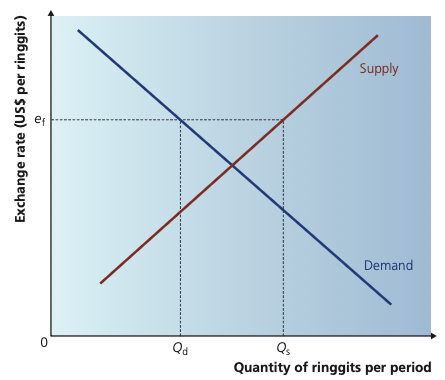
At the official rate ef, supply of ringgits exceeds demand: Qs > Qd. The authorities defend the fixed rate by buying the excess ringgits and paying with foreign-exchange reserves.
Adapted from the Cambridge International AS & A Level Economics book by Peter Smith (Second Edition, with Adam Wilby and Mila Zasheva).
The central bank sells foreign currency reserves and buys domestic currency. Persistent intervention can run reserves down.
The central bank supplies additional domestic currency in return for foreign currency, so reserves accumulate.
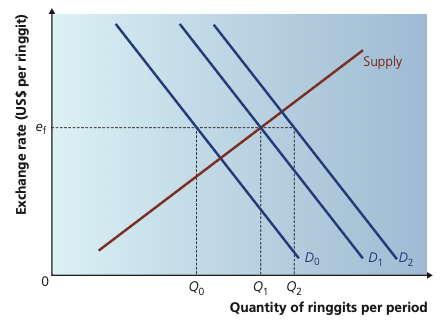
At D1, the official rate ef is the market equilibrium. If demand is lower at D0, reserves must be sold to absorb excess domestic currency; if demand rises to D2, the authorities supply more domestic currency and accumulate foreign reserves.
Adapted from the Cambridge International AS & A Level Economics book by Peter Smith (Second Edition, with Adam Wilby and Mila Zasheva).
An official reduction in the price of the domestic currency under a fixed-rate system.
An official increase in the price of the domestic currency under a fixed-rate system.
A market-driven fall in the value of the currency under a floating system.
A market-driven rise in the value of the currency under a floating system.
A devaluation makes exports cheaper to overseas buyers and imports more expensive to domestic residents, so export quantity demanded should rise and import quantity demanded should fall, ceteris paribus. This tends to increase aggregate demand. However, the current account does not necessarily improve immediately.
The speed of adjustment matters. In the short run, contracts are already in place and domestic firms may not be able to expand export supply immediately. Import and export demand can therefore be relatively inelastic at first. Over time, buyers can switch suppliers and producers can change output, so quantity responses are likely to become larger.
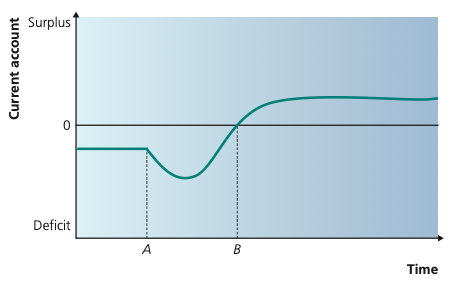
After devaluation at A, the current account can initially worsen because prices change before export and import quantities fully respond. As firms and consumers adjust, the current account improves and may move into surplus after B.
Adapted from the Cambridge International AS & A Level Economics book by Peter Smith (Second Edition, with Adam Wilby and Mila Zasheva).
The textbook states that a devaluation improves the current account only when the sum of the price elasticities of demand for exports and imports is numerically greater than 1. The logic is that the favourable quantity response must be strong enough to outweigh the adverse price effect.
Export volumes rise and import volumes fall after the currency becomes more competitive.
Export prices expressed in foreign currency fall while import prices in domestic currency rise. If quantity responses are weak, the current account may worsen.
If one country deliberately devalues to gain competitiveness, other countries may retaliate with their own devaluations, reducing the original advantage and potentially depressing world trade. A managed float is a floating system in which authorities occasionally intervene to smooth excessive short-run fluctuations.
Neither system is automatically superior in every circumstance. The textbook evaluates them mainly through adjustment to shocks, stability and the discipline they impose on macroeconomic policy.
| Issue | Floating exchange rate | Fixed exchange rate |
|---|---|---|
| Adjustment to external shocks | Exchange rate can change automatically, carrying much of the adjustment burden. | Real output, employment, wages and domestic demand may have to adjust because the rate itself is defended. |
| Monetary-policy independence | Greater scope to use interest rates for domestic stabilisation. | Monetary policy is constrained by the need to maintain the peg. |
| Trading stability | Potential volatility creates exchange-rate risk. | Known official rate can make future contracts and planning easier. |
| Policy discipline | Governments may be tempted to rely on depreciation to restore competitiveness after inflationary policy. | The commitment to the peg can impose financial discipline. |
| Reserve requirement | No commitment to continuously defend one level, although intervention may occur. | Foreign-exchange reserves are needed to defend the official rate. |
If domestic inflation rises faster than abroad, a floating currency can depreciate and help restore competitiveness. Under a fixed system, the exchange rate cannot perform this adjustment, so policy may have to deflate the domestic economy. That can reduce inflation but may temporarily raise unemployment and slow growth.
Floating rates create uncertainty for international traders and investors. Firms can reduce this risk through forward or futures contracts, a process known as hedging, but hedging itself can be costly. A fixed system reduces day-to-day currency uncertainty, although an occasional official realignment can still create large changes.
Under floating rates, a country can use monetary policy more independently, but changes in interest rates affect capital flows and the exchange rate. For example, higher interest rates can attract short-term capital, cause appreciation and weaken the current account. Policy changes can also spill over to trading partners through bilateral exchange-rate movements.
20 questions. Each answer is marked immediately with a short explanation of why it is correct or incorrect.