
Chapter 3 · Sole Traders, Partnerships, Social Enterprises and Franchises
Learn how different ownership structures operate, where their finance comes from, who makes the decisions and how the risks and rewards are shared.
Learning objectives
- Describe entrepreneurs, their roles and the difference between incorporated and unincorporated organisations.
- Explain the features, advantages and disadvantages of sole traders and partnerships.
- Understand limited partnerships and compare the franchisor's and franchisee's positions.
- Explain the purpose and forms of social enterprises, and how business size can vary.
Entrepreneurs
Entrepreneurs make business activity possible by identifying opportunities and turning ideas into goods or services. Some develop a new product, while others adapt an existing business idea for a different customer group or location.
The four roles of an entrepreneur
| Role | What it means | Example |
|---|---|---|
| Innovator | Spots a gap in the market and introduces or improves an idea. | A café owner offers freshly prepared healthy snacks. |
| Organiser | Combines land, labour, capital and other resources, and sets up operations. | Arranges premises, ingredients, equipment and staff. |
| Decision-maker | Chooses prices, finance, product range and working methods. | Decides whether to take a loan to open a new outlet. |
| Risk-taker | Commits money and time without a guaranteed return. | May lose savings if the business fails. |
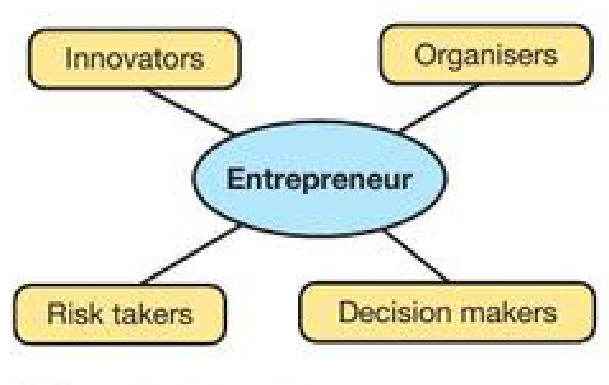
The book describes Mariana opening a café in Seville in 2012, financed by €20,000 of her savings and a €10,000 loan. Her choice to serve health-conscious customers illustrates innovation; financing and running the café show organisation, decision-making and risk-taking. These are the book's historical figures.
Successful entrepreneurs may earn profit, but they can also lose their investment. Profit is a possible reward for bearing business risk—not a guaranteed outcome.
Unincorporated and Incorporated Businesses
The legal status of a business determines how it is recognised in law. The textbook distinguishes two broad categories:
Unincorporated
The business and owner(s) are not legally separate. The owner(s) generally carry personal responsibility for business debts. Sole traders and ordinary partnerships are examples.
Incorporated
The business has a separate legal identity from its owners. It can own assets, make contracts and face legal action in its own name. Limited companies are discussed further in Chapter 4.
Choosing a legal form influences risk, ownership and access to finance. A self-employed owner may have close control but take on more personal financial risk than a shareholder in a limited company.
Features of a Sole Trader
This is the simplest form of business ownership in the textbook. Examples include small retailers, tutors, hairdressers, taxi drivers, gardeners and independent designers. It is generally straightforward to establish, and the owner makes important decisions independently.
Advantages and disadvantages of a sole trader
Advantages
- Control: the owner makes decisions without asking partners.
- Profit: the owner keeps the profit after business costs and taxes.
- Flexibility: changes can be made quickly.
- Personal service: close customer relationships may be easier.
- Simple set-up: fewer formalities than incorporating a company.
Disadvantages
- Unlimited liability: personal assets may be at risk.
- Limited finance: savings and borrowing may not cover expansion.
- Workload: the owner handles many duties and long hours.
- Small scale: may be unable to gain economies of scale.
- Continuity: the business may stop if the owner can no longer operate it.
A self-employed tutor controls lesson prices and schedules and keeps earnings after costs. However, if demand grows, one person may struggle to teach more hours or finance a larger teaching centre.
Features of a Partnership
Partnerships are common in professions such as accountancy, dentistry and legal services. Different partners may bring different skills, provide capital and share the work. An ordinary partnership is unincorporated, so partners generally have unlimited liability.
Deed of partnership
A deed of partnership is a written agreement that records how the business should be operated. It may set out:
- the capital each partner contributes;
- how profits and losses are shared;
- how decisions and control are divided;
- how partners may leave or the partnership may end; and
- rules for admitting new partners.
A written agreement helps reduce misunderstandings, particularly when disagreements arise or the business changes.
Advantages and disadvantages of partnerships
Advantages
- More owners can contribute more capital.
- Partners may specialise in different areas.
- Management and workload are shared.
- Relatively straightforward to establish.
- Financial details normally remain private.
Disadvantages
- Ordinary partners have unlimited liability.
- Profit is shared among the owners.
- Partners may disagree over decisions.
- One partner's actions may legally bind the firm.
- Many partnerships remain fairly small.
The book describes two dentists setting up a practice in Dubai in 1997, each contributing AED 200,000 from savings. The partners could combine funds, divide dental specialisms and share managerial responsibility.
Limited Partnerships
A limited partnership can include investors who contribute capital but do not manage the business day to day. These investors are often called sleeping partners. Their potential loss is generally limited to their investment, while at least one general partner has unlimited liability under the form described in the textbook.
General partner
Takes part in running the business and has unlimited liability for its debts.
Limited or sleeping partner
Contributes money and receives an agreed share of profit, but usually does not manage the business and has limited liability.
Important distinction: the textbook also mentions the UK limited liability partnership (LLP), a legally distinct arrangement with its own rules and filing requirements. It should not be confused with a limited partnership that has a general partner with unlimited liability. Legal details vary by country.
The book's Kenyan accounting-firm case shows how three partners contributed KES 2 million each and specialised in corporate tax, investments and auditing. It illustrates both access to more capital and the benefits of shared expertise.
Check your understanding · Halfway
Try all six questions before opening the suggested answers.
Identify the four roles of an entrepreneur and give one example of each.
Show suggested answer
An entrepreneur identifies or adapts a business idea (innovator), arranges resources such as staff and equipment (organiser), decides on matters such as prices and finance (decision-maker), and risks their invested money if the venture fails (risk-taker).
Explain the difference between an unincorporated and an incorporated business.
Show suggested answer
An unincorporated business has no separate legal identity from its owner(s). An incorporated business has a legal identity distinct from its owners. This difference affects legal responsibility and, commonly, owners’ liability.
Mariana owns a small café alone. Explain one advantage and one disadvantage of remaining a sole trader.
Show suggested answer
She can retain control and keep the profit, but has unlimited liability and could have to use personal funds to meet the café’s debts.
Two dentists wish to share specialist work and start-up costs. Explain two benefits of forming a partnership.
Show suggested answer
They can combine capital to help finance equipment and premises, and divide tasks according to their different expertise, reducing the burden on either owner.
Why is a deed of partnership useful even when partners trust each other?
Show suggested answer
It records agreements on investment, profit sharing, responsibilities, admitting new partners and what happens if partners disagree or leave. This can prevent misunderstandings.
A sleeping partner contributes money but does not manage the firm. Why might limited partnership arrangements appeal to that investor?
Show suggested answer
They may earn a share of profits and generally limit their exposure to their invested capital, rather than being personally liable for all the firm’s debts. The specific rules depend on the partnership form and jurisdiction.
Features of Franchises
Some entrepreneurs want to run their own outlet using an established business idea. A franchise is an arrangement in which one business permits another operator to trade under its name and systems in return for fees and conditions.
Franchisor
Owns the business concept and brand and grants permission to franchisees to operate under it. Provides agreed training, systems or marketing support.
Franchisee
Invests in and runs an outlet, paying fees and following operating standards set by the franchisor.
What a franchisor may provide
- permission to use an established brand name;
- help with setting up the outlet, equipment or supplies;
- staff and owner training in established operating systems;
- promotional materials, advertising and ongoing business support; and
- sometimes an exclusive territory to reduce competition with other outlets in the same franchise network.
What the franchisee usually pays
The arrangement may involve an initial franchise fee, regular fees linked to sales, contributions towards shared marketing, and charges for products or equipment supplied by the franchisor.
Advantages and disadvantages for the franchisee
Advantages
- A business model with a trading track record may reduce uncertainty.
- Training and expert support may be provided.
- Customers may already recognise the brand.
- Start-up requirements may be easier to estimate.
Disadvantages
- Initial and ongoing fees can be expensive.
- Profit is shared indirectly through fees and charges.
- Contracts and operating rules restrict independence.
- The business can still fail despite the brand and support.
Advantages and disadvantages for the franchisor
Advantages
- Can expand more quickly across locations.
- Franchisees supply much of the start-up capital.
- Franchisees bear some of the business risk.
- Owner-operators may be highly motivated.
Disadvantages
- The franchisor does not retain all outlet-level profit.
- Weak franchisees may harm brand reputation.
- Monitoring and supporting outlets is costly.
- Franchisees may source products elsewhere if allowed.
The book describes Husse, a Swedish pet-products franchising business with operations in more than 50 countries. Its historical UK example offered stock, promotional materials, training, an operating manual and a territory for a package price of up to £13,900. The case shows the trade-off between support and the costs of joining a franchise.
Features of Social Enterprises
Social enterprises can sell products, provide services or raise donations to finance their work. Typically they have a clear mission, use much of their surplus to support that mission, and aim to operate in an accountable and transparent way.
Forms of social enterprises in the textbook
| Type | How it works | Example |
|---|---|---|
| Consumer cooperative | Owned by people who purchase its goods or services; members help control the business. | A community buying group. |
| Retail cooperative | Independent retailers join together to improve purchasing power. | Local shops negotiating supply discounts together. |
| Worker cooperative | Employees jointly own and participate in managing the organisation and sharing its results. | A worker-owned dairy or food producer. |
| Charity | Collects funds or carries out trading activities to support a social cause. | A children's welfare charity running fundraising events. |
Cooperatives are owned and controlled by members, whose objectives may include fair prices, good working conditions or the benefit of a local community. Charities may raise funds through donations, events and the sale of goods to support people in need.
| Save the Children funding source (2016) | Share |
|---|---|
| Institutions (including governments) | 58% |
| Individuals | 25% |
| Corporations and foundations | 13% |
| Gifts in kind | 2% |
| Other | 2% |
Historical figures adapted into an accessible table from Figure 3.2 of the supplied Pearson textbook, printed page 24.
In the book's 2016 Save the Children example, institutions (including governments) accounted for the largest share at 58%; individuals contributed 25%. This shows that social-purpose organisations may rely on several kinds of funding rather than a single income source.
If employees jointly own a small dairy business, they can contribute to management decisions and share the results. Their objectives may include stable jobs and fair working conditions alongside earning enough to continue trading.
Large vs Small Businesses
The textbook points out that these business structures do not all have to be the same size:
- Sole traders tend to be small because one owner has limited time and access to finance.
- Partnerships are common in professional services and often remain relatively small.
- Franchisees frequently operate individual small outlets, while their franchisors may grow into large national or international businesses.
- Social enterprises range from small community groups to large international charities.
Therefore, ownership structure and business size are different concepts. A business does not become a different type merely because it grows.
Quick ownership comparison
| Structure | Ownership or control | Main trade-off |
|---|---|---|
| Sole trader | One owner | Full control, but personal liability and limited finance. |
| Ordinary partnership | Two or more owners | Shared capital and skills, but shared profits and possible disputes. |
| Franchise arrangement | Franchisor licenses the model to a franchisee | Brand and support, but fees and operating restrictions. |
| Social enterprise | Varies (members, workers, trustees or other structures) | Social mission rather than maximising private owners' returns. |
End-of-chapter understanding questions
Practise definitions, comparisons, application and evaluation. Reveal the suggested answers after attempting each question.
Define an entrepreneur and describe two of their functions.
Show suggested answer
An entrepreneur starts and organises a business, making key decisions and accepting financial risk. Two functions might be developing a new idea and arranging finance, labour or equipment.
Compare unlimited liability with limited liability. Why does the distinction matter?
Show suggested answer
Unlimited liability can expose an owner’s personal wealth to business debts. Limited liability generally restricts an investor’s loss to the capital invested, so it changes the financial risk of ownership.
Explain two advantages and two disadvantages of operating as a sole trader.
Show suggested answer
Advantages include full control, keeping profits, personal service and flexibility. Disadvantages include unlimited liability, difficulty raising funds, a heavy workload and limited continuity. Any two developed points on each side are valid.
A small accounting practice needs several specialist skills. Assess whether a partnership could be better than a sole trader.
Show suggested answer
A partnership allows the accountants to pool capital and specialise, helping clients and sharing work. However, profits must be shared, disagreements may occur, and ordinary partners have unlimited liability. The most suitable choice depends on their resources, trust and willingness to share control.
Distinguish between a franchisor and a franchisee. Give one example of what each contributes.
Show suggested answer
The franchisor owns and licenses the business concept or brand, often providing training and marketing support. The franchisee invests capital, pays agreed fees and runs an outlet under the franchisor’s rules.
Why might a franchise be less risky than starting a completely independent business? Give one limitation.
Show suggested answer
A recognised brand, established systems and training can reduce uncertainty. However, the franchise may require costly fees, strict rules and a share of sales or profit, and success is not guaranteed.
Explain one advantage and one disadvantage of franchising for the franchisor.
Show suggested answer
It can enable faster expansion with franchisees providing capital and bearing part of the risk. But poor performance by one franchisee can harm the brand, and the franchisor must provide support.
What are three typical features of a social enterprise?
Show suggested answer
It pursues a social or environmental purpose, generates income from trading and/or donations, and uses much of its surplus to advance that purpose. Social enterprises also seek accountability and transparency.
In the textbook’s 2016 Save the Children data, which source provided the largest share of funding, and what share came from individuals?
Show suggested answer
Institutions (including governments) supplied the largest share at 58%. Individuals supplied 25%. These figures are historical data from the supplied textbook, not current figures.
A business owner wants independence and maximum control, while another wants an established brand with marketing support. Suggest a suitable structure for each and justify your choices.
Show suggested answer
The first may prefer a sole trader arrangement, which offers independence but carries unlimited liability and finance constraints. The second may prefer becoming a franchisee, gaining brand recognition and support but accepting fees and operating restrictions.
A social enterprise grows internationally. Does it stop being a social enterprise because it is large? Explain.
Show suggested answer
No. Business size does not determine its social purpose. A large organisation can still prioritise social or environmental outcomes, reinvest surpluses and operate transparently.
Chapter 3 recap
Entrepreneurs innovate, organise, decide and take risks. Sole traders retain control but face unlimited liability; partnerships pool skills and capital but share profit and responsibility. Franchising exchanges fees and some independence for brand and support. Social enterprises prioritise a social or environmental mission, and any of these structures may vary in size.
Based on Chapter 3, Sole Traders, Partnerships, Social Enterprises and Franchises (printed pp. 19–26), of the user-supplied Pearson Edexcel International GCSE (9–1) Business Student Book by Rob Jones (Pearson). Notes, comparison tables and practice questions have been independently written. The cropped entrepreneur diagram and historical funding table are credited above. IGCSE360 is not affiliated with Pearson.